Non-Filers Lose 0.8% on Bank Cash Withdrawals Over Rs 50,000 a Day in Pakistan
Banks deduct 0.8% from non-filers who withdraw over Rs 50,000 cash in a day. Filers pay nothing. We read section 231AB and show how to stop it.
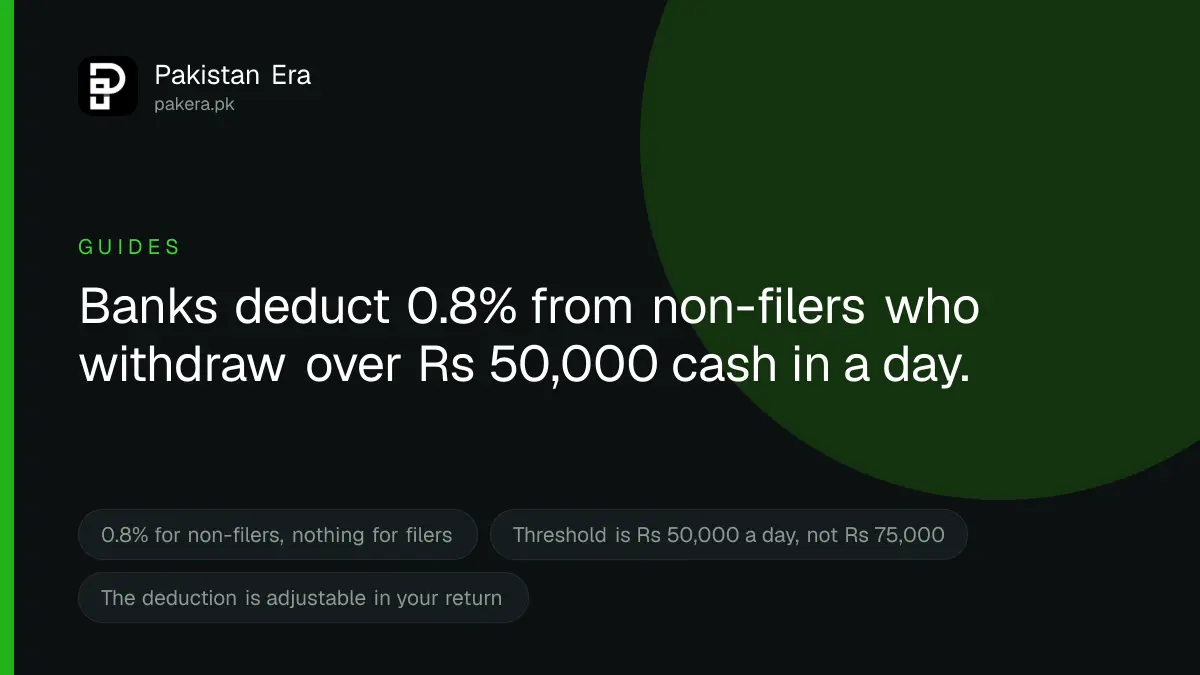
If your name is not on the Active Taxpayers List and you take out more than Rs 50,000 in cash from a bank in one day, the bank deducts 0.8 per cent. If you are on the list, it deducts nothing.
That is the whole rule. It sits in section 231AB of the Income Tax Ordinance, 2001. We read the section on 19 September 2026 in the version FBR published on its own download site, amended up to 30 June 2026, and we read the Finance Act 2026 to confirm nothing changed this year.
The money is not lost for good. The section calls it "advance adjustable tax", which means you can claim it back against your tax bill when you file a return. The return for tax year 2026 is due on 30 September 2026, so this is the right week to sort it out.
The rule in one table
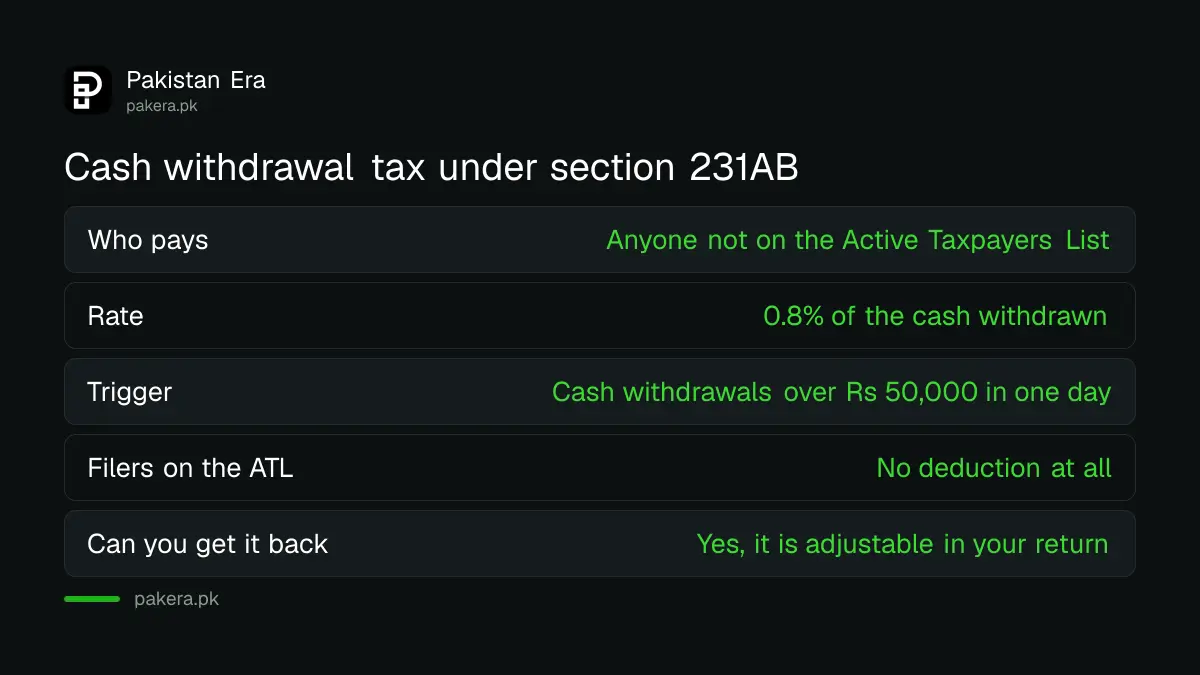
| Question | Answer from section 231AB |
|---|---|
| Who deducts it | Every banking company |
| Who pays it | A person whose name is not on the Active Taxpayers List |
| Rate | 0.8 per cent of the cash withdrawal |
| Trigger | Total cash withdrawals in a day exceeding Rs 50,000 |
| How the day is counted | Aggregate cash withdrawals in a single day |
| Filers on the ATL | No deduction |
| Type of tax | Advance adjustable tax, claimable in your return |
| Since when | Section added in 2023, rate raised from 0.6% to 0.8% in 2025 |
Two things in that table are worth reading twice. The trigger is the day's total, not a single transaction. Three withdrawals of Rs 20,000 each add up to Rs 60,000 and cross the line. And the rate applies to cash withdrawals. A bank transfer, a cheque paid into another account, a card payment at a shop or an online payment is not a cash withdrawal and section 231AB does not touch it.
The threshold is Rs 50,000, not Rs 75,000
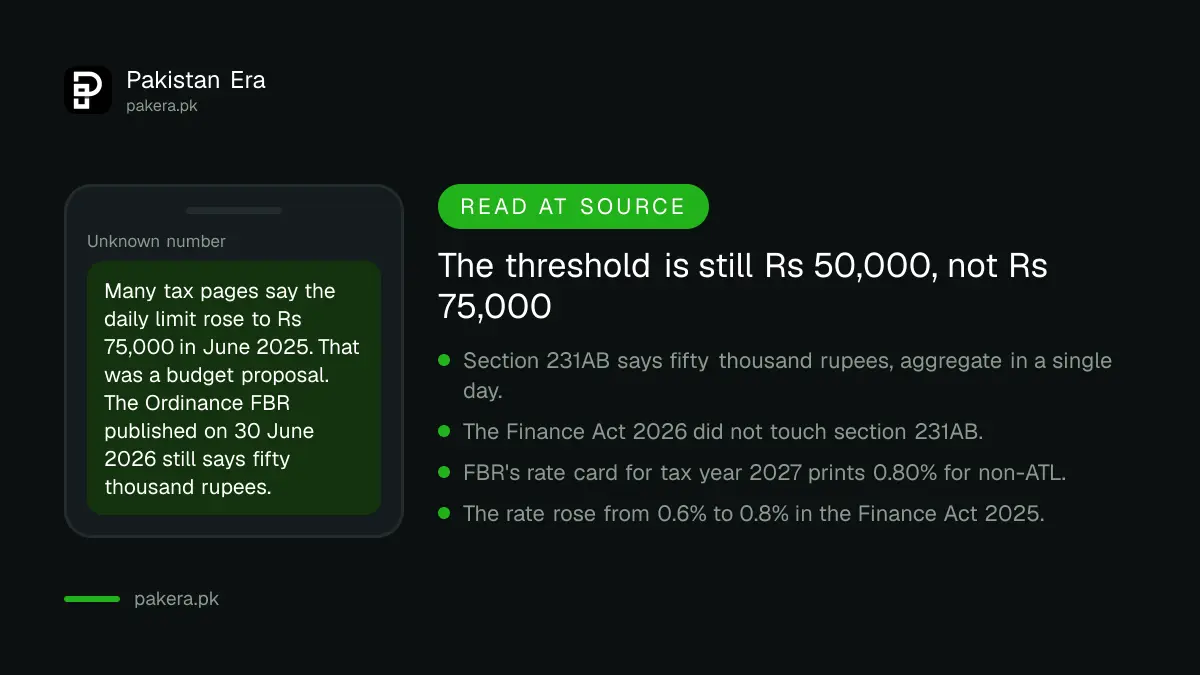
Search this topic and you will find pages saying the daily limit is now Rs 75,000. Some of them are calculators that will do the sum for you on the wrong number.
Here is where that came from. In June 2025, during the 2025-26 budget, it was reported that the government had decided to raise the limit to Rs 75,000. Earlier the same month it was reported that the rate would double to 1.2 per cent. Neither figure is in the law.
The Ordinance that FBR published, amended up to 30 June 2026, says "fifty thousand rupees" and "0.8%". The footnote records that 0.8 per cent replaced 0.6 per cent through the Finance Act 2025. We then searched the full text of the Finance Act 2026, gazetted on 26 June 2026, and it does not mention section 231AB at all. FBR's own withholding tax rate card, updated to 30 June 2026 for the Finance Act 2026, prints 0.80 per cent in the non-ATL column and leaves the ATL column empty.
So for tax year 2027, which started on 1 July 2026, the rule is unchanged from last year: 0.8 per cent, Rs 50,000 a day, non-filers only.
What the deduction costs in rupees
The section says the bank deducts 0.8 per cent "of the cash withdrawal" once the day's total passes Rs 50,000. The plain reading is that the rate applies to the withdrawal itself, not only to the part above Rs 50,000, and that is how banks are reported to apply it. We have not tested this at a counter, and no FBR page spells out the arithmetic, so check your own statement against these figures.
| Cash taken out in one day | Non-filer deduction at 0.8% | Filer deduction |
|---|---|---|
| Rs 50,000 | Rs 0, the threshold is not exceeded | Rs 0 |
| Rs 60,000 | Rs 480 | Rs 0 |
| Rs 100,000 | Rs 800 | Rs 0 |
| Rs 300,000 | Rs 2,400 | Rs 0 |
| Rs 1,000,000 | Rs 8,000 | Rs 0 |
On its own, Rs 800 on a lakh does not sound like much. It adds up for anyone who runs a shop, pays wages in cash or draws a large sum for a property deal or a wedding. A trader taking out Rs 300,000 every week loses about Rs 125,000 a year to a deduction a filer never pays.
One more point from the law. Most non-filer rates in Pakistan are doubled by the Tenth Schedule of the Ordinance. Rule 10 of that schedule lists section 231AB among the sections it does not apply to, so the 0.8 per cent is the whole charge. It is not doubled again.
There is no exemption in the section
The old cash withdrawal section, 231A, used to exempt the federal and provincial governments, foreign diplomats and anyone holding a certificate from the Commissioner that their income was exempt. Those exemptions were removed in 2015, the section itself was removed in 2021, and the new section 231AB was added in 2023 without any exemption of its own.
We searched the whole consolidated Ordinance for references to 231AB. There are three: the table of contents, the section itself, and the Tenth Schedule rule above. There is no clause in the Second Schedule exempting any class of person from it. If a bank tells you a certain account type is exempt, ask it to show you the provision.
How to stop paying it
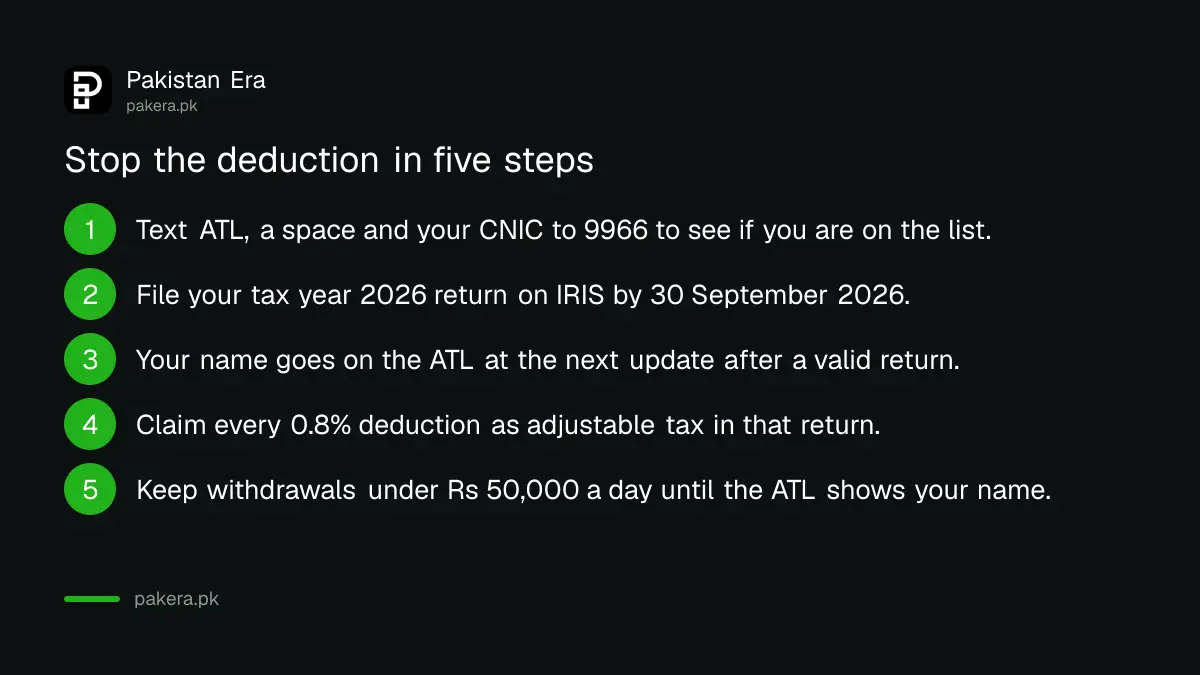
The only way to stop the deduction is to get your name on the Active Taxpayers List. There is no form to fill at the bank and no exemption to apply for.
- Check where you stand. Text ATL, a space, and your 13 digit CNIC without dashes to 9966. Our guide to checking your filer status covers the online lookup too. If the reply says active, the bank should not be deducting anything, and you should take the statement to the branch.
- File the tax year 2026 return. It covers income from 1 July 2025 to 30 June 2026 and is due on 30 September 2026. The steps are in our guide to filing the 2026 return. If you have never filed, you will need to register on IRIS first.
- Claim the deductions back in that return. Ask each bank for a tax deduction certificate for the year. The amounts go in the adjustable tax section of the return and reduce what you owe, or produce a refund if you owe nothing.
- Wait for the list to update. Your name appears at the next ATL update after a valid return. Until you see it there, the bank keeps deducting, because the bank checks the list, not your IRIS account.
- Keep daily cash under Rs 50,000 in the meantime. Where you can, pay by transfer, cheque or card instead. Those are not cash withdrawals and are not taxed under this section.
File late and it costs more than the deduction. Getting back on the list after the deadline now carries a surcharge of Rs 25,000 for an individual, and refunds are held while you are off the list.
Cash from an ATM counts
The section covers every cash withdrawal from a banking company, and an ATM withdrawal is one. Banks apply the deduction to ATM cash as well as counter cash, and the ATM slip usually shows it as a separate line. Check the slip if a Rs 60,000 withdrawal leaves you with Rs 480 less than you expected.
Cash withdrawn by cheque at the counter, by debit card at an ATM, or against a cash withdrawal slip all count towards the same day's total at that bank. What the text does not say is whether a bank must add up cash from two different banks. In practice a bank can only see its own accounts, so the daily total is what you draw from that bank across its accounts. That is our reading of the text, not something FBR has spelt out.
What the deduction is not
A few things get mixed up with this tax, so it helps to separate them.
| Charge | What it is | Section 231AB? |
|---|---|---|
| 0.8% on cash over Rs 50,000 a day | Advance tax deducted by the bank from non-filers | Yes |
| Tax on bank profit | Withholding on interest paid to you, filer and non-filer rates differ | No, section 151 |
| ATM service charge | A bank fee for using another bank's ATM | No, not a tax |
| Tax on cash deposits | Does not exist. Depositing cash is not taxed | No |
If a deduction on your statement does not match any of these, ask the bank for the section of the Ordinance it is deducting under. Every withholding line on a statement should have one.
Questions readers are asking
How much is the tax on cash withdrawal in Pakistan in 2026?
0.8 per cent of the cash withdrawn, deducted by the bank, for anyone whose name is not on the Active Taxpayers List, once the day's cash withdrawals exceed Rs 50,000. Filers pay nothing.
Is the limit Rs 50,000 or Rs 75,000?
Rs 50,000. The Rs 75,000 figure was a June 2025 budget report that did not make it into the law. The Ordinance FBR published on 30 June 2026 still says fifty thousand rupees.
Does the tax apply to ATM withdrawals?
Yes. An ATM withdrawal is a cash withdrawal from a banking company, and banks apply the deduction to ATM cash in the same way as counter cash.
Can I get the deducted money back?
Yes. Section 231AB calls it advance adjustable tax. Claim it in your annual return with the bank's tax deduction certificate, and it reduces your tax bill or comes back as a refund.
Are bank transfers, cheques or card payments taxed under section 231AB?
No. The section covers cash withdrawals only. Paying by transfer, cheque, debit card or online is the simplest way to stay under the threshold while you get on the list.
How do I become a filer so the deduction stops?
Register on IRIS, file a return for tax year 2026 by 30 September 2026, and wait for the next ATL update. Our guide to becoming a tax filer walks through registration for a first-time filer.
How we verified this
What we checked, where we read it, and what we could not confirm.
We checked the following on 19 September 2026, all on FBR's own download site.
- Income Tax Ordinance, 2001, consolidated and amended up to 30 June 2026, section 231AB and rule 10 of the Tenth Schedule.
- Finance Act, 2026, Act XLIII of 2026, as published in the Gazette of Pakistan on 26 June 2026. No amendment to section 231AB.
- FBR Withholding Income Tax Rate Card, updated up to 30 June 2026 as per the Finance Act 2026, section 231AB row.
Reported, not read at source: the June 2025 budget coverage of a Rs 75,000 threshold and a 1.2 per cent rate, and the way banks apply the rate to the whole withdrawal. FBR's Active Taxpayers List page was returning a server error when we checked, so the ATL mechanics above come from our own filer status and filing guides.
About the author

Tax, Bills and Technology Writer
Ali Akhtar is a young and curious voice here at Pakistan Era. He is currently pursuing his A-Levels and has a growing interest in Pakistan’s changing industrial landscape and educational trends. Ali likes to write in a way that helps him explain and explore the world around him. His writing reflects the perspective of the new generation navigating the evolving trends of Pakistan where technology, youth innovation, and shifting opportunities are reshaping the country’s future.