Pakistan Tests Fatah-2 ER Hypersonic Missile: What ISPR Said on 13 October and Left Out
ISPR says the army test-fired the Fatah-2 ER hypersonic ballistic missile on 13 October 2026. See its claims, plain meanings of the terms and what it left out.

Short answer: The Pakistan Army test-fired the extended-range version of Fatah-2 on 13 October 2026, the Inter Services Public Relations (ISPR) said. ISPR calls it a hypersonic ballistic missile. It gave no range, no speed, no flight data and no launch site. These are ISPR's claims, and nobody outside the army has checked them.
The ISPR website blocked our requests on 17 October, so we could not open the original press release. We read the statement as it was relayed in published reports, then set it beside our own page on the earlier Fatah-4 test. This page keeps to what ISPR said, explains the terms in plain words, and lists what is missing.
ISPR says the army test-fired Fatah-2 ER on 13 October
ISPR announced on Tuesday, 13 October 2026, that the army carried out a successful test launch of the extended-range version of the Fatah-2 weapon system, written Fatah-2 ER. It says the launch was witnessed by the Army Rocket Force Command chief, Lt Gen Nauman Zakaria, with senior officers, scientists and engineers.
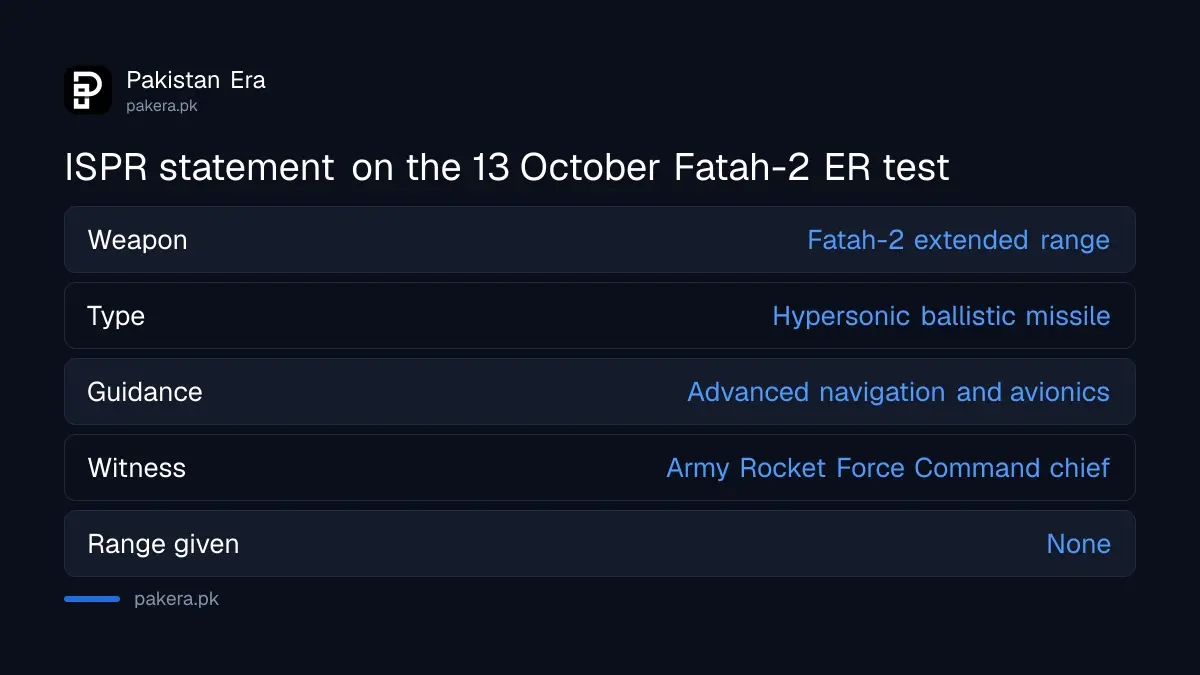
The statement says the commander praised the scientists and engineers for their dedication and technical skill. It adds that the President, the Prime Minister and the Chief of Defence Forces congratulated them. The Interior Minister also congratulated the nation, reports of the statement said.
| Point | What ISPR said |
|---|---|
| Date | Tuesday, 13 October 2026 |
| Weapon | Fatah-2 extended range (ER) |
| Type | Hypersonic ballistic missile |
| Guidance | Advanced navigation and avionics |
| Witness | Army Rocket Force Command chief, senior officers, scientists |
| Range given | None |
ISPR claims the missile can defeat missile defences
ISPR says the missile has advanced navigation and avionics and can hit targets with high precision. It says the missile's path and its ability to change direction let it beat enemy missile defence systems. It adds that the longer range will help the army engage deep targets.
These are descriptions from the army's own media wing. They are not test results. No figure was given for accuracy, speed, height or distance flown. No outside group has confirmed that the missile beats any defence system, and a claim of that kind cannot be checked from a one-page statement.
Hypersonic means faster than five times the speed of sound
"Hypersonic" is a speed word. It usually means a speed above Mach 5, which is five times the speed of sound. A ballistic missile flies high on a curved path and falls onto its target. ISPR says Fatah-2 ER is both hypersonic and ballistic. A cruise missile, like Fatah-4, flies low and powered.
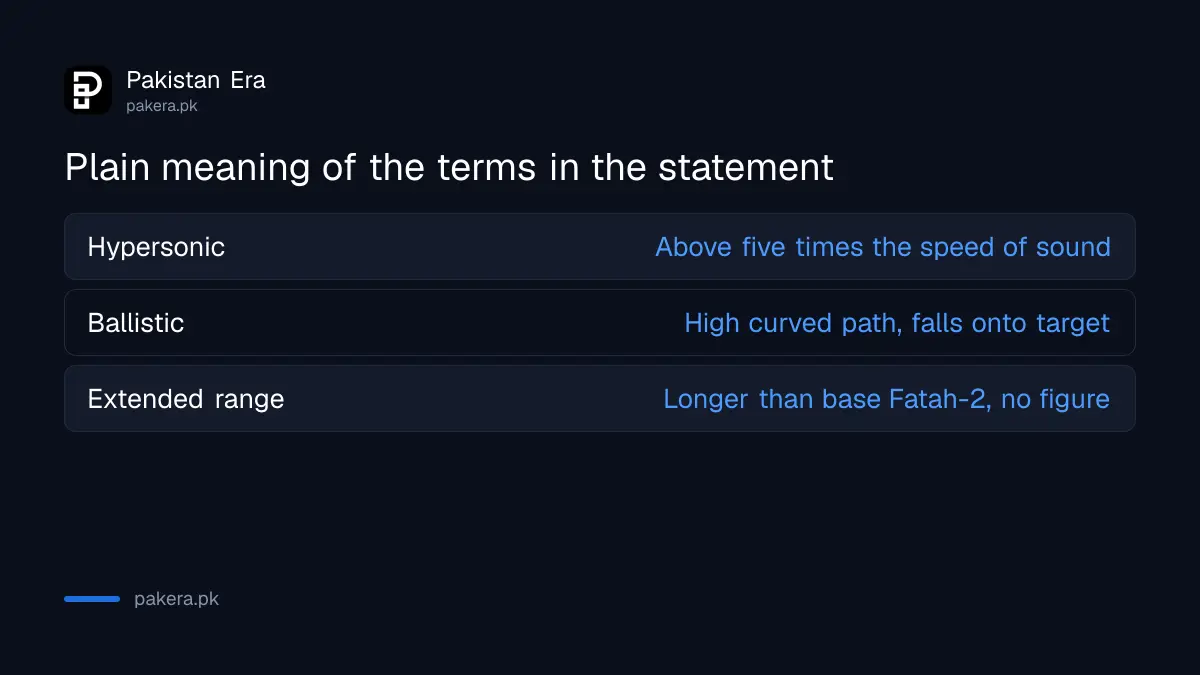
The Mach 5 figure is a general definition and not something ISPR stated. ISPR did not say how fast Fatah-2 ER flies. So the word tells us the army's label for the weapon, and it does not tell us the measured speed of this launch.
ISPR did not give the range, and published estimates are not official
The statement says only "extended range". It gives no kilometre figure for Fatah-2 ER. Figures seen in online defence writing are estimates from analysts, and we have not used them. The same holds for the original Fatah-2 and for any claim of how far the new version flies.

- Range: not given.
- Speed or flight height: not given.
- Launch site and landing area: not given.
- What changed from the base Fatah-2: not explained.
If ISPR publishes a range or flight detail, we will add it here with the date. Until then, any number you see is an outside estimate. We would call it unconfirmed.
The test followed the extended Fatah-4 launch a week earlier
ISPR announced a test of the extended-range Fatah-4 cruise missile on 6 October 2026, a week before this one. Both belong to the Army Rocket Force Command's Fatah series. Our report on the Fatah-4 test shows the same gaps: the word "extended" appeared, and a range number did not.
Senior commanders also reviewed security matters at the Corps Commanders Conference on 2 October. That statement did not mention missile tests. We make no link between the events, because ISPR has not made one.
Common questions about the Fatah-2 ER test
When did Pakistan test Fatah-2 ER?
ISPR announced the test launch on Tuesday, 13 October 2026. It did not say what time the launch took place.
What is the range of Fatah-2 ER?
ISPR has not said. It only says "extended range". Any kilometre figure online is an outside estimate, not an ISPR number.
Is Fatah-2 ER a cruise missile?
No. ISPR calls it a hypersonic ballistic missile. A ballistic missile follows a high curved path. Fatah-4 is the cruise missile in the same series.
Did ISPR say where the missile was fired?
No. The statement does not name a launch site or a landing area.
Who watched the launch?
ISPR says the Army Rocket Force Command chief, Lt Gen Nauman Zakaria, watched with senior officers, scientists and engineers.
Can the claim about beating missile defences be checked?
Not from the statement. It gives no test data. It is a description of design aims by the army, and we report it as a claim.
How we verified this
What we checked, where we read it, and what we could not confirm.
Last checked 17 October 2026. The statement is ISPR's, dated 13 October 2026. The ISPR site blocked our requests, so we did not open the original and read it as relayed in published reports; wording in quotation marks is theirs. The meaning of Mach 5 is general background and not an ISPR figure. We will update this page if ISPR publishes the full release or a range.
About the author

Senior Writer, Public Services and Technology
Shahid joined us in 2024 as an author. He is a senior contributor to Pakistan's leading technology websites. He writes detailed articles, mostly covering his expertise in the latest tech, mobiles, apps, gadgets, and step-by-step guides. His ideology is to help people understand the latest trends and explain complex methods through very easy-to-understand guides.