Pakistan Tests Extended-Range Fatah-4 Cruise Missile, ISPR Says
Pakistan test-launched an extended-range Fatah-4 cruise missile on 6 October 2026. What ISPR said, who watched, and how it compares with the 750 km original.
Pakistan test-launched an extended-range version of the Fatah-4 ground-launched cruise missile on 6 October 2026, the Inter Services Public Relations (ISPR) said. The military gave no new range figure. It said the test checked systems for better accuracy and survivability.
Update, 17 October 2026: ISPR reported a Fatah-2 ER hypersonic missile test on 13 October.
We read the ISPR statement as Radio Pakistan, the state broadcaster, published it on 6 October. The ISPR website itself blocked our requests, so we could not open the original press release. We then set the new statement beside the two earlier Fatah-4 statements, from September 2025 and May 2026, to see what is actually new.
The short answer: the word "extended" is new, and a range number is missing. Everything else repeats language used before.
ISPR says Pakistan tested an extended Fatah-4 on 6 October
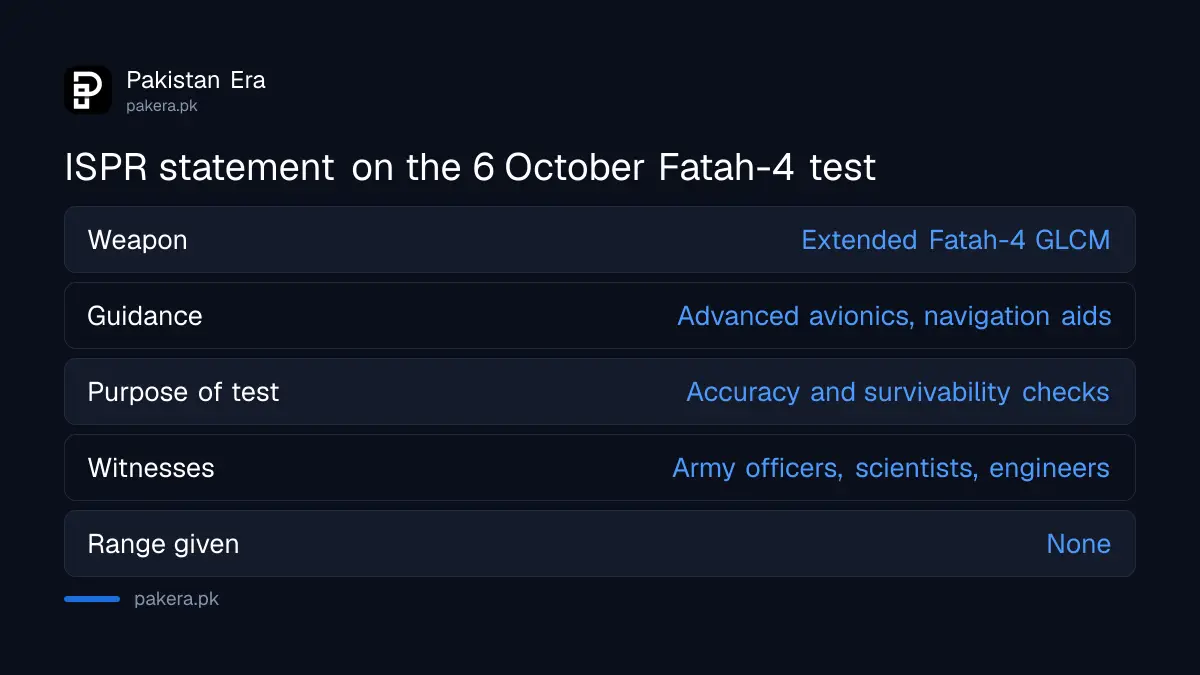
The 6 October test was of the "indigenously developed extended-range version" of Fatah-4, a ground-launched cruise missile (GLCM). ISPR said the system has advanced avionics and navigation aids and can hit targets "at extended ranges with high precision".
A cruise missile is different from a ballistic missile. It flies like a small unmanned aircraft, usually low and powered for most of its flight. A ballistic missile is fired high on a curved path and falls onto its target. "Ground-launched" simply means it is fired from a launcher on land, not from a ship or an aircraft.
ISPR's statement made four points:
- Pakistan carried out a successful test launch of the extended-range version of Fatah-4.
- The weapon has advanced avionics (the electronics that guide it) and modern navigation aids.
- The test validated "additional technical parameters" of sub-systems added for improved accuracy and enhanced survivability.
- Senior Pakistan Army officers and scientists and engineers of the developing agency watched the launch.
The statement did not name the test site, the time of launch or the distance the missile flew.
Senior army officers and scientists witnessed the launch
The launch was witnessed by senior officers of the Pakistan Army along with scientists and engineers from the agency that developed the missile, according to ISPR. The statement did not name any officer or the agency.
The President, the Prime Minister, the Chief of Army Staff and Chief of Defence Forces, and the services chiefs commended the test, ISPR said. They praised the "technical prowess, dedication and commitment" of the people who worked on it. The Chief of Defence Forces post was created by the Twenty-seventh Amendment in 2025; how it works is set out in Pakistan's Chief of Defence Forces explained.
The witness list is a small but real change. In September 2025 ISPR said the Chief of General Staff watched the first launch. In May 2026 it said officers of the Army Rocket Force Command attended. This time it named neither.
This is the third Fatah-4 launch ISPR has announced
ISPR has now announced three Fatah-4 launches in just over a year. The first, on 30 September 2025, gave a range of 750 kilometres. The second, on 14 May 2026, was called a training fire. The third, on 6 October 2026, introduced an extended version.
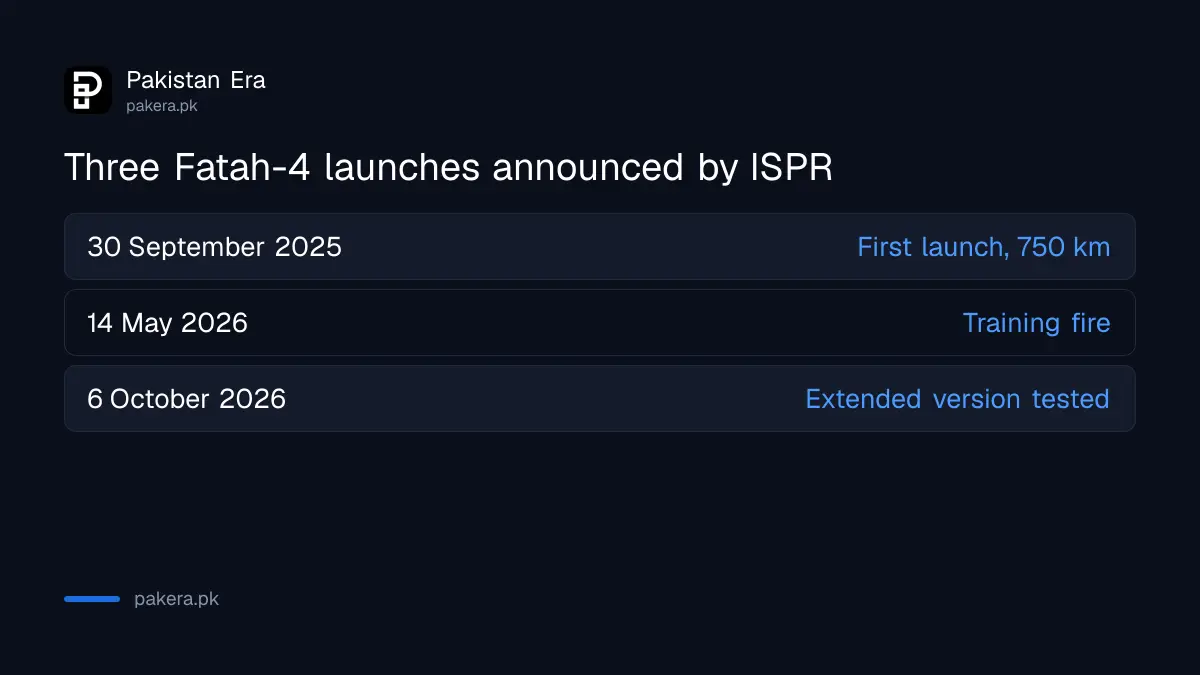
We compared the three statements line by line. This table shows only what each one said, in plain words.
| Point | 30 September 2025 | 14 May 2026 | 6 October 2026 |
|---|---|---|---|
| What it was called | Launch of newly inducted Fatah-4 | Training fire of Fatah-4 | Test launch of extended-range version |
| Range stated | 750 km | "Long-range targets", no figure | "Extended ranges", no figure |
| Terrain hugging mentioned | Yes | No | No |
| Army Rocket Force Command named | Yes | Yes, it conducted the fire | No |
| Witnesses named | Chief of General Staff, senior officers, scientists and engineers | Senior Rocket Force officers, scientists and engineers | Senior army officers, scientists and engineers |
"Terrain hugging", mentioned in 2025, means the missile flies close to the ground and follows hills and valleys. ISPR said in 2025 that this helps it avoid missile defence systems. The 2026 statements did not repeat the phrase, though nothing in them says the feature changed.
The extended range has not been stated
ISPR has not given a range for the extended version, so any number you see is an estimate, not an official figure. The only official Fatah-4 range on record is 750 km, from the September 2025 statement about the original version.

We searched the three ISPR statements for a figure for the new version and found none, so we have not used one. If ISPR publishes a range, we will add it here with the date.
The same caution applies to words like "survivability". In military use it means the chance that a missile reaches its target without being shot down or failing. ISPR did not explain which sub-systems were changed, and it would be guessing to say more.
Army Rocket Force Command operates the Fatah series
Fatah-4 belongs to the Army Rocket Force Command, ISPR said in September 2025, and it was meant to add reach and survivability to the army's conventional missile systems. The word "conventional" matters: it means a non-nuclear weapon.
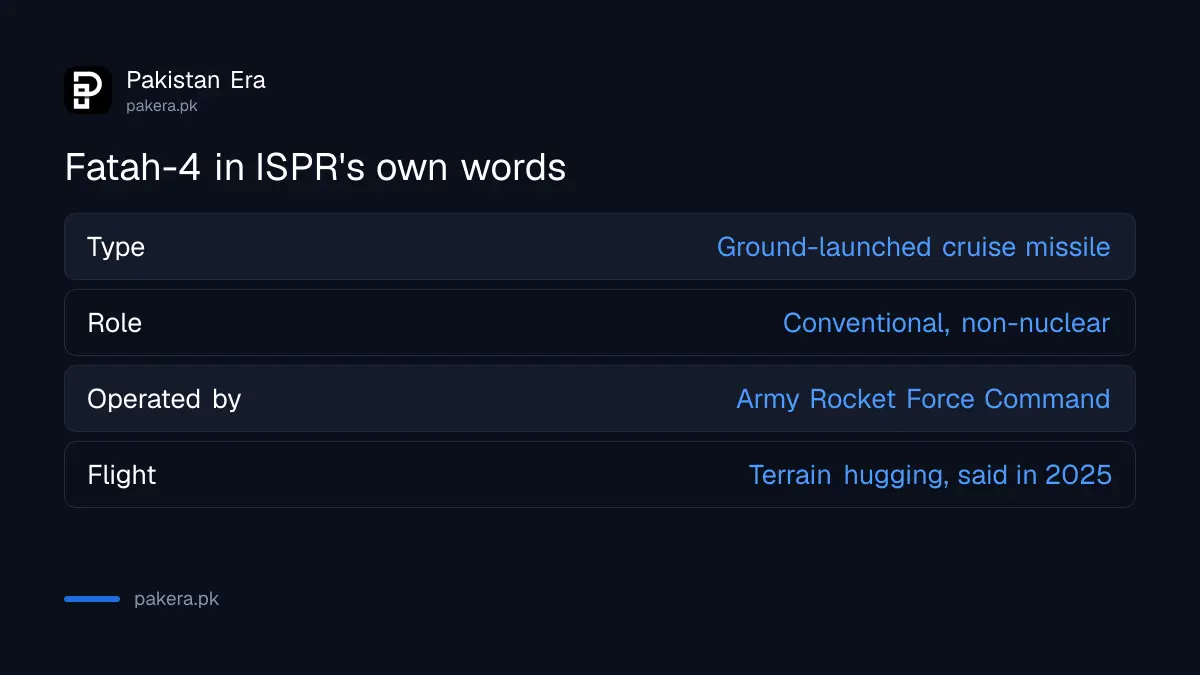
The May 2026 statement went further and said the Rocket Force Command itself carried out that training fire. It called Fatah-4 part of the "F series". The October statement did not mention the command at all.
Missile tests are announced regularly in Pakistan, and ISPR statements usually follow the same pattern: a short description, a list of witnesses and the leadership's congratulations. Senior commanders also reviewed security matters days earlier at the Corps Commanders Conference on 2 October, though that statement did not mention missile tests.
Common questions
When did Pakistan test the extended Fatah-4?
On 6 October 2026. ISPR announced the test the same day, and Radio Pakistan published the statement on 6 October.
What is the range of the Fatah-4 extended version?
ISPR has not said. It only said the missile can engage targets "at extended ranges". The original Fatah-4 was given a range of 750 km in September 2025.
Is Fatah-4 a ballistic missile?
No. ISPR calls it a ground-launched cruise missile. Cruise missiles fly low and powered, like a small unmanned aircraft, while ballistic missiles follow a high, curved path.
Who witnessed the Fatah-4 test?
Senior officers of the Pakistan Army and scientists and engineers of the developing agency, ISPR said. No names were given.
Is Fatah-4 a nuclear weapon?
ISPR described Fatah-4 in 2025 as part of the army's conventional missile systems, which means non-nuclear. The October 2026 statement did not address this.
Where was the Fatah-4 test carried out?
ISPR did not say where the launch took place.
How we verified this
What we checked, where we read it, and what we could not confirm.
Last checked 7 October 2026, about 2:00 am PKT. We read the 6 October 2026 ISPR statement as published by Radio Pakistan, along with Radio Pakistan's reports of the 30 September 2025 launch and the 14 May 2026 training fire. The ISPR website returned an access block to us, so the original press releases were not opened. The comparison table is our own reading of the three statements.
About the author

Senior Writer, Public Services and Technology
Shahid joined us in 2024 as an author. He is a senior contributor to Pakistan's leading technology websites. He writes detailed articles, mostly covering his expertise in the latest tech, mobiles, apps, gadgets, and step-by-step guides. His ideology is to help people understand the latest trends and explain complex methods through very easy-to-understand guides.