Reply to an FBR Section 114(4) Notice: File Your Missing Tax Return in 30 Days
Got an FBR notice under section 114(4)? You have 30 days to file the missing return. See how far back it can go, what to file and what happens if you wait.
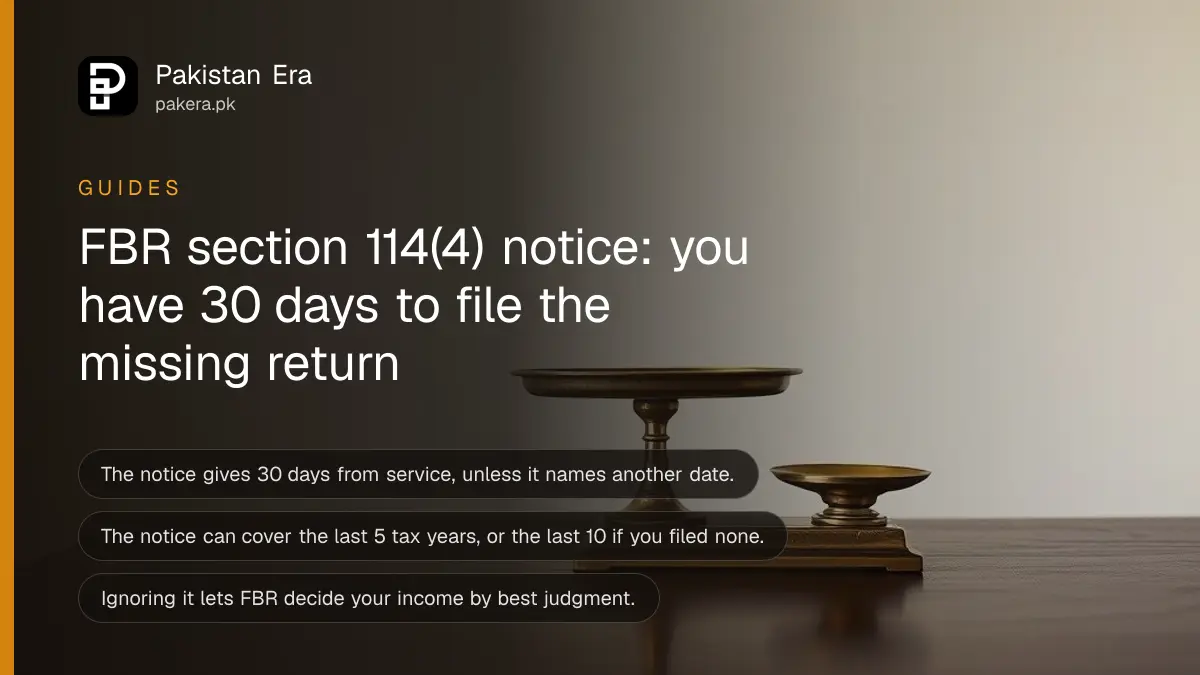
Short answer: A notice under section 114(4) of the Income Tax Ordinance tells you to file a tax return you missed. The notice gives you 30 days from the day it is served, unless it names a different date. File the missing return on IRIS inside that window. If you do not, FBR can fix your income itself and send you a tax bill.
A shopkeeper in Faisalabad had never filed a return. Then a notice arrived for last year, and another for the year before. He thought the notice was the penalty. It is not. It is a last chance to file before the officer decides your income for you.
We read the Income Tax Ordinance, 2001, as amended up to 30 June 2026, on FBR's own website on 12 October 2026. This page explains what a section 114(4) notice says, how far back it can go and what to do in the first week.
A section 114(4) notice is an order to file a return you did not file
Under section 114(4), the Commissioner can send a written notice to anyone who, in the Commissioner's opinion, must file a return but has not. The notice requires the return within 30 days of service, or a longer or shorter period if the notice says so.
The notice is about a specific tax year. A tax year runs from 1 July to 30 June, so the notice names the year or years for which a return is missing. Read the year on the notice first, because you may need a separate return for each one.
The notice does not say you owe tax. It says you did not file. The tax, if any, comes out of the return you file or out of an assessment if you stay silent.
FBR can go back five years, and ten years for some people
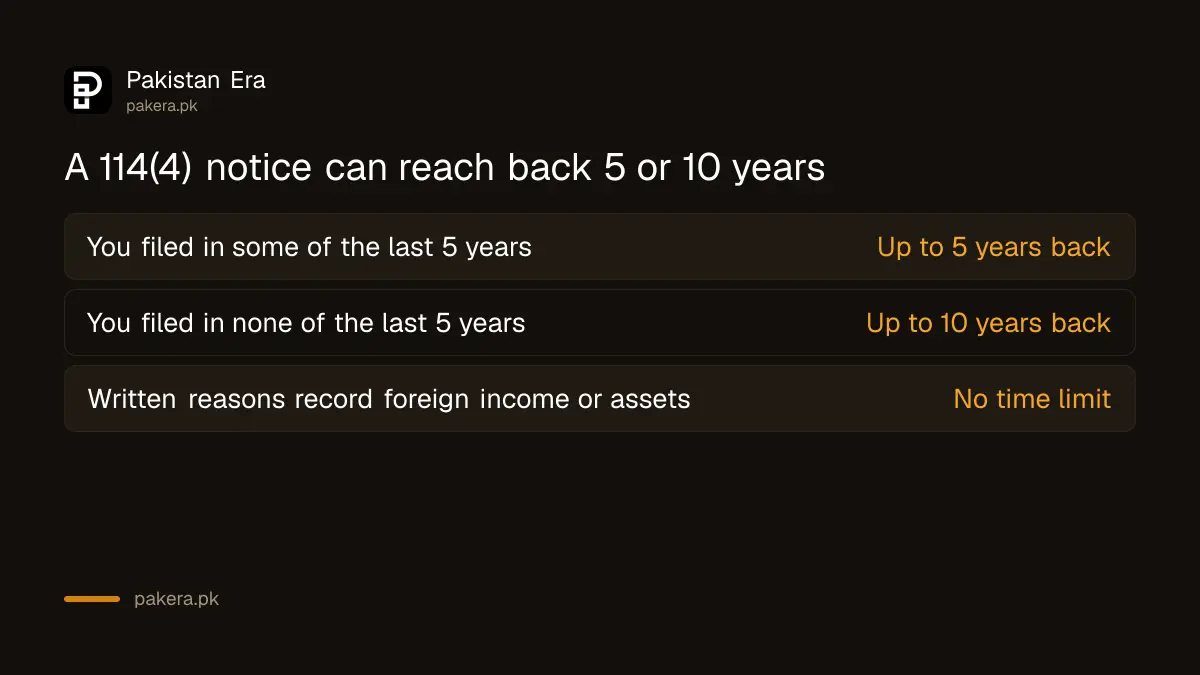
The Commissioner can issue the notice for one or more of the last five completed tax years. If you did not file for any of those five years, the notice can reach back to one or more of the last ten completed tax years.
| Your situation | How far back a notice can go |
|---|---|
| You filed in some of the last five years | One or more of the last 5 completed tax years |
| You filed in none of the last five years | One or more of the last 10 completed tax years |
| The Commissioner records in writing that you have foreign income or foreign assets | No time limit under this sub-section |
The last row comes from a proviso added to section 114(5). It needs written reasons from the Commissioner, so ask for them if you think the rule is being used against you wrongly.
Check first that the notice is real and meant for you
Before you act, confirm the notice came from FBR and that your NTN and CNIC on it are right. Fake notices do circulate, and a wrong CNIC can mean the notice belongs to someone else.
The steps for spotting a fake are set out in how to check an FBR notice, circular or email is real. A genuine notice names the officer, the tax year and the section. If it asks you to pay money into a personal account, it is not from FBR.
Also check whether you were required to file at all for that year. The ten legal tests are listed in who must file an income tax return in Pakistan. The notice rests on the Commissioner's opinion, and that opinion can be wrong.
File the missing return before the 30 days end
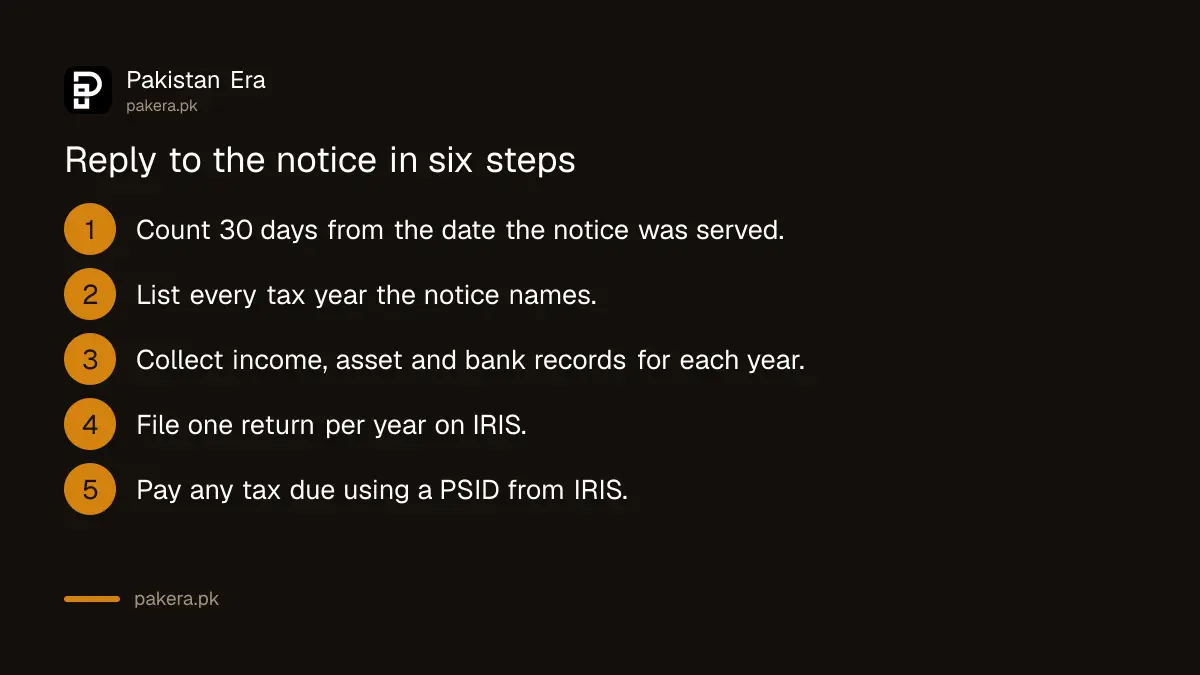
The safest reply to a section 114(4) notice is the return itself. File it on IRIS for each year named. Use the return form for that year, not the current one, and keep the acknowledgement.
- Note the date the notice was served and count 30 days from it, or use the date the notice states.
- List the tax years named in the notice.
- Collect your income, asset and bank records for each of those years.
- Log in to IRIS and file one return per year, with the wealth statement where it is required.
- Pay any tax due with the return, using a PSID from IRIS.
- Download the acknowledgement and keep it with the notice.
Login problems are common near deadlines. The fixes are in how to fix FBR IRIS 2.0 login errors and file the return. If the portal fails on your last day, keep screenshots and write to the Commissioner the same day.
Silence lets FBR assess your income by best judgment
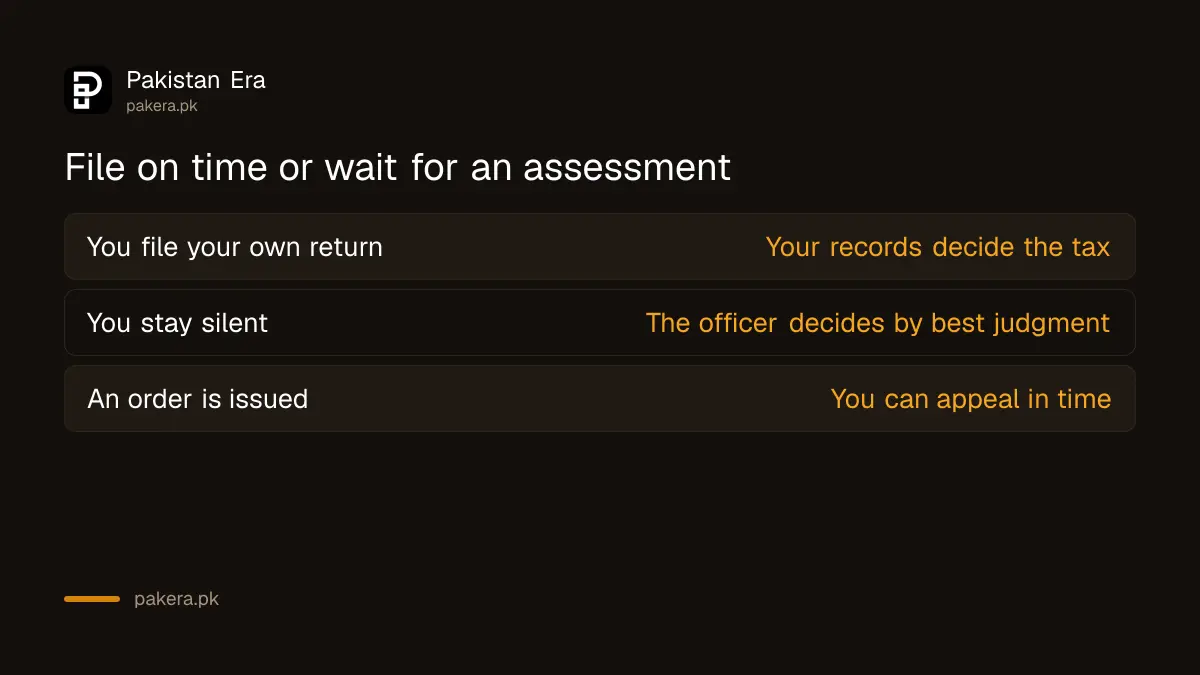
If you do not file in response to the notice, section 121 allows a best judgment assessment. The Commissioner uses any available information and decides your taxable income and your tax. You then get an assessment order stating the income, the tax and how to appeal.
That order is usually larger than an honest return would be, because the officer works from third-party data rather than your own records. Such an order can be appealed, but the first step is easier and cheaper: file.
| Item | What the law says |
|---|---|
| Who does the assessment | The Commissioner, under section 121 |
| Basis | Any available information, to the best of the Commissioner's judgement |
| Time limit for the order | Six years after the end of the tax year |
| Time limit when the notice reached back under the ten year proviso | Two years from the end of the tax year in which the notice was issued |
| What the order must state | Taxable income, tax due, tax paid, and the time, place and manner of appeal |
If an assessment order does arrive, the route is set out in how to appeal an FBR income tax order. A mistake in the order's own arithmetic can be corrected faster, as explained in asking FBR to correct a mistake in a tax order under section 221.
Filing late has a price, and that price is better than an assessment
A late return can attract a surcharge and, in some cases, a penalty. The surcharge for late filers is covered in the late filing cost on the Active Taxpayer List.
If you have already filed for a year and later find a mistake, that is a different path. Revising an existing return is covered in how to revise your income tax return under section 114(6).
Common questions
How many days do I have after a section 114(4) notice?
You have 30 days from the date the notice is served, or the longer or shorter period written on the notice. Count from the service date, not the date printed at the top.
Can FBR send a notice for a year from eight years ago?
Yes, if you did not file in any of the last five years. In that case the notice can cover one or more of the last ten completed tax years.
What happens if I ignore the notice?
The Commissioner can make a best judgment assessment under section 121 and issue an order with the income and tax decided by the officer.
Is a section 114(4) notice a penalty?
No. It is a demand to file a return. A penalty or surcharge can follow only if you file late or do not file.
Do I have to file if I think I am not required to?
Check the ten tests first. If you are not required, reply to the Commissioner in writing with your reasons and proof, before the 30 days end.
Can I ask for more time?
You can write to the Commissioner before the date and ask for an extension, with the reason. The law lets the Commissioner allow a longer period, but that is the officer's decision.
How we verified this
What we checked, where we read it, and what we could not confirm.
We read sections 114 and 121 of the Income Tax Ordinance, 2001, amended up to 30 June 2026, as published by the Federal Board of Revenue, on 12 October 2026. Notice formats, forms and portal steps change, so check IRIS and your notice before you act. This page is general information, not tax advice.
About the author

Global Affairs & Political Economy Writer
Muhammad Hatim is a book lover who started writing because he enjoys it. At Pakistan Era he writes about international relations, geopolitics and the global economy, with a particular interest in South Asia and the forces behind current events.