How to Revise Your Income Tax Return in Pakistan Under Section 114(6)
Made a mistake in your FBR tax return? Section 114(6) lets you revise it, with no approval in the first 60 days. See the conditions, penalties and IRIS steps.
You can revise a filed income tax return in Pakistan under section 114(6) of the Income Tax Ordinance 2001. Within 60 days of filing, you do not need the Commissioner's approval. After that you apply on IRIS first, and approval is treated as given if the Commissioner does not decide within 60 days.
Deadline day is when mistakes happen. A salary figure typed wrong, a bank profit left out, a plot missing from the wealth statement. The law expects this and gives you a way to fix it. We read section 114(6) and section 116(3) in FBR's own copy of the Ordinance, amended up to 30 June 2026, and the steps below follow them.
Section 114(6) lets you fix an omission or a wrong statement
Anyone who has filed a return and then finds an omission or a wrong statement in it may file a revised return. The revision must meet four conditions, or the revised return is treated as invalid, as if it was never filed.
These are the four conditions, in the words of the law made simple:
| Clause | What it requires | What it means for you |
|---|---|---|
| 114(6)(a) | Revised accounts or revised audited accounts | Mainly for businesses; the Commissioner can waive it |
| 114(6)(b) | Written reasons for the revision, signed by you | Type a short, honest reason on IRIS |
| 114(6)(ba) | The Commissioner's written approval | Not needed within 60 days of filing |
| 114(6)(c) | Income not lower than any FBR order already made | You cannot revise below an assessment FBR has already made |
From 1 July 2026, the Finance Act 2026 added one more reason to revise: accepting a settlement offered by FBR's algorithmic settlement mechanism. That route, in section 114(6B), needs no approval, but you pay the tax the mechanism works out. Most salaried people will not meet it.
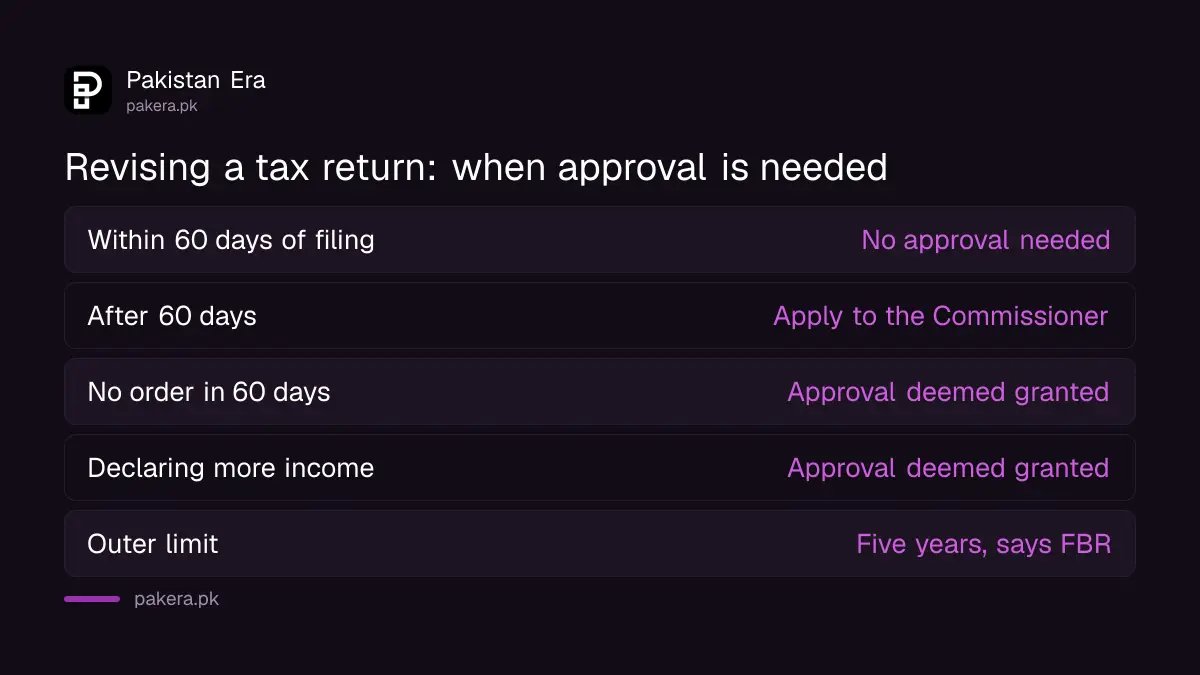
The first 60 days after filing need no approval
The Commissioner's approval under clause (ba) does not apply if you file the revised return within 60 days of filing the original. For a return filed on 30 September 2026, that window runs to 29 November 2026, by our count.
Count from the date you filed the original, not from the deadline. If you filed on 15 September, your 60 days end on 14 November.
After 60 days, approval is needed, but the law protects you in three ways:
- Deemed approval. If the Commissioner has not made a written order within 60 days of your request, approval is treated as granted.
- Paying more tax. If your revised return declares more income, or a smaller loss, than your original return as assessed under section 120, approval is treated as granted.
- Honest mistakes. The law says the Commissioner "shall grant approval" in the case of a bona fide omission or wrong statement.
How long do you have overall? Section 114(6) does not set an outer date in the text we read. FBR's own filing page says a return "can be revised within five (5) years of being originally filed". Treat five years as the limit.
Revise the return on IRIS in two stages
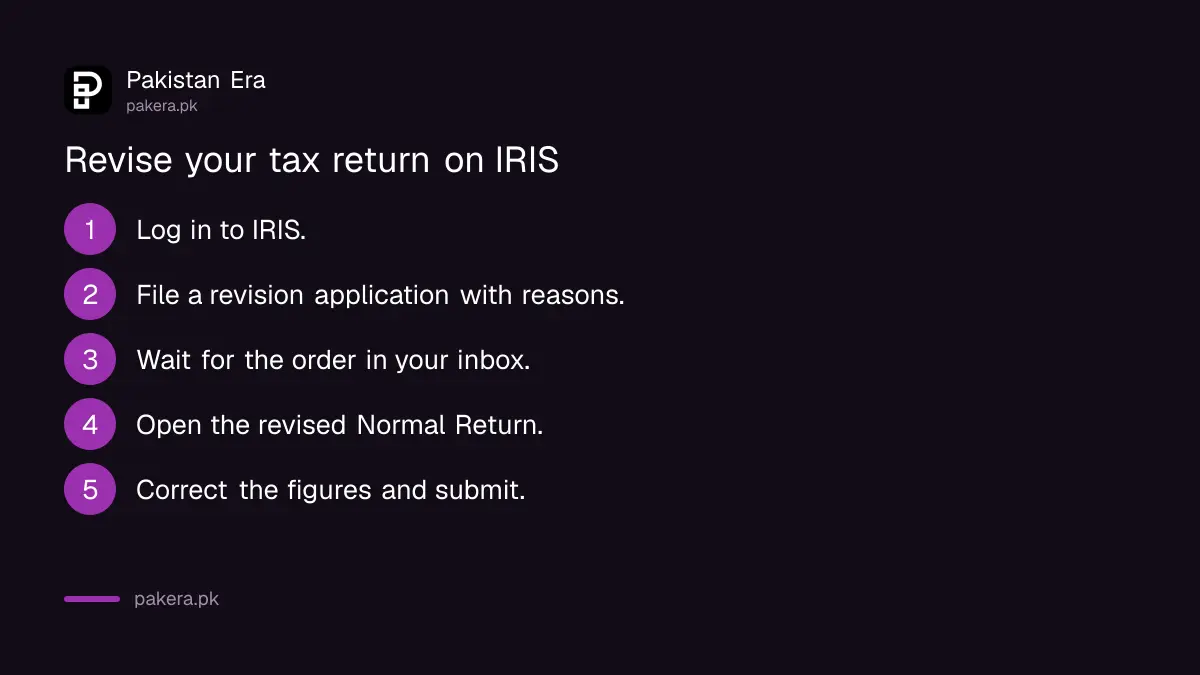
After the 60 day window, file a revision application on IRIS with your reasons, wait for the Commissioner's order in your IRIS inbox, then file the revised return. FBR's IRIS FAQs set out both stages.
- Log in to IRIS at iris.fbr.gov.pk.
- Open Declaration, then Revision Applications, and choose Return of Income for complete year.
- Pick the tax period. Click Period, enter 2026, search and select the dates shown.
- Write your reasons in the Contents tab. Say what was wrong and what the right figure is.
- Submit and print the application. The Commissioner's order will arrive in your IRIS inbox.
- File the revised return. Open Declaration, then Returns / Statements (Revised), then Normal Return. Your old figures load; change what is wrong and submit.
Within the first 60 days, clause (ba) does not apply, so the approval step is not required by law. The FAQs were written for the older IRIS screens, and IRIS 2.0 may lay out the menus differently. If a menu name does not match, look for the words "revision" and "revised". If you cannot log in, work through the IRIS 2.0 login errors first.
Before you start, confirm the original is really filed. A return still in Draft does not need revising; it needs submitting. Check your return was filed on IRIS by looking for it in Completed Tasks.
A wrong wealth statement is revised under section 116(3)
You can revise the wealth statement without the Commissioner's approval. File it with a revised reconciliation and your reasons, before you receive a notice under section 122(9). It cannot be revised after five years from the return's due date.
Section 116(3) asks for three things with the revised wealth statement: the revised wealth reconciliation, the reasons for revising, and an intimation to the Commissioner in the prescribed form. FBR's filing page confirms that no approval application is needed for this one.
There is one check on it. If the Commissioner thinks the revision is not correcting a genuine mistake, the Commissioner may declare it void, but only by a written order after giving you a chance to be heard.
On IRIS the FAQs point to Declaration, then Returns / Statements (Revised), then 116(3) Wealth Statement. The old data loads, and you edit it. The wealth statement reconciliation must still come to zero, so a new asset usually needs a matching source of funds.
Revising before FBR finds the error saves the penalty
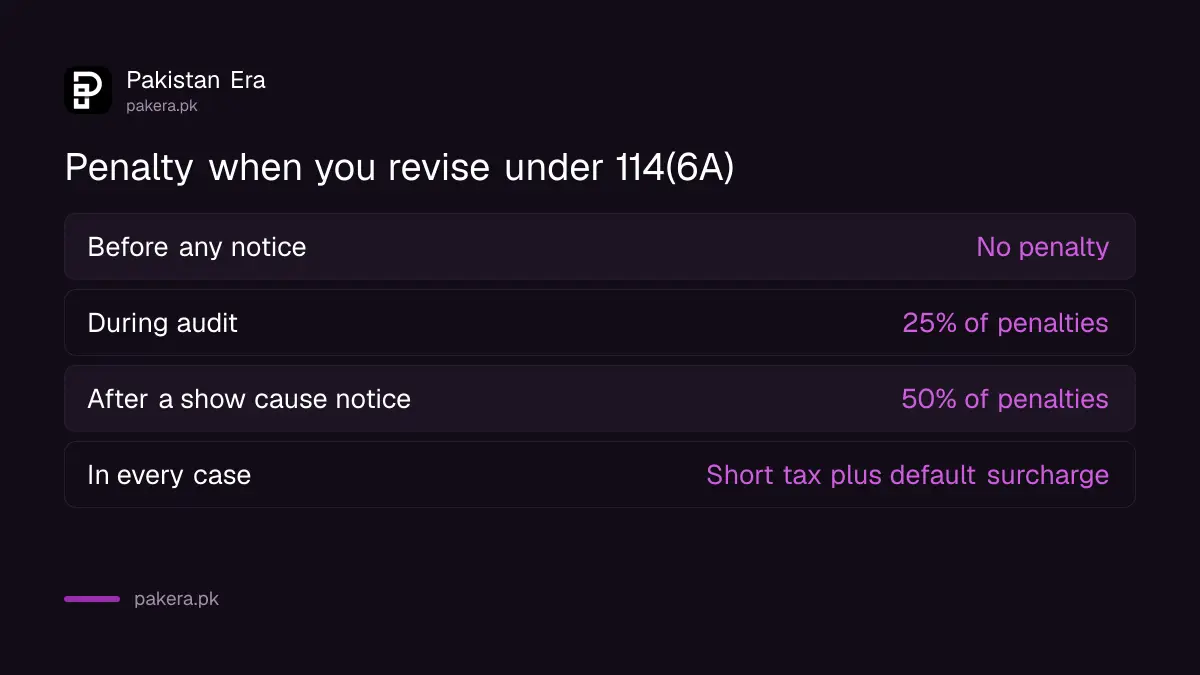
Under section 114(6A), if you revise voluntarily and pay the short tax with the default surcharge before a notice under section 177 or 122(9), no penalty is recovered. Wait until FBR raises it, and part of the penalty applies.
| When you revise | What you pay with the revised return |
|---|---|
| On your own, before any notice | Short tax and default surcharge, no penalty |
| After the Commissioner points it out in audit, before a show cause notice | Short tax, default surcharge and 25% of the penalties |
| After a show cause notice under section 122(9) | Short tax, default surcharge and 50% of the penalties; the notice then abates |
The lesson is simple. If you know a figure is wrong, fix it now. Revising up costs you only the tax you already owed, plus the surcharge. If you filed late and are also dealing with the Rs 25,000 ATL surcharge, that is a separate charge and a revision does not replace it.
Common questions
Can I revise my income tax return after submitting it?
Yes. Section 114(6) allows a revised return when you find an omission or a wrong statement. You must give written reasons.
Do I need the Commissioner's approval to revise?
Not if you revise within 60 days of filing the original. After that you need approval, but it is treated as granted if the Commissioner does not decide within 60 days of your request.
How many years back can I revise a return?
FBR's filing page says within five years of the original filing. A wealth statement cannot be revised after five years from the return's due date.
Do I need approval to revise my wealth statement?
No. Section 116(3) lets you revise it with the revised reconciliation and your reasons, before a notice under section 122(9) reaches you.
Will I pay a penalty if I revise and owe more tax?
Not if you revise on your own before a notice under section 177 or 122(9) and pay the short tax with the default surcharge. That is section 114(6A).
Can a revised return lower my income below FBR's assessment?
No. Clause (c) says the income declared cannot be less than income already determined by an FBR order, such as an amended assessment.
How we verified this
What we checked, where we read it, and what we could not confirm.
Last checked on 30 September 2026. We read sections 114(6), 114(6A), 114(6B) and 116(3) of the Income Tax Ordinance 2001 in FBR's consolidated copy amended up to 30 June 2026. The five year figure for returns is from FBR's page on revising a return; the section itself does not state it in the text we read. The IRIS menu steps are from FBR's IRIS FAQs, written for the older interface; we did not log in to IRIS 2.0 to test them. The 60 day end dates are our own count. A business that must also file revised accounts under clause (a) should speak to a tax adviser.
About the author

Tax, Bills and Technology Writer
Ali Akhtar is a young and curious voice here at Pakistan Era. He is currently pursuing his A-Levels and has a growing interest in Pakistan’s changing industrial landscape and educational trends. Ali likes to write in a way that helps him explain and explore the world around him. His writing reflects the perspective of the new generation navigating the evolving trends of Pakistan where technology, youth innovation, and shifting opportunities are reshaping the country’s future.