How to Appeal an FBR Income Tax Order in Pakistan: 30 Days and the Fees
You have 30 days to appeal an FBR income tax order to the Commissioner (Appeals). See the fee, the payment condition, the Tribunal route and the steps to file.
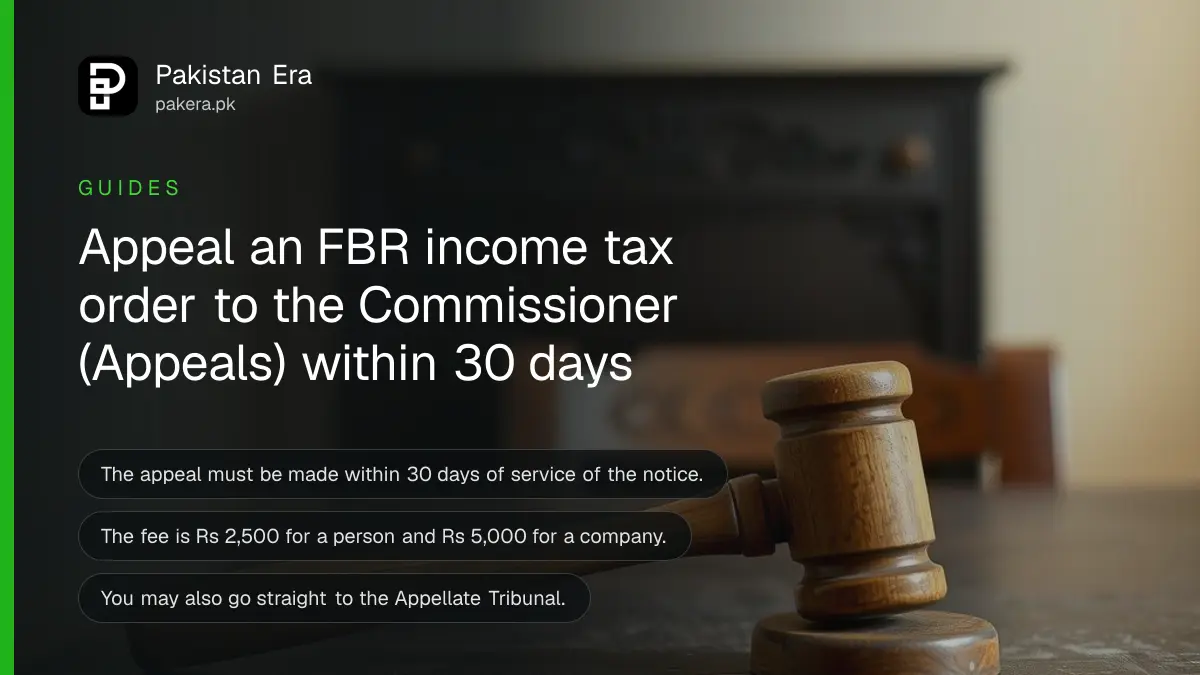
Short answer: To challenge an FBR income tax assessment order, you file an appeal with the Commissioner (Appeals) within 30 days of the notice of demand. The fee is Rs 2,500 for a person and Rs 5,000 for a company when the appeal is against an assessment. You must also have paid the tax due under section 137(1) first.
A shopkeeper opens an assessment order that adds Rs 4 million to his income. The notice gives him a demand and a date. He can pay and stay quiet, or he can challenge the order. The second path has a clock, and it starts on the day the notice of demand is served, not the day he gets round to reading it.
We read sections 122, 127, 129, 131 and 137 of the Income Tax Ordinance, 2001, as amended up to 30 June 2026, on FBR's own website on 12 October 2026. This is a plain reading of the law, not legal advice. For a large demand, a tax lawyer or a tax practitioner is worth the fee.
You have 30 days from service of the notice of demand
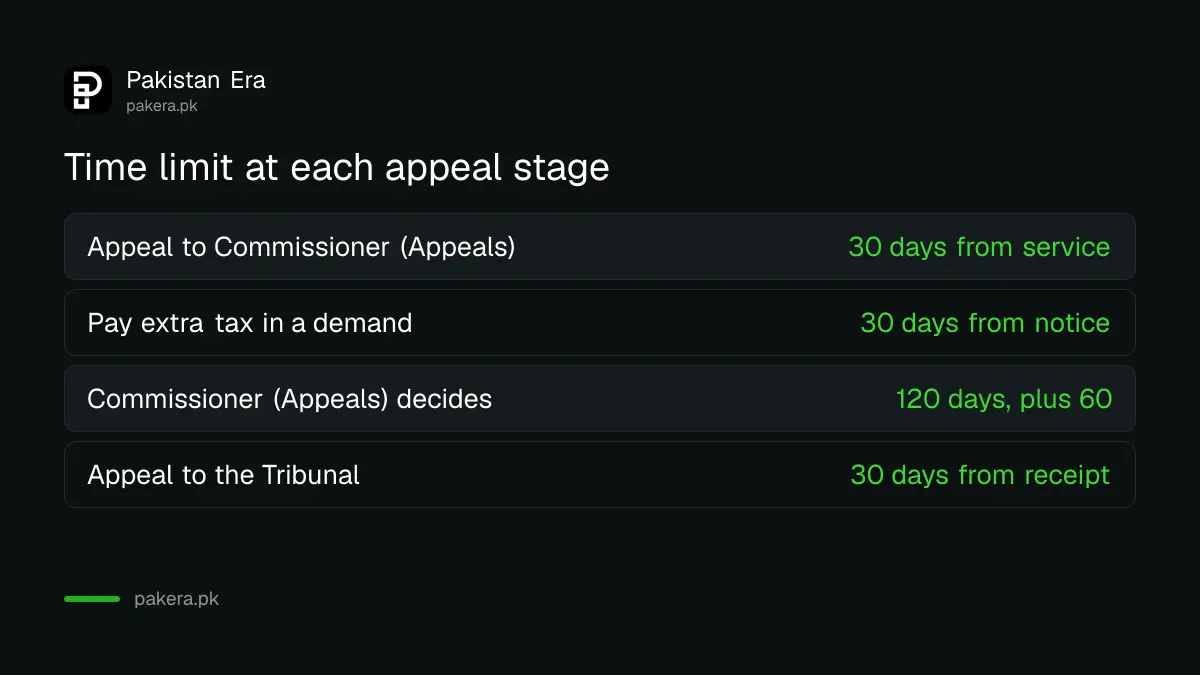
Section 127(5) says the appeal must be made within 30 days. For an assessment or penalty, the 30 days run from the date the notice of demand is served. For any other order, they run from the date the order itself is served.
Count from the day of service, not the day of the order. If you were away, keep the courier slip or the IRIS notification time, because that proves the date of service. Section 127(6) lets the Commissioner (Appeals) admit a late appeal if you show sufficient cause, but you must ask in writing and the Commissioner can say no.
| Step | Time limit | Where the law says it |
|---|---|---|
| Appeal to Commissioner (Appeals) | 30 days from service | Section 127(5) |
| Pay extra tax in a demand notice | 30 days from service of the notice | Section 137(2) |
| Commissioner (Appeals) decides | 120 days, plus 60 if extended | Section 129(4) proviso |
| Appeal to the Appellate Tribunal | 30 days from receipt of the order | Section 131(1) |
The fee depends on the order and on whether you are a company
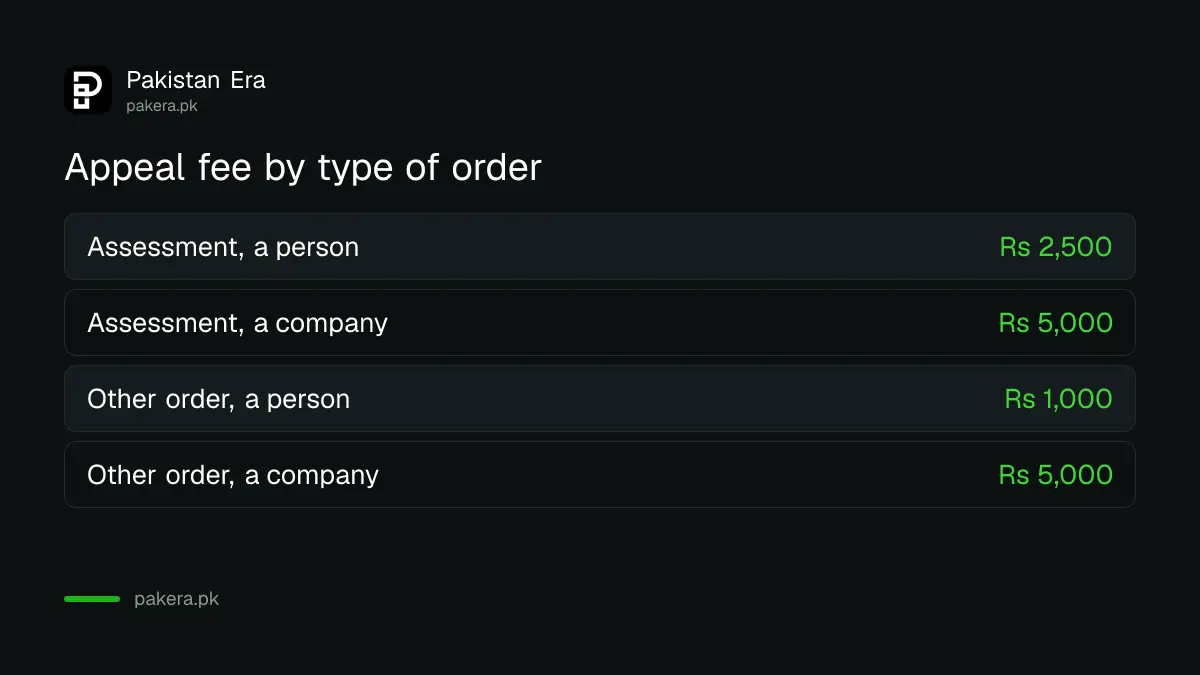
Section 127(4) fixes the fee. An appeal against an assessment costs Rs 5,000 for a company and Rs 2,500 for anyone else. An appeal against any other order costs Rs 5,000 for a company and Rs 1,000 for anyone else.
| Appeal against | Company | Not a company |
|---|---|---|
| An assessment order | Rs 5,000 | Rs 2,500 |
| Any other order | Rs 5,000 | Rs 1,000 |
The Ordinance calls this the "prescribed fee". It says nothing about how to pay it. The appeal form and FBR's instructions tell you, and we did not open that form, so follow what the form says on the day.
Pay the tax you owe first, then appeal the rest
Section 127(2) says a taxpayer cannot appeal against an assessment order unless he has paid the tax due under section 137(1). That is the tax payable on your taxable income, due on the due date for your return.
Read that carefully. You are not asked to pay the whole extra demand before you appeal. You are asked to have paid the tax that fell due with the return itself. Earlier versions of the law asked for 15 per cent of the disputed tax, and that rule was replaced. If you paid too little with the return, a revised return under section 114(6) may close the gap, where the law still allows one. If you are unsure whether you have met the condition, ask before the 30 days run out.
An appeal does not always stop recovery. Our reading is that the demand under section 137(2) is still due within 30 days of the notice, unless a stay is granted. A stay is a separate request. Ask for one in the appeal if the amount would hurt your business.
Which orders you can appeal
Section 127(1) lists the orders. They include orders under sections 120(2A), 121, 122, 143, 144, 162, 170, 182 and 205, an order holding a person personally liable under section 161(1), and an order refusing to rectify a mistake under section 221.
In plain terms, you can appeal an amended assessment, a best-judgment assessment, an order on tax you failed to deduct, a penalty order, and a refusal to correct a mistake. State-owned enterprises are excluded from this route. If your order does not appear on the list, the Ordinance may give another remedy, so check first.
How to file the appeal
Section 127(3) says an appeal must be in the prescribed form, verified in the prescribed way, state the grounds precisely, carry the fee and arrive within time. Section 127(3A) allows FBR to set up electronic filing, so ask whether your office takes it online.
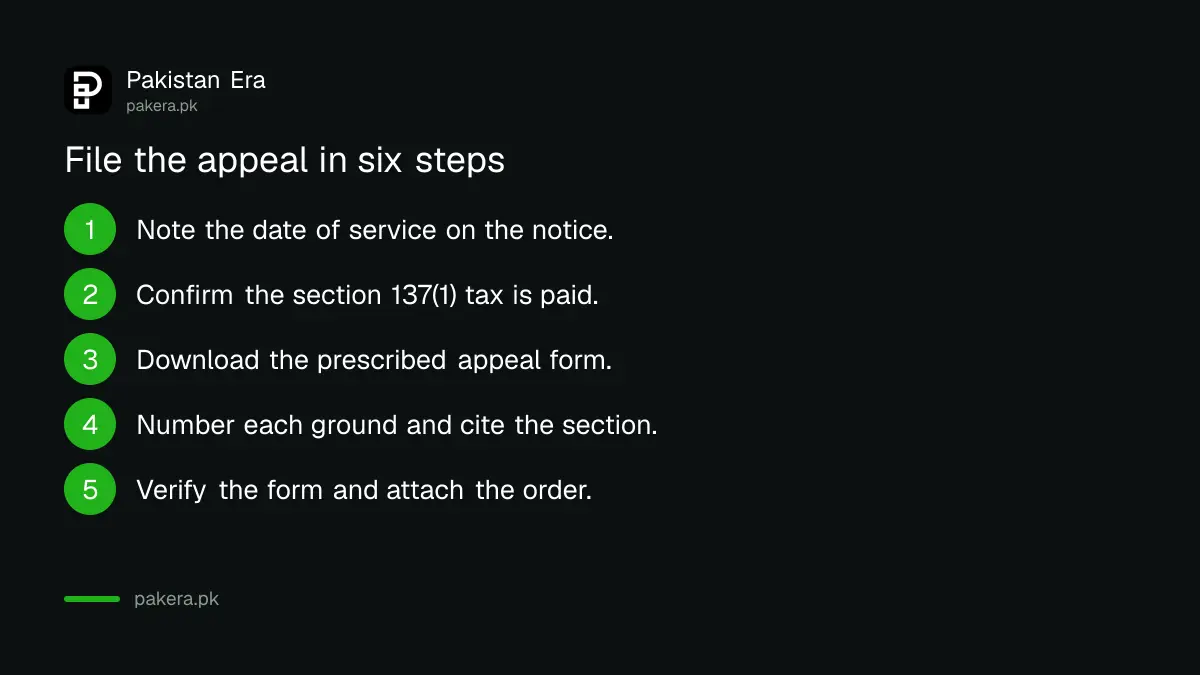
- Note the date of service on the notice of demand or the order.
- Confirm the tax due under section 137(1) has been paid.
- Download the prescribed appeal form from FBR.
- Write each ground as a separate numbered point, with the section or fact you rely on.
- Verify the form as it instructs and attach the order and notice.
- Pay the fee, lodge the appeal and keep the receipt.
Grounds matter, and a win can mean money back, which then runs through an income tax refund claim. The Commissioner (Appeals) may confirm, modify or annul the order. The Commissioner (Appeals) may not raise the assessment or cut a refund without giving you a reasonable chance to show cause, under section 129(2).
You may go straight to the Appellate Tribunal
A proviso to section 127(1) lets you skip the Commissioner (Appeals) and file directly before the Appellate Tribunal Inland Revenue. If you lose before the Commissioner (Appeals), section 131 gives you 30 days from receipt of the order to appeal to the Tribunal.
The Tribunal fee is Rs 20,000 for a company and Rs 5,000 for others. Filing does not stop recovery by itself. On application, the Tribunal may stay recovery for 90 days, after hearing the Commissioner, and the stay ends if you do not follow the hearing schedule.
Before you choose, read the amended assessment order itself, because a notice that has not been properly served or a time barred amendment may be the better ground. FBR now runs some audits through a National Faceless Centre, so the order may come from there. If your issue is delay rather than a tax order, a complaint to the Federal Tax Ombudsman is a different route.
Common questions
How long do I have to appeal an FBR assessment order?
You have 30 days. They run from the date the notice of demand is served for an assessment or penalty, and from the date of service of the order in other cases.
How much is the appeal fee?
Rs 2,500 for a person and Rs 5,000 for a company against an assessment. For other orders it is Rs 1,000 for a person and Rs 5,000 for a company.
Do I have to pay the full demand before I appeal?
No. Section 127(2) asks only that you have paid the tax due under section 137(1), the tax on your declared income at the return due date. The extra demand may still be recoverable unless a stay is granted.
Can I appeal after the 30 days?
Possibly. Section 127(6) lets the Commissioner (Appeals) admit a late appeal if you were prevented by sufficient cause, on a written application. It is a discretion, not a right.
Can I go straight to the Tribunal?
Yes. A proviso to section 127(1) lets you file directly before the Appellate Tribunal Inland Revenue instead, and the Tribunal appeal must then follow its own 30 day and fee rules.
How long does the Commissioner (Appeals) take to decide?
The order must be passed within 120 days of filing, or within 60 more days for recorded reasons. Time lost to adjournments at your request, stays or similar is left out of the count.
How we verified this
What we checked, where we read it, and what we could not confirm.
We read sections 122, 127, 129, 131 and 137 of the Income Tax Ordinance, 2001, as amended up to 30 June 2026, from FBR's Income Tax Ordinance page on 12 October 2026. We did not open the prescribed appeal form or the Income Tax Rules, so how to pay the fee and which office takes the form are not stated here. A Finance Act can change any figure above, so check the latest amended text before you rely on it.
About the author

Senior Writer, Public Services and Technology
Shahid joined us in 2024 as an author. He is a senior contributor to Pakistan's leading technology websites. He writes detailed articles, mostly covering his expertise in the latest tech, mobiles, apps, gadgets, and step-by-step guides. His ideology is to help people understand the latest trends and explain complex methods through very easy-to-understand guides.