How to Ask FBR to Correct a Mistake in Your Tax Order Under Section 221
Section 221 lets you ask FBR to correct a mistake plain on the record of a tax order. See the five year limit, the deemed rectification rule and the steps.
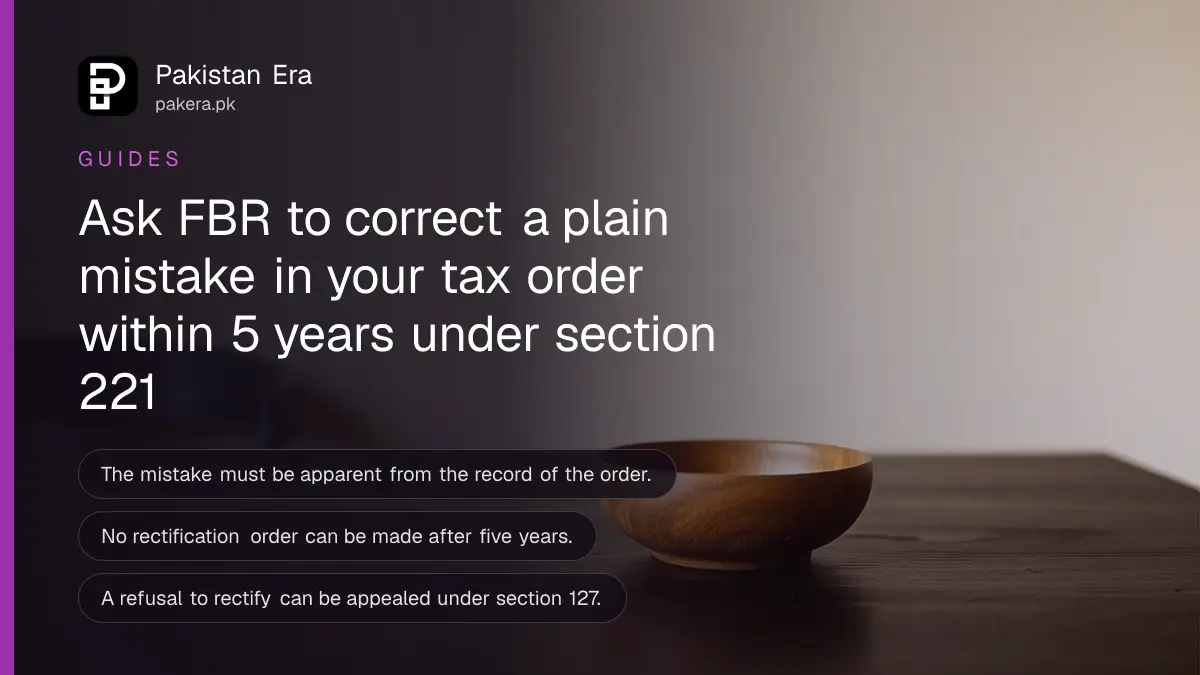
Short answer: If an FBR order has a mistake that is plain on the record, you can ask the same officer to correct it under section 221 of the Income Tax Ordinance. There is no fee in the section. The order cannot be rectified after five years, and a mistake you reported is treated as rectified if nothing is done by the end of the next financial year.
A salaried clerk gets an assessment order that taxes the same Rs 600,000 bonus twice. The addition is simply a copy mistake. He does not need to argue law or go to a tribunal for that. He can point to the line and ask the Commissioner to correct it, in writing, on the record.
We read sections 221 and 127 of the Income Tax Ordinance, 2001, as amended up to 30 June 2026, on FBR's own website on 12 October 2026. We did not read the Income Tax Rules or any application form. This is a plain reading, not legal advice.
Section 221 corrects errors, not disagreements
Section 221(1) lets the Commissioner, the Commissioner (Appeals) or the Appellate Tribunal amend an order passed by that same authority "to rectify any mistake apparent from the record". It can be done on their own motion, or when a taxpayer brings the mistake to their notice.
The key words are "apparent from the record". In plain terms, the error should be visible on the papers, without a long argument. Examples are a wrong figure copied from your return, a sum that does not add up, or a payment credit left out. We are giving that as a plain meaning, not as a court definition.
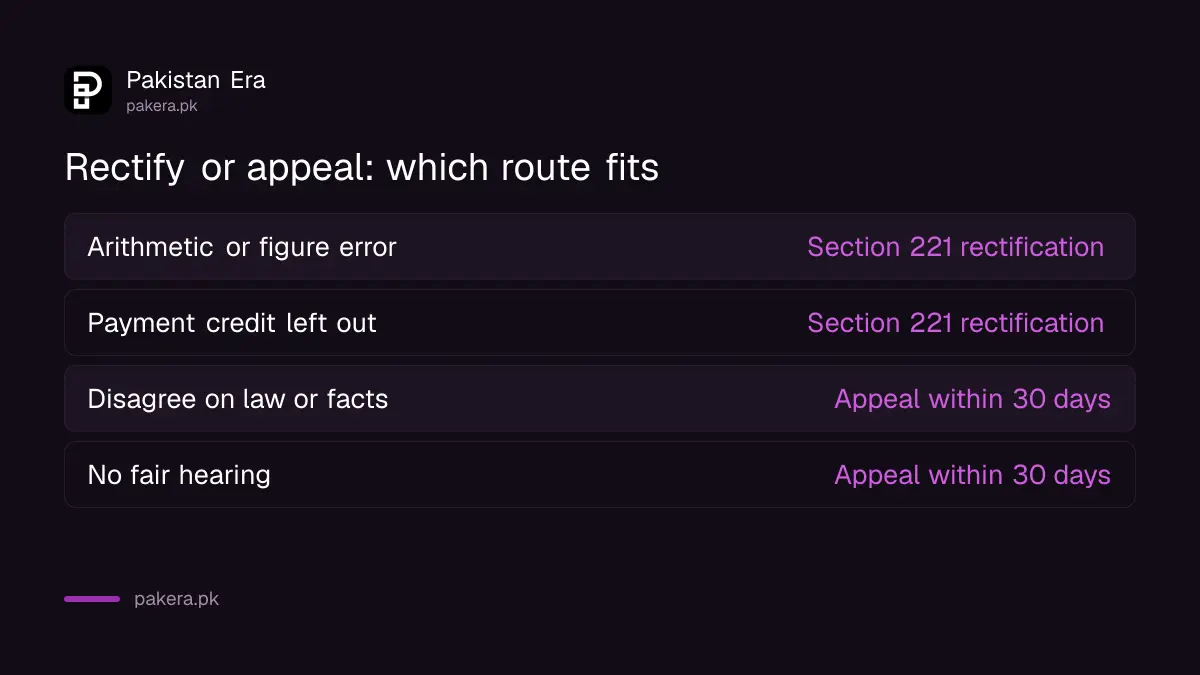
| Your problem | Right route |
|---|---|
| Arithmetic error or wrong figure on the face of the order | Rectification under section 221 |
| Tax credit or payment left out of the order | Rectification under section 221 |
| You disagree with FBR's view of the law or facts | Appeal under section 127, within 30 days |
| You did not get a fair hearing | Appeal under section 127 |
The same officer who made the order fixes it
Under section 221(1), an authority amends "any order passed by him". So you ask the Commissioner who passed the order, or the Commissioner (Appeals) if that is who passed it, or the Tribunal for its own order. You write to that office, not to a new one.
Section 221(2) protects you in one situation. If the correction would raise your assessment, cut your refund or otherwise work against you, it cannot be made unless you have been given a reasonable opportunity of being heard. So asking for a correction does not leave you without a hearing.
Be careful about one thing. A mistake can work both ways. If you ask for a correction, the officer may find another error in the same order that goes against you. Section 221(2) says you must then be heard, but check the whole order yourself before you write.
The five year limit and the deemed correction rule
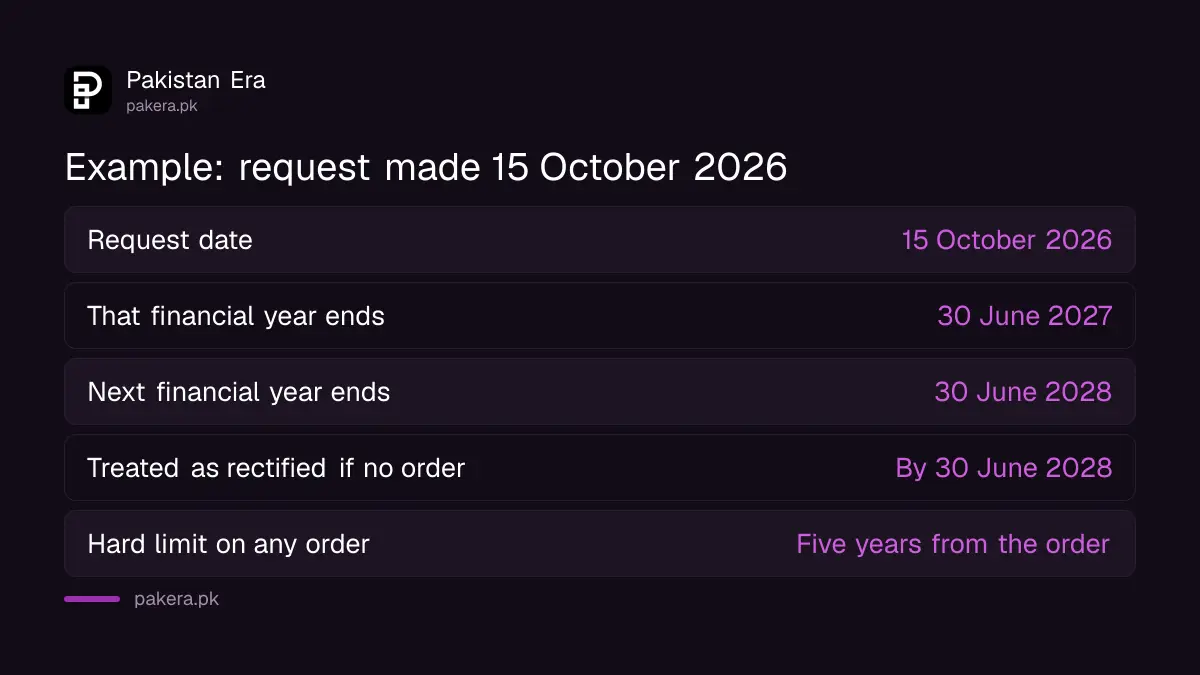
Section 221(4) says no order of rectification may be made after five years from the date of the order sought to be rectified. Section 221(3) adds a protection for you. If a mistake was brought to the Commissioner or Commissioner (Appeals) and no order was made before the end of the financial year next following, the mistake is treated as rectified.
Take an example. You write on 15 October 2026. That falls in the financial year ending 30 June 2027. The "financial year next following" is the one ending 30 June 2028, so our reading is that if no order is made by then, the mistake is treated as rectified. Ask your adviser to confirm how your office counts it.
Do not wait for that date. Meanwhile the demand in the order may still be recoverable, and the time to appeal runs separately. The safe course is to file the application and, if the 30 day appeal limit is close, appeal as well.
How to write the application
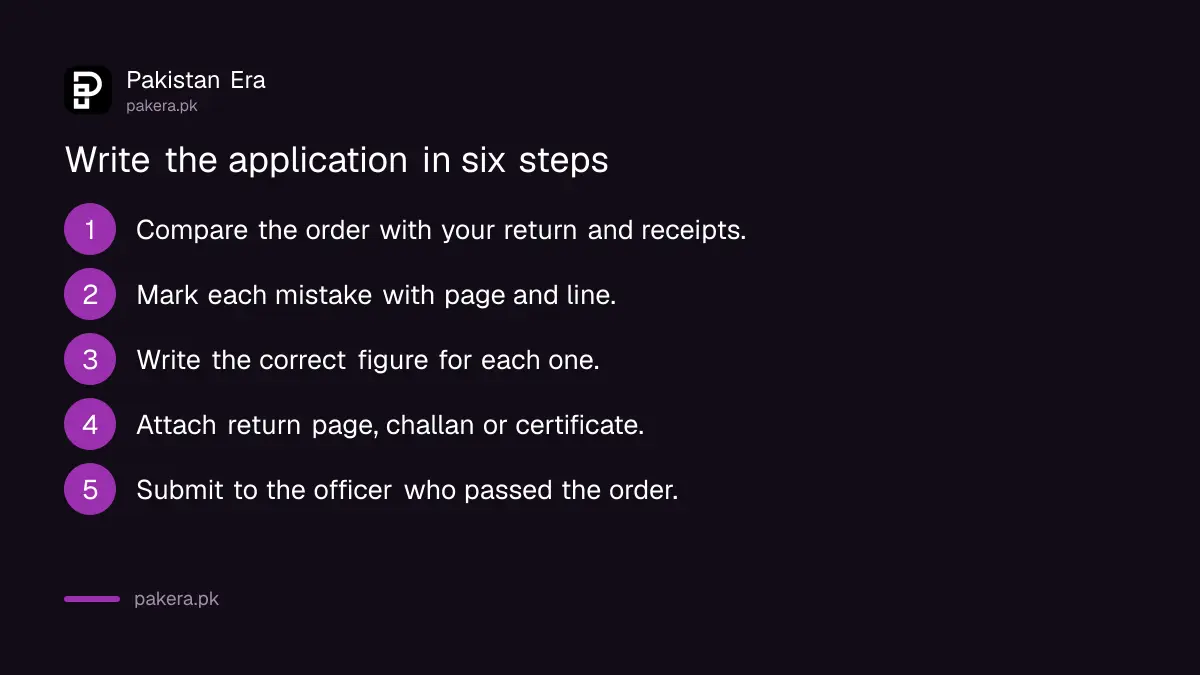
Write a short letter to the officer who passed the order. Quote the order number and date, point to the exact line or page, state what is wrong, and say what the figure should be. Attach the page of your return or the receipt that shows it.
- Read the order against your return and your payment receipts.
- Mark each mistake with the page and line.
- Write one numbered paragraph for each mistake and the correct figure.
- Attach the proof, such as the return page, the challan or the withholding certificate.
- Submit to the officer who passed the order, in the way the office accepts, and get a dated receipt.
- Diary the date, and note the 30 day appeal limit separately.
Section 221 does not set a prescribed form or a fee, as far as we read. IRIS may have a screen for it, and we did not log in, so ask your tax office what it accepts. Our guide on checking that your return was filed on IRIS shows how to confirm what your own record says before you compare it with an order.
If FBR refuses, you can appeal the refusal
Section 127(1) lists an order under section 221 refusing to rectify a mistake, in full or in part, among the orders you can appeal to the Commissioner (Appeals). The same 30 day limit and fee rules apply as for any other appeal.
That makes rectification low risk. If it works, the figure is fixed. If it is refused, you have a written refusal that you can appeal. For the steps, fees and the payment condition, see how to appeal an FBR income tax order.
If the order came from a notice you did not answer, read how to reply to a section 122 notice first. A rectification will not fix a missing reply.
Common questions
What is a mistake apparent from the record?
It is an error that shows on the papers, such as a wrong figure or a sum that does not add up. In plain terms, it is something you can point to without arguing law or facts.
Is there a fee for section 221?
Section 221 does not state a fee. An appeal against a refusal under section 127 does carry a fee, Rs 1,000 for a person and Rs 5,000 for a company.
How long do I have to ask?
Within five years from the date of the order, under section 221(4). Appeals have a shorter limit of 30 days, so do not confuse the two.
What if FBR does nothing?
Under section 221(3), a mistake brought to the Commissioner or Commissioner (Appeals) is treated as rectified if no order is made before the end of the financial year next following.
Can FBR make my assessment worse when I ask?
Only after hearing you. Section 221(2) says no order that raises the assessment or reduces a refund can be made without a reasonable opportunity of being heard.
Does asking stop the demand notice?
Not on its own, as far as the section says. The demand may stay due. If the amount is large and the appeal limit is close, take advice and appeal in time.
How we verified this
What we checked, where we read it, and what we could not confirm.
We read section 221 and section 127(1) of the Income Tax Ordinance, 2001, amended up to 30 June 2026, on FBR's Income Tax Ordinance page on 12 October 2026. We did not read the Income Tax Rules or an IRIS screen, so any prescribed form or electronic route is not described here. A later Finance Act may change the section.
About the author

Senior Writer, Public Services and Technology
Shahid joined us in 2024 as an author. He is a senior contributor to Pakistan's leading technology websites. He writes detailed articles, mostly covering his expertise in the latest tech, mobiles, apps, gadgets, and step-by-step guides. His ideology is to help people understand the latest trends and explain complex methods through very easy-to-understand guides.