Who Must File an Income Tax Return in Pakistan: 10 Legal Tests for 2026
Who must file an income tax return in Pakistan for 2026: income above the limit, a car above 1000cc, a 500 sq yd plot or an NTN. Check yourself by 15 October.
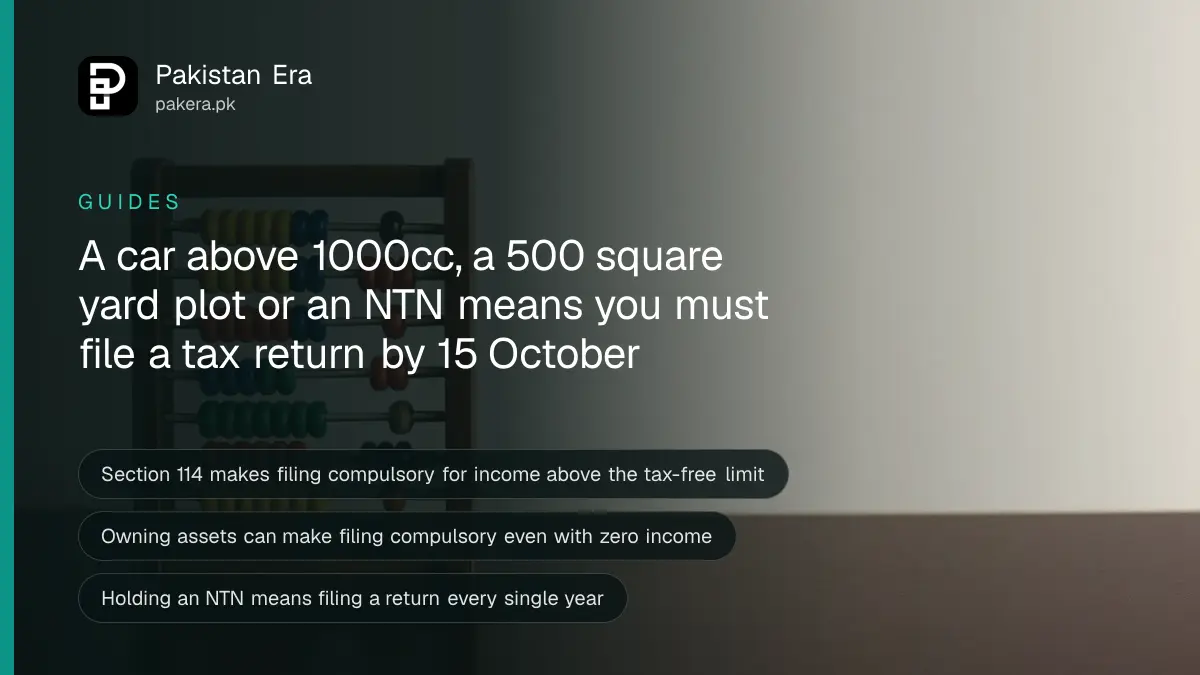
Short answer: in Pakistan you must file an income tax return if your taxable income is above the tax-free limit, or if you meet any one of the asset and status tests in section 114 of the Income Tax Ordinance, even with no income at all. Owning a car above 1000cc, a plot of 500 square yards in a rating area, or simply holding an NTN is enough. The last date for Tax Year 2026 is 15 October 2026.
We read section 114 in the FBR's own consolidated Ordinance, amended up to 30 June 2026, and FBR Circular No. 3 of 2026-27 that set the date. Below is every test, in plain words, so you can tick yourself off one line at a time.
Income above the tax-free limit makes filing compulsory
Section 114(1)(ab) requires every person other than a company to file if taxable income for the year is above the amount that is not taxed. For most salaried people that limit is Rs 600,000 a year. Companies and non-profit organisations must file every year whatever they earn.
Taxable income means income after allowed deductions, not your gross pay before anything is taken off. The rate tables for each income band are in our page on salary tax slabs. If your salary is taxed at source and you have no other income, the deduction alone does not excuse you. Crossing the limit means a return is due.
Section 114(1)(ae) adds anyone whose income is under final taxation. That covers income where tax deducted at source is the final tax, so you still declare it in a return.
The ten tests that apply even with no income
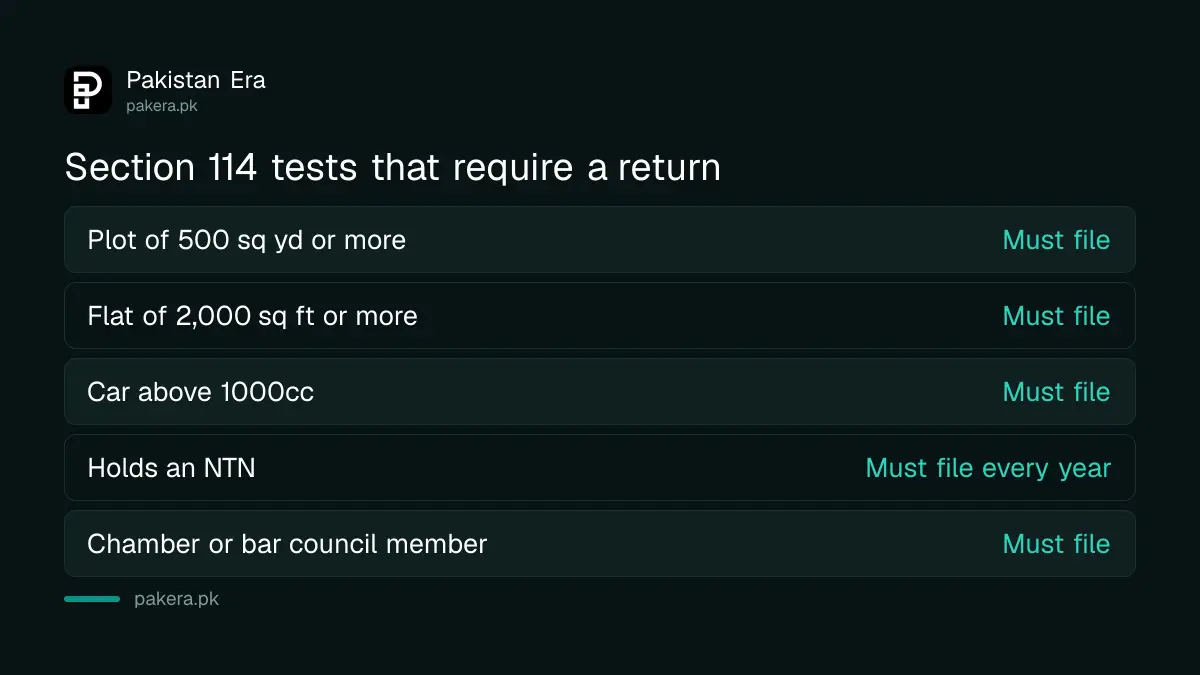
Section 114(1)(b) lists people who must file even if their income is below the limit. Meeting any single test is enough. Most of them are about what you own, not what you earn.
| Clause | You must file if you... |
|---|---|
| (b)(i) | Were charged to tax in either of the two previous tax years |
| (b)(ii) | Claim a business loss carried forward |
| (b)(iv) | Own a plot or house of 500 square yards or more in a rating area |
| (b)(v) | Own a flat of 2,000 square feet or more in a rating area |
| (b)(vi) | Own a motor vehicle above 1000cc |
| (b)(vii) | Have obtained a National Tax Number |
| (b)(viii) | Hold a commercial or industrial electricity connection with yearly bills above Rs 500,000 |
| (b)(ix) | Are a resident registered with a chamber, trade body, market committee or professional body |
| (b)(x) | Are a resident individual who must file a foreign income and assets statement |
| (c) | Fall in a class of people the FBR notifies with the minister's approval |
A rating area is a city or town area where provincial property tax is charged. Clause (b)(iii) adds a similar test for plots of 500 square yards and flats inside older municipal limits, cantonments and Islamabad.
Four common cases, and the answer for each
The tests catch more people than most expect. A car, a professional licence or an old NTN is often the trigger, not income. Here is how the rules apply to four everyday situations.
- A housewife with a 1300cc car in her name. She must file under (b)(vi), even with no income. A nil return with a wealth statement is enough.
- A lawyer enrolled with a bar council, earning little. He must file under (b)(ix), because bar councils are named in the clause.
- A student who registered on IRIS last year to buy a motorbike as a filer. She must file every year under (b)(vii), because she now holds an NTN.
- A retired teacher with a pension below the limit, a 1000cc car and a 10 marla house. A 1000cc car is not above 1000cc, and 10 marla is under 500 square yards, so he may not be required to file. He can still choose to.
That last case shows why exact numbers matter. The law says "above 1000 CC" for cars and "500 square yards or more" for land, so a 1000cc car does not count but a 500 square yard plot does. A marla is not the same size in every city, so check your plot's area in square yards on your documents.
People with no income who still want filer status can file anyway. The steps are in our page on how to file a nil tax return.
How to check yourself in five minutes
Go through the tests in order and stop at the first one that applies. If none applies and your income is below the limit, filing is optional. Keep the result with your papers, since the answer can change when you buy a car or property.
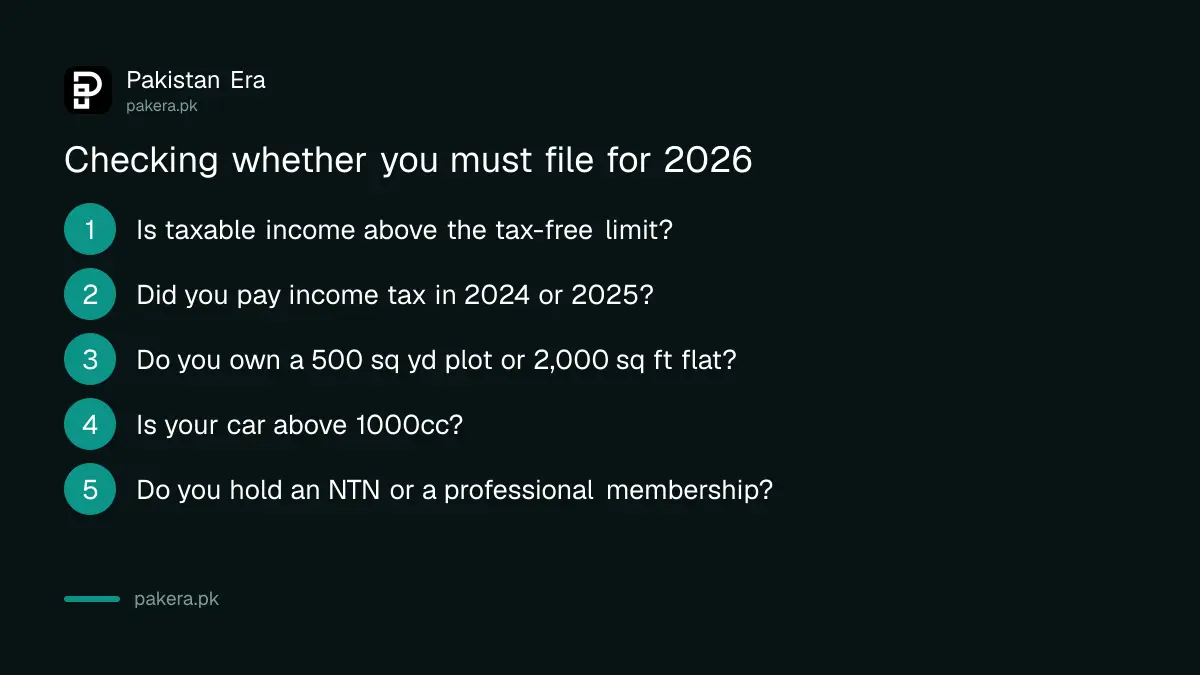
- Add up your taxable income from 1 July 2025 to 30 June 2026. Is it above the tax-free limit?
- Check whether you paid income tax in either Tax Year 2024 or Tax Year 2025.
- Check your property papers for plots of 500 square yards or more and flats of 2,000 square feet or more in a city area.
- Check your vehicle registration book for engine size above 1000cc.
- Check whether you have an NTN, a chamber or bar membership, or foreign assets.
If you are not sure whether you hold an NTN, you can check your filer status with your CNIC. For an individual the NTN is normally the CNIC number.
Missing a required return carries a penalty
If you are required to file and do not, section 182 sets a penalty of Rs 1,000 a day or 0.1 per cent of tax payable a day, whichever is higher. The minimum is Rs 10,000 for someone with 75 per cent or more of income from salary, and Rs 50,000 for everyone else.
The same entry cuts the penalty by 75, 50 or 25 per cent if you file within one, two or three months after the due date. So filing late is still far cheaper than not filing. Late filers also pay a Rs 25,000 surcharge to get on the Active Taxpayers List, as set out in our page on filing after the deadline.
The current due date for Tax Year 2026 is 15 October 2026, moved from 30 September by the FBR under section 214A. Details are in our report on the 15 October extension.
Common questions
Who is required to file an income tax return in Pakistan?
Anyone with taxable income above the tax-free limit, every company, and anyone who meets a section 114 test, such as owning a car above 1000cc or holding an NTN.
Do I have to file if my income is below Rs 600,000?
Not on income grounds alone. But you must still file if you meet an asset or status test, such as a 500 square yard plot or a car above 1000cc.
Does owning a 1000cc car make me file a return?
No. The law says above 1000cc. A 1300cc car or larger brings the duty to file.
If I have an NTN, must I file every year?
Yes. Section 114(1)(b)(vii) makes anyone who has obtained an NTN a required filer.
What is the last date to file for Tax Year 2026?
15 October 2026, under FBR Circular No. 3 of 2026-27.
How we verified this
What we checked, where we read it, and what we could not confirm.
Last checked on 10 October 2026. We read sections 114 and 182 in the FBR's Income Tax Manual Part I, the Income Tax Ordinance, 2001 amended up to 30 June 2026, and FBR Circular No. 3 of 2026-27 of 30 September 2026. The Rs 600,000 tax-free limit is from our reading of the salary tax slabs. The four cases are worked examples, not rulings, and an unusual situation is worth checking with a tax adviser.
About the author

Tax, Bills and Technology Writer
Ali Akhtar is a young and curious voice here at Pakistan Era. He is currently pursuing his A-Levels and has a growing interest in Pakistan’s changing industrial landscape and educational trends. Ali likes to write in a way that helps him explain and explore the world around him. His writing reflects the perspective of the new generation navigating the evolving trends of Pakistan where technology, youth innovation, and shifting opportunities are reshaping the country’s future.