Challenge a Federal Ombudsman Decision in Pakistan: File a Representation to the President in 30 Days
Lost a case at the Wafaqi Mohtasib, FTO or Banking Mohtasib? File a representation to the President of Pakistan within 30 days. Steps, address and timelines.
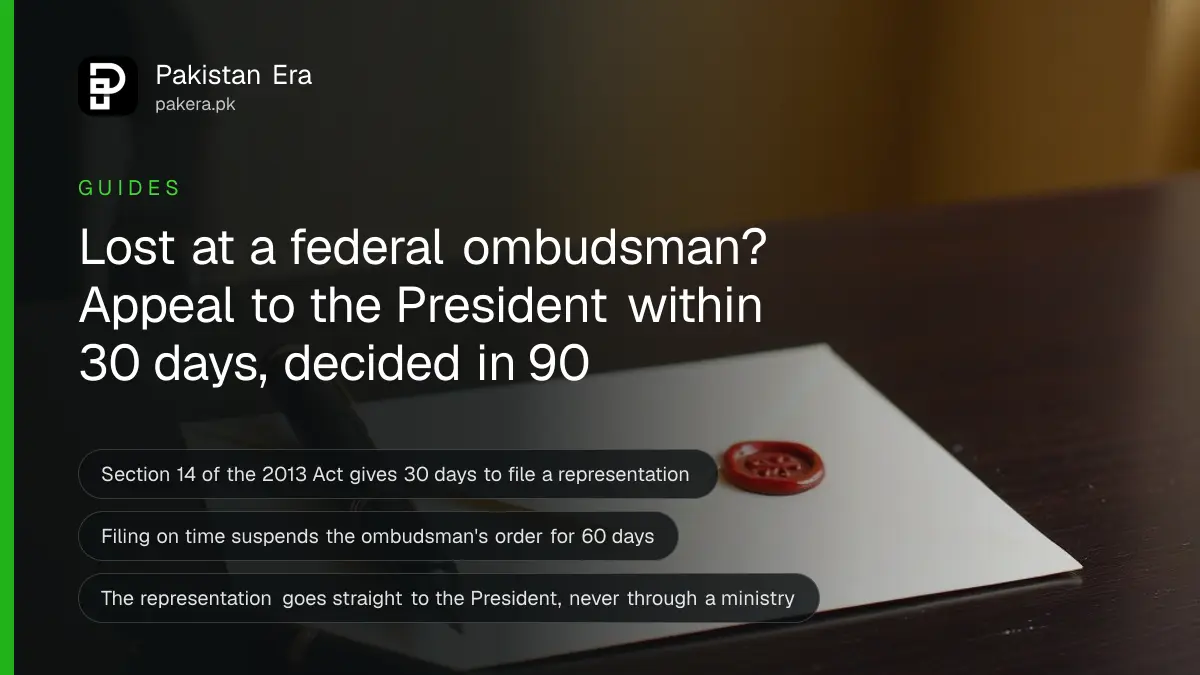
If a federal ombudsman decides against you, you can file a representation to the President of Pakistan within 30 days of the decision. It goes straight to the President, not through any ministry, and must be decided within 90 days. Filing it on time also freezes the ombudsman's order for 60 days.
This route covers the Wafaqi Mohtasib, the Federal Tax Ombudsman, the Banking Mohtasib, the Insurance Ombudsman and the federal ombudsperson for workplace harassment. It is set out in section 14 of the Federal Ombudsmen Institutional Reforms Act, 2013. We read the Act on Pakistan Code.
The route is busier than most people think. On 8 October 2026 the President received a report saying more than 6,000 representations were decided between 2024 and 2026, which the President's office called a record.
You have 30 days, and two routes inside that time
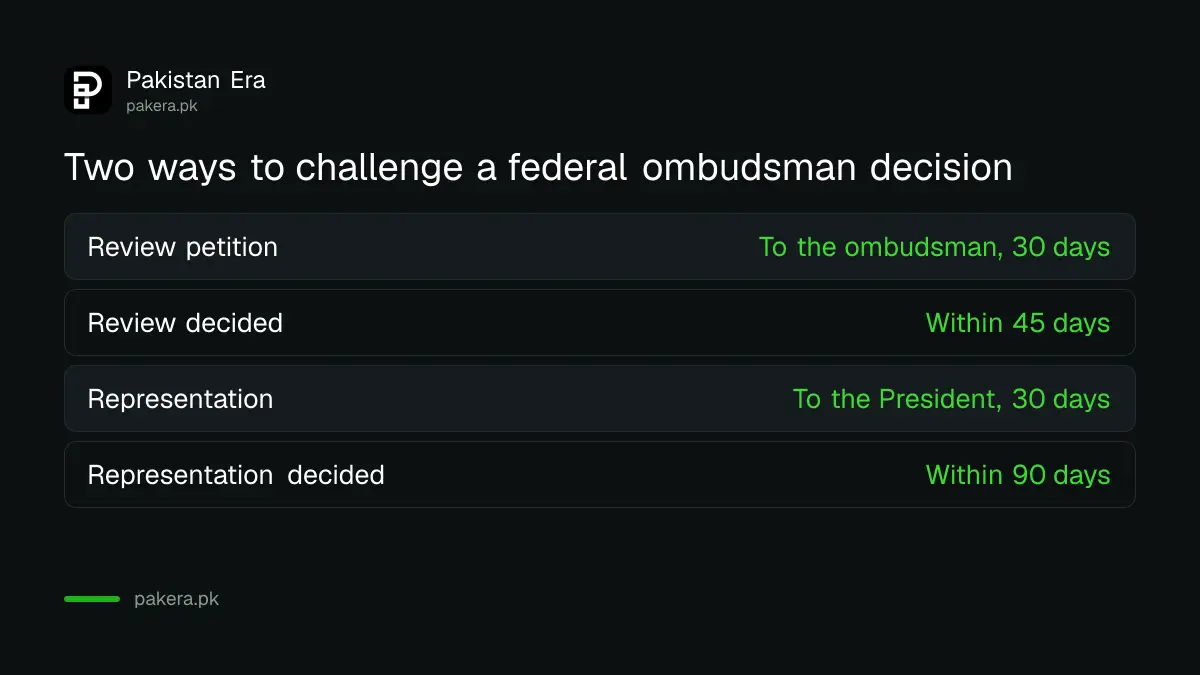
Within 30 days of the ombudsman's decision you can ask the same ombudsman to review it, or send a representation to the President. A review is decided within 45 days. A representation is decided within 90 days.
| Option | Time to file | Who decides | Time to decide |
|---|---|---|---|
| Review petition | 30 days from the decision | The same ombudsman | 45 days |
| Representation | 30 days from the decision | The President of Pakistan | 90 days |
A review suits a plain mistake, such as a document the ombudsman missed or a wrong figure. Section 13 lets the ombudsman "alter, modify, amend or recall" its own order. A representation suits a real disagreement with the reasoning, because a fresh reviewer looks at it.
The Act does not say whether filing a review stops the 30 day clock for a representation. Do not assume it does. If you plan to go to the President, file within 30 days of the original decision.
Which ombudsman decisions you can take to the President
Section 14 applies to every ombudsman under the 2013 Act. That means the five federal ombudsmen listed in its definition of "relevant legislation". Provincial ombudsmen in Punjab, Sindh, Khyber Pakhtunkhwa and Balochistan follow their own provincial laws instead.
- Wafaqi Mohtasib, for complaints against federal departments such as NADRA, Sui gas companies, power companies and the Post Office. The Wafaqi Mohtasib Order of 1983 also gives a 30 day representation right in Article 32.
- Federal Tax Ombudsman, for complaints against FBR officers.
- Banking Mohtasib, for complaints against banks.
- Insurance Ombudsman, for refused or delayed insurance claims.
- Federal Ombudsperson for Protection Against Harassment, for workplace harassment cases.
If your case started as a complaint to the Wafaqi Mohtasib, or as a complaint about your bank to the Banking Mohtasib, this is your next step after a decision you think is wrong.
The right is not only for the citizen. The Act says "any person or party aggrieved", so a department or bank that loses can also go to the President. If you won, watch for that. A representation by the other side suspends your order too.
How to file a representation to the President
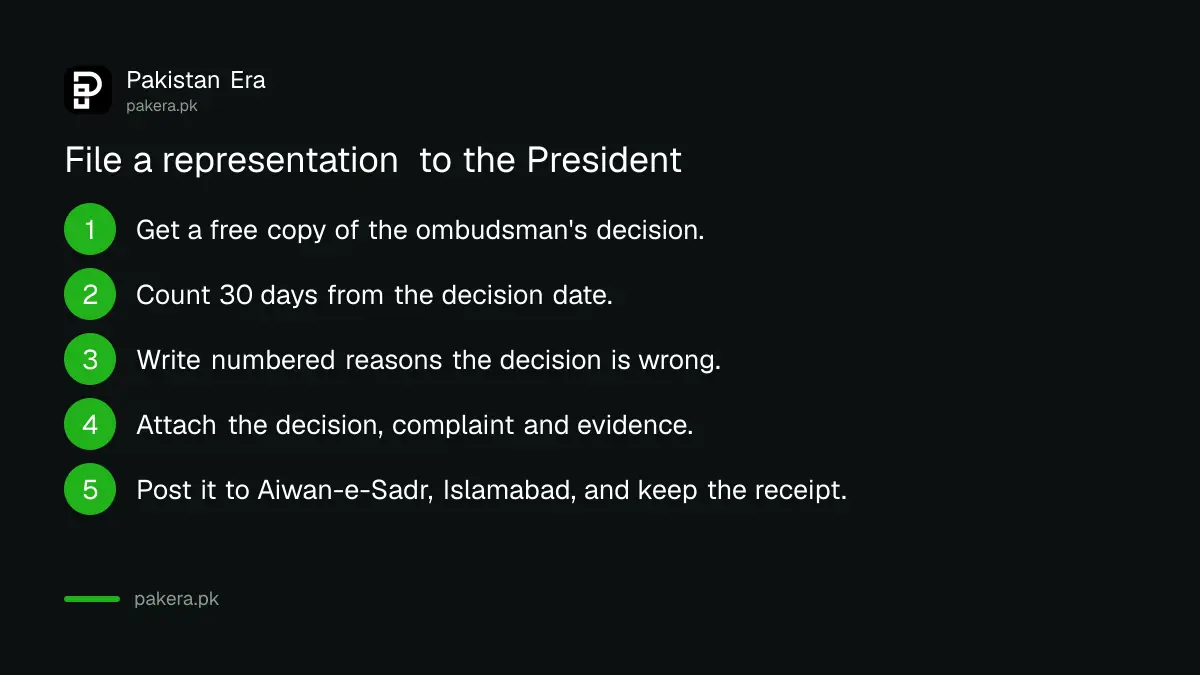
Write a signed representation addressed to the President of Pakistan, attach the ombudsman's decision and your evidence, and send it to the Aiwan-e-Sadr in Islamabad within 30 days. Section 14(3) says it must go "directly to the President and not through any Ministry, Division or Department".
- Get a copy of the decision. Section 16 says the ombudsman must give the parties free copies of its findings within 15 days of the decision. Ask for it if it has not arrived.
- Mark your deadline. Count 30 days from the date of the decision, not from the day you received it. If the copy came late, say so in your representation.
- Write the representation. Give your name, CNIC, contact details, the ombudsman's name and complaint number, and the date of the decision. Then explain in numbered points why the decision is wrong.
- Attach the papers. The decision, your original complaint, the agency's reply and any evidence the ombudsman ignored.
- Send it to the President. Address it to the President of Pakistan, Aiwan-e-Sadr, Islamabad. Use registered post or courier and keep the receipt, because it proves the filing date.
We found no official representation form or fee on the President's website. The Act sets no fee. The President's contacts page lists dg_coord2@president.gov.pk for public complaints and grievances, and the exchange on 051-9010100. Emailing a copy as well as posting the original is sensible, but the Act does not say email alone is enough.
What happens after you file
The ombudsman's order is suspended for 60 days. A legal expert in the President's office examines the case, often without a hearing. The President must decide within 90 days, and can accept, change or reject the ombudsman's order.
Section 14(4) says the person who processes it must be qualified to be a Supreme Court judge, or must have been Wafaqi Mohtasib or Federal Tax Ombudsman. At present that work sits with Justice (retired) Irfan Qadir, the President's Consultant for Legal Affairs, who presented the 6,000 representation report on 8 October.
Section 15 says neither the President nor the ombudsman has to give a personal hearing. Cases can be decided on the record and the agency's written comments. So your written representation is probably your only chance to make your case. Put everything in it.
There is a hopeful sign here. The President's office said on 8 October that most recent decisions were "pronounced in the presence of the concerned parties". That is a practice, not a right, so do not rely on it.
Mistakes that sink a representation
Late filing is the biggest one. The 30 days run from the decision date. Sending it through the ministry that runs the agency is another, because the Act forbids that route. And repeating the original complaint without saying where the ombudsman went wrong wastes the reviewer's time.
Be specific. "The ombudsman ignored my receipt dated 3 March, attached as Annex B" is far stronger than "the decision is unjust". Keep it short, two to four pages, with numbered annexes.
For context on how many people use this system, the Wafaqi Mohtasib alone reported a record 261,101 complaints resolved in 2025. Only a small share reach the President, but those that do get a second, independent look.
Common questions
How many days do I have to file a representation against an ombudsman decision?
30 days from the date of the decision, under section 14(1) of the Federal Ombudsmen Institutional Reforms Act, 2013.
Is there a fee for a representation to the President?
The Act sets no fee, and we found none on the President's website. You only pay your own postage and any lawyer you choose to hire.
Does a representation stop the ombudsman's order?
Yes, for 60 days, if it is filed within the 30 day limit.
How long does the President take to decide?
The Act says a representation shall be decided within 90 days.
Can I file a representation against a provincial ombudsman's decision?
Not under this Act. Provincial ombudsmen follow provincial laws, which set their own appeal routes.
Do I need a lawyer to file a representation?
No. The Act does not require one, though a lawyer can help in a complex tax or banking case.
How we verified this
What we checked, where we read it, and what we could not confirm.
Last checked 10 October 2026, about 8:30 pm PKT. The 30, 45, 60 and 90 day rules, the direct filing rule, the reviewer's qualifications, the no hearing rule and the free copy rule are from sections 13 to 16 of the Federal Ombudsmen Institutional Reforms Act, 2013, and Article 32 of the Wafaqi Mohtasib Order, 1983, both on Pakistan Code. The 6,000 representations figure is from the President's office release of 8 October 2026, carried as PID PR No. 96. Contact details are from the President of Pakistan contacts page.
About the author

Tax, Bills and Technology Writer
Ali Akhtar is a young and curious voice here at Pakistan Era. He is currently pursuing his A-Levels and has a growing interest in Pakistan’s changing industrial landscape and educational trends. Ali likes to write in a way that helps him explain and explore the world around him. His writing reflects the perspective of the new generation navigating the evolving trends of Pakistan where technology, youth innovation, and shifting opportunities are reshaping the country’s future.