How to File a Monthly Sales Tax Return
Sales tax is filed every month, including a null return. The annexure sequence, why input tax claims fail, and how it differs from income tax.

A sales tax return is due every month, even in a month where you sold nothing. That is the single thing that catches newly registered businesses. Registration creates a monthly obligation, and a month with no activity needs a null return rather than silence.
Filing is done on FBR's IRIS portal against your sales tax registration number. If you are not yet registered, the documents and the process are covered in our guide to sales tax registration, and this page picks up from the month after that.
The month has more than one deadline
People think of a single filing date. In practice a sales tax month has a sequence, and missing an earlier step blocks a later one.
| Stage | What happens |
|---|---|
| Annexure of purchases and sales | Invoice level data is entered first |
| Supplier declarations | Your purchases depend on suppliers declaring their sales |
| Payment | Tax payable is paid before the return is submitted |
| Return submission | The return itself is filed on IRIS |
| Null month | Still filed, showing no activity |
Reported practice places the annexure stage, the payment and the return submission on different dates in the following month, commonly described as around the tenth, the fifteenth and the eighteenth. We could not read the current dates on an FBR page, so treat those as reported and confirm on IRIS, which shows the applicable due date for your period.
The input tax problem nobody warns you about

Your claim for input tax on purchases depends on your supplier having declared the corresponding sale. If the supplier has not filed, or filed differently, your claim does not match and the credit is not available to you.
That makes your return partly hostage to other people's filing. The practical response is to check the position before the deadline rather than on the day, and to chase suppliers who are late. Keep the invoice, keep the payment evidence, and deal with a mismatch as a supplier conversation rather than a filing problem, because the filing cannot fix it.
Filing it, in order
- Log in to IRIS with your registration credentials.
- Open the sales tax return for the correct tax period.
- Complete the purchase and sales annexures with invoice level detail.
- Reconcile what appears against your own records before going further.
- Pay any tax payable, then submit the return and save the acknowledgement.
Save the acknowledgement every month. A return you cannot evidence is a return you may be asked to prove, and the acknowledgement is the cheapest proof there is.
A null return is a real filing
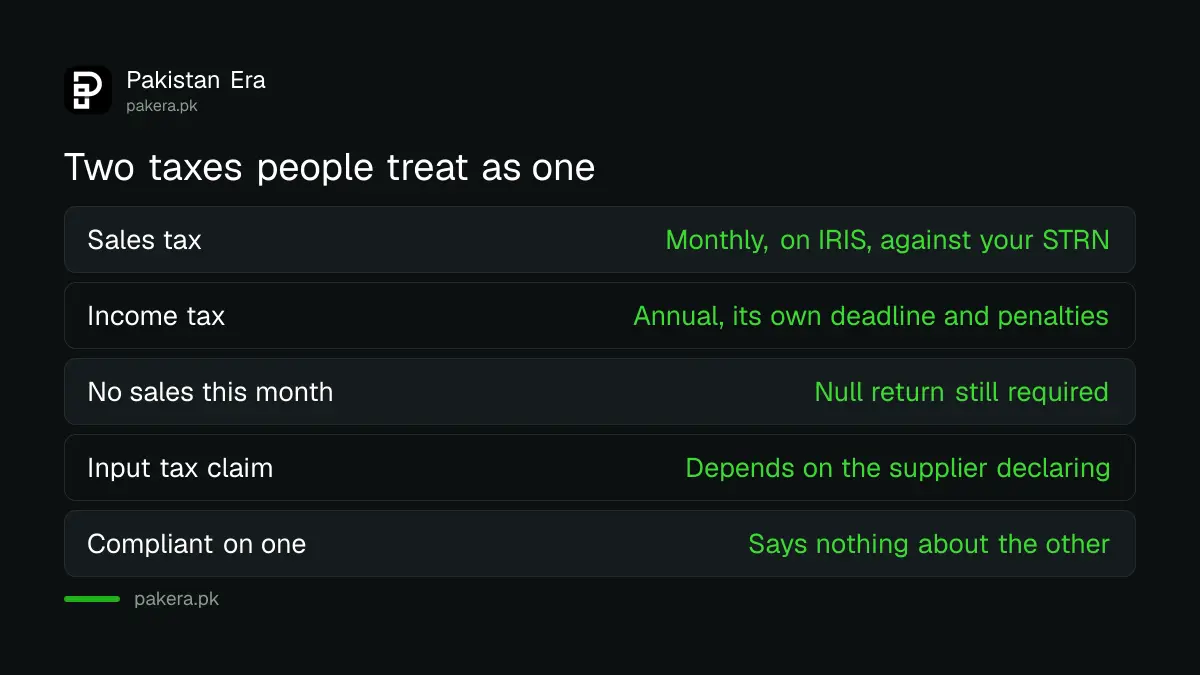
If the business made no taxable supplies in the month, file showing that. Not filing is not the same as filing nothing, and the consequences of the two are completely different.
Businesses that pause, or that registered ahead of trading, accumulate months of non filing without noticing, and then face the cost of catching up. If a business genuinely has no future activity, deal with that properly rather than by going quiet, because an inactive registration keeps generating obligations.
Sales tax and income tax are separate obligations
Filing sales tax monthly does not satisfy your income tax return, and filing an income tax return does not cover sales tax. They are different taxes with different periods and different consequences.
The income tax side has its own annual deadline and its own penalties, and we cover it in our guide to filing an income tax return and in our page on the late filing surcharge. Being current on one and absent on the other is a common and expensive position.
Get help before the arrears build
Monthly compliance is the part small businesses underestimate. Twelve returns a year, each with invoice level data and a dependency on suppliers, is a real workload, and the cost of a competent person doing it is usually less than the cost of catching up later.
If you are already behind, deal with it deliberately rather than filing at random. Establish which periods are missing, what the position was in each, and take advice on the order to fix them. Verifying your own registration details is a reasonable first step, and verifying an NTN covers that check.
Common questions about the sales tax return
Do I have to file if I had no sales?
Yes. File a null return showing no activity. Not filing at all is treated differently and worse.
When is the return due?
Reported practice places the annexures, the payment and the return on different dates in the following month, commonly around the tenth, fifteenth and eighteenth. Confirm the date shown on IRIS for your period.
Why is my input tax not showing?
Usually because the supplier has not declared the corresponding sale, or declared it differently. Chase the supplier, since the filing cannot repair a mismatch on its own.
Is this the same as my income tax return?
No. They are separate taxes with separate periods and penalties. Being compliant on one says nothing about the other.
Can I file it myself?
Many businesses do. Whether you should depends on the volume of invoices and how comfortable you are reconciling annexures against supplier declarations each month.
How we verified this
What we checked, where we read it, and what we could not confirm.
Last checked 26 August 2026. We did not read the current sales tax return due dates, the annexure deadlines or the null return requirement on an FBR page on that date, so the sequence and the dates described here are reported and marked so in the body, and the page directs the reader to the due date shown on IRIS for their own period rather than to our figures. No penalty amount is quoted for the same reason. This is general information about a compliance obligation and not tax advice, and a business with arrears should take professional help rather than filing at random.
About the author

Senior Writer, Public Services and Technology
Shahid joined us in 2024 as an author. He is a senior contributor to Pakistan's leading technology websites. He writes detailed articles, mostly covering his expertise in the latest tech, mobiles, apps, gadgets, and step-by-step guides. His ideology is to help people understand the latest trends and explain complex methods through very easy-to-understand guides.