How a Street Vendor Gets a Legal License in Pakistan
A street vendor needs a license from the local Metropolitan or Municipal Corporation. Islamabad's own licensing scheme, the fee, and why vending without one.
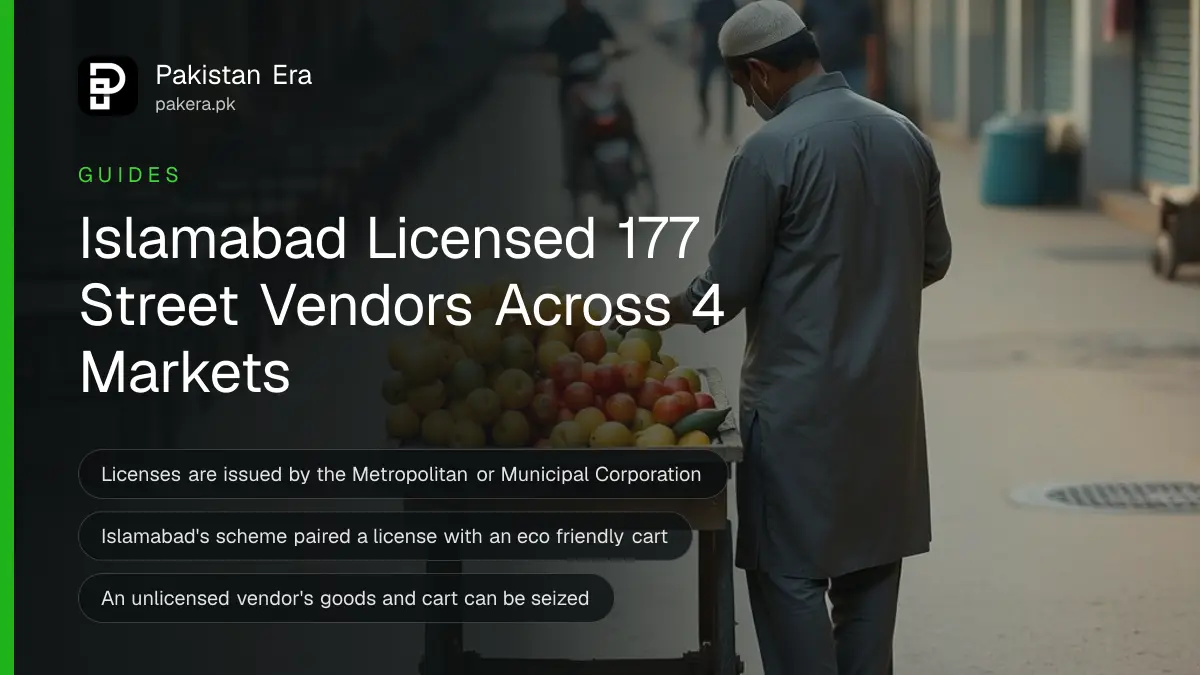
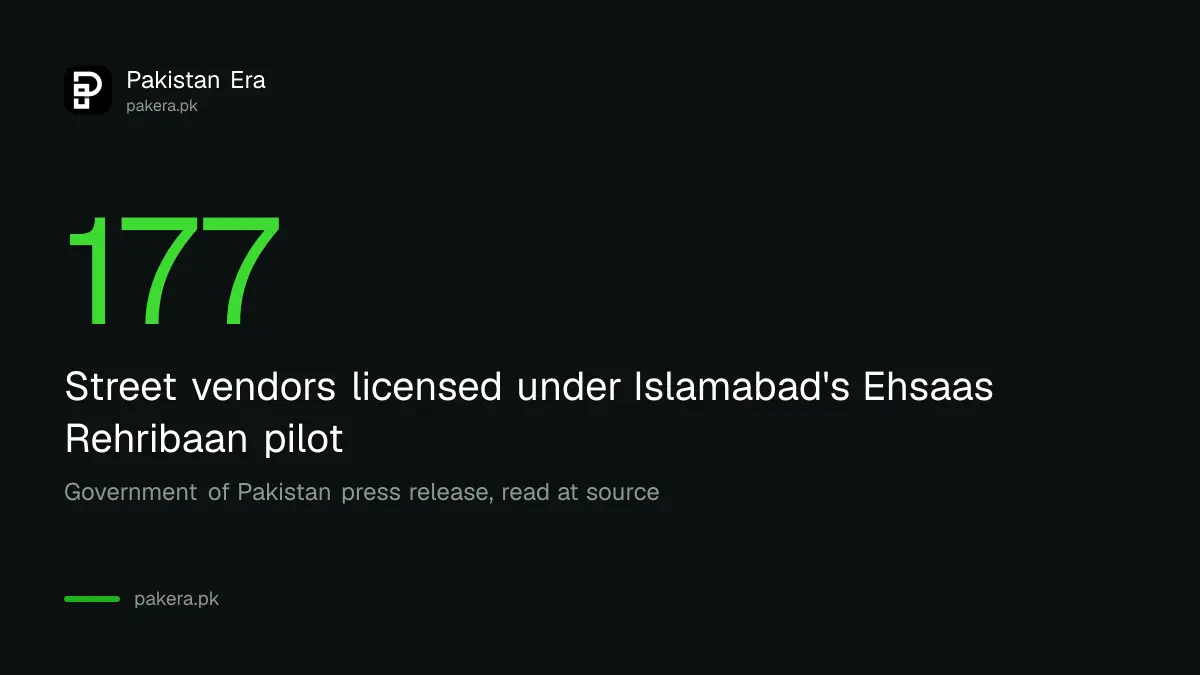
A street vendor needs a license from the local Metropolitan Corporation, Municipal Corporation or Cantonment Board, not from any federal office. In Islamabad, the Metropolitan Corporation Islamabad has already licensed around 177 vendors across 4 markets under the Ehsaas Rehribaan scheme, pairing the license with an eco friendly cart. The authority, the paperwork and the fee differ from one city to the next, because street vending is regulated at the municipal and provincial level, so a vendor in Lahore or Karachi has to check their own city's corporation rather than assume Islamabad's process applies everywhere.
We read the Government of Pakistan's own press release on the Islamabad licensing drive before writing this, since a lot of what circulates about street vendor licensing online is either a general news summary or advice written for a different country altogether. What follows is grounded in one real, working scheme, with the honest caveat that your own city may run it differently.
Licensing sits with the city, not with any national office
There is no single federal body that issues a street vendor license for all of Pakistan. The authority is local: a Metropolitan Corporation in a provincial capital, a Municipal Corporation or Committee in a smaller city, or a Cantonment Board in a cantonment area. Each of these runs its own licensing rules, fees and allotted vending zones under its own by-laws.
That means the honest first step for any vendor is finding out which of these bodies actually covers the street or market they work in, since a cart parked just across a boundary line can fall under a completely different authority with a different process.
Islamabad's own scheme pairs a license with a cart
Islamabad is the one city where the current scheme is documented in enough detail to describe properly. The Metropolitan Corporation Islamabad, working with the Capital Development Authority and the Ehsaas Rehribaan programme, has issued vending licenses to street vendors in phases, alongside a new eco friendly cart with a solar fitting.
| What the scheme covered | Figure |
|---|---|
| Vendors licensed in the documented phase | About 177, across 4 markets |
| License fees collected in that phase | Rs 3.5 million, combined across vendors |
| Capital investment generated | Rs 17.5 million |
| Cart loans arranged through microfinance banks | Rs 11.5 million |
A vendor who could not pay for a cart outright was linked to a microfinance bank for a loan rather than being turned away. That is a detail worth knowing if cost is the thing stopping someone from applying: the scheme was built around vendors who do not have spare capital sitting around, not around ones who already do.
The general steps carry across most cities, even where the names differ
We could not find a single published, step by step checklist on a current city website, so the steps below describe the shape of the process as it runs in practice, rather than quoting one city's exact form.
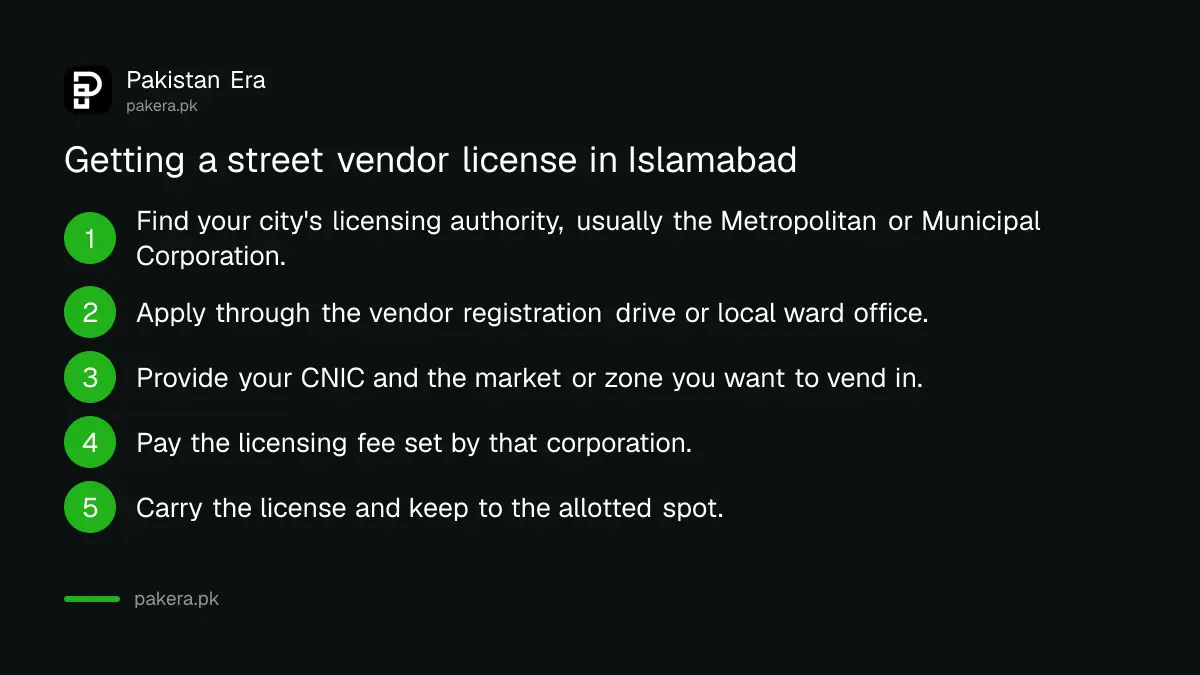
- Identify your city's licensing authority, whether that is a Metropolitan Corporation, a Municipal Corporation or a Cantonment Board.
- Apply through a vendor registration drive or your local ward office, since many cities run these as periodic drives rather than a year round open counter.
- Provide your CNIC and name the specific market, street or zone you intend to vend in.
- Pay the licensing fee set by that corporation, which varies by city and is not a single national figure.
- Keep to your allotted spot once licensed, since the license is usually tied to one vendor and one location or cart.
A newer provincial law is pushing registration further
Khyber Pakhtunkhwa's provincial assembly passed a dedicated street vendor registration bill in 2026, aimed at bringing vendors across the province under a formal registration system rather than leaving licensing to scattered municipal practice. We confirmed the bill's passage, its number and the department that moved it on the assembly's own records, but we could not read its full operative text in this session, so we are not stating its specific fee, age or penalty provisions here as confirmed fact. A vendor in Khyber Pakhtunkhwa should ask their local government office which rules are now in force under that law, rather than relying on whatever figure is being shared informally.
This points at a wider direction: more cities and provinces are moving street vending from an informal, tolerated activity into a formally licensed one, which is also why checking the current rule locally matters more than ever.
Vending without a license carries real risk
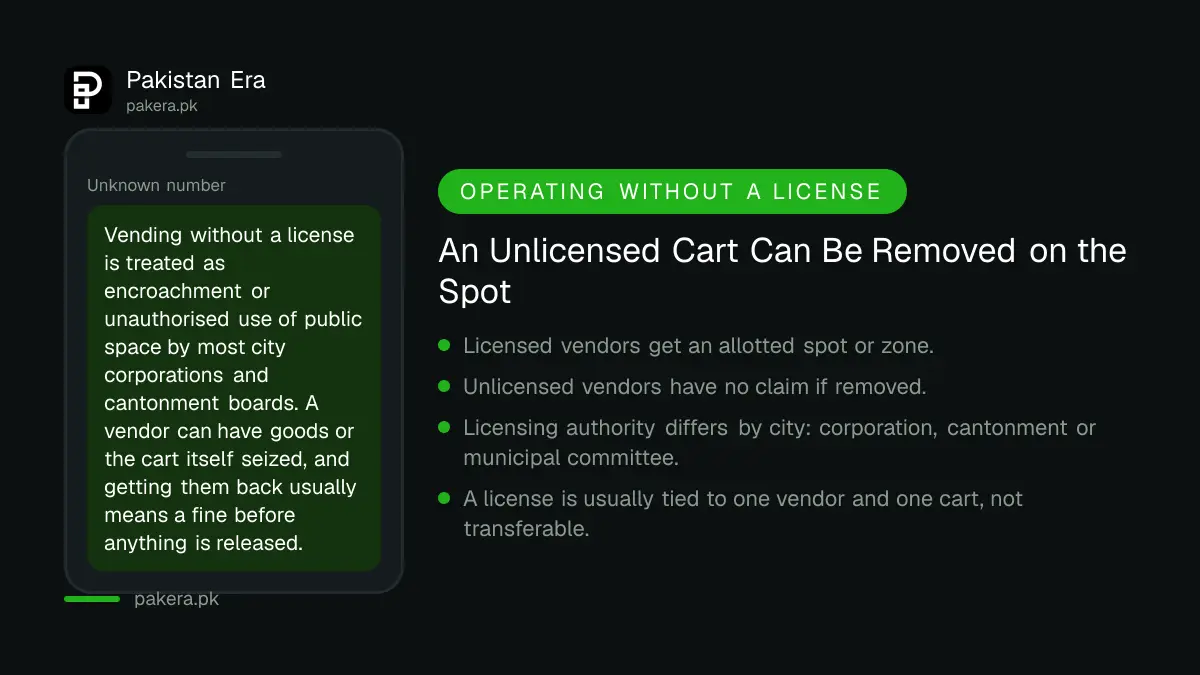
An unlicensed vendor has no legal claim to the spot they work from. Most city corporations and cantonment boards treat unlicensed vending as encroachment on public space, which means goods or the cart itself can be removed by enforcement staff without much warning.
Getting a seized cart or stock back is rarely free. It usually means a fine paid to the corporation before anything is released, on top of the lost trading days while the dispute is sorted out. A license, even where the fee feels like an extra cost upfront, removes that constant risk and gives the vendor a spot nobody else can claim ahead of them.
A registered vendor also sits on firmer ground if a dispute ever comes up with another vendor over the same patch of street, since the license itself is the proof of who was allotted that spot. This kind of formal licensing runs alongside the wider system of business registration with the local council that shopkeepers and other small traders go through for the same reason: a paper record nobody can argue with later.
Common questions
Who issues a street vendor license in Pakistan?
The local Metropolitan Corporation, Municipal Corporation or Cantonment Board, depending on the city. There is no single national licensing office.
Does the licensing process work the same in every city?
No. Fees, forms and the allotted zones differ by city, because street vending is regulated at the municipal and provincial level.
What did Islamabad's vendor licensing scheme cover?
Around 177 vendors across 4 markets were licensed under the Ehsaas Rehribaan programme, each paired with a new eco friendly cart.
What happens if a vendor operates without a license?
The goods or cart can be treated as encroachment and removed, and getting them back usually requires paying a fine to the corporation.
Can a vendor who cannot afford a cart still get licensed in Islamabad's scheme?
The scheme linked such vendors to microfinance banks for cart loans rather than requiring the full cost upfront.
Is there a provincial law specifically for street vendors?
Khyber Pakhtunkhwa's assembly passed a dedicated vendor registration bill in 2026. Check with your local government office for the rules now in force.
How we verified this
What we checked, where we read it, and what we could not confirm.
Last checked on 5 October 2026. We read the Government of Pakistan Press Information Department's own release on the Ehsaas Rehribaan conference for the Islamabad licensing figures, cart financing and the banks involved. We confirmed Khyber Pakhtunkhwa's street vendor registration bill directly on the provincial assembly's own records for its passage date, number and sponsoring department, but could not read its operative provisions in full in this session. We did not find a single current, published step by step vendor licensing checklist for any city in this session, so the process steps above describe the general shape of how it runs rather than one city's exact form; confirm the current fee and paperwork with your own city's corporation or cantonment board before applying.
About the author

Senior Writer, Public Services and Technology
Shahid joined us in 2024 as an author. He is a senior contributor to Pakistan's leading technology websites. He writes detailed articles, mostly covering his expertise in the latest tech, mobiles, apps, gadgets, and step-by-step guides. His ideology is to help people understand the latest trends and explain complex methods through very easy-to-understand guides.