How to Check Your Restaurant or BBQ Suction Hood in Punjab Under the EPA Pre-Smog Plan 2026
Punjab's EPA listed suction hoods for open kitchens and BBQ outlets in its 5 July 2026 order. See what it says, what it omits and how to check yours today.
Short answer: Punjab's Environmental Protection Agency (EPA) listed "suction hoods in restaurants with open kitchens and BBQ outlets" as an action in its Pre-Smog Action Plan 2026. The order is dated 5 July 2026. Field officers were told to ensure it by 30 July. Owners should check their hood, duct and filter before inspectors visit.
Smoke from grills and tandoors is easy to see on a Lahore or Faisalabad evening. The smoke from a BBQ outlet does not look like much next to a brick kiln, but it adds up in a street full of grills. The EPA has put it on a written list.
We read the EPA Punjab order on 13 October 2026. This page explains what the order says, what it leaves unsaid, and what a sensible owner can do now.
The EPA named open kitchens and BBQ outlets in its plan
The order is numbered 507/PA/DG/EPA/2026 and signed by the Director General of EPA Punjab. It is issued under Section 6(1)(t) with Section 5(4) of the Punjab Environmental Protection Act, 1997. Item 19 says: ensure suction hoods in restaurants with open kitchens and BBQ outlets.
The responsible officers are the Deputy Directors and Assistant Directors (Field). The timeline in the plan is 30 July. The plan covers July to September 2026, the months before the smog season.
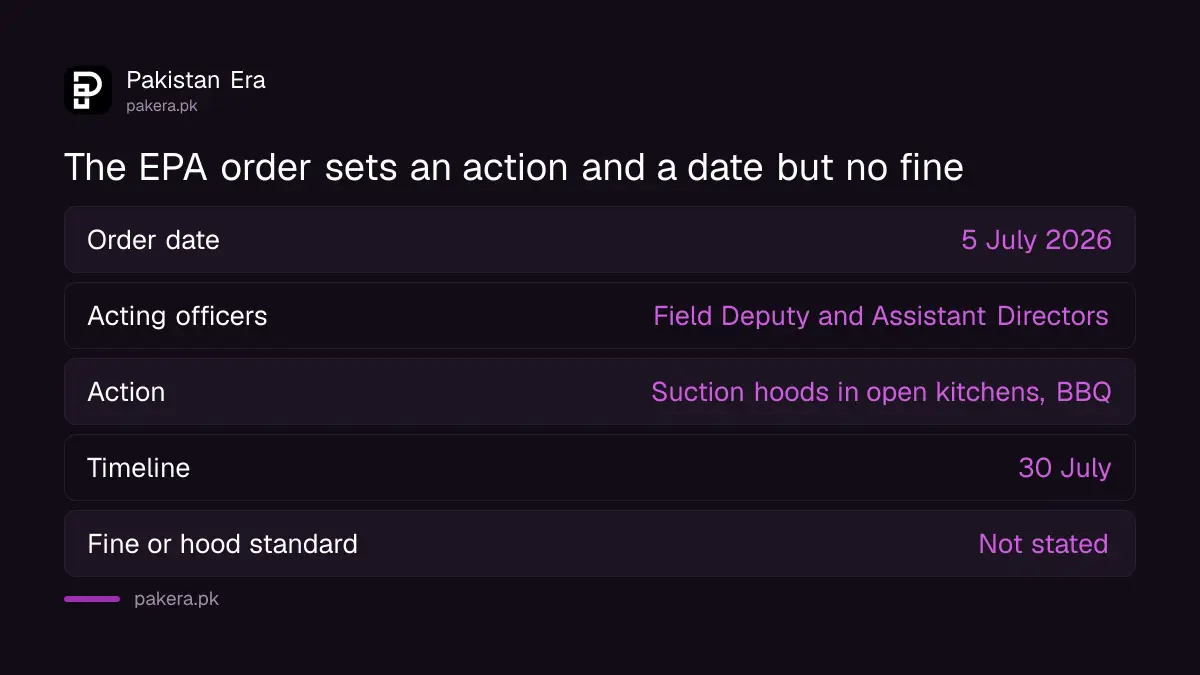
The order does not set a fine or a hood standard
The plan is a list of actions with an officer and a date. It does not give a hood size, a filter type, a stack height or a penalty for restaurants. We found no separate notice on those points in the files we read.
That matters. If someone tells you a fixed fine applies to your outlet, ask for the notice in writing. The Punjab Environmental Protection Act, 1997 and the Smog Rules are the laws behind the plan, and the plan mentions both when it talks about notices to industry.
| Point | What the order says |
|---|---|
| Date of order | 5 July 2026 |
| Who is told to act | Deputy Directors and Assistant Directors (Field) |
| Action | Ensure suction hoods in restaurants with open kitchens and BBQ outlets |
| Timeline | 30 July |
| Fine or hood standard | Not stated in the order |
Check your hood, duct and filter before an inspection
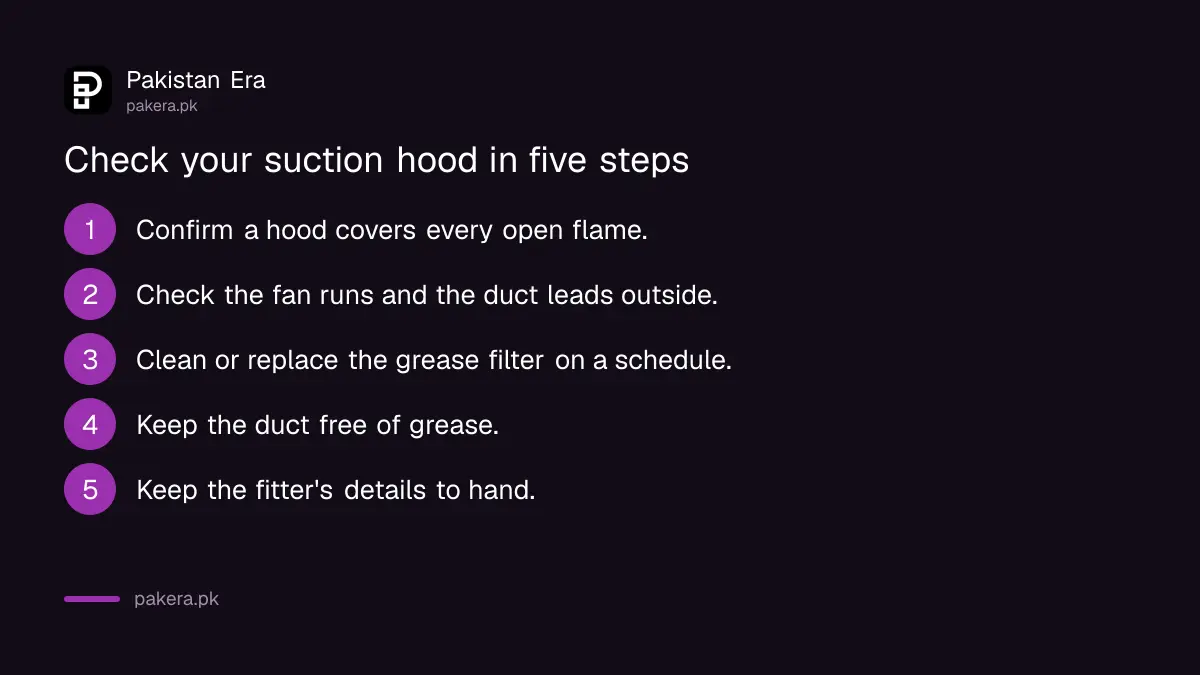
A suction hood pulls smoke and grease from the grill and sends it through a duct. A filter catches some grease. If any part is missing or blocked, the smoke goes into the street. The steps below are our practical suggestions, not EPA requirements.
- Look at the grill area. Is there a hood over every open flame, tandoor or BBQ station?
- Check that the fan runs when the grill is lit and that the duct leads out, not back into the room.
- Clean or replace the grease filter on a fixed schedule and write the date down.
- Keep the duct clear of grease build-up, which is also a fire risk.
- Keep a note of the maker or fitter in case an officer asks.
Fuel counts too. Burning clean charcoal or gas gives less smoke than burning wet wood or waste. The EPA plan separately lists inspections of approved fuel at factories, which shows how much the agency cares about what is burnt.
If you get a notice, read it and keep a reply
A notice from an EPA field officer should say which rule you are accused of breaking and give you time to respond. Read it fully and reply in writing before the date. Keep a copy.
The plan itself tells field officers to issue pre-smog notices under the Act and the Smog Rules to industries and brick kilns, with a date of 15 August. Restaurants are a separate line. If a notice names a different law, ask the officer to explain it.
If you are unsure what applies to you, contact your district EPA office. The order lists Deputy Directors and Assistant Directors (Field) by district, and the office can tell you what is expected of an outlet your size.
Neighbours can report smoke and you can report others
The same department takes complaints about smoking kilns, factories and open burning. If a grill outlet near you fills the street with smoke, the same channels apply. The steps for sending a useful report are in the page on how to report a smoking kiln or factory in Punjab.
For what smog means for your family, read about the Punjab smog season and what actually protects you. On bad air days the live Punjab AQI page shows the numbers.
What we could not confirm
We did not find a fresh October to December order that repeats or changes the hood item. The plan we read covers July to September. EPA Punjab may issue another plan for the main smog months, and its rules may differ.
We also did not test whether inspections of restaurants have taken place. The order tells officers to ensure the hoods but does not report results.
Common questions
Do all Punjab restaurants need a suction hood?
The order names restaurants with open kitchens and BBQ outlets. It does not say it applies to every restaurant.
What is the fine for not having a hood?
The order we read states no fine. Ask for any notice in writing before you accept a figure.
Who checks the hoods?
The order gives the task to the Deputy Directors and Assistant Directors (Field) of EPA Punjab.
Was there a deadline?
Yes, 30 July 2026 for this item. The plan covers July to September 2026.
Which law is behind the plan?
The order is issued under Section 6(1)(t) and Section 5(4) of the Punjab Environmental Protection Act, 1997.
Does this apply in Sindh or Islamabad?
No. It is a Punjab order. Other provinces and Islamabad have their own agencies and rules.
How we verified this
What we checked, where we read it, and what we could not confirm.
Last checked on 13 October 2026, Pakistan time. We read EPA Punjab's Pre-Smog Action Plan 2026 order on the Environment Protection Department website. We read item 19 and the sections on notices and fuel. We did not test an inspection or file a complaint.
About the author

Tax, Bills and Technology Writer
Ali Akhtar is a young and curious voice here at Pakistan Era. He is currently pursuing his A-Levels and has a growing interest in Pakistan’s changing industrial landscape and educational trends. Ali likes to write in a way that helps him explain and explore the world around him. His writing reflects the perspective of the new generation navigating the evolving trends of Pakistan where technology, youth innovation, and shifting opportunities are reshaping the country’s future.