Smog Season in Punjab: What Actually Protects You
Smog is pollution, not fog, and it does not lift at mid morning. What helps indoors, what masks do, and who is most at risk.
Smog is not thick fog. It is pollution, it does not lift at mid morning, and the thing that protects you indoors is closing windows rather than opening them.
Punjab's smog season runs roughly from late October into January, and the advice that works for fog is close to useless against it.
The difference that changes what you do
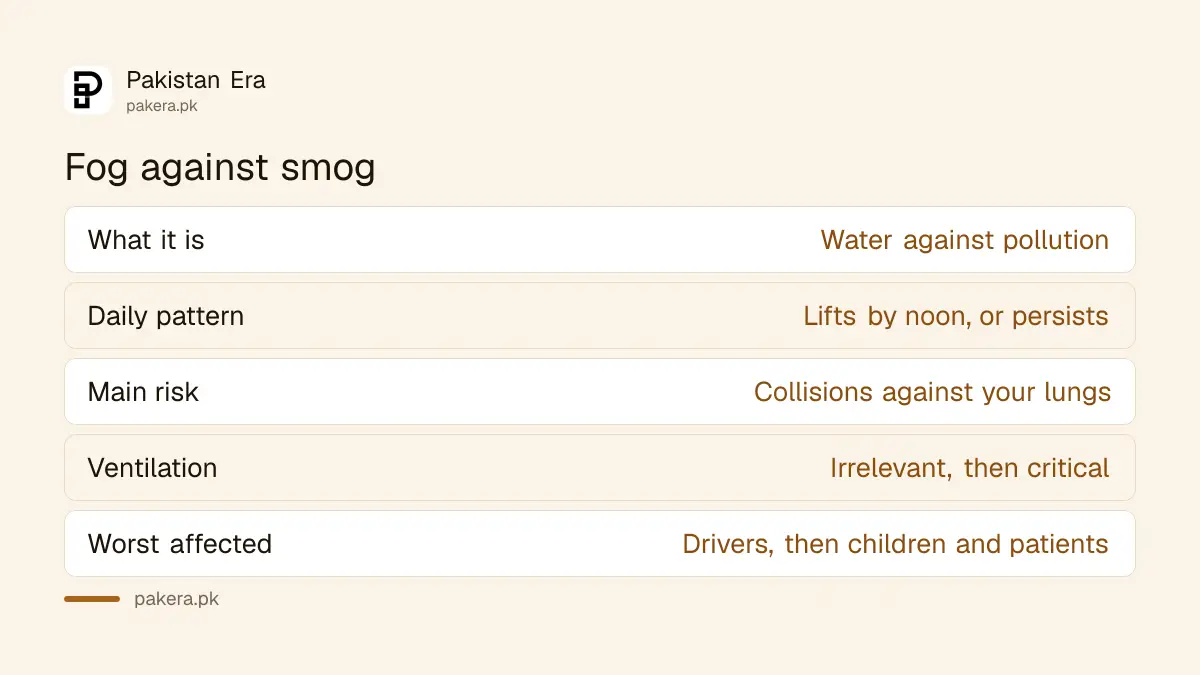
| Fog | Smog | |
|---|---|---|
| What it is | Water droplets | Pollution held near the ground |
| Daily pattern | Forms overnight, lifts late morning | Can persist all day for weeks |
| Main risk | Visibility and collisions | What you breathe |
| Ventilation | Irrelevant | Keep outdoor air out |
| Who is worst affected | Drivers | Children, older people, asthma and heart patients |
Both reduce visibility and both can close roads. Only one of them is a health problem that continues while you sit at home.
Our guide to fog and motorway closures covers the driving side, including why an early departure is usually the wrong choice.
Why Lahore in winter
Three things arrive together. Emissions from traffic, industry and brick kilns continue as usual. Crop residue burning adds to them across the plain. And winter weather traps the lot.
That last part is the one people miss. In cold, still conditions a layer of warmer air can sit above cooler air near the ground and act as a lid, so pollution that would normally disperse upward simply accumulates. Without wind or rain it stays until the weather changes.
It is why smog can be worse on a calm, bright winter day than on a windy one, and why it does not clear on the schedule fog does.
What actually helps at home
Most of the advice that circulates is either useless or backwards.
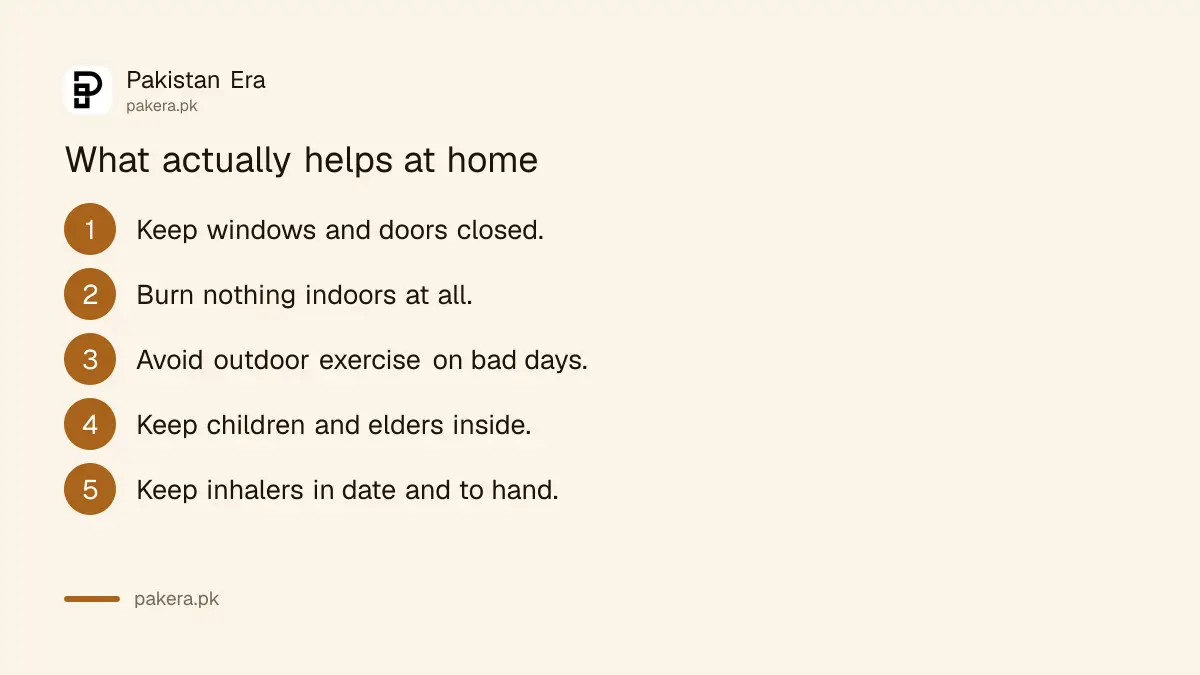
- Keep windows and doors closed on bad days, including at night.
- Do not burn anything indoors, including wood, coal or rubbish.
- Avoid outdoor exercise while air quality is poor.
- Keep children and older relatives indoors on the worst days.
- Keep asthma inhalers and heart medication in date and to hand.
Opening windows to let fresh air in is the instinct, and in smog it is the wrong one. The air outside is the problem.
A dust mask or surgical mask does very little against the fine particles that matter. If you are buying protection, look for a proper fitted respirator rather than a cloth or paper mask, and understand that a mask worn loosely does close to nothing.
For indoor air, our guide to choosing an air purifier for smog covers what to look for and what the claims mean.
Who should take it most seriously
Fine particles reach deep into the lungs and, for some people, that matters far more than for others.
Children breathe faster relative to their size and their lungs are still developing. Older people and anyone with asthma, chronic lung disease or a heart condition are at greater risk of their existing condition worsening. Pregnant women are also usually advised to limit exposure.
If somebody in the household has asthma, treat the start of smog season as a prompt to check the inhaler supply and the action plan before the first bad week, not during it.
School closures and restrictions
Provincial governments have responded to bad smog with school closures, changes to working hours, restrictions on certain industries and brick kilns, and action against crop residue burning.
Those decisions are made by the provincial government and its environmental protection department, and they are announced at short notice. A closure applies to named districts, so check whether yours is on the list rather than reading a headline about Punjab.
Our guide to where to get the official weather forecast covers the meteorological side, though air quality decisions come from the province rather than from PMD.
Reading an air quality number
Air quality indices are widely quoted during smog season and rarely explained.
The number is a scale, not a concentration, and different apps can show different figures for the same city because they use different monitoring points and sometimes different scales. A reading from a sensor on the other side of a large city may not describe your street.
Treat the trend and the category as useful, and the precise figure as approximate. If two sources disagree sharply, the sensible response is to act on the worse of them rather than to pick the one you prefer.
If breathing gets difficult
Smog turns a manageable condition into an emergency for some people every winter.
Difficulty breathing, chest tightness that does not settle, or a child struggling to speak in full sentences are reasons to seek medical help rather than wait. Our guide to what Rescue 1122 actually does covers the ambulance service, and our list of emergency helpline numbers covers who to call.
Common questions
Is smog the same as fog?
No. Fog is water droplets and lifts as the ground warms. Smog is pollution trapped near the ground and can persist for days or weeks.
Should I open windows to air the house?
Not on a bad smog day. The outdoor air is the source of the problem, so keep it out.
Does a surgical mask help?
Very little against fine particles. A properly fitted respirator is what makes a difference, and fit matters as much as the mask.
Why is it worse on calm days?
Still, cold conditions can trap pollution near the ground, so it accumulates instead of dispersing.
Who announces school closures?
The provincial government, usually for named districts. Check whether your district is listed.
Why do air quality apps disagree?
They use different monitoring points and sometimes different scales. Use the category and trend rather than the precise number.
How we verified this
What we checked, where we read it, and what we could not confirm.
Last checked 4 September 2026. This guide is written ahead of the smog season rather than during it, and it deliberately quotes no air quality reading, closure or restriction, because those change daily and only the issuing authority is current for them. The description of the causes of Punjab's winter smog, the role of winter weather conditions in trapping pollution near the ground, the health guidance on ventilation, masks, outdoor exercise and higher risk groups, and the explanation of air quality indices, reflect general public health understanding of particulate pollution rather than a specific Pakistani document we have quoted, and none of it is medical advice. School closures, working hour changes and restrictions on industry, brick kilns and crop residue burning are decided and announced by provincial governments and their environmental protection departments, so check your own district against the official announcement rather than a headline. If you or a family member has asthma or a heart or lung condition, take advice from your own doctor before the season rather than during a bad week.
About the author

Public Services and Education Journalist
Fajr Riaz is a journalist and content writer at Pakistan Era, based in Lahore. She covers the questions people meet in everyday life in Pakistan: how a public service works, what a change in the rules means, and where to find a reliable answer.