Fog and Motorway Closures in Pakistan: What to Know
Closures come from the motorway police, not the weather office. Why an early start is the wrong call, and what to carry before December.
Dense fog closes Punjab's motorways most winter nights, and the closure is announced by the motorway police, not by the weather office. Two different organisations, two different places to look.
The other thing worth knowing before December: fog forms overnight and burns off late morning, so leaving at five in the morning is usually the worst choice, not the safest.
Who announces what
| You want | Where it comes from |
|---|---|
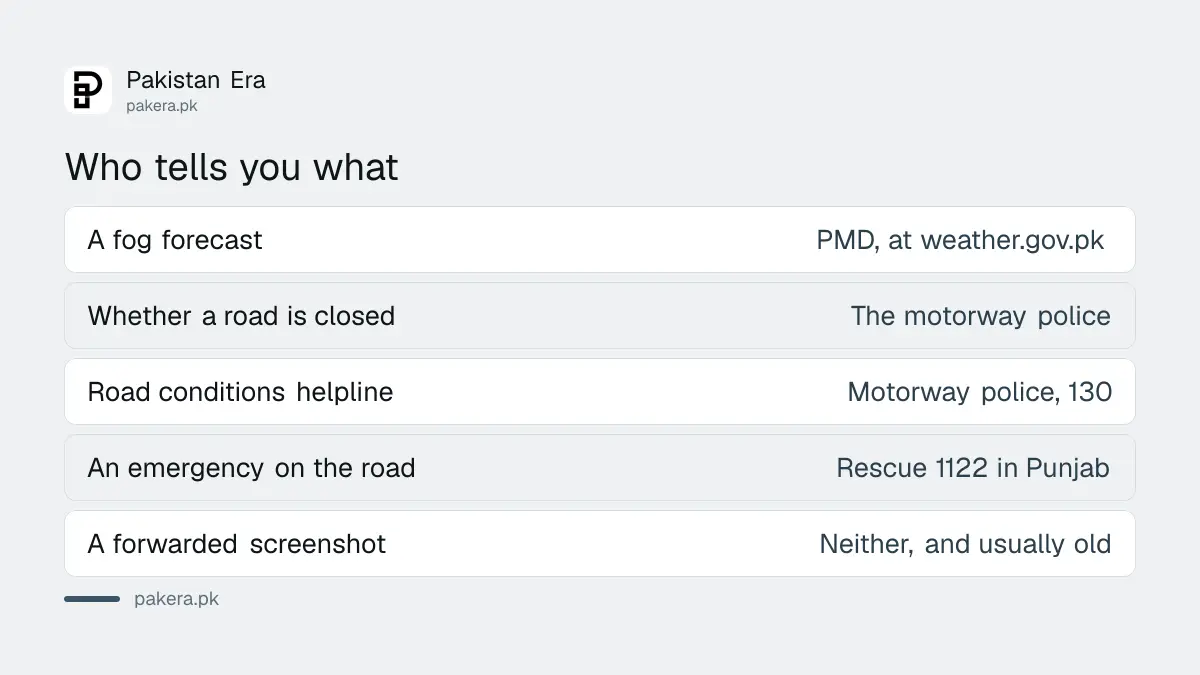
| A fog forecast or warning | Pakistan Meteorological Department, at weather.gov.pk |
| Whether a motorway is closed right now | The National Highways and Motorway Police |
| The helpline for road conditions | Motorway police helpline 130 |
| An emergency on the road | Rescue 1122 in Punjab |
People check the forecast, see no warning, set off, and find the M-2 shut at Kot Momin. The forecast tells you fog is likely. Only the motorway police tell you whether the road is open.
Our guide to where to get the official weather forecast covers the PMD side, including the fact that its live forecasts moved to weather.gov.pk.
Why early morning is the trap
Radiation fog forms on clear, still, cold nights, thickens through the small hours, and is usually at its worst between roughly midnight and just after sunrise. It then lifts as the ground warms.
That means the traditional pre-dawn departure, chosen to avoid traffic, puts you on the road at exactly the wrong time. Leaving at nine or ten in the morning is often both faster and safer in December and January, because you arrive after the road has reopened rather than sitting at a closed toll plaza.
If you must travel overnight, plan for the possibility that you will be stopped and held somewhere for hours, and carry what that implies.
What to do when you hit fog
The instinct most drivers have is the dangerous one.
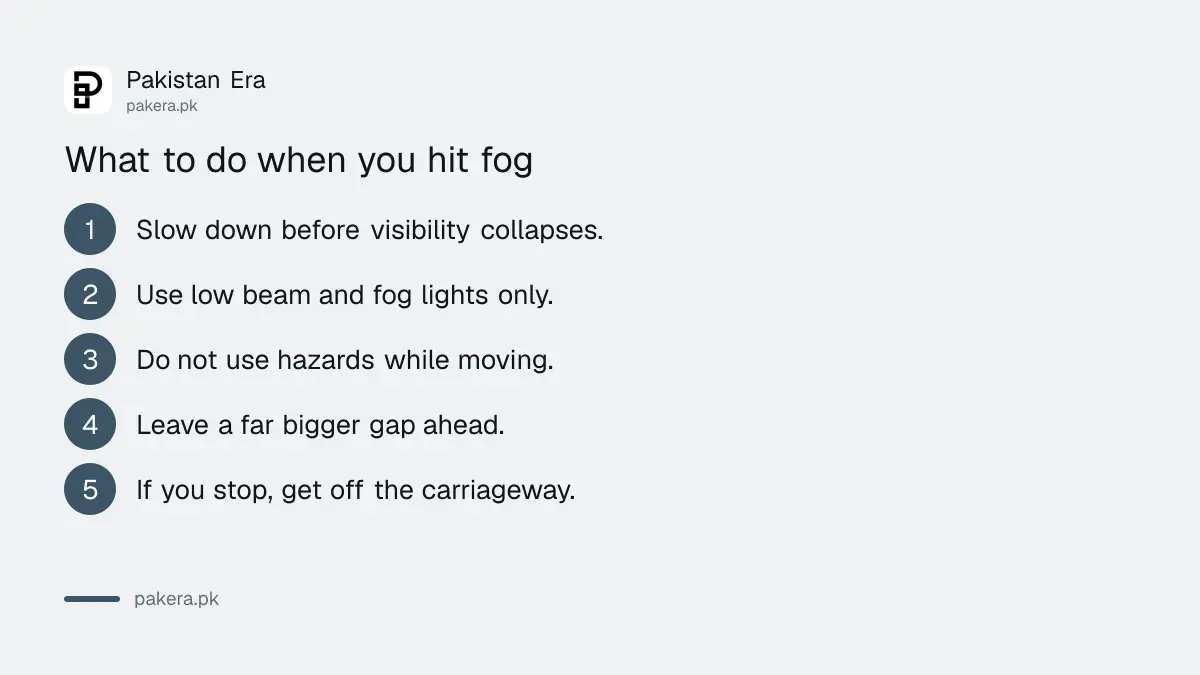
- Slow down early, before visibility collapses.
- Use low beam headlights and fog lights, never full beam.
- Do not use hazard lights while moving, since they hide your indicators.
- Increase the gap to the vehicle ahead far beyond normal.
- If you stop, get right off the carriageway and switch hazards on there.
Full beam reflects off the water droplets and makes visibility worse, not better. And stopping on the hard shoulder in dense fog is how multi vehicle pile-ups start, so keep going to an exit or a service area if you possibly can.
Do not follow the tail lights of the vehicle in front as a guide. If that driver leaves the road, so will you.
Before you leave in winter
A closure can hold you for several hours, sometimes overnight, and the vehicle becomes where you wait.
Take blankets or warm layers, water, food that does not need heating, any medication you take daily, and a fully charged phone with a power bank. Fill the tank before you set off rather than expecting to reach a particular service area, and keep it above half through the journey so that idling for warmth is not a problem.
Tell somebody your route and expected arrival. If you are held, the delay is often longer than the phone battery.
Check the toll and tag before the season
A closure that reopens suddenly produces a queue, and the slowest thing at a reopened plaza is cash payment.
Our guide to getting an M-Tag covers the tag itself, and our page on recharging an M-Tag online covers keeping a balance on it. Our guide to motorway toll rates covers what the journey costs, and there is a separate charge for using the motorway without a working tag, which we cover in the extra toll without an M-Tag.
Sorting the tag in October is easier than discovering the balance is empty in a queue in January.
If there is a crash
Fog crashes are usually multiple vehicle collisions, and what you do in the first minutes matters.
Get people away from the carriageway before anything else, because the next vehicle cannot see the wreck either. Then call for help. Our guide to what Rescue 1122 actually does explains that the same number covers road traffic crashes as well as ambulances, and our list of emergency helpline numbers covers the rest.
Our guide to what to do after a road accident covers the steps afterwards, including what not to admit at the scene.
Smog is a different problem
Winter in Punjab brings both, and they are not the same thing. Fog is water. Smog is pollution, and it lingers through the day rather than lifting at mid morning.
Smog also closes roads and schools, but on air quality grounds rather than visibility alone, and the health advice is different. We cover that separately in our guide to smog season in Punjab.
Common questions
Who announces motorway closures in Pakistan?
The National Highways and Motorway Police, not the weather office. Its helpline is 130.
When is fog worst?
It forms on clear, cold, still nights and is usually thickest from around midnight to shortly after sunrise, lifting as the ground warms.
Should I leave early to avoid delays?
In fog season that often makes it worse. A mid morning departure frequently arrives sooner because the road has reopened.
Should I use full beam headlights in fog?
No. Full beam reflects off the droplets and reduces visibility. Use low beam and fog lights.
Can I use hazard lights while driving in fog?
They hide your indicators and confuse drivers behind. Use them when stopped and off the carriageway.
What should I carry?
Warm layers, water, food, medication, a charged phone and a power bank, and a tank filled before you set off.
How we verified this
What we checked, where we read it, and what we could not confirm.
Last checked 4 September 2026. This guide is written ahead of the fog season rather than during it, and it deliberately quotes no current closure, forecast or warning, because those change hourly and only the issuing body is authoritative for them. That the Pakistan Meteorological Department publishes forecasts, warnings and advisories at weather.gov.pk is taken from PMD's own site, which we read on 3 September 2026. That motorway closures are announced by the National Highways and Motorway Police rather than by PMD, and the motorway police helpline number, are reported rather than read on an official page for this piece, and should be confirmed before you rely on them. The driving guidance on speed, headlights, hazard lights, following distance and stopping reflects standard fog driving practice rather than a specific Pakistani regulation we have quoted. For live conditions on the day you travel, contact the motorway police, and for the forecast use weather.gov.pk.
About the author

Senior Writer, Public Services and Technology
Shahid joined us in 2024 as an author. He is a senior contributor to Pakistan's leading technology websites. He writes detailed articles, mostly covering his expertise in the latest tech, mobiles, apps, gadgets, and step-by-step guides. His ideology is to help people understand the latest trends and explain complex methods through very easy-to-understand guides.