Smog Forecast 2026 in Pakistan: NDMA Sees Low to Moderate Risk in November, Worst Spells in December
NDMA's smog forecast for 2026: low to moderate in the Punjab plains in November, moderate to high in December in Punjab and the Peshawar Valley. See the causes.
The National Disaster Management Authority (NDMA) expects smog risk in the Punjab plains to stay low to moderate in November 2026 and rise to moderate to high in December, when central and northern Punjab, the big urban and industrial corridors and the Peshawar Valley face the longest spells. It says more frequent rain over upper Punjab and Khyber Pakhtunkhwa may make this November's smog less persistent than last year's.
The outlook is part of the NDMA's Disaster Early Warning report for October to December 2026, which we read in full on 1 November. Below is the month-by-month risk, why smog forms where it does, what last year looked like in official numbers, and what you can do on bad days.
Smog risk by month, from the NDMA outlook
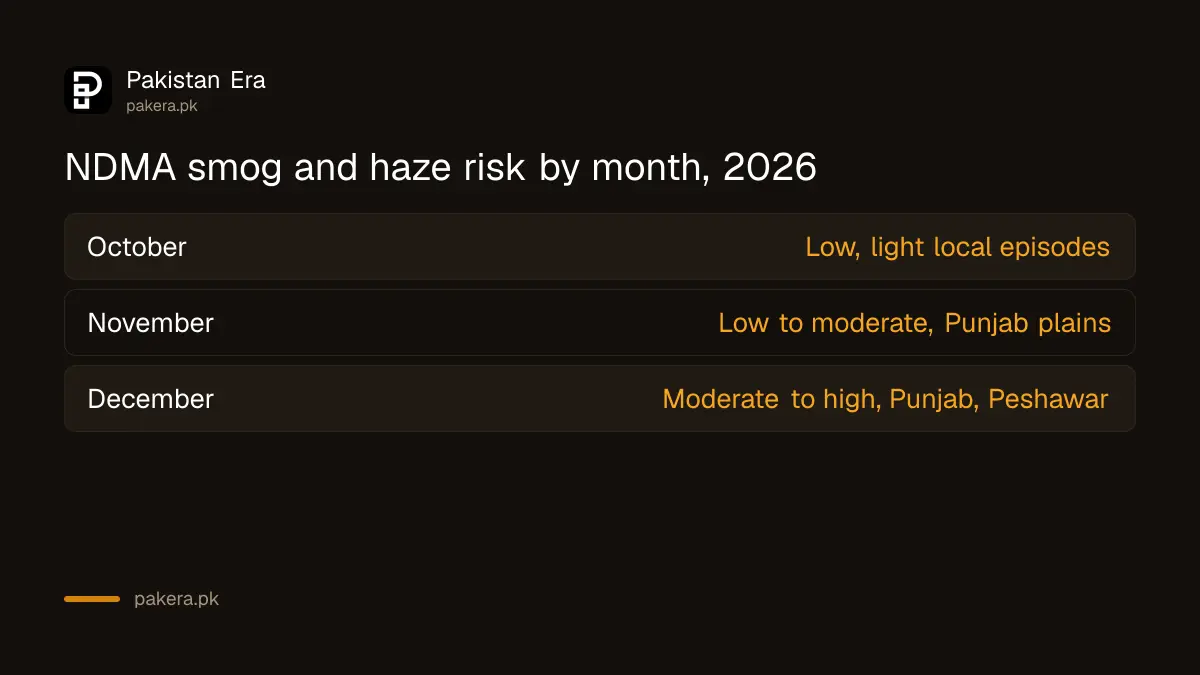
The NDMA rates October 2026 low, November low to moderate and December moderate to high. Risk builds "from mid-late November through December" as the air turns cooler and more stable, which traps dust and smoke near the ground.
| Month | NDMA smog and haze risk | Where | Why |
|---|---|---|---|
| October 2026 | Low, with light local episodes | Central and southern Punjab in dry spells | Rain over north and centre clears the air |
| November 2026 | Low to moderate | Punjab plains, worst in central and southern Punjab | Rain spells in upper Punjab and KP, drier further south |
| December 2026 | Moderate to high | Central and northern Punjab, urban and industrial corridors, Peshawar Valley | Drier, colder, weak winds, shallow mixing layer |
November should be easier than last year in the north
The NDMA expects near-normal to above-normal rain over northern Pakistan in November, with wetter spells possible over Khyber Pakhtunkhwa, Kashmir and upper Punjab. Rain washes particles out of the air, so these areas may see shorter smog episodes than in November 2025.
Central and southern Punjab are the weak spot. The report says they may stay near normal for rain, and long dry, still stretches there "may allow pollutants to accumulate". So Sialkot, Narowal and the Rawalpindi side may get relief after each rain spell, while Multan, Bahawalpur and the south of the province could see haze build up between spells. Sindh and southern Balochistan may be near normal to drier than usual.
For a sense of what "bad" meant last year: Pakistan Environmental Protection Agency tables for Islamabad show no Good or Moderate day in November 2025, and 17 Very Unhealthy days in December 2025. This season has started early: Islamabad already logged an AQI of 151 on 29 October, in the Unhealthy band.
December is when the NDMA expects the worst spells
December should be drier over most of Pakistan as temperatures fall. The NDMA says weak winds and a shallow mixing layer may keep pollutants near the surface "for several consecutive days", with moderate to high smog in central and northern Punjab and the Peshawar Valley.
The mixing layer is the lowest slice of air, where smoke and dust can spread upward. On cold, still December mornings it can be very shallow, so pollution has nowhere to go.
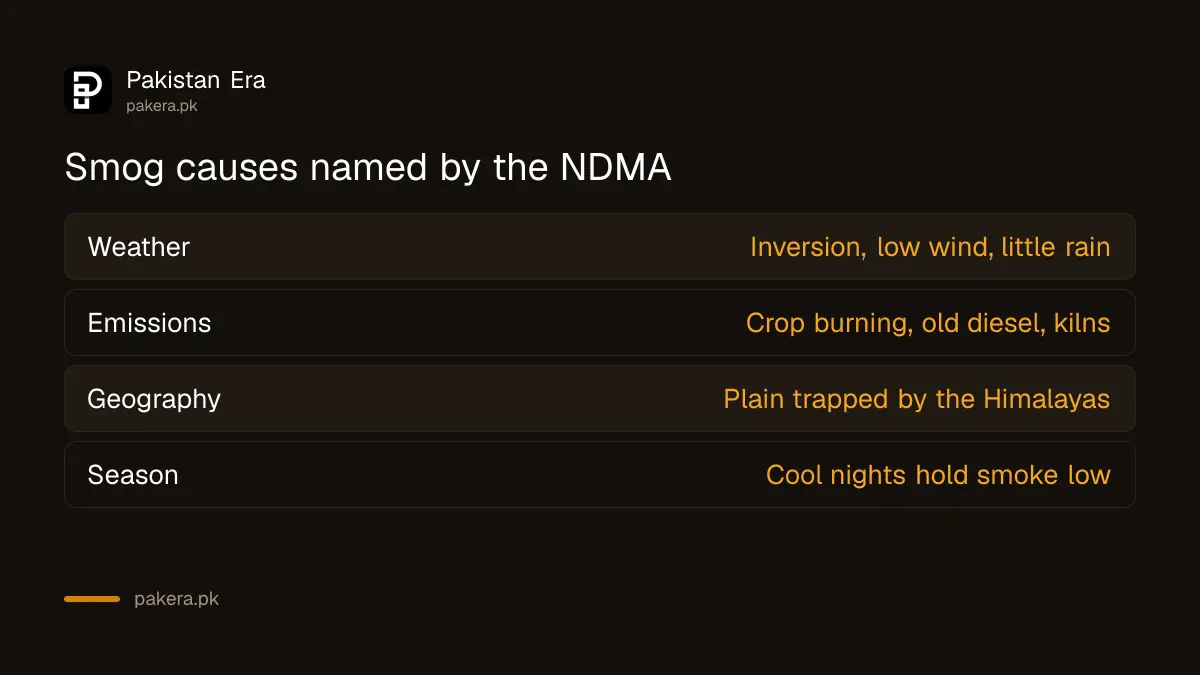
The NDMA names four causes of smog in Pakistan
The report lists weather, emissions, geography and the seasonal pattern. The emission sources it names are crop residue burning, vehicles, especially motorcycles and old diesel vehicles, industrial smoke from brick kilns, steel and cement, and power made from coal or furnace oil.
- Weather: temperature inversion, low wind, little rain and high humidity.
- Emissions: crop burning, motorcycles and old diesel vehicles, brick kilns, steel and cement plants, coal and furnace oil power.
- Geography: the Indo-Gangetic Plain, covering Punjab and eastern Khyber Pakhtunkhwa, traps pollution against the Himalayas.
- Season: cool nights and small day-night temperature swings hold emissions near the ground.
Our view: the list matters because most items on it are local. Rain helps, but the outlook can only tell you when the air will be still. What fills it is decided in each district, from burning fields to smoky trucks, which is why Punjab's pre-smog action plan for 2026 targets these same sources.
What you can do on high-smog days
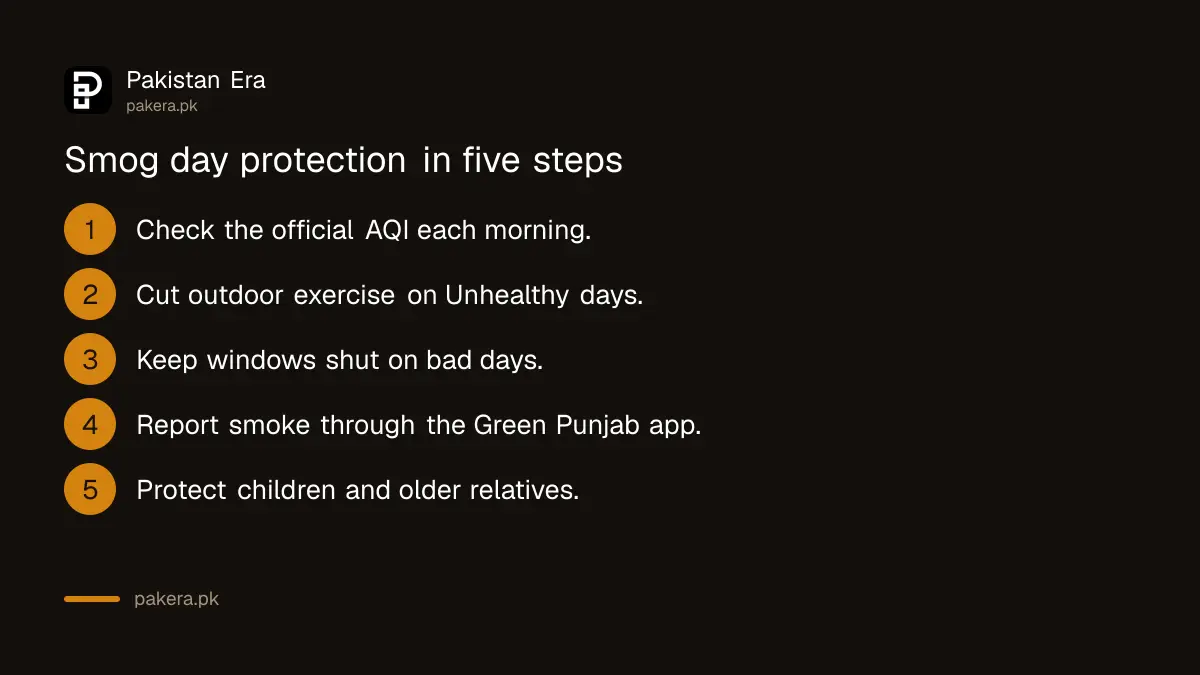
Check the official air quality reading before outdoor plans, keep children and older relatives indoors on Unhealthy days, and report smoke you can see. Plan for December, not just November, because that is when the NDMA expects the longest spells.
- Check the AQI each morning: Punjab's air quality readings for Lahore and other cities, and Pak-EPA's table for Islamabad.
- On Unhealthy days, cut outdoor exercise and school runs on foot where you can.
- Keep windows shut when the reading is Unhealthy or worse.
- Report crop burning, smoky vehicles or kilns through the Green Punjab app if you live in Punjab.
- Follow the practical steps to protect children and elderly people from smog.
Smog also brings fog-like haze on roads in December. If you drive the motorways at night, check the PMD fog bulletin first. School closures and work-from-home orders for smog are decided by each provincial government, not by the NDMA.
Common questions
Will there be smog in November 2026?
The NDMA rates November low to moderate in the Punjab plains, with more risk in central and southern Punjab during dry spells.
When will smog be worst in 2026?
In December, the NDMA says, with moderate to high smog in central and northern Punjab and the Peshawar Valley.
Will this year's smog be less than last year's?
The NDMA expects more rain spells over upper Punjab and KP in November, which may make episodes shorter than in 2025. December is still expected to be poor.
What causes smog in Pakistan?
Still, cold air plus crop burning, vehicle smoke, brick kilns and industry, and coal or furnace oil power, according to the NDMA.
Does the NDMA close schools for smog?
No. School closures and smog holidays are decided by provincial governments.
Is Karachi at risk of smog this winter?
The NDMA's smog section focuses on Punjab and the Peshawar Valley and does not name Karachi as a hotspot.
How we verified this
What we checked, where we read it, and what we could not confirm.
Last checked 1 November 2026. The smog projections, causes and rain outlook come from the smog section of the NDMA's Disaster Early Warning outlook for October to December 2026, read on 1 November. The Islamabad figures for 2025 come from Pak-EPA's monthly AQI reports. The report is a seasonal outlook, not a daily forecast. We could not open the Punjab EPA website from our location, so we did not use its smog data.
About the author

Senior Writer, Public Services and Technology
Shahid joined us in 2024 as an author. He is a senior contributor to Pakistan's leading technology websites. He writes detailed articles, mostly covering his expertise in the latest tech, mobiles, apps, gadgets, and step-by-step guides. His ideology is to help people understand the latest trends and explain complex methods through very easy-to-understand guides.