Gold Prices Falling in Pakistan: What Buyers, Sellers and Savers Should Know
Gold in Pakistan fell Rs 40,200 a tola in seven trading days in November 2026. Why it fell, and what wedding buyers, sellers and savers can weigh. Not advice.
یہ صفحہ اردو میں پڑھیں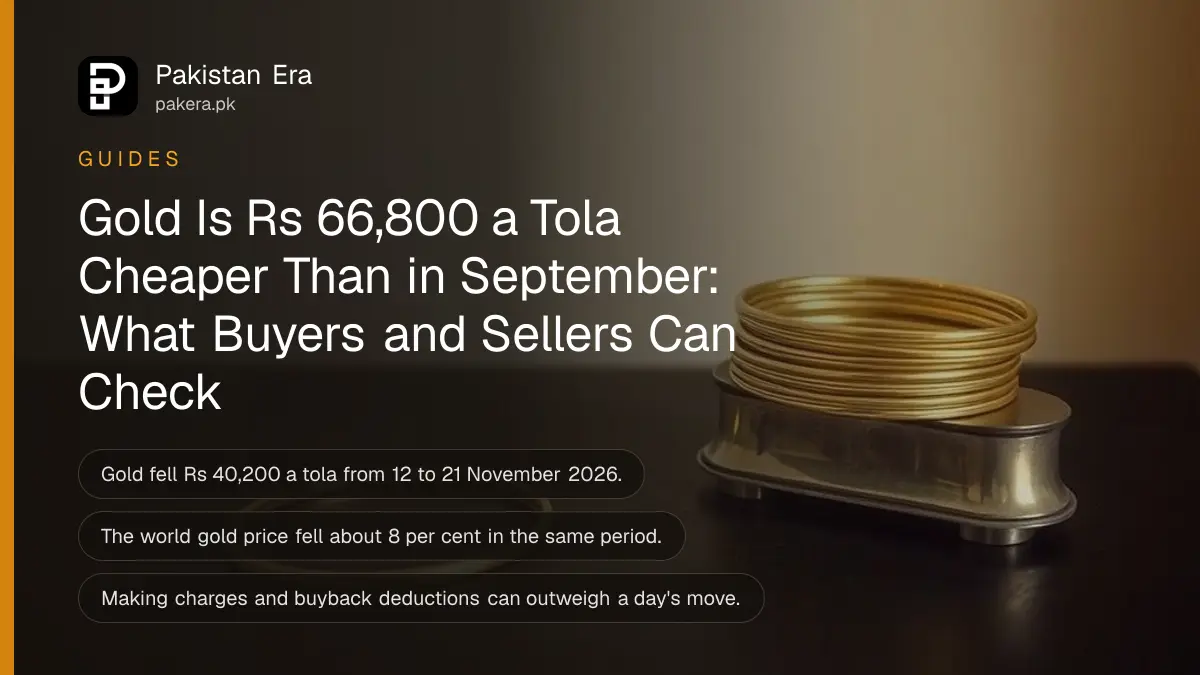
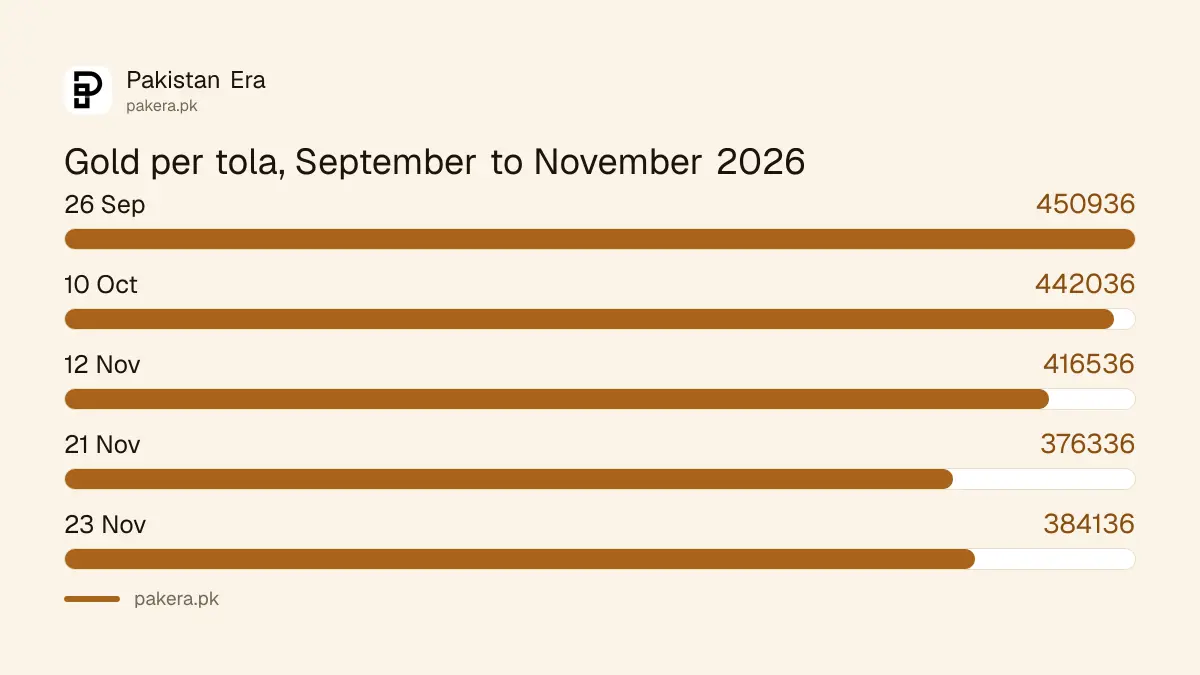
Gold in Pakistan fell from Rs 416,536 a tola on 12 November 2026 to Rs 376,336 on 21 November, a drop of Rs 40,200 in seven trading days. On 23 November it rose to Rs 384,136. That is still Rs 66,800 below the Rs 450,936 of 26 September, the highest rate in our records this autumn.
Not financial advice: this page explains what happened to gold prices and lists general points people in Pakistan often weigh. It does not tell you to buy, sell or hold gold, and it does not predict prices. Nobody can time the market. Decide for your own family, and talk to someone you trust if large sums are involved.
If you have a wedding coming, gold at home, or savings you were thinking of putting into gold, this page is for you. It covers how far gold fell, why, and the practical points that matter more than any single day's rate. For the rate today, see today's petrol, gold, LPG and dollar rates, and for every daily rate since 12 November, the gold rate for 23 November, and for the start of the fall, the gold rate for 12 November.
Gold has fallen about 15 per cent from its September high
The 24 karat rate was Rs 450,936 a tola on 26 September and Rs 384,136 on 23 November, so a tola is Rs 66,800, or about 15 per cent, cheaper. Most of the fall came in November, and the sharpest part came in a single week.
| Date | 24 karat per tola | Below the 26 September rate |
|---|---|---|
| 26 September 2026 | Rs 450,936 | Highest in our records this autumn |
| 10 October 2026 | Rs 442,036 | Rs 8,900 |
| 24 October 2026 | Rs 422,036 | Rs 28,900 |
| 12 November 2026 | Rs 416,536 | Rs 34,400 |
| 21 November 2026 | Rs 376,336 | Rs 74,600 |
| 23 November 2026 | Rs 384,136 | Rs 66,800 |
These are the reported rates of the All Pakistan Sarafa Gems and Jewellers Association, from our own daily records. Gold also went below Rs 400,000 a tola on 18 November, for the first time since September 2025. The worst single day was 20 November, down Rs 15,400.
Gold fell because the world price fell, not the rupee
Pakistan's gold rate is the world price in dollars, turned into rupees. The world price fell from about $3,940 an ounce on 12 November to about $3,620 on 23 November. The rupee hardly moved, so the world price did almost all the work.
Reports gave these reasons for the world fall:
- Traders expect higher US interest rates, with talk of a rise in December. Gold pays no interest, so it looks less attractive when interest rates rise.
- The US dollar stayed strong. A strong dollar usually pushes gold down.
- A sell-off in technology shares and lower oil prices added to the nervous mood.
None of these tells you what happens next. The same reasons can change in a week. On 23 November gold rose Rs 7,800 a tola in one day, which shows how fast it can turn.
Buying wedding jewellery: making charges matter more than one day's rate
For jewellery, the rate on the day is only part of the bill. Making charges, wastage and the karat can change the price more than a day's move in the gold rate, so many families compare those first and get every detail in writing.
Points families often weigh when gold is moving:
- Buying in parts. Some families buy a set now and the rest closer to the date, so one bad day does not decide the whole bill. This spreads the risk; it does not beat the market.
- Making charges and wastage. Ask the shop how it charges for making, per tola or per piece, and whether it adds wastage (extra weight for gold lost in the work). Two shops with the same gold rate can quote very different totals.
- Karat and weight in writing. Most wedding jewellery is 22 or 21 karat, not 24. Ask for the karat, the exact weight and the rate on the receipt.
- Tax. A registered shop adds sales tax on its invoice. The details are in tax on buying gold.
To check a quote before you pay, use calculating the price of gold jewellery. It shows how the rate, karat and making charges add up.
Selling gold: the buyback deduction often matters more than the rate
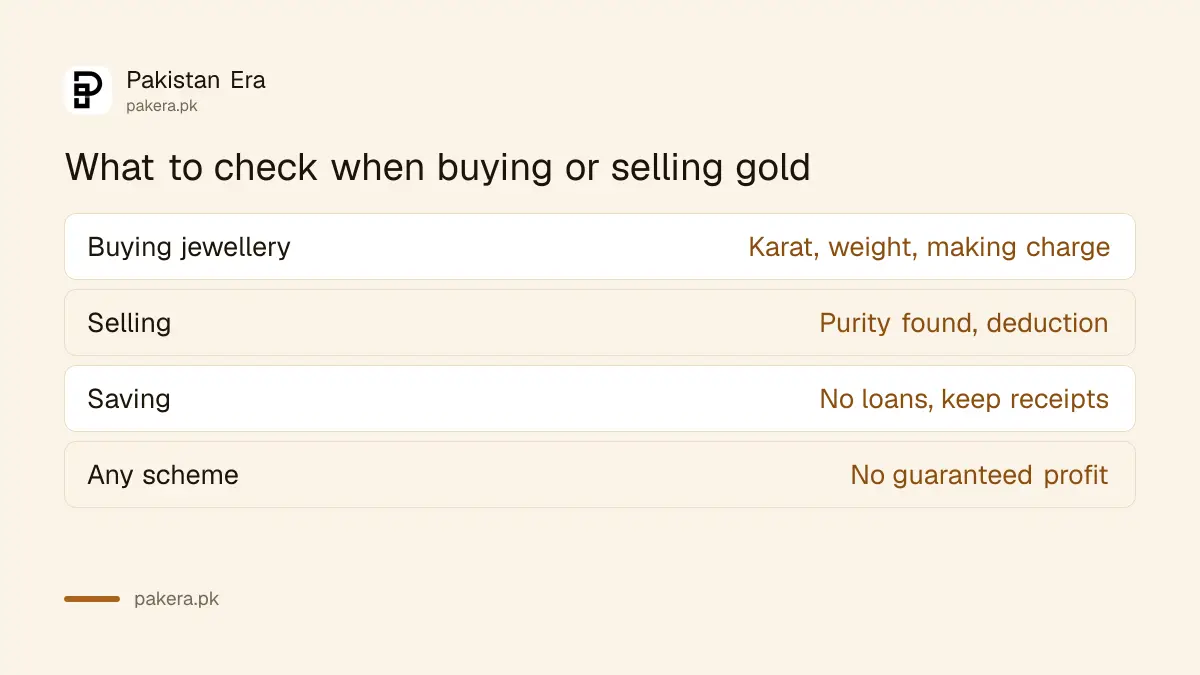
When you sell, a jeweller rarely pays the full 24 karat rate. Shops usually deduct for purity, for any stones, and a buyback margin. So the deduction, and how pure your gold really is, can matter more than a few thousand rupees of movement in the rate.
- Know the purity. Old jewellery may be 21 karat or lower. Many shops test purity before they quote. Ask what karat they found.
- Compare at least two shops. The deduction varies a lot. Ask each shop for the rate it is paying and the amount it is deducting, separately.
- Bars and coins versus jewellery. Plain bars and coins of known purity usually sell back with a smaller deduction than jewellery, which carries making charges you do not get back.
- Weigh it yourself. Ask to see the weight on the scale, and turn grams into tola with the tola to gram converter.
If you need cash for a short time and do not want to sell, a gold loan from a microfinance bank is another route. Read the auction terms before you sign.
Saving in gold: hold only what you can keep for years
People who save in gold usually think in years, not weeks. A 15 per cent fall in two months hurts most for someone who borrowed to buy or who needs the money soon. So many savers keep to money they will not need for a long time.
- Do not borrow to buy gold. If the price falls, you still owe the loan in full.
- Buy only what you can hold. Money you may need in the next year or two is better kept where its value does not swing. Profit rates on National Savings accounts are one comparison point.
- Bars and coins cost less to get in and out of. Jewellery carries making charges you lose on resale.
- Keep every receipt. It shows the karat, weight and price you paid, which helps when you sell, and for your wealth statement if you file tax.
- Zakat. A lower rate lowers the value of the gold you hold. Zakat on gold and silver shows the sum.
Gold scams grow when prices move fast
Big moves bring out apps, groups and "investment plans" that promise gold profits. Any scheme that guarantees a profit on gold, asks you to deposit money in a personal account, or sells "digital gold" you can never collect is a warning sign.
- Buy physical gold from a known jeweller with a shop and a printed receipt.
- Be careful with apps or WhatsApp groups that offer daily gold profits or ask you to bring in friends. That is how Ponzi schemes work.
- Check whether a company that takes investors' money is registered with the Securities and Exchange Commission of Pakistan. A licence alone is not proof: in the Blink Capital case, a licensed broker ran a Ponzi scheme. A promised fixed return is the bigger warning.
- Never share a one time code or your bank login with anyone selling gold.
Common questions
How much has gold fallen in Pakistan?
From Rs 416,536 a tola on 12 November to Rs 376,336 on 21 November, a fall of Rs 40,200. On 23 November it was Rs 384,136, about 15 per cent below the 26 September rate of Rs 450,936.
Why are gold prices falling in Pakistan?
Because the world gold price fell, on expectations of higher US interest rates and a strong dollar. The rupee barely moved.
Is now a good time to buy gold?
Nobody can say. Prices can fall further or rise quickly, as the Rs 7,800 rise on 23 November showed. We do not predict prices or tell anyone to buy or sell.
Should I sell my gold now?
That depends on your own needs. If you sell, compare two shops, ask for the rate and the deduction separately, and check the purity they found.
Does a lower gold rate change my zakat?
Yes. Zakat is worked out on the value of the gold you hold, so a lower rate gives a lower value. Use the rate on the day you calculate.
How we verified this
What we checked and where we read it.
Last checked 23 November 2026 at about 21:00 PKT. The gold rates are the reported rates of the All Pakistan Sarafa Gems and Jewellers Association, which has no website of its own, taken from our daily rate records and checked against at least two separate reports for each day used. The international prices and reasons for the fall are reported figures. The dollar rate is from the State Bank of Pakistan daily revaluation sheets. Percentages and differences are our own arithmetic. The practical points are general considerations, not financial advice.
About the author

Tax, Bills and Technology Writer
Ali Akhtar is a young and curious voice here at Pakistan Era. He is currently pursuing his A-Levels and has a growing interest in Pakistan’s changing industrial landscape and educational trends. Ali likes to write in a way that helps him explain and explore the world around him. His writing reflects the perspective of the new generation navigating the evolving trends of Pakistan where technology, youth innovation, and shifting opportunities are reshaping the country’s future.