Calculate the Price of Gold Jewellery in Pakistan: Tola, Karat and Making Charges
Work out gold jewellery price in Pakistan from the tola rate: karat, weight, making charges and 3% sales tax, with a 1.5 tola 22 karat example on Rs 442,036.
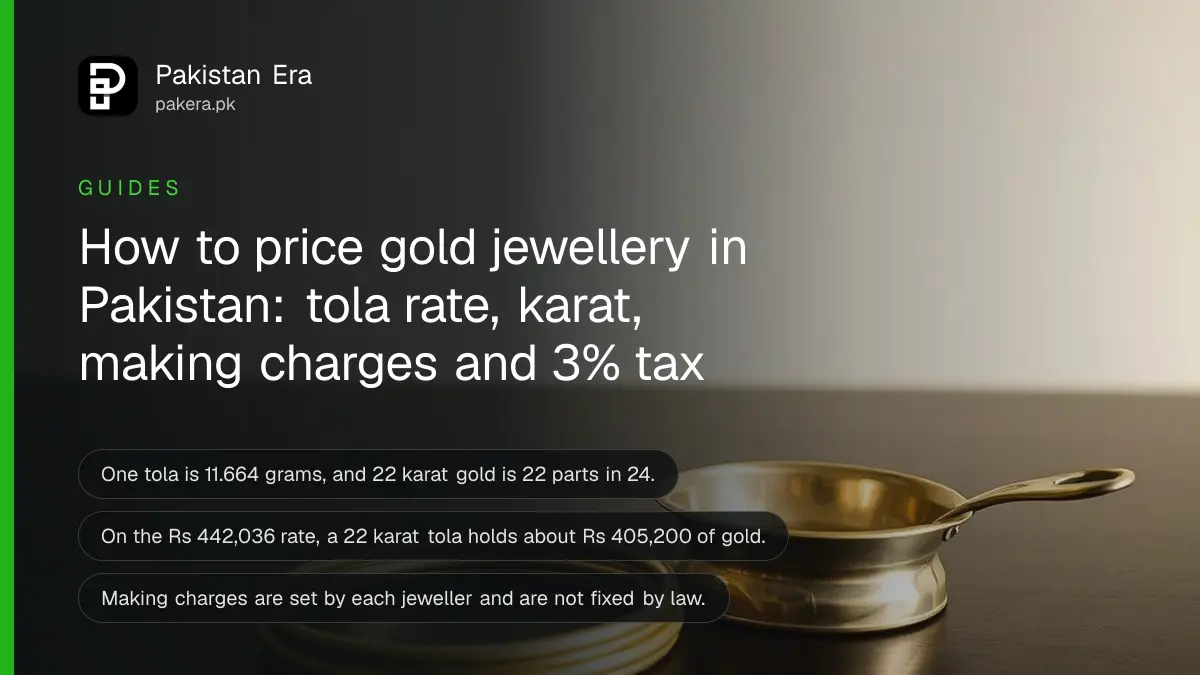
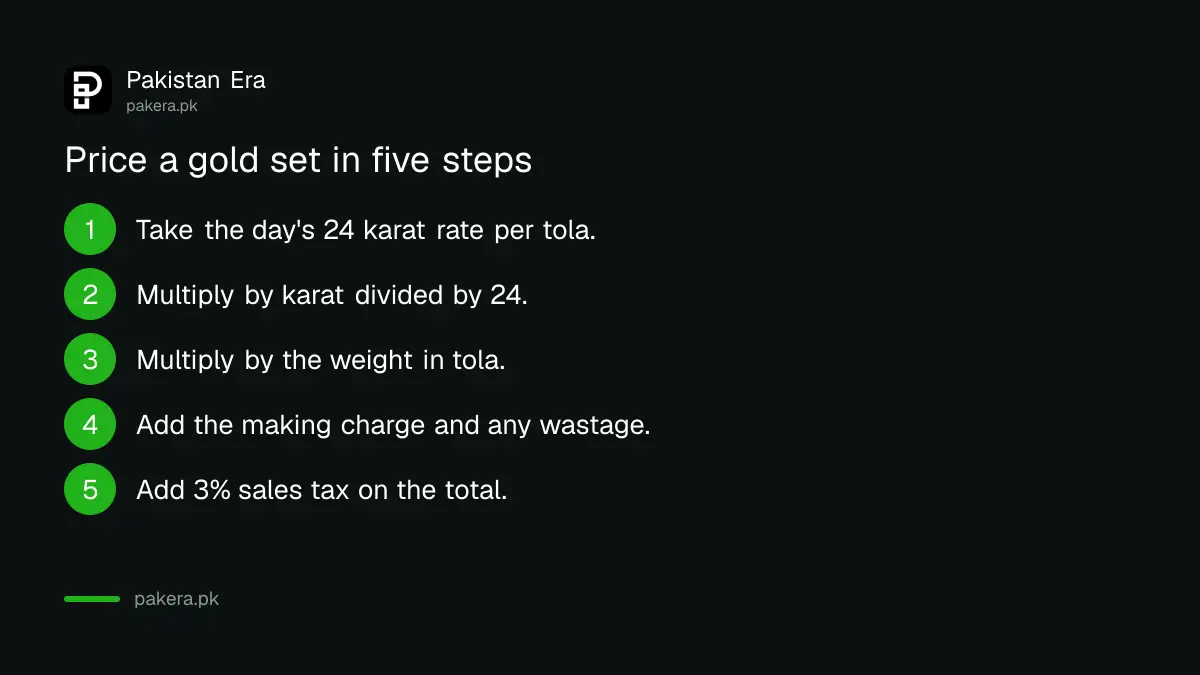
Short answer: To price a gold set in Pakistan, take the day's 24 karat rate per tola, multiply by karat divided by 24, multiply by the weight in tola, add the making charge, then add 3% sales tax. On the rate reported for 10 October 2026, Rs 442,036 a tola, a 22 karat tola is worth about Rs 405,200 in gold.
A family walks into a Saddar jeweller with a rate they saw on their phone that morning. The shopkeeper quotes a figure Rs 30,000 higher for the same set. Neither is lying. The phone showed the price of pure gold. The shop priced a finished bangle.
This page gives you the sum to check any quote yourself. All rates here are the ones reported on 10 October 2026, the newest we could read on 12 October. Replace them with the rate on the day you buy.
The market rate is for 24 karat gold per tola
The rate you see in the news is the price of 24 karat gold, which is almost pure, per tola. A tola is 11.664 grams. Jewellery is rarely 24 karat, so the rate is a starting point and not the price of your set.
The All Pakistan Gems and Jewellers Sarafa Association sets the daily rate that most news reports quote. It was reported at Rs 442,036 per tola and Rs 378,974 per 10 grams on Saturday 10 October. We could not read the association's own notice, so these figures are marked as reported. Our gold rate report for 10 October shows how it moved that week.
Three words matter. Karat tells you how much of the metal is gold. Tola and gram are the weights. A shop may quote in either, so convert before you compare.
Karat decides how much of the rate you pay for
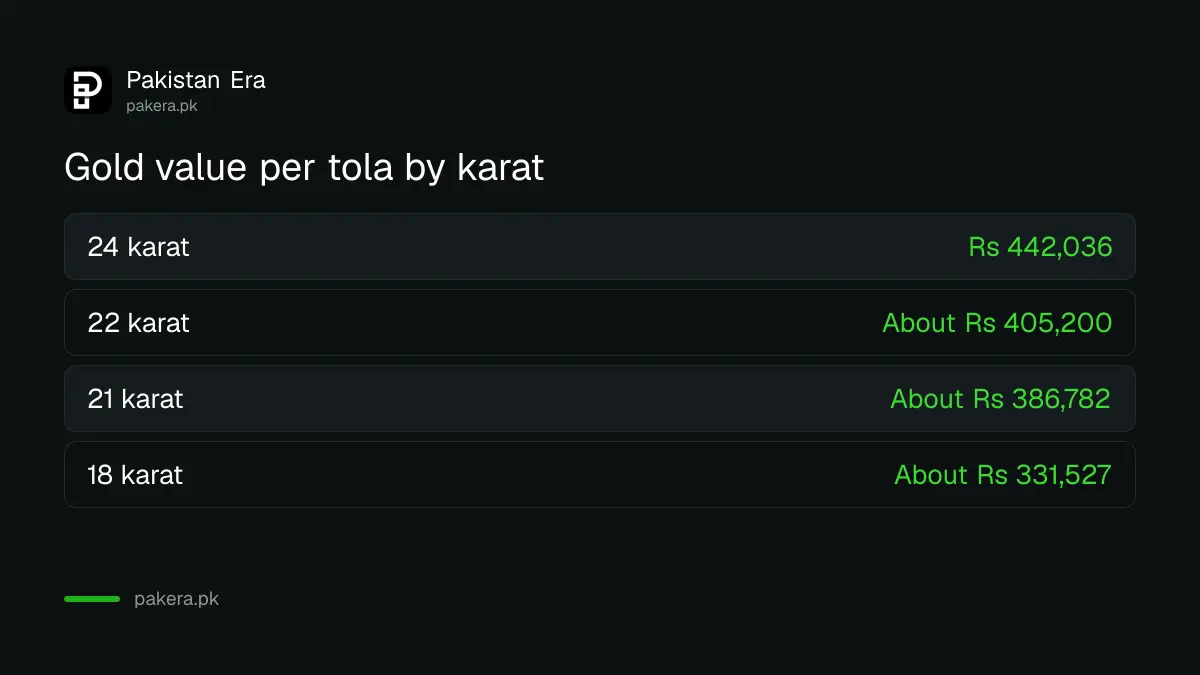
Divide the karat by 24 to get the share of pure gold. A 22 karat piece is 22 parts gold in 24, which is about 91.7%. So a 22 karat tola costs 91.7% of the 24 karat rate before making charges.
| Karat | Share of pure gold | Per tola | Per gram |
|---|---|---|---|
| 24 | 100% | Rs 442,036 | Rs 37,897 |
| 22 | 91.7% | Rs 405,200 | Rs 34,739 |
| 21 | 87.5% | Rs 386,782 | Rs 33,160 |
| 18 | 75% | Rs 331,527 | Rs 28,423 |
These are our arithmetic from the reported 24 karat rate and the 11.664 gram tola. They are the value of the gold alone. A shop's rate card for 22 karat may differ by a small amount because shops round and set their own rates.
Making charges and wastage are the part you can negotiate
Making charges pay for the craftsman's work. Wastage is gold lost while shaping the piece, which some shops add as extra weight. Neither is fixed by law. Jewellers set them, so you can ask for each one in writing and compare shops.
Shops quote making charges in different ways. Some give a rupee amount per tola. Some give a rupee amount per gram. Some give a percentage of the gold value. Ask which one, and ask the shop to write the figure next to the weight on the estimate.
Plain bangles have lower making charges than set pieces with stones or fine work. Stones add their own price, and a shop usually weighs the piece with the stones in it. Ask for the gold weight and the stone weight separately. Otherwise you may pay the gold rate for stone weight.
A worked example: 1.5 tola of 22 karat jewellery
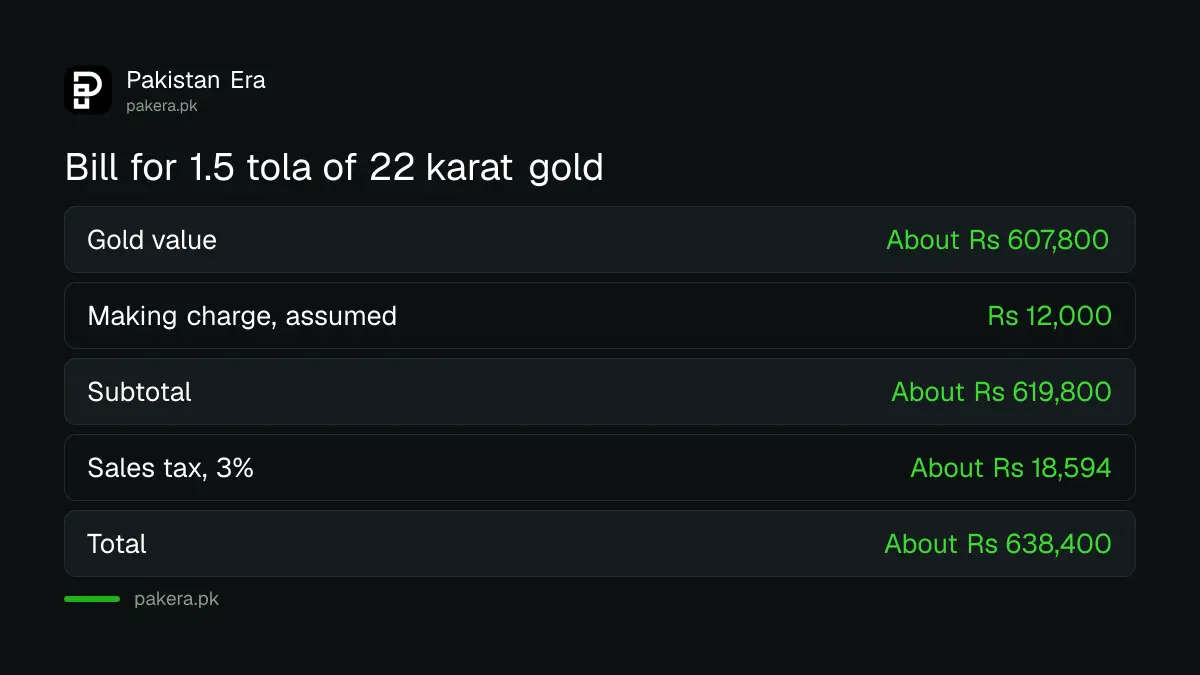
Take a set that weighs 1.5 tola, or about 17.5 grams, in 22 karat gold. The making charge in this example is Rs 8,000 a tola, an assumed figure for the sum. Your shop's figure will differ.
- Gold value: Rs 442,036 x 22 / 24 x 1.5 tola = about Rs 607,800.
- Making charge: Rs 8,000 x 1.5 tola = Rs 12,000.
- Subtotal before tax: about Rs 619,800.
- Sales tax at 3% of the subtotal: about Rs 18,594.
- Total bill: about Rs 638,400.
If a quote is far above your own sum, ask which line is higher. It is usually the making charge or a wastage line. The 3% rate comes from the Sales Tax Act, as set out in our report on sales tax on buying gold, and it applies to locally made jewellery from a registered jeweller.
What to put on the estimate before you pay
Ask for a written estimate with the weight, karat, rate used, making charge, stone weight and tax shown on separate lines. Keep the receipt. It protects you if you sell the piece later or must show it in a wealth statement.
Three more checks help. Ask the shop to weigh the piece in front of you on a scale that shows the date of its last check. Ask for the buy-back rule in writing, because many shops deduct making charges and a share of wastage when they take a piece back. And compare the shop's rate for the day against the reported association rate. If the shop uses a higher rate, ask why.
Our report on three sites showing three different gold prices explains why the headline rate can differ from the shop's.
Common questions
How many grams are in one tola of gold?
One tola is 11.664 grams in the gold market. Some shops round it to 11.66 grams. Check which figure the shop uses.
How do I work out the price of 22 karat gold from the 24 karat rate?
Multiply the 24 karat rate by 22 and divide by 24. For Rs 442,036 a tola, that gives about Rs 405,200 a tola.
Is sales tax charged on gold jewellery in Pakistan?
Yes. Locally made jewellery from a registered jeweller carries 3% sales tax on the sale value, under the Eighth Schedule of the Sales Tax Act.
Are making charges fixed by the government?
No. We found no government rate for making charges. Each jeweller sets them, so compare estimates from two or three shops.
Does the gold rate on my phone match the shop's price?
Not usually. The phone rate is for 24 karat gold. The shop prices karat, weight, making charges, any stones and tax on top.
How we verified this
What we checked, where we read it, and what we could not confirm.
We read the reported 10 October 2026 gold rate on 12 October 2026. The 3% rate is from the Sales Tax Act as amended to 30 June 2026, published on the FBR website, which we read on 1 October 2026. The worked example uses an assumed making charge. Rates change daily, so use the rate on the day you buy.
About the author

Tax, Bills and Technology Writer
Ali Akhtar is a young and curious voice here at Pakistan Era. He is currently pursuing his A-Levels and has a growing interest in Pakistan’s changing industrial landscape and educational trends. Ali likes to write in a way that helps him explain and explore the world around him. His writing reflects the perspective of the new generation navigating the evolving trends of Pakistan where technology, youth innovation, and shifting opportunities are reshaping the country’s future.