Tax on Buying Gold in Pakistan: 3% Sales Tax and Wealth Statement
Gold jewellery bought in Pakistan carries 3% sales tax. No income tax is taken at the counter, and filers must show their gold in the wealth statement.
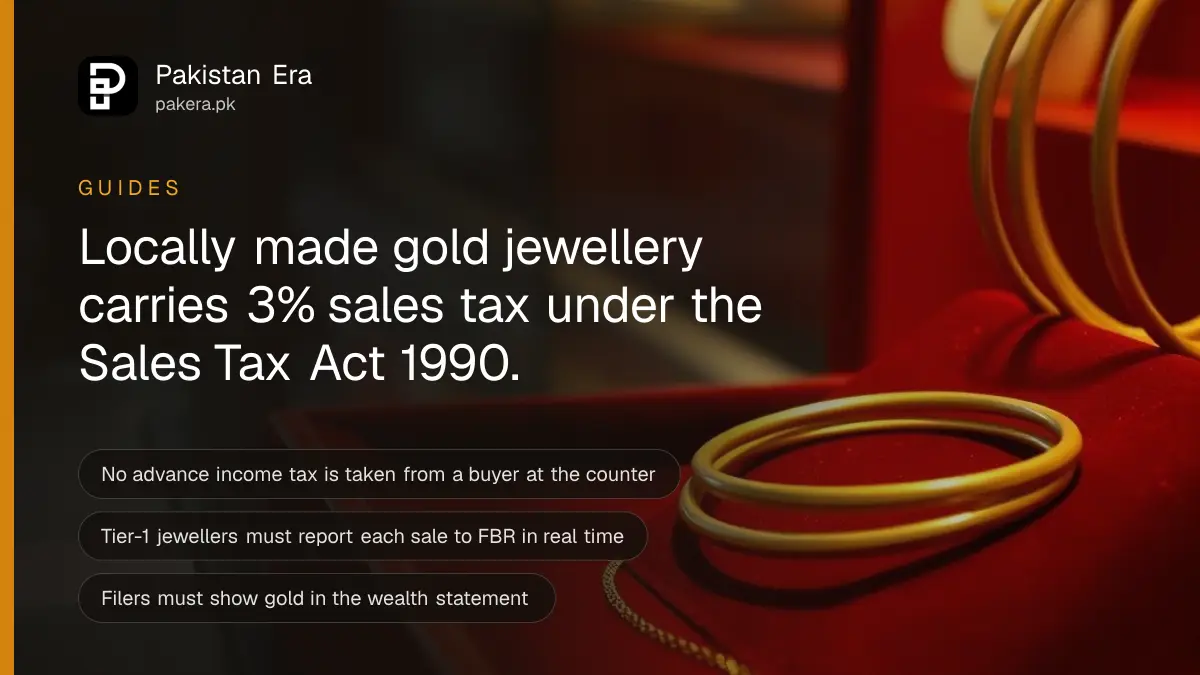
When you buy locally made gold jewellery from a registered jeweller in Pakistan, the sales tax is 3% of the sale value, under the Sales Tax Act 1990. There is no separate income tax that the jeweller must take from you, filer or non-filer. But the gold is an asset, so if you file a tax return you must show it in your wealth statement.
We read the Sales Tax Act as amended up to 30 June 2026 and the Income Tax Ordinance 2001 as published by FBR in July 2026. Here is what each law says about gold, in plain words.
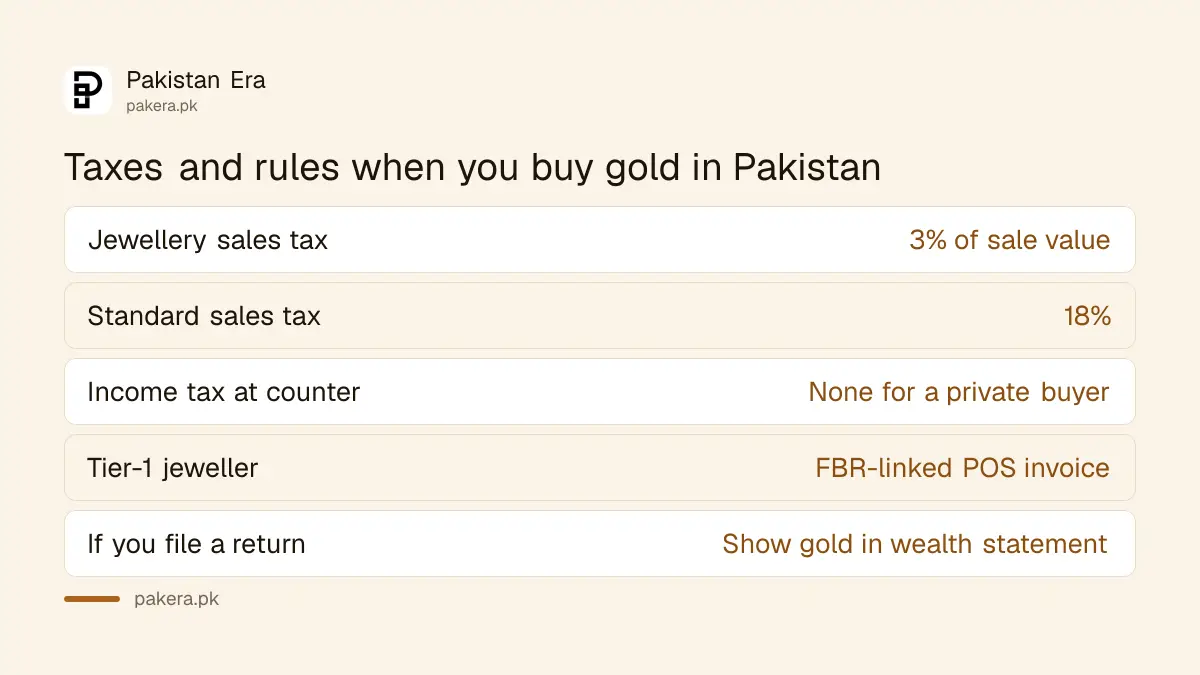
| Tax or rule | What it means for a buyer | Where it comes from |
|---|---|---|
| Sales tax on locally made jewellery | 3% of the sale value, no input tax credit for the jeweller | Sales Tax Act, Eighth Schedule, serial 78 |
| Standard sales tax rate | 18%, for goods with no reduced rate | Sales Tax Act, section 3 |
| POS invoice | Tier-1 jewellers must report each sale to FBR in real time | Sales Tax Act, Tier-1 retailer rules |
| Wealth statement | Show gold you own if you file a return | Income Tax Ordinance, section 116 |
| Unexplained assets | Gold you cannot explain can be treated as income | Income Tax Ordinance, section 111 |
Sales tax on gold jewellery is 3% of the sale value
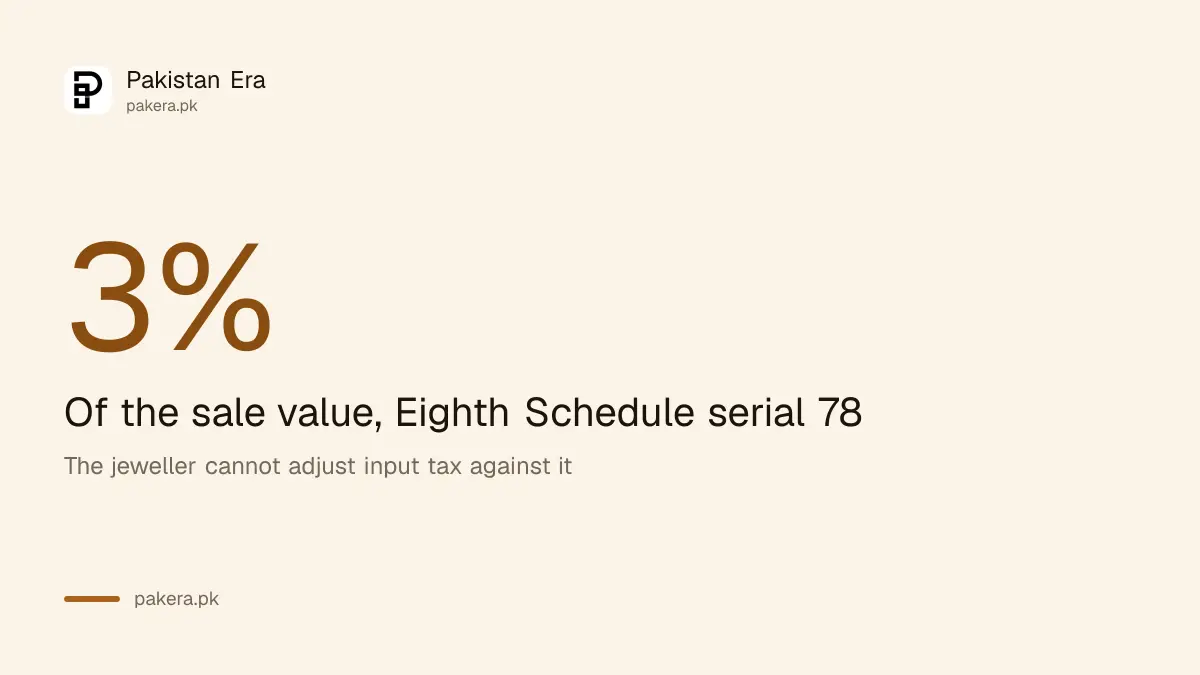
Locally made jewellery of gold or other precious metal carries 3% sales tax under serial 78 of the Eighth Schedule. The jeweller cannot claim back tax paid on inputs against it. The 3% is charged on the value of the sale, so it rises with the gold rate.
The Eighth Schedule is the list of goods taxed at reduced rates. Serial 78 covers "locally manufactured articles of jewellery, or parts thereof, of precious metal or of metal clad with precious metal", under customs heading 71.13. It was added by the Finance Act 2022 and is unchanged in the 2026 text.
Take a simple example. If the bill for a set comes to Rs 400,000 before tax, 3% is Rs 12,000. The real bill also depends on the gold rate on the day, the weight, the karat and the making charges. Those are why every gold rate source shows a different price, and the tax follows whatever the final value is.
Gold bars and coins have no reduced rate in the 2026 law
We found no reduced sales tax entry for gold bars or biscuits in the Sales Tax Act as amended to 30 June 2026. The 3% entry covers only articles of jewellery. FBR has not published separate guidance on bars that we could find.
Two other gold entries exist, and neither helps a shop buyer. The Sixth Schedule exempts "monetary gold", the gold that central banks hold as reserves. And the Twelfth Schedule leaves unworked gold out of the extra tax charged at import. The general rate under section 3 of the Act is 18%.
So if you buy a bar, ask the seller for a proper sales tax invoice that names the rate charged. If they will not give one, you have no record of what you paid or what tax went to FBR.
Large jewellers must issue an FBR-linked POS invoice
A jeweller who is a Tier-1 retailer must connect every sales counter to FBR's computer system, so each sale is reported in real time. FBR says buyers from these shops can verify the invoice in its Tax Asaan app or by SMS to 9966.
The Sales Tax Act defines a Tier-1 retailer by any one of these tests:
- a shop that is part of a national or international chain;
- a shop in an air-conditioned mall, plaza or centre, but not a kiosk;
- a shop whose electricity bill over the last 12 months passed the limit set in the Act;
- a retailer with turnover above Rs 200 million in the last 12 months;
- any other retailer the Board names.
A Tier-1 retailer that does not integrate loses part of its input tax for that period. A small jeweller in a street market may not be Tier-1 at all, so it may not have a POS system.
No income tax is collected from you at the counter
We searched the Income Tax Ordinance for every rule on gold and found none that makes a jeweller collect advance tax from a private buyer. That holds for filers and non-filers alike. The gold rules in the Ordinance are aimed at businesses.
The one that comes closest is clause 31 in Part II of the Second Schedule. It sets withholding at 1% when a business that must deduct tax under section 153 pays for gold, silver or articles made from them. That tax is adjustable. It applies to buyers the law names as withholding agents, mostly companies and larger businesses, not to someone buying a ring.
There is also a rule for selling. Section 37 says no loss is recognised when you dispose of jewellery. So if you sell gold for less than you paid, the law ignores the loss.
How to show gold in your wealth statement
Every resident who files an income tax return must file a wealth statement with it, under section 116. Gold and jewellery are assets, so they belong there, along with any gold bought during the year.
The wealth statement must also cover assets of your spouse, minor children and other dependants. FBR uses it to match what you own against what you earned. Section 111 lets FBR treat a "valuable article" as income if you cannot explain where the money for it came from. A gold set bought in cash with no record is exactly that kind of article.
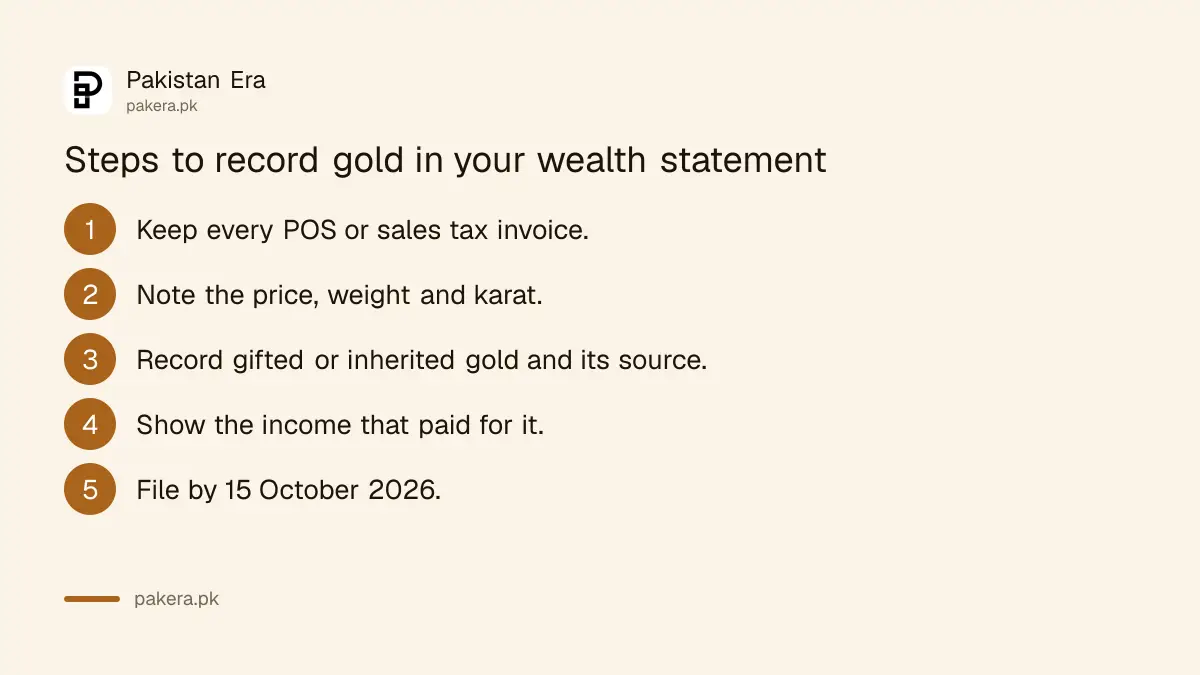
- Keep every invoice. A POS invoice or a sales tax invoice proves the date, weight and price.
- Note the price, weight and karat. Keep these beside each item so the figure in your statement can be backed up.
- Show inherited or gifted gold too. Record where it came from, such as a gift from a parent or an inheritance.
- Explain the money. The wealth reconciliation should show that your income or savings covered the purchase.
- File by the deadline. FBR has extended the tax year 2026 return date to 15 October 2026.
The full method is in how to fill the FBR tax return and wealth statement, and you can check your filer status by SMS once it is done.
Common questions
What is the sales tax on gold jewellery in Pakistan?
3% of the sale value for locally made jewellery, under serial 78 of the Eighth Schedule of the Sales Tax Act 1990.
Do non-filers pay extra tax when buying gold?
We found no rule that makes a jeweller collect extra tax from a non-filer buying for personal use. Non-filers still lose out elsewhere, such as on bank cash withdrawals.
Is there sales tax on gold bars?
We found no reduced rate for bars in the 2026 law. The 3% rate covers only jewellery. Ask the seller for an invoice showing the rate charged.
Do I have to declare my wife's gold?
Yes, if you file a return. Section 116 asks for the assets of your spouse, minor children and other dependants as well as your own.
How do I know the jeweller reported my sale to FBR?
Open the FBR POS menu in the Tax Asaan app, tap Verify Invoice, and enter the FBR invoice number or scan the QR code. Or send INV, your CNIC number and the FBR invoice number, separated by spaces, to 9966.
Can I claim a loss if gold prices fall?
No. Section 37 of the Income Tax Ordinance says no loss is recognised on disposal of jewellery.
How we verified this
What we checked, where we read it, and what we could not confirm.
Last checked on 1 October 2026. We read FBR's Sales Tax Act 1990 as amended up to 30 June 2026: section 3 (18% rate and Tier-1 retailers), section 2(43A) (Tier-1 definition), the Tier-1 integration rules, the Sixth Schedule (monetary gold), the Eighth Schedule (serial 78) and the Twelfth Schedule. We read FBR's POS invoice verification page for the Tax Asaan and 9966 checks. We read FBR's Income Tax Ordinance 2001 as published in July 2026: sections 37(5), 111 and 116, and clause 31 of Part II of the Second Schedule. The electricity bill limit in the Tier-1 test did not come through in our copy of the text, so we have not stated it. The Rs 400,000 bill is our own example.
About the author

Tax, Bills and Technology Writer
Ali Akhtar is a young and curious voice here at Pakistan Era. He is currently pursuing his A-Levels and has a growing interest in Pakistan’s changing industrial landscape and educational trends. Ali likes to write in a way that helps him explain and explore the world around him. His writing reflects the perspective of the new generation navigating the evolving trends of Pakistan where technology, youth innovation, and shifting opportunities are reshaping the country’s future.