How to Check if an Online Store Is a Scam in Pakistan Before You Pay
Check if an online store is a scam in Pakistan before you pay: domain age on PKNIC, Google Safe Browsing, seller details, and where to report fraud if cheated.
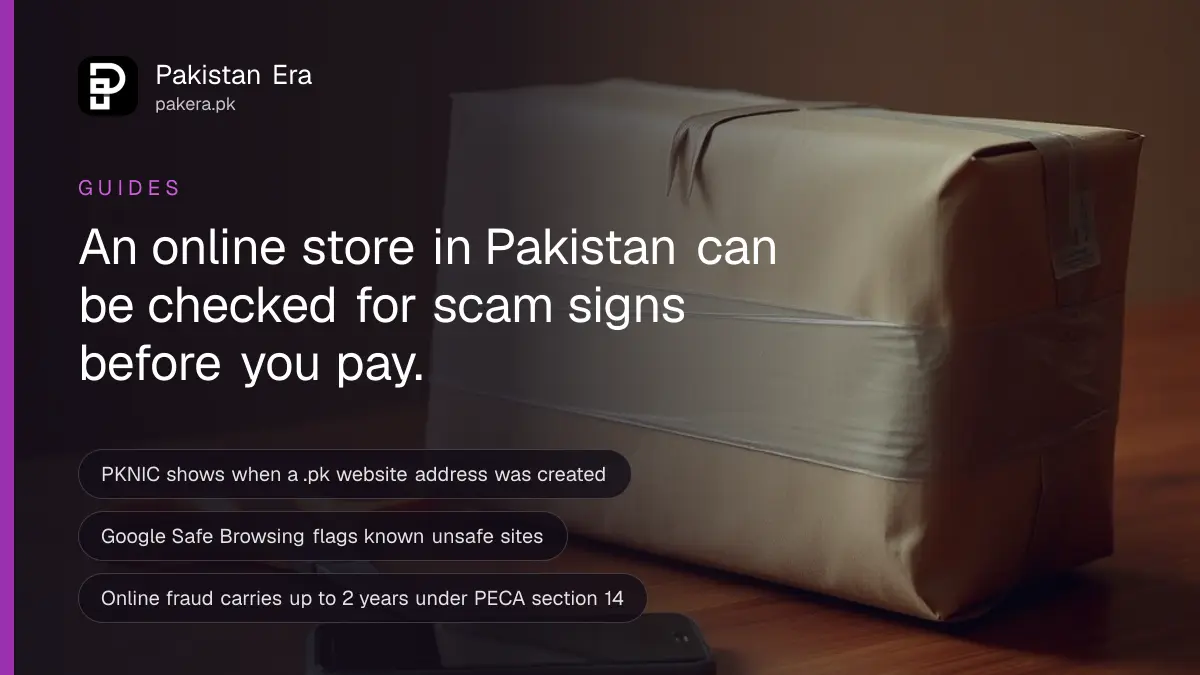
Before you pay an online store in Pakistan, check three things: how old its website address is, whether Google flags it as unsafe, and whether the seller has a real name, address and return policy. Pay by cash on delivery or card where you can. If you were cheated, call your bank first, then report to NCCIA.
The pattern is familiar. A Facebook or Instagram ad shows a branded watch or lawn suit at half price. The page asks for advance payment by bank transfer or mobile wallet. The parcel never comes, or it holds something else. We ran the checks below ourselves on 1 October 2026, using official tools, and read the laws that apply on the Pakistan Code and Punjab Code websites.
Check how old the website address is
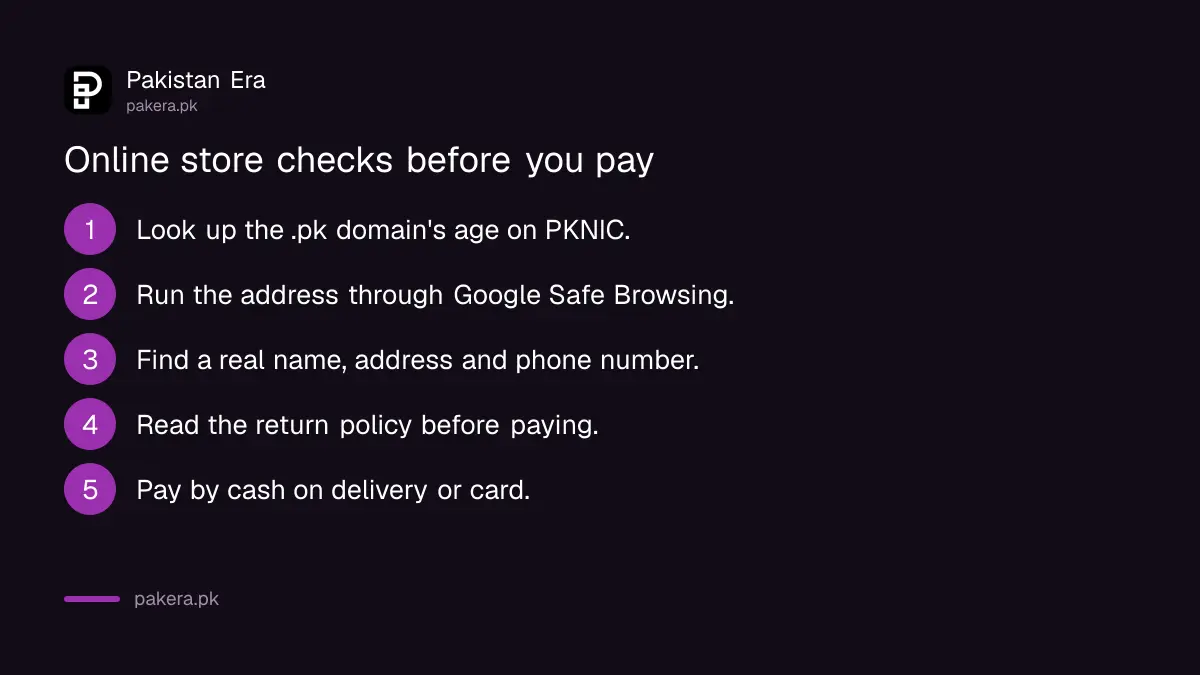
For a .pk address, PKNIC, the body that runs .pk domains, shows the date it was created. Enter the name on PKNIC's lookup page. A store claiming "ten years in business" on a domain made last month has told you enough.
We tested it on 1 October 2026 with our own address, pakera.pk. The PKNIC domain lookup answered at once with "Domain is Registered", a create date of 19 July 2024 and an expiry date. It does not show the owner's name, so it cannot prove who runs a store. It can only show how new the address is.
Stores on .com or other endings are not in PKNIC's records. A young address is not proof of fraud either, because honest small sellers start somewhere. Treat it as one warning sign, then look for others.
Check whether Google marks the site as dangerous
Google's Safe Browsing site status page tells you whether a web address is currently flagged as unsafe. Paste the store's address and read the result. A warning means stop. A clean result only means Google has not caught it yet, so keep checking.
Google says its Safe Browsing site status tool examines billions of web addresses a day and finds thousands of new unsafe sites daily. Many are real sites that were broken into. So a familiar shop can also turn dangerous, which is one more reason to type the address yourself instead of tapping an ad.
Look at the address bar closely. A spoof site copies a real brand's name with one letter changed or an extra word. Under section 26 of the Prevention of Electronic Crimes Act 2016, setting up a website that pretends to be an authentic source is spoofing. It carries up to three years in prison, a fine of up to Rs 500,000, or both.
Check the seller, the return policy and the payment method
A real seller gives a full name, an address and a working phone number. It shows its return and refund policy before you pay. It also accepts cash on delivery or a card. A seller who wants advance payment into a personal account is a warning.
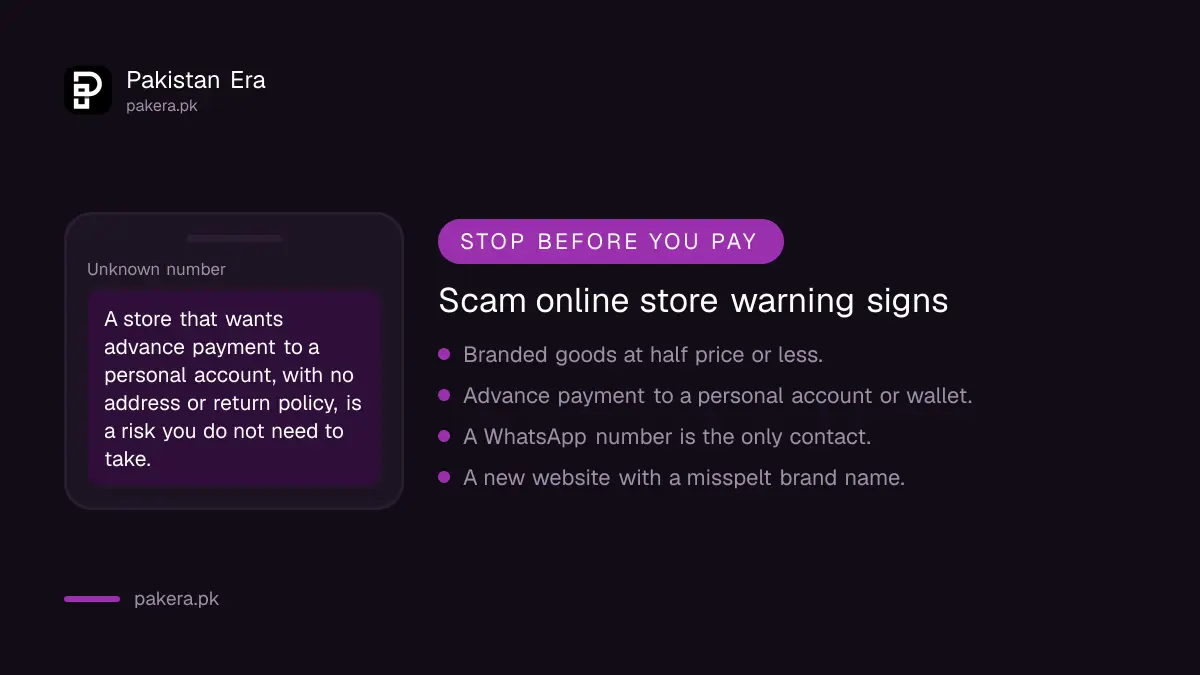
| Sign to look for | Safer store | Warning sign |
|---|---|---|
| Price | Close to the market price | Branded goods at half price or less |
| Payment | Cash on delivery or card | Advance payment to a personal account or wallet only |
| Contact | Address, landline or business number, email | WhatsApp number only |
| Return policy | Written and shown before you pay | None, or "no returns" on everything |
| Website address | Older domain, matches the brand | New domain, brand name misspelt |
The return policy point has the law behind it in Punjab. Section 20 of the Punjab Consumer Protection Act 2005 says a seller's return and refund policy must be disclosed to the buyer clearly before the sale is completed. Section 19 says a trader must give a receipt with the date of sale and a description of the goods. A business that is registered for tax will have an NTN, and you can verify an NTN through FBR before a large purchase.
Card payments matter for a plain reason. A card or bank payment leaves a record with your bank, and the bank has a complaint process with deadlines. Cash handed to a courier for a parcel you have not opened leaves you only with the parcel.
Act fast if you already paid a scam store
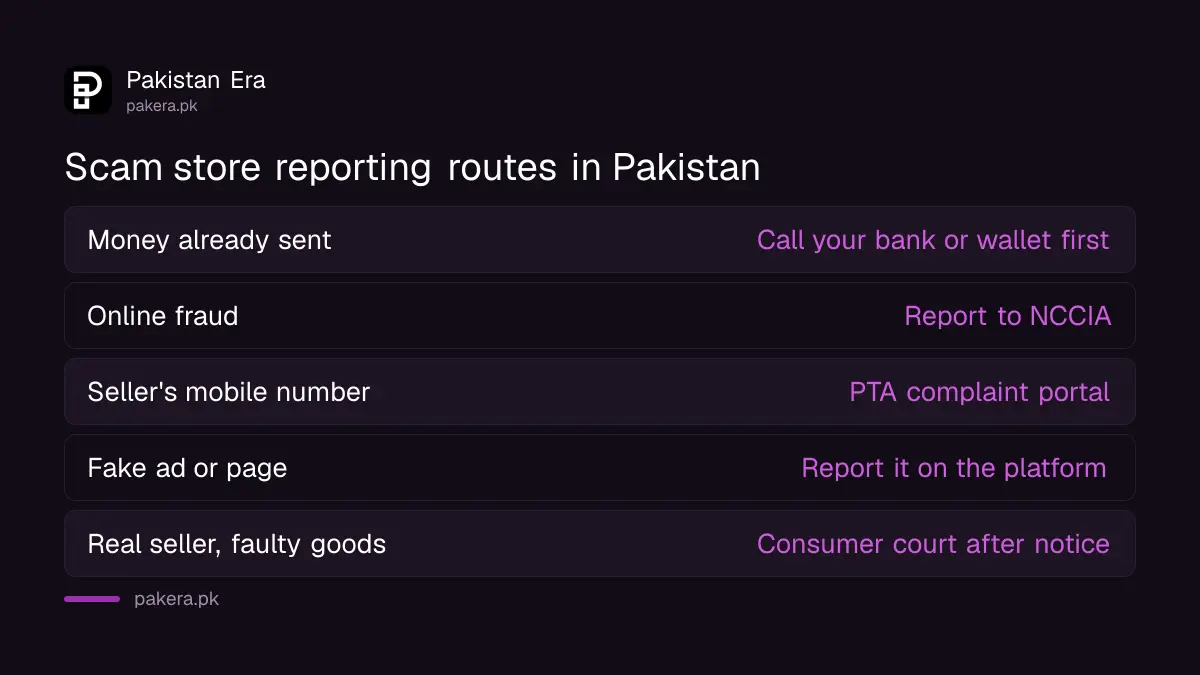
Call your bank or wallet provider first, the same hour if you can. Ask them to stop or trace the payment and give you a complaint reference. Then report the fraud to NCCIA and report the seller's mobile number to PTA. Keep every screenshot.
- Call your bank or wallet helpline. Give the date, time, amount and the receiving account or number. Ask for a complaint number in writing. The State Bank's rules give banks fixed deadlines for answering fraud complaints.
- Save the evidence. Take screenshots of the ad, the store page, the chat, the payment receipt and the seller's number before the page disappears.
- Report the fraud to NCCIA. The National Cyber Crime Investigation Agency investigates offences under the Prevention of Electronic Crimes Act. Section 14 makes electronic fraud punishable with up to two years in prison, a fine of up to Rs 10 million, or both.
- Report the mobile number to PTA. PTA's complaint portal has a category for mobile numbers used in fraudulent activity. The portal answered normally when we opened it on 1 October 2026.
- Warn the platform. Report the ad or page on Facebook, Instagram or wherever you found it, so it reaches fewer people.
The NCCIA complaint website blocked our automated check on 1 October 2026. That is a bot filter, not proof it is down, so open it in a normal browser. Our step-by-step page on how to report a cybercrime in Pakistan covers what to attach.
Use the consumer court when a real seller cheats you
If the seller is real but sent faulty goods, the consumer court is the route. In Punjab, you first send the seller a written notice. The seller has 15 days to reply, and your claim must normally be filed within 30 days.
We read section 28 of the Punjab Consumer Protection Act 2005 on the Punjab Code website, as amended in 2025. The notice asks the seller to fix the defect or pay damages. A consumer court will not hear the claim unless you show the notice was delivered and the seller did not respond. The 30 days run from when the cause of action arose. The court may allow a late claim for sufficient cause, within limits tied to the warranty period.
Consumer law is provincial, so Sindh, Khyber Pakhtunkhwa and Balochistan have their own Acts and time limits. Our page on how to take a shop to consumer court explains the process without a lawyer. A store that is fake from the start is a fraud case for NCCIA, not a consumer claim, because there is no real seller to serve.
Common questions
How can I check if a website is real in Pakistan?
Check the domain's age on PKNIC for .pk sites, run the address through Google's Safe Browsing site status, and confirm the seller's name, address and return policy before paying.
Is cash on delivery safe for online shopping?
It is safer than advance payment, because you pay only when a parcel arrives. Open the parcel in front of the rider where the seller allows it, since cash leaves no bank record.
Can I get my money back from an online scam?
Sometimes, if you act fast. Call your bank or wallet at once and ask them to trace or hold the payment. The longer you wait, the more likely the money has moved on.
Where do I complain about an online shopping fraud in Pakistan?
Report it to NCCIA, which investigates online fraud under the Prevention of Electronic Crimes Act 2016. Report the seller's mobile number to PTA, and file a complaint with your bank.
How long do I have to file a consumer court claim in Punjab?
Normally 30 days from when the problem arose, after giving the seller written notice. The court can allow more time for sufficient cause, within limits.
Does a website with a padlock mean the store is safe?
No. The padlock means the connection is encrypted. It says nothing about who runs the store or whether your order will arrive.
How we verified this
What we checked, where we read it, and what we could not confirm.
Last checked on 1 October 2026. We ran a PKNIC domain lookup on pakera.pk and opened PTA's complaint portal and Google's Safe Browsing site status page. We read sections 14, 26 and 29 of the Prevention of Electronic Crimes Act 2016, as amended, on pakistancode.gov.pk, and sections 19, 20 and 28 of the Punjab Consumer Protection Act 2005, as amended in 2025, on punjablaws.punjab.gov.pk. NCCIA's website and SECP's company search returned bot checks to our automated requests, so we do not quote either. We did not place a test order with any store.
About the author

Tax, Bills and Technology Writer
Ali Akhtar is a young and curious voice here at Pakistan Era. He is currently pursuing his A-Levels and has a growing interest in Pakistan’s changing industrial landscape and educational trends. Ali likes to write in a way that helps him explain and explore the world around him. His writing reflects the perspective of the new generation navigating the evolving trends of Pakistan where technology, youth innovation, and shifting opportunities are reshaping the country’s future.