Dengue Vaccine in Pakistan: Qdenga Not Registered, Dengvaxia Discontinued
Is there a dengue vaccine in Pakistan? We searched DRAP's register: Qdenga is not listed and Dengvaxia is discontinued. What WHO advises and how to stay safe.
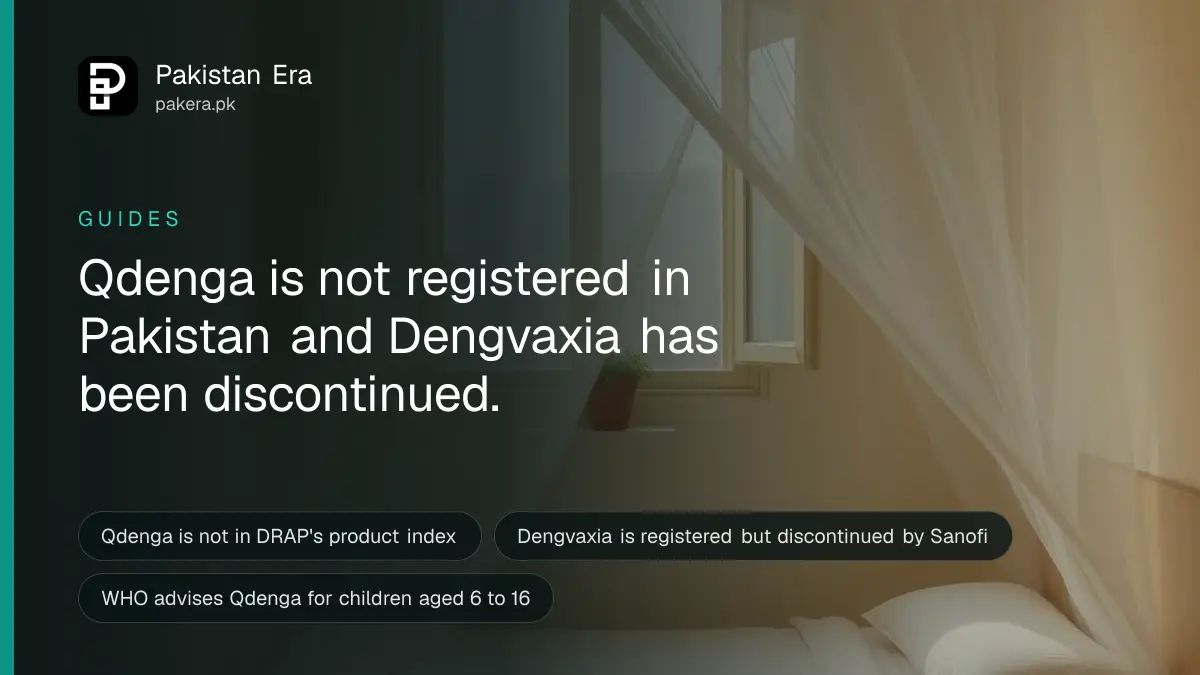
No: you cannot get a dengue vaccine in Pakistan in any practical sense. Qdenga, the newer vaccine WHO recommends, is not in DRAP's register. The older one, Dengvaxia, is registered but its maker has discontinued it. Your protection is still mosquito control and knowing the warning signs.
We searched DRAP's online drug register ourselves on 1 October 2026, and read WHO's 2024 position paper on dengue vaccines. The answer is not what many people hope after a bad dengue season, so here it is plainly.
Qdenga is not registered with DRAP in Pakistan
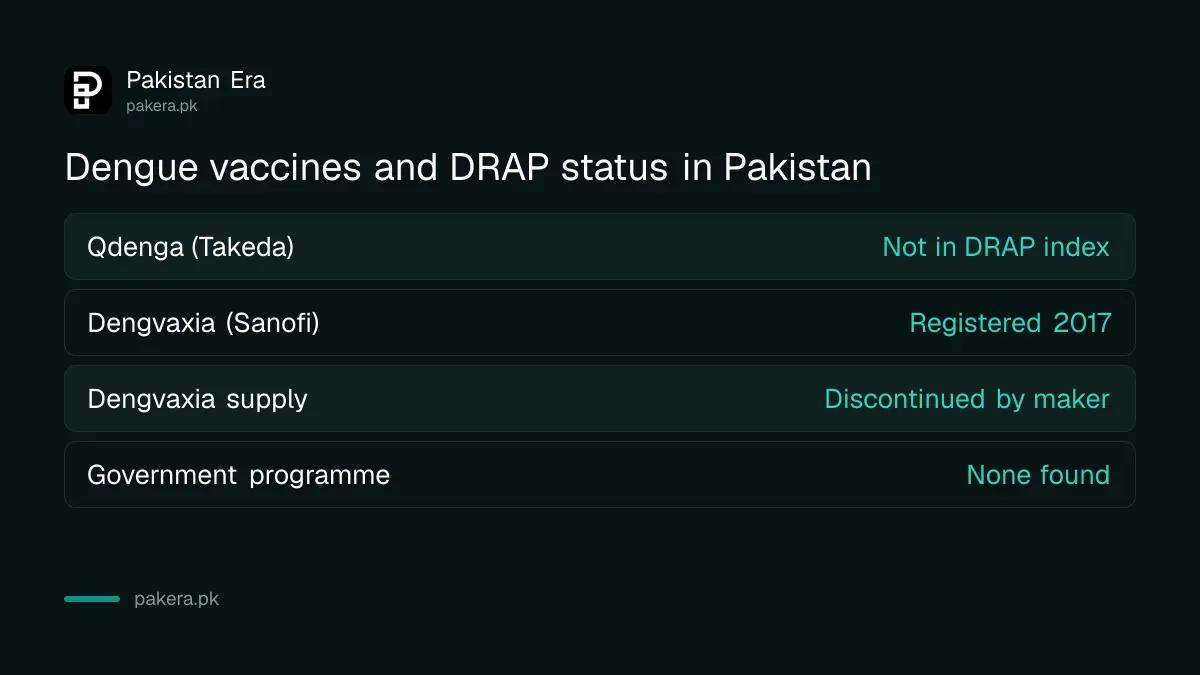
Qdenga, also called TAK-003 and made by Takeda, does not appear in the Drug Regulatory Authority of Pakistan's product index. We searched it by brand on 1 October 2026 for "Qdenga", "Q-denga" and "Takeda", and every search came back empty.
A medicine must be registered with DRAP before it can be sold in Pakistan. So a clinic or pharmacy cannot lawfully sell Qdenga here while it is unregistered.
The same register search works for anything you are offered. You can check whether a medicine is registered with DRAP by its brand name or registration number in a few seconds.
Dengvaxia is registered but its maker has discontinued it
Dengvaxia, made by Sanofi Pasteur in France, is in DRAP's register. It has registration numbers 082506 and 082507, both dated 15 September 2017, imported by Hoechst Pakistan Limited. DRAP shows the status as "Provisionally Active".
A live registration does not mean you can buy it. Sanofi has discontinued Dengvaxia because of low global demand. The US Centers for Disease Control and Prevention and Singapore's Ministry of Health both say so on their own pages, and both say the decision was not about safety.
The last lots were due to expire in August 2026, as reported. If that is right, any stock left anywhere is now out of date.
Dengvaxia was never a vaccine for everyone anyway. WHO says it protects people who have had dengue before, but raises the risk of severe dengue in people who have not. That is why WHO said only people with proof of a past infection should get it, after a blood test.
| Qdenga (TAK-003) | Dengvaxia (CYD-TDV) | |
|---|---|---|
| Maker | Takeda | Sanofi Pasteur |
| DRAP register | Not found | Registered 2017, "Provisionally Active" |
| Doses | 2 doses, at least 3 months apart | 3 doses, 6 months apart |
| Who WHO says it is for | Children 6 to 16 in high-transmission areas | Only people with a past dengue infection, after a test |
| Status now | Used in other countries | Discontinued by the maker |
WHO recommends Qdenga for children aged 6 to 16 in high-dengue areas
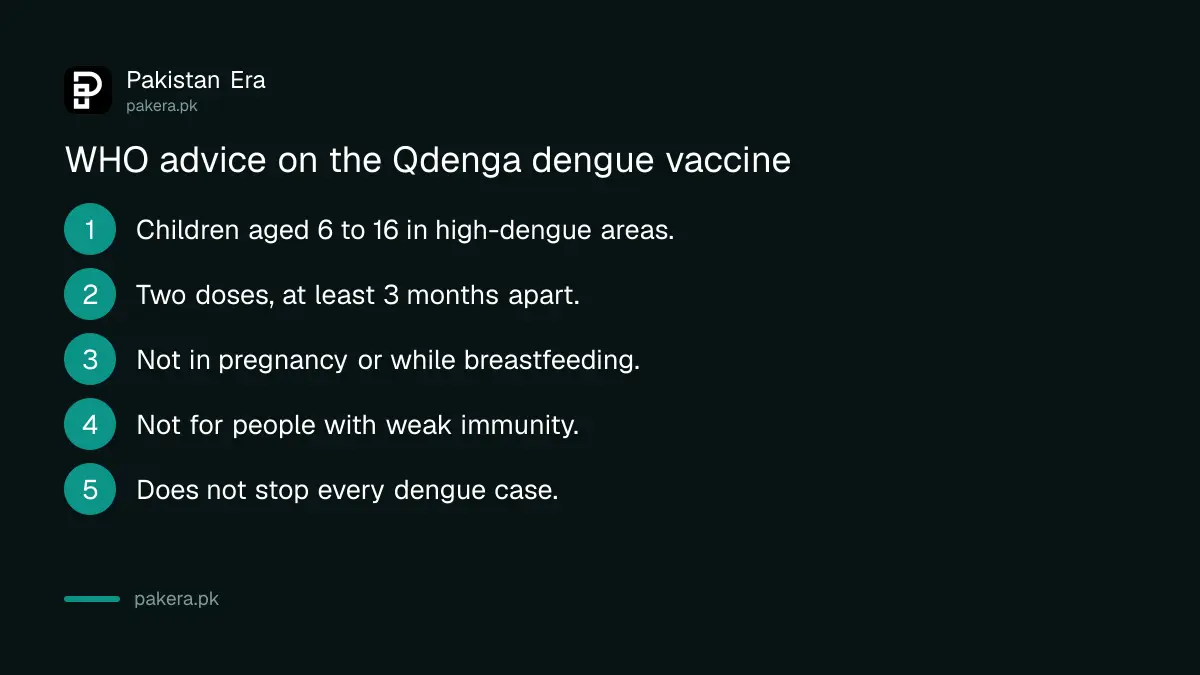
WHO's position paper of 3 May 2024 says countries should consider Qdenga for children aged 6 to 16 in places with high dengue transmission. It is given as 2 doses, at least 3 months apart, and WHO does not recommend a booster.
WHO adds a few limits that matter for families:
- Pregnancy and breastfeeding. Qdenga is not recommended in pregnancy, and pregnancy should be avoided for a month after a dose. It is contraindicated during breastfeeding.
- Weak immune system. It is a live vaccine, so it is contraindicated for people with weakened immunity, including those on chemotherapy or high-dose steroids.
- Adults with long-term illness. People in dengue areas with conditions such as diabetes or kidney disease could be offered it outside the 6 to 16 range, up to age 60.
- Allergic reactions. Everyone should be watched for 15 minutes after the injection.
Most important of all, WHO says plainly that Qdenga "does not prevent all cases of dengue", and that mosquito control must stay at the heart of any dengue plan.
Prevention and early care still protect you from dengue in Pakistan
Without a vaccine on offer, stopping bites and spotting danger early are what work. The Aedes mosquito that spreads dengue breeds in clean standing water and bites mostly in daytime.
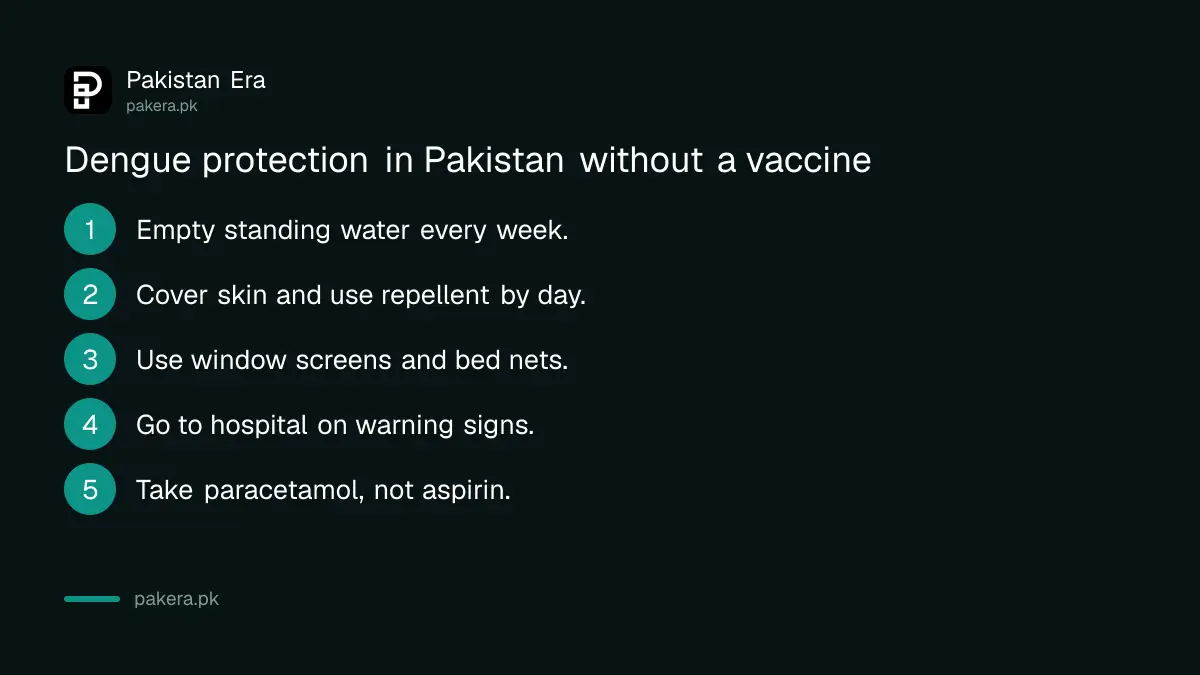
- Empty standing water every week. Check coolers, flower pots, tyres, buckets and roof tanks.
- Cover your skin in daytime. Wear full sleeves and use a mosquito repellent, especially in the early morning and before dusk.
- Screen and net. Use window nets, and a bed net for babies and anyone sleeping in the day.
- Know the warning signs. Severe stomach pain, repeated vomiting, bleeding gums or extreme weakness need a hospital at once. The full list is under dengue warning signs.
- Take only paracetamol for fever. Avoid aspirin and ibuprofen unless a doctor says otherwise, because they can make bleeding worse.
This matters now. Sindh saw dengue cases in Karachi rise sharply in August 2026, and last year Sindh was still recording thousands of new cases in November.
Be wary of anyone selling a dengue vaccine in Pakistan
If a clinic, chemist or social media page offers a dengue shot, ask for the brand and the DRAP registration number before you pay. Then check it in DRAP's register yourself.
A product that is not registered may be smuggled, fake or badly stored. Vaccines need a cold chain, and a live vaccine that has been kept warm can fail without anyone noticing.
We found no dengue vaccine in any government vaccination programme in Pakistan. The federal EPI website did not load for us on 1 October 2026, so we could not check its schedule page that day.
Common questions
Is there a dengue vaccine in Pakistan?
Not in practice. Qdenga is not registered with DRAP. Dengvaxia is registered but discontinued by its maker.
Is Qdenga available in Pakistan?
No. It was not in DRAP's product index when we searched on 1 October 2026, so it cannot lawfully be sold here.
Can I get Dengvaxia in Pakistan?
Very unlikely. Sanofi has discontinued it worldwide, and the last lots were reported to expire in August 2026.
Who should get the dengue vaccine according to WHO?
WHO recommends Qdenga for children aged 6 to 16 in areas with high dengue transmission, as 2 doses at least 3 months apart.
Can a pregnant woman get the dengue vaccine?
No. WHO does not recommend Qdenga in pregnancy, and it is contraindicated during breastfeeding.
Does the dengue vaccine give full protection?
No. WHO says Qdenga does not prevent all cases of dengue, so mosquito control is still needed.
How we verified this
What we checked, where we read it, and what we could not confirm.
Last checked on 1 October 2026. We searched the DRAP product index by brand for Qdenga, Q-denga, Takeda and Dengvaxia, and opened both Dengvaxia records. We read the WHO position paper on dengue vaccines of 3 May 2024. Dengvaxia's discontinuation is confirmed on the US CDC's dengue vaccine page and in a Singapore Ministry of Health reply. The August 2026 expiry of the last lots is as reported from a Sanofi statement. DRAP's register search by generic name did not return dengue entries, so our check of Qdenga rests on brand and maker searches. We did not survey pharmacies.
About the author
Public Services and Education Journalist
Fajr Riaz is a journalist and content writer at Pakistan Era, based in Lahore. She covers the questions people meet in everyday life in Pakistan: how a public service works, what a change in the rules means, and where to find a reliable answer.