Right to Public Services Act in Punjab: Appeal a Missed Deadline and Get Up to 70% of the Fine
Notified services carry a time limit, an officer who misses it can be fined, and up to seventy per cent of that fine is paid to you.
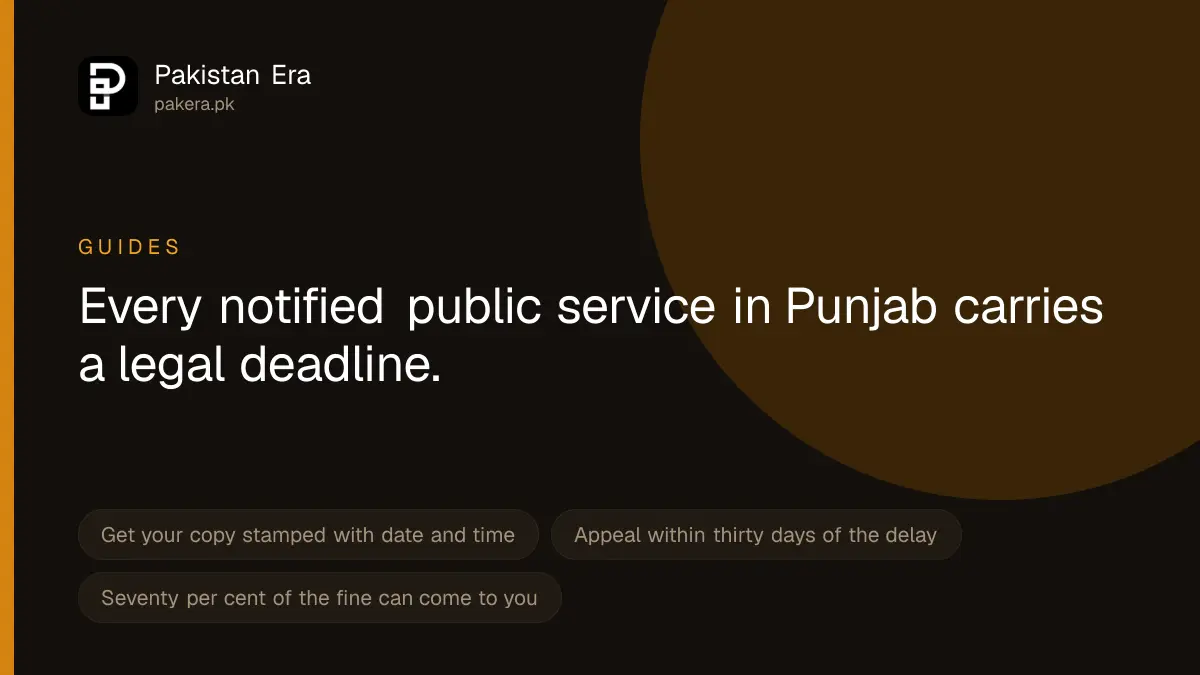
Every notified government service in Punjab has a deadline. If the officer misses it, you can appeal, the officer can be fined up to twenty five thousand rupees, and up to seventy per cent of that fine can be paid to you.
The first step is small and easy to miss: get your copy of the application stamped with an inward number, date and time when you hand it in. That stamp is where the clock starts, and you appeal within thirty days of a missed deadline.
The Punjab Code lists no amendment to it.
The timeline at a glance
| Step | Time limit in the Act |
|---|---|
| Officer provides the service or rejects it with reasons | The notified time for that service |
| Your appeal to the Appellate Authority | 30 days from rejection, delay or a deficient service |
| Appellate Authority decides | 30 days |
| Further appeal to the Commission | 15 days from the Appellate Authority's order |
| Commission decides | 30 days |
| Officer replies to a show cause notice | 30 days |
What the Act gives you
| Right | What section 3 says |
|---|---|
| Access | To have access to the public service |
| Time | To receive it within the specified time limit |
| Transparency | To receive it in a transparent manner |
| Accountability | To hold the designated officer accountable for deficiency |
| Compensation | To claim compensation for failure or delay |
The last one is the unusual part. Compensation is written into the right itself, not left to a court.
The stamp that starts the clock
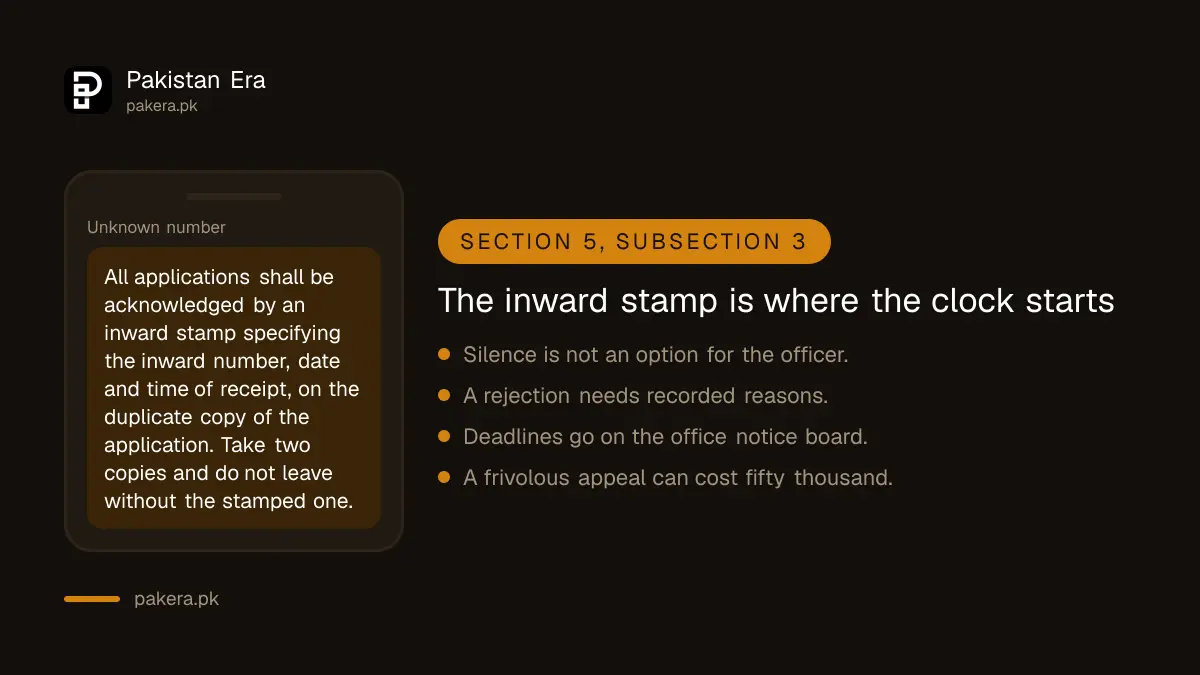
Section 5 says the specified time limit starts from the date the application is submitted to the designated officer, or to a person under him authorised to receive it.
Then subsection 3 sets out how that is recorded. All applications received shall be duly acknowledged by putting an inward stamp specifying the inward number, the date and the time of receipt, on the duplicate copy of the application.
Read that again. The stamp goes on your copy, and it carries a number, a date and a time.
Without it you have no proof of when the clock started, and an appeal about delay becomes an argument about when you turned up. So take two copies, hand one in, and do not leave until the other is stamped.
The officer must answer, one way or the other
Section 5 subsection 4 removes silence as an option. Within the specified time limit the designated officer shall either provide the public service or reject the application. If the application is rejected, the officer shall record the reasons and intimate them to the applicant.
So a rejection with reasons is lawful. Being told to come back next week, indefinitely, is not.
Section 9 also requires the details of the designated officers, the public services and the time limit for each to be displayed on the notice board in every authority, notified in the official Gazette, and where possible put on the authority's website. If you cannot find the deadline, the notice board is where the Act says it should be.
How the appeal works
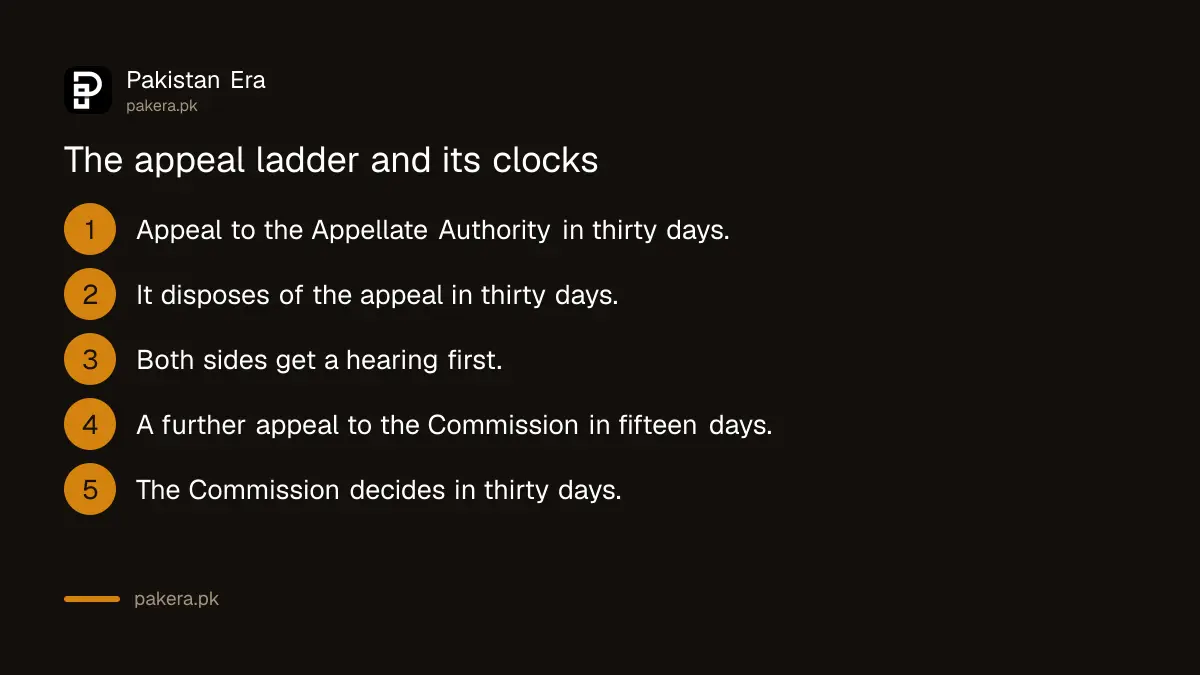
- Appeal to the Appellate Authority within thirty days of the rejection, the expiry of the time limit, or receipt of a deficient service.
- The Appellate Authority disposes of the appeal within thirty days.
- It may direct the officer to provide the service within a stated period, or to remove the deficiency.
- If you or the officer are aggrieved, a further appeal goes to the Commission within fifteen days.
- The Commission disposes of that appeal within thirty days.
Before passing an order, the Appellate Authority must give both you and the designated officer an opportunity of being heard. It holds civil court powers over production of documents, summons, and requisitioning public records.
The fine, and your share of it
Section 11 sets the penalty. If the Appellate Authority believes the officer failed to provide the service in time, caused delay, or provided a deficient service, it issues a show cause notice giving thirty days to reply. If the answer does not satisfy it, the Authority imposes a fine on the officer of not less than five hundred and not more than twenty five thousand rupees.
Section 12 applies the same idea one level up. If the Appellate Authority fails to decide an appeal within its thirty days without sufficient cause, the Commission may fine the Appellate Authority between one thousand and twenty five thousand rupees.
Section 13 is the one to remember. On imposing a fine under either section, the Authority or the Commission may order that a portion of the fine be awarded to the aggrieved person as compensation, and that portion shall not exceed seventy per cent of the fine.
Section 14 adds that the Commission may recommend disciplinary action against the officer as well.
The risk of a complaint you cannot support
Section 20 is the balance, and it is worth knowing before filing.
If your appeal is rejected by the Appellate Authority, and it also holds that the complaint was false, frivolous or vexatious, and the Commission upholds that, the Commission serves you a show cause notice with fifteen days to reply. If it is then satisfied the complaint was false and frivolous, it may fine you up to fifty thousand rupees.
So the Act is not a way to apply pressure on an office that is simply busy. It is a remedy for a missed, notified deadline.
What to put in your appeal
Keep the appeal short and attach proof. The Act does not prescribe a form, so a clear letter works.
- Your name, CNIC number and address.
- The service you applied for and the office.
- A copy of your stamped application showing the inward number, date and time.
- The notified time limit, copied from the office notice board.
- What happened: no reply, a rejection without reasons, or a deficient service, with dates.
Ask for compensation from the fine under section 13 in the same letter. If your problem is with a private shop rather than an office, the consumer law applies instead; see our guide to shop receipt and refund rules in Punjab.
Our guide to the Pakistan Citizen Portal covers the general federal complaint channel, our guide to tracking a NADRA application covers one of the services people wait on most, and our guide to tracking a driving licence covers another.
Common questions
Is there a similar law in Khyber Pakhtunkhwa?
Yes. Khyber Pakhtunkhwa has its own Right to Public Services Commission, covered in our guide to complaining to the KP RTS Commission.
Which services have a deadline in Punjab?
Those the Government notifies in the official Gazette as public services, with the time limit specified in the same notification.
When does the time limit start?
From the date the application is submitted, evidenced by an inward stamp with number, date and time on your duplicate copy.
How long do I have to appeal?
Thirty days from the rejection, the expiry of the time limit, or receipt of a deficient service.
Can I be paid anything?
Yes. Up to seventy per cent of the fine imposed on the officer may be awarded to you as compensation.
How much can an officer be fined?
Not less than five hundred and not more than twenty five thousand rupees.
What if my complaint is found frivolous?
The Commission may fine you up to fifty thousand rupees after a show cause notice.
How we verified this
What we checked and where we read it.
We read the Punjab Right to Public Services Act 2019 on the Punjab Code, the Punjab Government's law portal, on 8 November 2026.
Last checked 8 November 2026. We read the Punjab Right to Public Services Act 2019 on the Punjab Code that day. Section 3 on the rights, section 4 on notified services and designated officers, section 5 on the inward stamp and the duty to provide or reject with reasons, sections 6 and 7 on appeals to the Appellate Authority and the Commission and their time limits, section 9 on notice board display, sections 11 to 14 on fines of Rs 500 to Rs 25,000, compensation of up to seventy per cent and disciplinary action, and section 20 on fines of up to Rs 50,000 for a false or frivolous complaint are all taken from that text. Which services are notified, and their time limits, are set by Government notification, which we did not read, so check the office notice board. Nothing here is legal advice.
About the author

Tax, Bills and Technology Writer
Ali Akhtar is a young and curious voice here at Pakistan Era. He is currently pursuing his A-Levels and has a growing interest in Pakistan’s changing industrial landscape and educational trends. Ali likes to write in a way that helps him explain and explore the world around him. His writing reflects the perspective of the new generation navigating the evolving trends of Pakistan where technology, youth innovation, and shifting opportunities are reshaping the country’s future.