Pakistan Has 14,249 Lab-Confirmed Measles Cases in 2026, NIH Says, as Whooping Cough Rises to 48
NIH says Pakistan has 14,249 lab-confirmed measles cases in 2026. Week 42 shows whooping cough at 48, meningitis 38 and rubella 15. Check your child's doses.
یہ صفحہ اردو میں پڑھیں
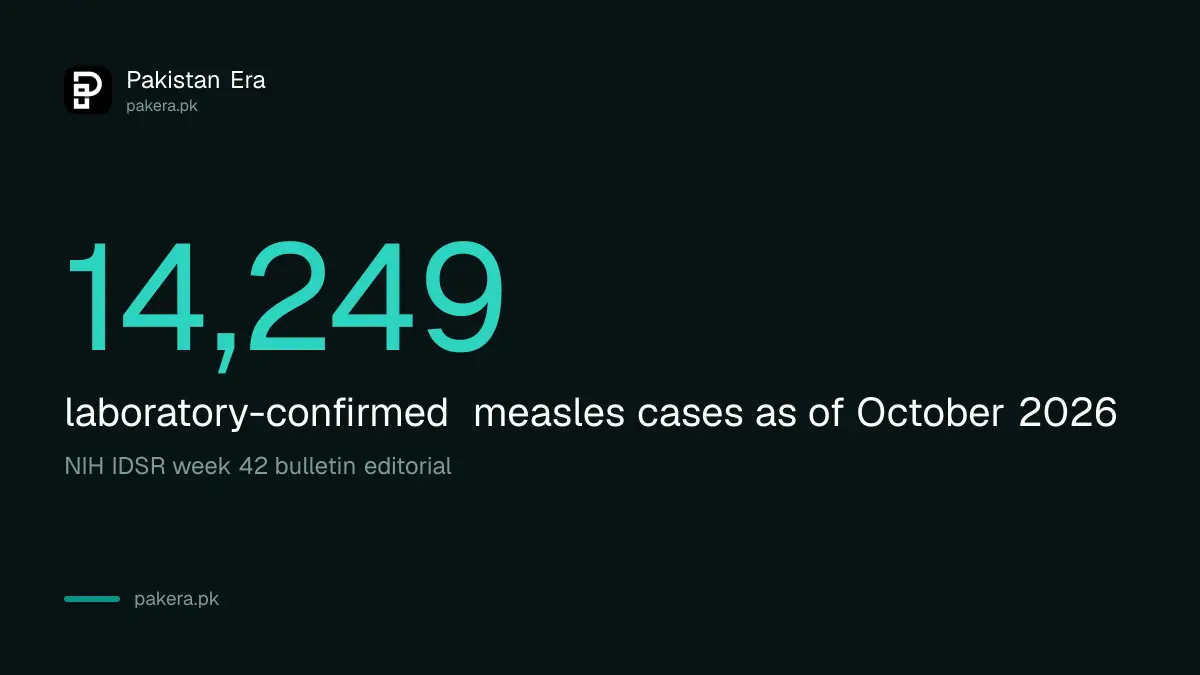
Pakistan has recorded 14,249 laboratory-confirmed measles cases in 2026 as of October, the National Institutes of Health (NIH) said in its week 42 bulletin, posted on 11 November 2026. The same bulletin shows whooping cough up from 32 to 48 suspected cases in a week, and meningitis up from 29 to 38.
NIH raised measles in the bulletin's editorial because of a very large outbreak in Bangladesh, and said Pakistan's own figure points to "a substantial ongoing disease burden". Suspected measles fell this week, to 282. But three other illnesses that vaccines prevent rose. Below are the figures, what NIH asks health departments to do, and how to check your child's vaccines.
NIH counts 14,249 confirmed measles cases in Pakistan this year
The figure is from national surveillance up to October 2026. These are cases confirmed by a laboratory test, not only suspected ones, which makes them a firm minimum. Many children with measles are never tested, so the true number is higher.
NIH links the risk to children who are unvaccinated or have missed a dose. It names missed routine vaccination, families moving between areas, unequal access to vaccines and gaps in disease reporting. It also warns that official vaccination coverage figures may not show the real immunity in a district.
Bangladesh's outbreak passed 230,000 suspected cases and 1,254 deaths
The NIH editorial cites Bangladesh's Directorate General of Health Services. It reported 230,013 suspected measles cases between 15 March and 1 November 2026, with 23,935 confirmed by labs and 1,254 deaths. Most of the burden fell on children.
NIH says the two countries' situations differ. But it points out that measles is spreading in both at the same time, and that people move across the region. It calls for more information sharing between South Asian countries and closer watch at borders.
| Measure | Pakistan | Bangladesh |
|---|---|---|
| Lab-confirmed measles in 2026 | 14,249 (to October) | 23,935 (15 March to 1 November) |
| Suspected measles | 282 in week 42 alone | 230,013 in the period |
| Deaths reported | not given in the bulletin | 1,254 |
| Source | NIH national surveillance | Bangladesh DGHS, cited by NIH |
Suspected measles fell to 282 this week, but labs still confirm about 3 in 10
NIH counts 282 suspected measles cases in week 42, down from 333 in week 41. Khyber Pakhtunkhwa sent 224 of them, Sindh 34, Balochistan 16 and Gilgit-Baltistan 8. Punjab did not report into the clinic system.
Public health labs tested 487 measles samples in week 42 and confirmed 151, about 31 per cent. Khyber Pakhtunkhwa's labs confirmed 94 of 177, Sindh's 27 of 81 and Punjab's 22 of 205. In week 41, the labs confirmed 213 of 652.
Our measles, mumps and chickenpox tracker has the weekly counts since week 37.
Whooping cough, meningitis and rubella rose in week 42
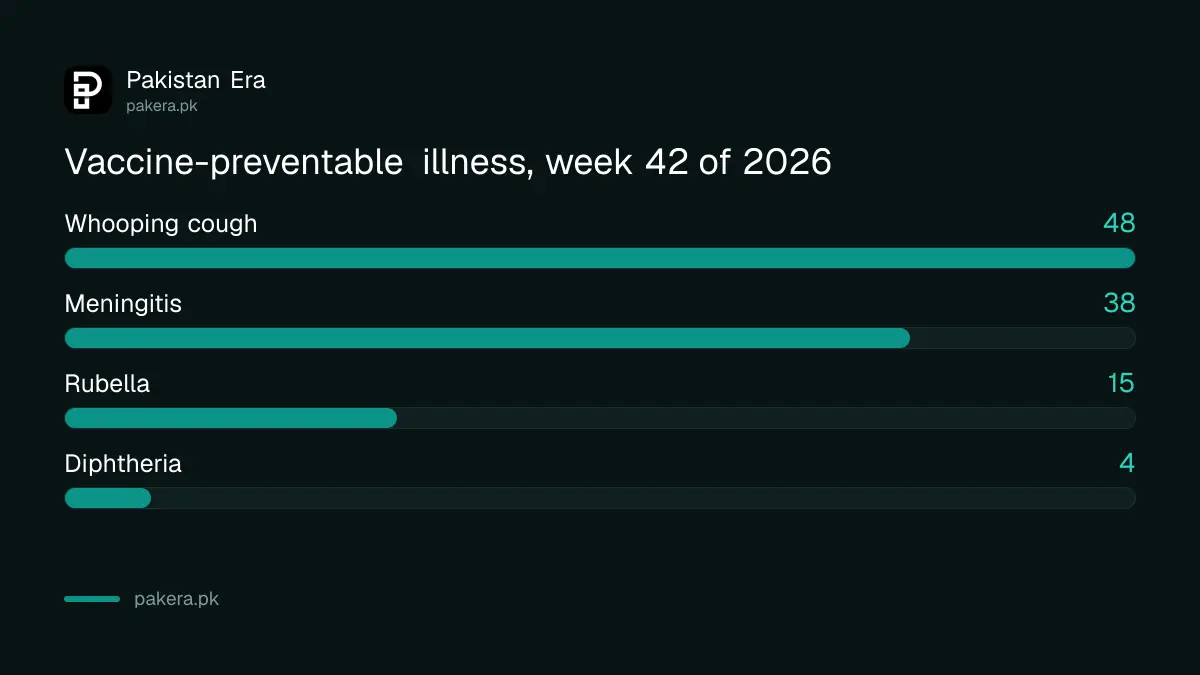
NIH says pertussis, meningitis and rubella all increased this week. Pertussis is whooping cough, a cough that comes in long fits and is most dangerous for babies. All three can be prevented or reduced by vaccines given free under Pakistan's routine programme.
| Illness | Week 41 | Week 42 | Where most cases were |
|---|---|---|---|
| Whooping cough (pertussis) | 32 | 48 | KP 18, Balochistan 17, GB 12 |
| Meningitis | 29 | 38 | Sindh 22, KP 11, GB 5 |
| Rubella | 2 | 15 | all 15 in Balochistan |
| Mumps | 388 | 375 | KP 157, Balochistan 88 |
| Diphtheria (probable) | 4 | 4 | all in KP |
If a baby has coughing fits followed by a "whoop" or turns blue while coughing, see a doctor the same day. Our page on whooping cough signs in babies lists NIH's stages.
Check your child's measles doses in five steps
Measles vaccine is free at government health centres in every province. Two doses give strong protection. NIH's own first step is to reach children who have had no vaccine at all.
- Find your child's vaccination card. Look for the two measles doses, usually at 9 months and 15 months.
- If a dose is missing, take the child and the card to the nearest government vaccination centre. A late dose still protects.
- If the card is lost, tell the vaccinator. They can advise on catching up.
- Check the full list of free vaccines in our EPI baby vaccination schedule, including the whooping cough doses.
- If a child has a fever with a rash, red eyes and a cough, keep them away from other children and see a doctor.
Common questions
How many measles cases has Pakistan confirmed in 2026?
14,249 laboratory-confirmed cases as of October 2026, according to the NIH week 42 bulletin posted on 11 November.
How many suspected measles cases were there in week 42?
282, down from 333 in week 41. Khyber Pakhtunkhwa reported 224 of them.
Is whooping cough rising in Pakistan?
It rose this week, from 32 to 48 suspected cases. Most came from Khyber Pakhtunkhwa, Balochistan and Gilgit-Baltistan.
Why did NIH mention Bangladesh?
Bangladesh reported 230,013 suspected measles cases and 1,254 deaths from 15 March to 1 November 2026. NIH says measles spreading in both countries shows the region's risk.
Is the measles vaccine free in Pakistan?
Yes. Both doses are free at government vaccination centres under the routine immunisation programme. See how to check both measles doses.
How we verified this
What we checked, where we read it, and what we could not confirm.
We read the NIH Integrated Disease Surveillance and Response weekly bulletin for week 42 of 2026 on the NIH weekly bulletin page on 12 November 2026. The file was posted on the evening of 11 November. The 14,249 figure and the Bangladesh figures are from the bulletin's own editorial; we did not check the Bangladesh numbers separately. Weekly counts are from Table 1 and lab results from Table 5, compared with the week 41 bulletin. The bulletin gives no measles death figure for Pakistan.
About the author
Public Services and Education Journalist
Fajr Riaz is a journalist and content writer at Pakistan Era, based in Lahore. She covers the questions people meet in everyday life in Pakistan: how a public service works, what a change in the rules means, and where to find a reliable answer.