Baby Vaccination Schedule in Pakistan: Free EPI Vaccines From Birth to 15 Months
The free EPI baby vaccination schedule in Pakistan: which vaccine at which age, where to get it, what to do about a lost card or a missed dose. Read it now.
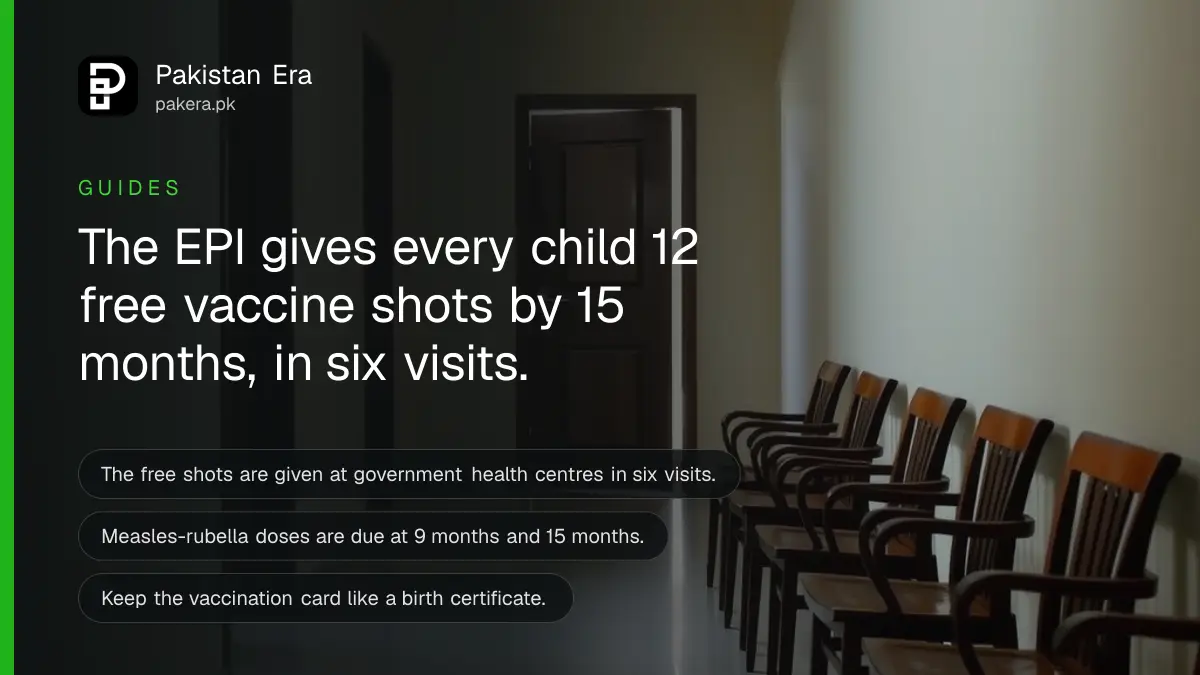
Pakistan's government gives children 12 vaccine shots, free, by the age of 15 months, over six clinic visits. The visits fall at birth, 6 weeks, 10 weeks, 14 weeks, 9 months and 15 months. Take your baby to any government health centre and carry the vaccination card every time.
Update, 11 October 2026: Punjab also runs Aaghosh, a programme for pregnant mothers.
A new mother often gets one list from a relative and a different list from a neighbour. Both are usually a little wrong. The only list that counts is the national schedule of the Expanded Programme on Immunization (EPI), which the Federal Directorate of Immunization (FDI) runs.
We checked this baby vaccination schedule in Pakistan against the World Health Organization (WHO) immunization data for Pakistan, which lists each vaccine and the age it is given, and against the Federal Directorate of Immunization's (FDI) published text. The FDI posts its own schedule as a picture and its website would not open reliably for us, so the table below follows the WHO data.
The EPI schedule runs across six visits up to 15 months
The FDI says children receive 12 vaccine shots by the age of 15 months, in six visits. They protect against 12 diseases, including childhood TB, polio, diarrhoea, pneumonia, diphtheria, whooping cough, tetanus, hepatitis B, meningitis, typhoid, measles and rubella.
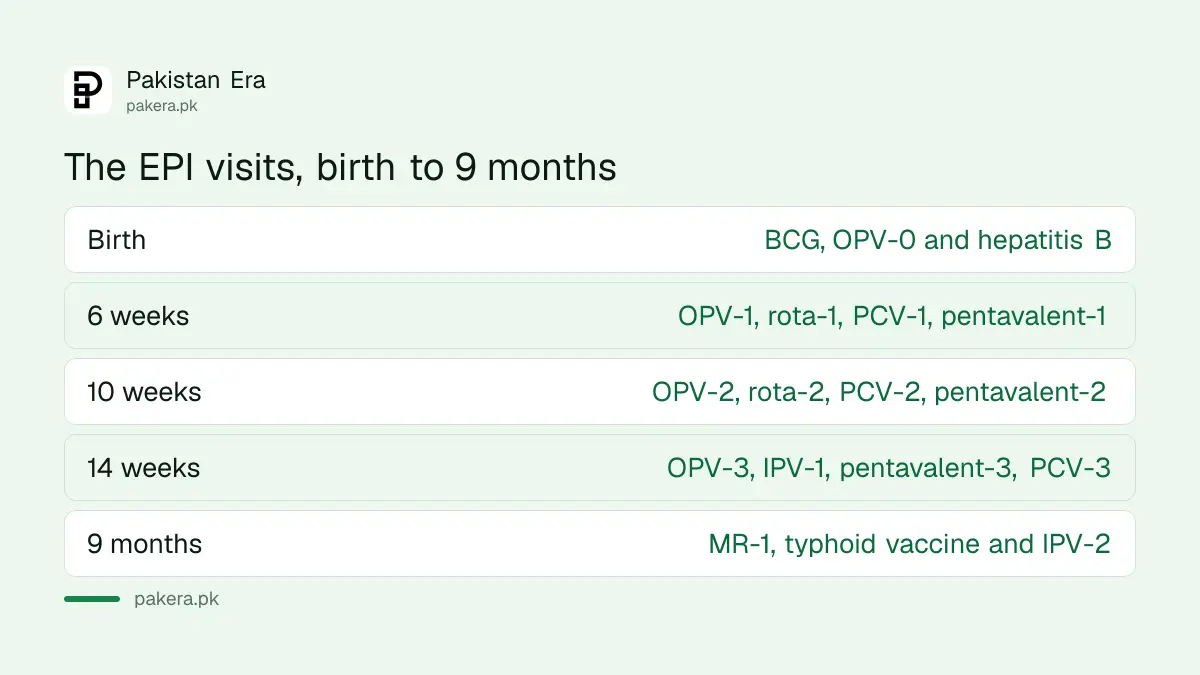
| Age | Vaccines your child gets | Source |
|---|---|---|
| Birth | BCG (TB), the first oral polio drops (OPV-0) and the hepatitis B birth dose | WHO schedule data for Pakistan |
| 6 weeks | OPV-1, rota-1, PCV-1 (pneumonia), pentavalent-1 | WHO schedule data and the FDI page |
| 10 weeks | OPV-2, rota-2, PCV-2, pentavalent-2 | WHO schedule data and the FDI page |
| 14 weeks | OPV-3, IPV-1 (injected polio), pentavalent-3 and PCV-3. There is no rota dose at this visit. | WHO schedule data and the FDI page |
| 9 months | Measles-rubella (MR-1), typhoid conjugate vaccine (TCV) and the second polio injection (IPV-2) | WHO schedule data and the FDI page |
| 15 months | Measles-rubella (MR-2) | WHO schedule data and the FDI page |
Pentavalent is one shot that protects against five diseases: diphtheria, whooping cough, tetanus, hepatitis B and Hib, a cause of meningitis. PCV protects against pneumococcal pneumonia. Rota protects against the virus behind severe baby diarrhoea.
Government health centres give every EPI vaccine free
The FDI states that its aim is free vaccines for every Pakistani child and mother, through government health facilities. That means Basic Health Units (BHUs), mother and child health centres, and district and tehsil hospitals. The vaccine itself costs nothing.
If anyone asks you to pay for an EPI dose, say no and ask to speak to the in-charge. For vaccine questions you can also call 1166, the free Sehat Tahaffuz helpline that the FDI lists on its HPV leaflet.
Private clinics sell the same vaccines, and they also sell extras that the government schedule does not cover. If you use a private clinic, ask for every dose to be written on the same card, so the record stays in one place.
How to follow the schedule visit by visit
The routine is simple once you have done it twice. Most mothers say the first visit is the confusing one.
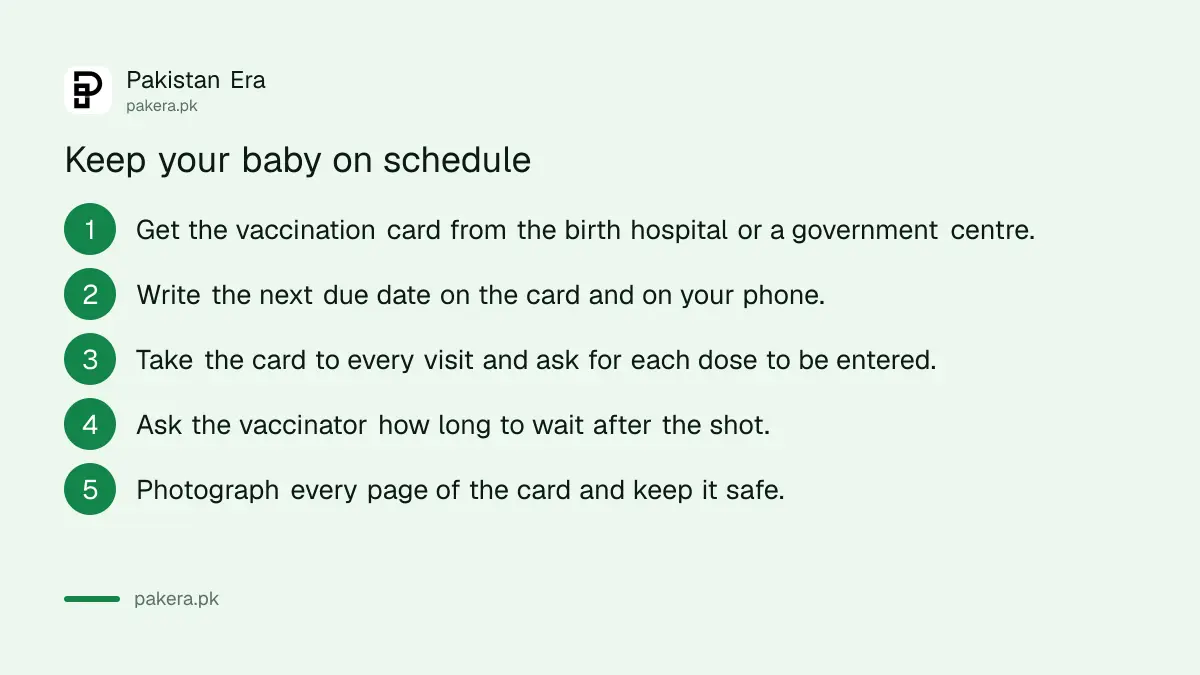
- Ask for the vaccination card at the birth hospital, or at your nearest government centre if you did not get one.
- Write the next due date on the card and on your phone calendar before you leave.
- Take the card to every visit, and to any doctor, and ask that new doses be entered.
- Ask the vaccinator how long to stay after the shot, in case your baby reacts.
- Photograph each page of the card and keep the photo somewhere safe.
Mild fever and a sore, swollen leg are common for a day or two. A baby who is very sleepy, will not feed or has a high fever needs a doctor the same day.
The vaccination card is your child's proof, so guard it
The FDI says every dose must be recorded on the immunization card, and that parents should keep it as carefully as a birth certificate. Schools, hospitals and some visa offices ask for it later.
If you lose it, go back to the centre that gave the vaccines. Centres keep their own register, so the staff can often copy your child's doses onto a new card. We could not find an FDI notice that sets a formal replacement process, so treat this as common practice, not a published rule. Ask for the entry to be stamped and signed.
If your child was vaccinated in several places and no record survives, ask a paediatrician before repeating any dose. Do not restart the series on your own.
The card also helps when you register your child with the state. The steps for the child's registration form are in how to get a NADRA B-form for your child, and a photocopy of the card can sit in the same file.
A missed dose is picked up where you stopped
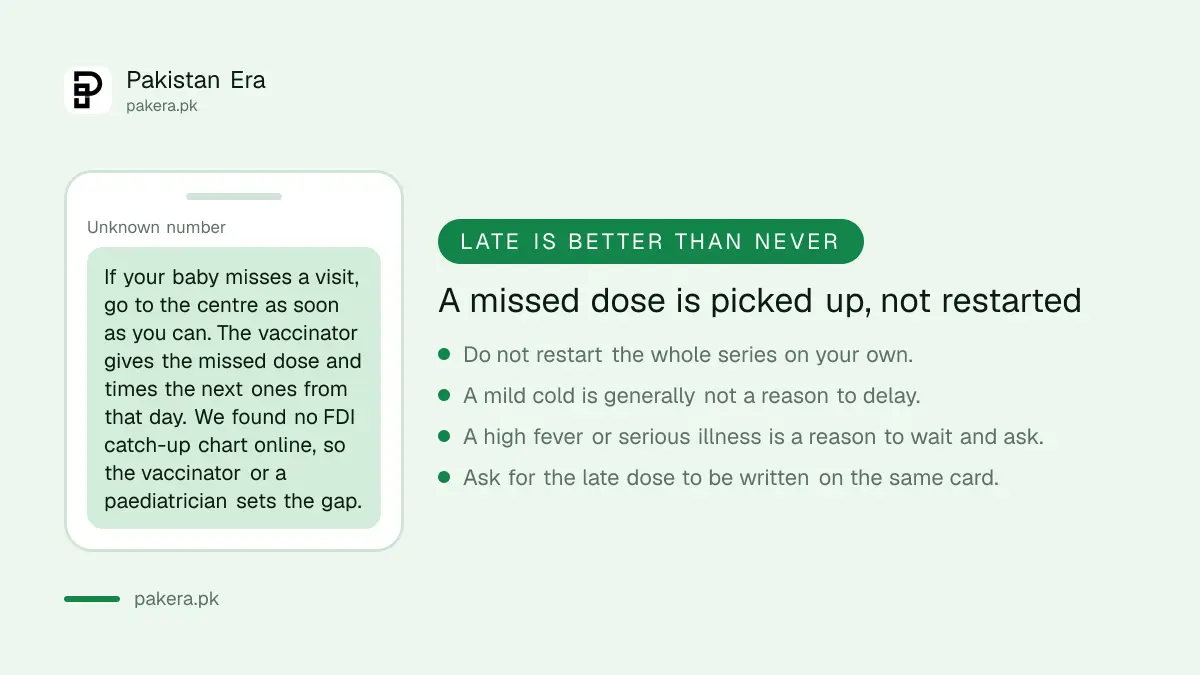
The general medical rule is to continue the series, not to start again. If your baby is late for the 10 week dose, the vaccinator gives it on the day you arrive, and the later doses are timed from there. We could not find an FDI catch-up chart online, so the vaccinator or a paediatrician has to set the exact gap.
A mild cold is generally not a reason to delay. A serious illness or high fever is, and the vaccinator will tell you.
Polio drops and HPV sit outside the six visits
Polio drops also come in house to house campaigns, on top of the doses in the table. Those extra drops do not replace a clinic dose. With the virus still circulating, as in Pakistan's polio cases this year, give the drops every time they are offered. The latest count is in the sixth polio case of 2026.
The HPV shot is not part of the baby schedule. It is a single dose for girls aged 9 to 14, given in campaigns. Details are in the free HPV vaccine for girls.
Common questions
Are all baby vaccines in Pakistan free?
The EPI vaccines are free at government health centres. Extra vaccines outside the EPI list cost money, mainly at private clinics.
How many vaccines does a child get by 15 months?
The FDI says 12 vaccine shots across six visits, from birth to 15 months.
At what age is the measles vaccine given in Pakistan?
The first measles-rubella dose is given at 9 months and the second at 15 months.
Is the typhoid vaccine part of the free schedule?
Yes. WHO says Pakistan was the first country to put the typhoid conjugate vaccine into its routine schedule, starting in Sindh in 2019. Punjab and Islamabad followed in 2021. Ask your centre if it has stock.
What if I lost my child's vaccination card?
Go back to the centre that gave the vaccines and ask them to copy the entries from their register. Do not repeat doses on your own.
Can I vaccinate my baby at a private hospital instead?
Yes, but you pay, and you should ask that every dose goes on the same card.
How we verified this
What we checked, where we read it, and what we could not confirm.
Last checked 7 October 2026. We read the Federal Directorate of Immunization's published schedule text, its FAQ page and national immunization policy listing, and the WHO Eastern Mediterranean pages on Pakistan's typhoid vaccine and immunization programme. The schedule table follows the WHO Immunization Data portal's vaccination schedule file for Pakistan (2025 data, downloaded 7 October 2026). The FDI schedule itself is an image and its site did not load reliably for us, so the FDI cross-check uses its published text only. The government can change the schedule, so check it against your child's card or ask the vaccinator. This article is general information, not medical advice. For your child's health, speak to a doctor.
About the author
Public Services and Education Journalist
Fajr Riaz is a journalist and content writer at Pakistan Era, based in Lahore. She covers the questions people meet in everyday life in Pakistan: how a public service works, what a change in the rules means, and where to find a reliable answer.