Pakistan Has Recorded 4 Polio Cases in 2026
Four polio cases in 2026: two in Bannu, one each in North Waziristan and Sujawal, after 31 in 2025 and 74 in 2024. What it means.
Pakistan has recorded four wild poliovirus cases in 2026: two in Bannu and one each in North Waziristan and Sujawal. That follows 31 cases in 2025 and 74 in 2024, so the direction is right and the disease is still here.
Update, 11 October 2026: NIH counted 49 suspected acute flaccid paralysis cases in week 38.
Update, 1 October 2026: the polio programme confirmed a fifth case of 2026 on 29 September, a 17-month-old girl in Bannu District. The 2026 total is now five, three of them in Bannu District. Details are in Pakistan confirms fifth polio case of 2026 in Bannu. Figures below this line are as first published.
Four is not zero. Polio has come back from a low before, and the year the country came closest is the reason the campaigns keep running.
We first read the case figures on 7 September 2026 and updated them on 28 September 2026 from poliofreepakistan.gov.pk, the Pakistan Polio Eradication Programme site, which confirmed the fourth case on 11 September.
The count, year by year
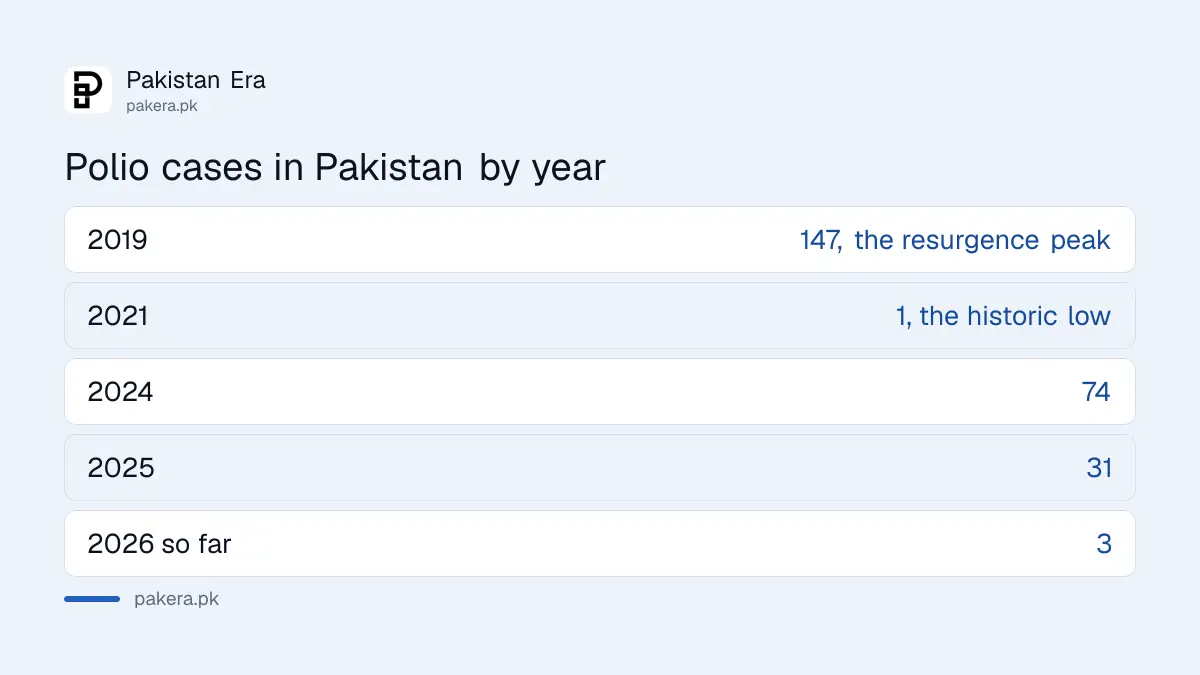
| Year | Cases | What the programme calls it |
|---|---|---|
| 2019 | 147 | Resurgence peak |
| 2021 | 1 | Historic low |
| 2024 | 74 | Post Covid comeback |
| 2025 | 31 | Renewed strategy |
| 2026 so far | 4 | Bannu (2), North Waziristan, Sujawal |
Read the 2021 and 2024 rows together, because that pair is the whole argument. One case in 2021, then 147 the year of the peak behind it and 74 three years after it.
What one case means
A reported case is a child paralysed. It is not the number of infections.
Most poliovirus infections cause no paralysis at all, so a country that reports a small number of cases still has the virus circulating in far more children than the count suggests. That is why the programme runs environmental surveillance on sewage samples rather than waiting for paralysis to appear.
It is also why a drop from 74 to 31 to 3 is progress rather than victory. The gap between one case and a hundred and forty seven has been crossed before, in the wrong direction.
Where it has concentrated
The programme publishes provincial totals for 2015 to 2025 together, and they are lopsided.
Khyber Pakhtunkhwa recorded 214 cases over that period. Sindh recorded 104. Balochistan recorded 81. Punjab recorded 31. Gilgit Baltistan, Azad Jammu and Kashmir and Islamabad together recorded two to three.
The three districts named for 2026, Sujawal in Sindh and Bannu and North Waziristan in Khyber Pakhtunkhwa, sit inside the two provinces carrying most of that history.
Why children get vaccinated again and again
The most common question at the door is why a child who was vaccinated last month is being vaccinated again.
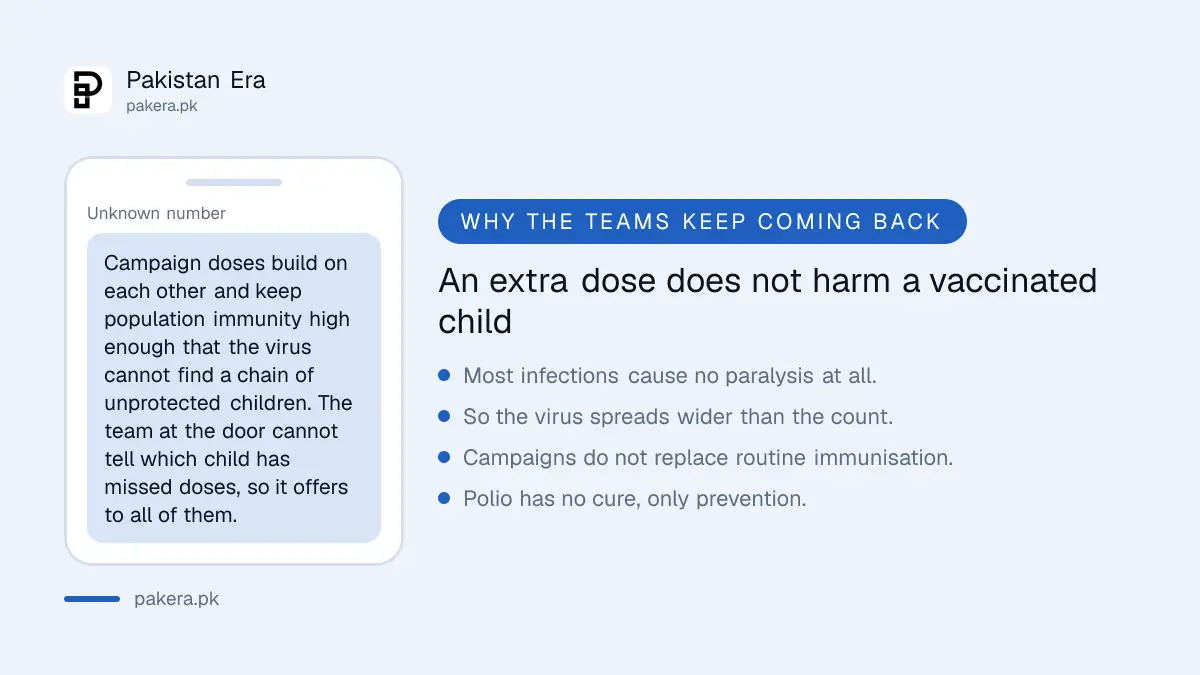
The oral vaccine used in campaigns is not a single course that finishes. Each round adds to a child's protection, and campaigns are repeated because immunity in a population has to be kept high enough that the virus cannot find a chain of unprotected children to move through.
A child who has had every routine dose is not harmed by another campaign dose. A child who has missed doses is exactly who the round exists for, and the team at the door has no way of knowing which is which.
Routine immunisation is the other half of it and it is not replaced by campaigns. Our guide to registering a child and getting a B Form covers the document that follows a child through the health and school systems.
What a household is asked to do
- Let every child under five take the drops, including newborns and children vaccinated in an earlier round.
- Check the finger marking afterwards, because that is how coverage is recorded.
- Tell the team about any child who was out of the house, so they can return.
- Keep the routine immunisation card up to date separately from campaign rounds.
- Ask for the team's identification if you are unsure who is at the door.
Campaign dates are announced locally rather than nationally, usually by the district administration. Reporting in early September 2026 described a drive beginning on 21 September covering Punjab districts including Lahore and Rawalpindi. We could not confirm that date on the national programme's own pages, so treat it as reported and check your district administration's announcement.
What we could not verify, and why we are saying so
A campaign ran from 21 to 27 September 2026 in 115 high-risk districts, the fourth of the year, according to poliofreepakistan.gov.pk. The details are in our report on the September polio campaign. No date for the next campaign had been published by 28 September.
The case figures above are published and we are quoting them. The campaign dates are not, so we are not presenting a date as fact on the strength of news coverage alone.
If you need the date for your area, the district administration announcement is the source that actually governs it, and it is usually issued a few days ahead.
Health services this connects to
Polio has no cure, which is the entire reason the effort goes into prevention rather than treatment. A child paralysed by polio needs long term support rather than a course of medicine.
Our guide to getting a disability certificate and Special CNIC covers the documents that unlock support, and our guide to medical assistance from Bait-ul-Mal covers help with treatment costs. Our guide to free health programmes in Punjab beyond the Sehat Card covers what else is available without paying.
Common questions
How many polio cases has Pakistan had in 2026?
Four confirmed cases: two in Bannu and one each in North Waziristan and Sujawal.
How does that compare with last year?
The programme records 31 cases in 2025 and 74 in 2024.
Which province has had the most?
Khyber Pakhtunkhwa, with 214 cases across 2015 to 2025, followed by Sindh with 104.
Why is my child given drops again?
Campaign doses build on each other and keep population immunity high. An extra dose does not harm a fully vaccinated child.
When is the next campaign in my area?
Dates are announced by district administrations. We could not find a published national schedule for September 2026.
Does a low case count mean polio is gone?
No. Most infections cause no paralysis, so the virus circulates more widely than the case count shows.
How we verified this
What we checked, where we read it, and what we could not confirm.
Last checked 7 September 2026. The case figures are taken from poliofreepakistan.gov.pk, the site of the Pakistan Polio Eradication Programme, updated on 28 September 2026: four confirmed cases in 2026, two in Bannu and one each in North Waziristan and Sujawal; 147 cases in 2019 described as the resurgence peak; one case in 2021 described as the historic low; 74 cases in 2024; 31 cases in 2025; and provincial totals for 2015 to 2025 of 214 in Khyber Pakhtunkhwa, 104 in Sindh, 81 in Balochistan, 31 in Punjab and two to three across Gilgit Baltistan, Azad Jammu and Kashmir and Islamabad. We also opened poliofreepakistan.gov.pk on the same date and did not find a published 2026 campaign schedule there; the most recent dated item we could reach was from December 2024. The campaign beginning on 21 September 2026 in Punjab districts including Lahore and Rawalpindi is reported in news coverage from early September 2026 and we could not confirm it on a government page, so it is described here as reported rather than stated as fact. The general points about most poliovirus infections not causing paralysis, about environmental surveillance of sewage samples, and about repeated campaign doses maintaining population immunity, are standard descriptions of how the programme works rather than figures taken from a particular page. Check your district administration's announcement for campaign dates in your area. Nothing here is medical advice, and questions about a particular child should go to a doctor or the routine immunisation centre.
About the author

Public Services and Education Journalist
Fajr Riaz is a journalist and content writer at Pakistan Era, based in Lahore. She covers the questions people meet in everyday life in Pakistan: how a public service works, what a change in the rules means, and where to find a reliable answer.