PPSC Mental Ability and Reasoning Test Guidebook: 4 Areas, 100 Marks and 33% to Qualify in Punjab CCE
PPSC has published its Mental Ability and Reasoning Test guidebook for CCE: 4 areas, 100 marks, 33% to qualify, negative marking. Samples and what is missing.
یہ صفحہ اردو میں پڑھیں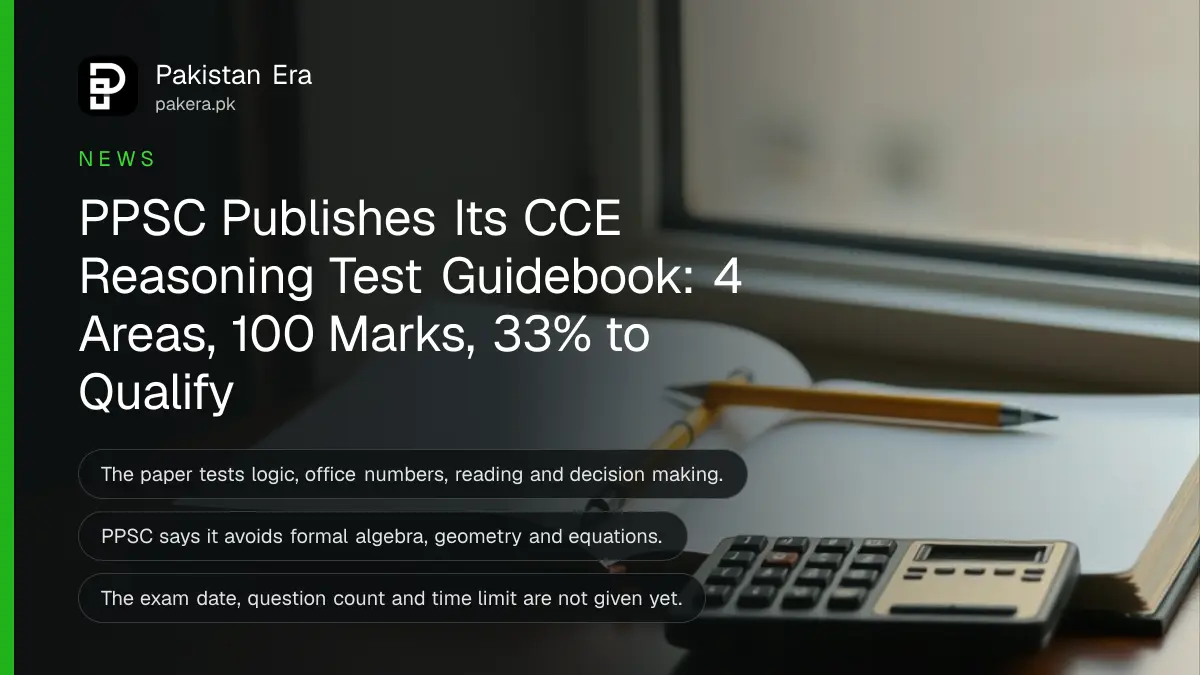
PPSC has published an 18-page guidebook for the Mental Ability and Reasoning Test in its Combined Competitive Examination. The paper is 100 marks of MCQs in four areas, with a 33% qualifying mark and negative marking. It says the CCE is expected in 2027.
Punjab candidates have had a new paper to prepare for since the Punjab Public Service Commission (PPSC) added it to the syllabus, with little detail on what it looks like. Now there is an official answer. PPSC added the guidebook and a press release to its home page, both with file dates of 6 November 2026, and we read both on 7 November.
The surprise is what it is not. This is not an IQ puzzle book. PPSC says the paper checks whether a candidate can think like an administrative officer: read a rule, spot a wrong figure, and decide what to do first. The rest of the CCE structure is in our page on the PPSC CCE revised syllabus.
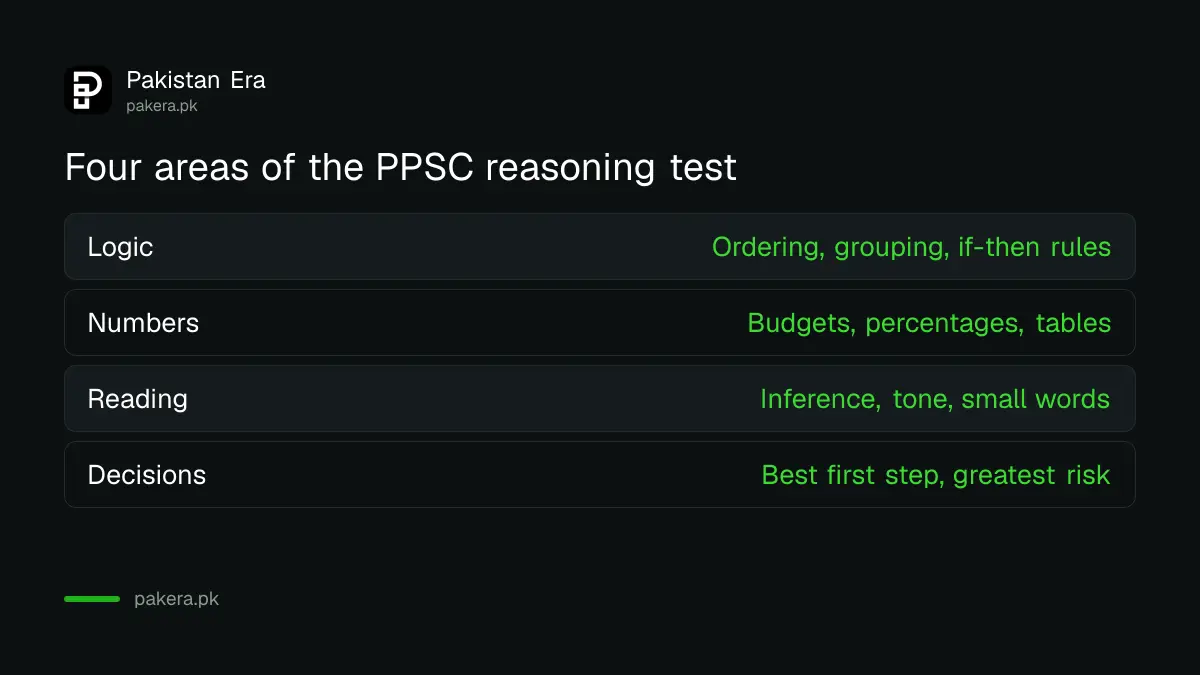
The guidebook splits the test into four areas
PPSC lists four sub-areas and gives worked sample questions for each one. Together they make up Paper II of the CCE. The guide does not say how many questions come from each area, or how many questions the whole paper has.
| Area | What PPSC says it checks | Question types it names |
|---|---|---|
| Logical and Analytical Reasoning | Sorting confusing information and drawing conclusions from rules | Ordering, grouping, scheduling, arrangement, if-then, patterns |
| Quantitative and Numeric Processing | Practical numbers at work, not advanced maths | Percentages, ratios, budgets, invoices, tables, charts, error detection |
| Reading and Verbal Comprehension | Understanding policies, reports, letters and instructions | Vocabulary in context, analogies, passages, inference, tone |
| Problem Solving and Decision Making | Judgment in real office situations | Most or least appropriate action, best first step, greatest risk, what to escalate |
Numbers are about budgets, not algebra
PPSC plainly says this section avoids formal algebra, geometry and equations. It tests percentages, budgets, ratios, tables and checking for errors. If your maths stopped at matric, that should be a relief, but accuracy under time pressure is still what the paper rewards.
Here is one of its samples in short. A department bought 12 chairs for Rs 96,000 and now needs 5 more at a flat 10% discount. The unit price is Rs 8,000, the discounted price is Rs 7,200, and five chairs cost Rs 36,000. That is the level: office arithmetic, read carefully.
Another sample has no calculation at all. It lists four people with ID and slip digits, and asks which record does not match. Person Y's ID ends 6358 and the slip ends 6538. The whole question is whether you noticed two swapped digits.
Logic questions turn rules into a small puzzle
The logic section gives a few rules and asks what must, could or cannot be true. PPSC warns against outside knowledge: answer only from what the question gives you. Its advice is to write the rules in short symbols and draw slots or a simple grid.
One sample has five files reviewed one at a time. Finance must come before HR. Which cannot be first? HR, because Finance always comes ahead of it. Another gives a code for BORED and asks you to apply it to ROBED. And one tricky answer is "cannot be determined", so that option is sometimes correct.
Reading questions test small words that change meaning
PPSC says an officer can know every word in a letter and still miss the instruction. So the paper tests words like although, unless, provided that and except. It wants you to separate what a text says from what it implies, without adding your own assumptions.
Take its leave policy sample. Staff must apply five working days ahead "unless the absence is due to an unforeseen emergency". An employee falls ill suddenly. The correct reading is that the five-day rule may not apply. One word, "unless", carries the whole answer.
Decision questions reward the measured first step
This area puts you in an office with a problem and asks what to do. PPSC's advice is to remove any option that breaks law, ethics or safety, then drop the extreme and the passive answers. The right choice is usually measured, practical and open to follow-up.
One sample: a staff member with a clean three-year record has started coming late. Options include a formal warning, a pay cut, a private talk, or doing nothing. PPSC's answer is the private meeting, since it finds the cause before any punishment. In a real paper, the harsh option and the lazy option are often the two you can eliminate first.
A simple way to use the guidebook
Read it as a map of the test, not as a question bank. Solve the samples without looking at the answers, then read PPSC's explanation for each one. This plan is our suggestion, not PPSC's. The negative marking means guessing can cost you, so slow accuracy beats rushing.
- Download the PPSC guidebook PDF from the Commission's own site.
- Solve the samples for all four areas with a timer, and mark which area costs you the most.
- Practise percentages, ratios and reading tables for 20 minutes a day.
- Read one government notice a day, and write down what it requires, by when, and with what exception.
- Practise rewriting logic rules as short symbols, as the guide suggests.
- Review the PPSC passing marks and negative marking for other papers, because this paper's own cut-off is different.
What the PPSC guidebook does not tell you yet
The guidebook leaves out the things most candidates will ask first. It gives no exam date, no count of questions, no time limit and no value for the negative mark. The press release also warns that the 33% qualifying mark may be revised after analysis.
| Question | What we found |
|---|---|
| Total marks for this paper | 100, MCQs (press release) |
| Qualifying mark | 33%, with negative marking, "may be revised" (press release) |
| Exam date | Not given. The release says only "expected to be held in 2027" |
| Number of questions and time | Not given |
| Marks lost per wrong answer | Not given |
| Questions per area | Not given |
Be careful with anyone selling a past paper for this test today. The test is new in this form, and the only official samples we found are the ones in the guide. Our note on checking the real PPSC website covers fake pages that ask for money.
Common questions
What is the Mental Ability and Reasoning Test in PPSC CCE?
It is Paper II of the revised Combined Competitive Examination, worth 100 marks in MCQs. It covers logic, numbers, reading and decision making.
What are the passing marks for the PPSC mental ability paper?
The press release sets a 33% qualifying mark with negative marking for the forthcoming CCE. PPSC says it may revise this later.
Is advanced maths needed for the PPSC reasoning test?
No. PPSC says it avoids formal algebra, geometry and equations, and focuses on practical numbers such as budgets and percentages.
When is the next PPSC CCE?
PPSC only says it is expected in 2027. It has not given a date in these two documents.
Where can I download the guidebook?
From the notices on the PPSC home page, listed as guidelines for the Mental Ability and Reasoning Test.
Does the guidebook replace the syllabus?
No. It covers only Paper II. The other 10 papers are listed in the press release.
What we checked and sources
On 7 November 2026 we read the PPSC home page, the 18-page Mental Ability and Reasoning Test guidebook and the press release on the Combined Competitive Examination. The 6 November date comes from the file names and file details, because neither document prints a date. The samples are from PPSC, shortened in our own words.
About the author

Tax, Bills and Technology Writer
Ali Akhtar is a young and curious voice here at Pakistan Era. He is currently pursuing his A-Levels and has a growing interest in Pakistan’s changing industrial landscape and educational trends. Ali likes to write in a way that helps him explain and explore the world around him. His writing reflects the perspective of the new generation navigating the evolving trends of Pakistan where technology, youth innovation, and shifting opportunities are reshaping the country’s future.