Pakistan Reports 49 Suspected AFP Paralysis Cases in a Week, KP 34
NIH's week 38 bulletin counts 49 suspected AFP paralysis cases in Pakistan, down from 63. They are not confirmed polio. See where they came from and what to do.
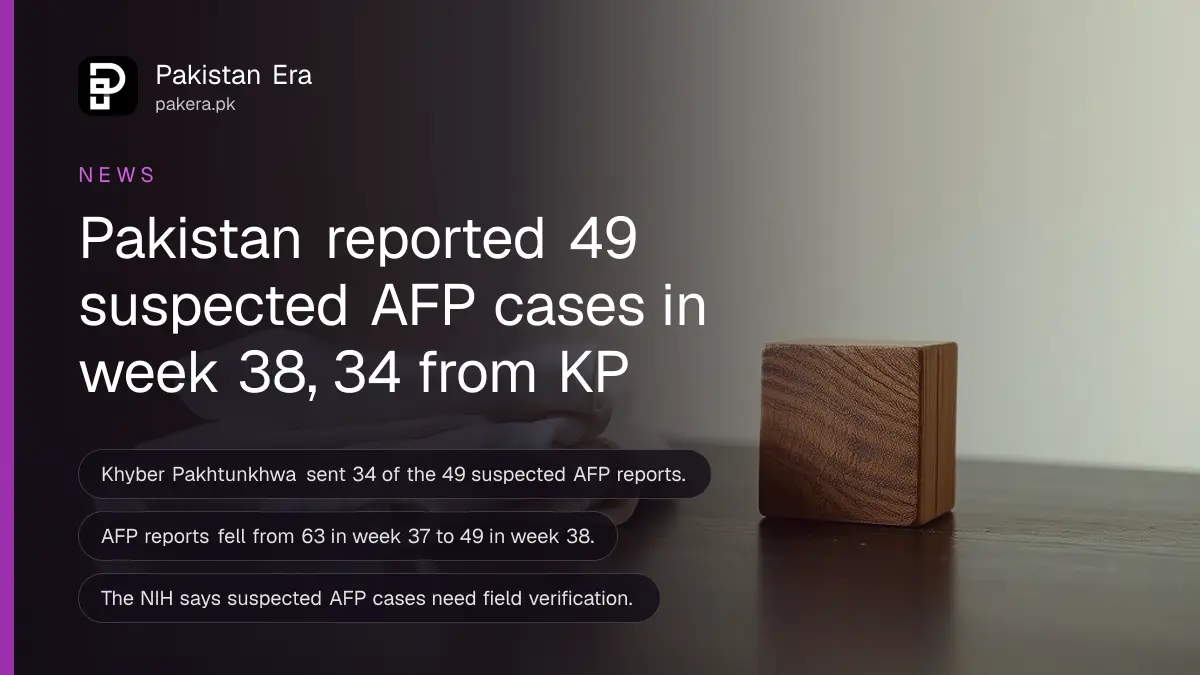
Short answer: Pakistan reported 49 suspected acute flaccid paralysis (AFP) cases in week 38 of 2026, down from 63 the week before, the National Institutes of Health (NIH) says. Khyber Pakhtunkhwa sent 34 and Sindh 12. These are suspected cases only, and not confirmed polio. A child with sudden weakness in a limb needs a doctor and a report at once.
The NIH put the bulletin online on Friday 9 October 2026. We read the week 38 and week 37 tables ourselves. Punjab did not report in either week, so the national count leaves out the largest province.
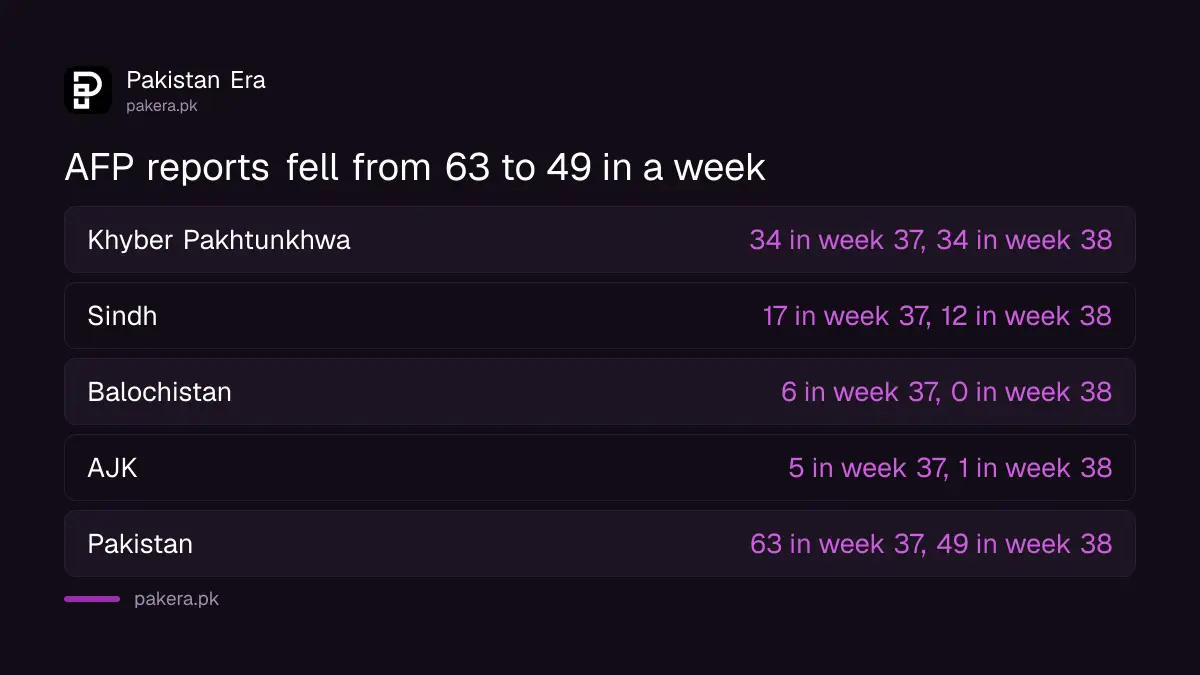
AFP reports fell from 63 to 49 in one week
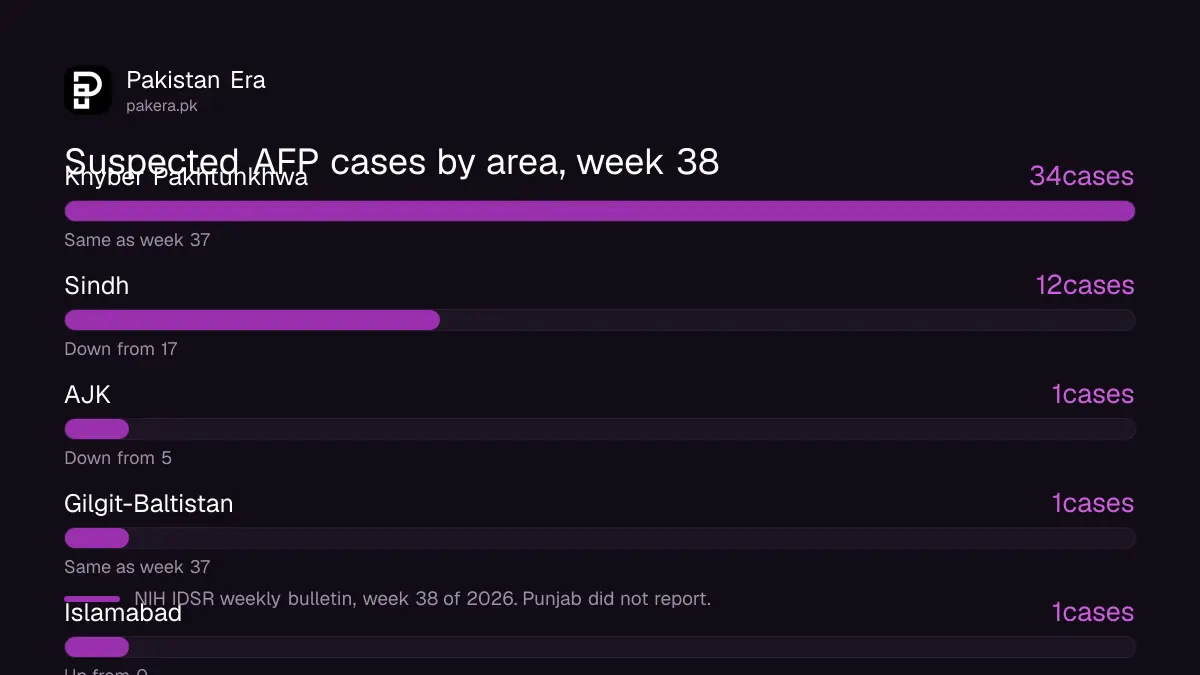
Suspected AFP cases in Pakistan fell by 14 in week 38, from 63 to 49. Khyber Pakhtunkhwa again reported 34. Sindh reported 12, down from 17. Balochistan reported none, down from 6. AJK, Gilgit-Baltistan and Islamabad reported 1 each.
The NIH counts these cases through its Integrated Disease Surveillance and Response system, called IDSR. Clinics in 158 districts send weekly forms. The bulletin says the AFP cases are suspected and need field verification. It lists AFP among the diseases that declined in Sindh and AJK this week.
| Area | Week 37 | Week 38 |
|---|---|---|
| Khyber Pakhtunkhwa | 34 | 34 |
| Sindh | 17 | 12 |
| Balochistan | 6 | 0 |
| AJK | 5 | 1 |
| Gilgit-Baltistan | 1 | 1 |
| Islamabad | 0 | 1 |
| Punjab | NR | NR |
| Pakistan | 63 | 49 |
NR means not reported. The bulletin does not explain why Punjab is missing.
A suspected AFP case is not a polio case
AFP means sudden weakness or floppy paralysis in a limb. Polio is one cause, but not the only one. Every AFP report must be investigated and tested before anyone can call it polio. The NIH bulletin itself calls these cases suspected and says they need field verification.
That explanation of why AFP is counted is general medical knowledge, and it is not written in the bulletin. What the bulletin does say is that the cases are suspected and unverified. Confirmed polio cases are announced separately by the polio programme. We reported the latest in the sixth polio case of 2026, and keep the running count in polio cases in Pakistan in 2026.
Khyber Pakhtunkhwa sends two thirds of the reports
Khyber Pakhtunkhwa sent 34 of the 49 AFP reports in week 38, about 69 per cent. It sent 34 of 63 the week before, about 54 per cent. The NIH does not give AFP counts by district in this bulletin, so we cannot say where in the province they came from.
A count of AFP reports is not a count of polio. The bulletin does not say what a normal weekly number is, and it does not say whether 49 is high or low. We cannot judge that from one bulletin, and the NIH makes no such claim.
The vaccine is the protection, and the helpline takes reports
The World Health Organization (WHO) says there is no cure for polio, and that it can only be prevented. A polio vaccine given multiple times can protect a child for life. Polio mainly affects children under five, and one in 200 infections leads to irreversible paralysis, usually in the legs.
The national polio programme lists a toll-free helpline, 1166, on its official page. It says callers can report missed vaccination teams and ask about booster schedules. Our report on the last campaign is in the October 2026 polio campaign result, and the routine schedule is in the baby vaccination schedule.
- Take a child with sudden weakness, floppy limbs or inability to stand to a doctor at once.
- Ask the doctor to report it, so it can be tested.
- Check that your child has every polio dose for their age.
- Let the vaccination team in when it visits.
- Call 1166 if a team misses your street.
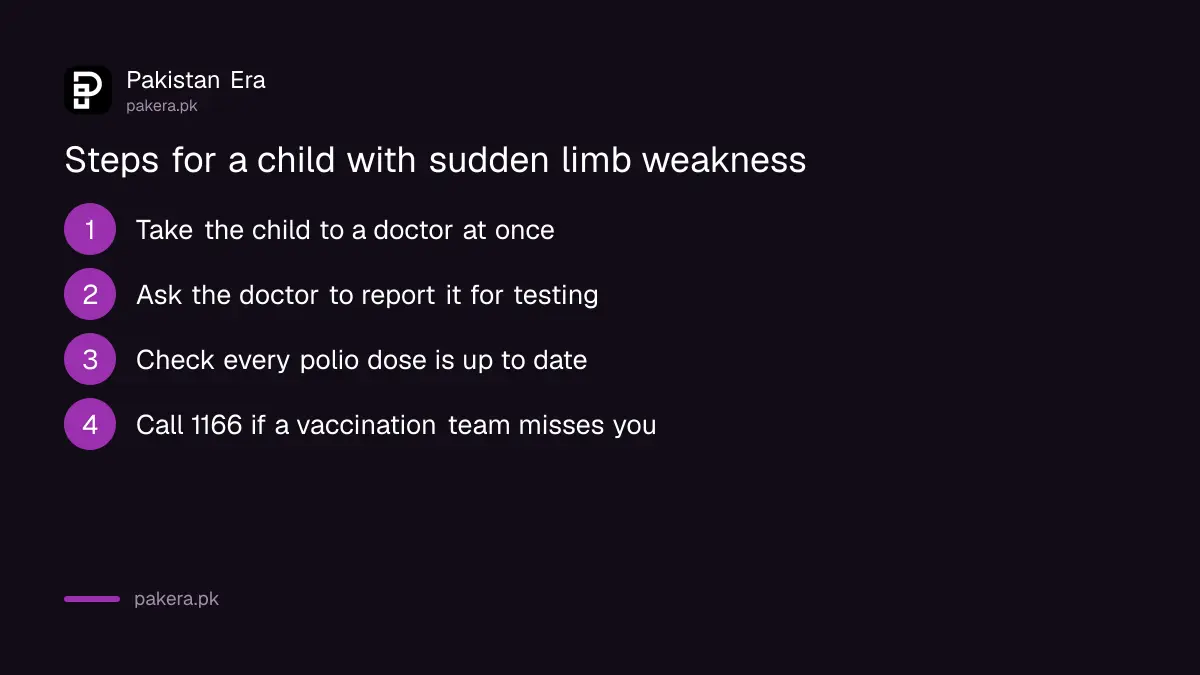
Steps 1 and 2 are our plain-language advice, and are not instructions printed in the bulletin.
What the NIH asks health departments to do
The week 38 bulletin does not list AFP on its public health actions page. That page covers viral hepatitis and dog bites this week. For AFP the bulletin only gives the counts and the note that suspected cases need field verification.
So there is no official order to read into this number. Treat it as a count of reports sent to the NIH. If a confirmed polio case appears, the polio programme announces it separately, and we will report it.
Common questions
How many AFP cases did Pakistan report in week 38?
The NIH counted 49 suspected AFP cases in week 38 of 2026, down from 63. Khyber Pakhtunkhwa reported 34, Sindh 12, and AJK, Gilgit-Baltistan and Islamabad 1 each.
Does AFP mean polio?
No. AFP is a symptom, sudden weakness or floppy paralysis. Polio is one possible cause. The NIH calls these cases suspected and says they need field verification.
Are these new polio cases?
No. Confirmed polio cases are announced by the polio programme, not in this weekly table. Our latest report is on the sixth case of 2026.
What are the first signs of polio?
WHO lists fever, fatigue, headache, vomiting, stiff neck and pain in the limbs as early symptoms. Polio can cause paralysis in a matter of hours.
Can polio be treated?
No. WHO says there is no cure for polio and that it can only be prevented, with repeated doses of polio vaccine.
Who do I call to report a missed polio team?
The national polio programme's official page lists the toll-free line 1166 for reporting missed vaccination teams.
How we verified this
What we checked, where we read it, and what we could not confirm.
Last checked on 11 October 2026. We read the NIH's Public Health Bulletin, Pakistan, Week 38, 2026 and the Week 37 bulletin, both listed on the NIH's IDSR weekly reports page. AFP counts are from Table 1 and the text under it. Polio facts are from the WHO poliomyelitis fact sheet. The helpline is from the programme's Polio in Pakistan page.
About the author

Tax, Bills and Technology Writer
Ali Akhtar is a young and curious voice here at Pakistan Era. He is currently pursuing his A-Levels and has a growing interest in Pakistan’s changing industrial landscape and educational trends. Ali likes to write in a way that helps him explain and explore the world around him. His writing reflects the perspective of the new generation navigating the evolving trends of Pakistan where technology, youth innovation, and shifting opportunities are reshaping the country’s future.