What to Do When Your Street Floods
Urban flooding kills mostly by electrocution, not drowning. What to switch off, what not to walk through, and how to handle a flooded car.
When a Pakistani street floods, the thing most likely to kill you is not the water. It is the electricity in it.
We found that when we looked at this season's deaths: electrocution has been killing more people during the monsoon than drowning, and almost all the safety advice being shared is about water. So this guide starts with the power.
The power, before the water

Standing water in a street is frequently live. A fallen line, a submerged pole base, a leaking connection or a wet meter board is enough, and there is no way to see it.
- Switch off your main breaker before water reaches the level of sockets. Do it early, not once the water is already inside.
- Never touch a switch, plug or appliance with wet hands or standing in water.
- Assume every pole, wire, transformer and metal shutter standing in water is live until somebody with authority says otherwise.
- Keep children away from water near poles and transformers. This is where the deaths cluster.
- Do not try to move a fallen wire, with a stick or anything else. Call it in and keep people back.
We set out why this pattern repeats every year in the piece on electrocution killing more people than drowning.
If you have to go out
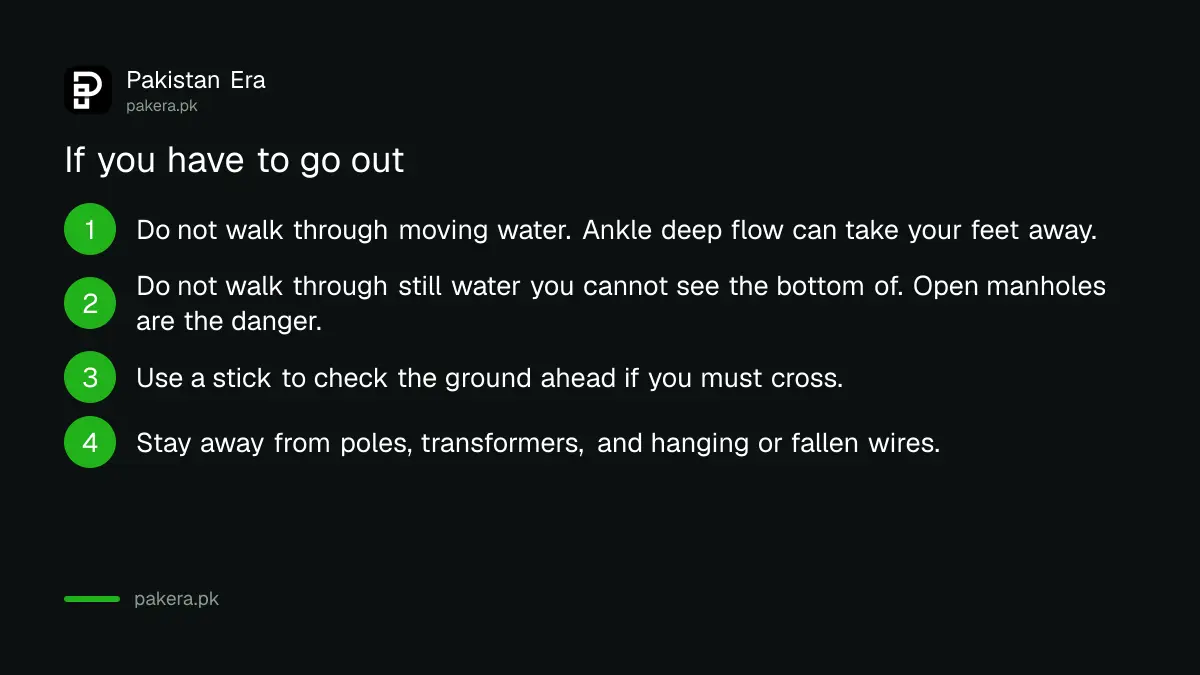
- Do not walk through moving water. Water flowing at ankle depth can take your feet from under you. It does not look dangerous, and that is the problem.
- Do not walk through still water you cannot see the bottom of. The danger is the open manhole, and in Pakistani cities covers are routinely missing or lifted deliberately to drain the road faster.
- If you must cross, use a stick to test the ground ahead of each step.
- Route around poles, transformers and hanging wires, even if it means a longer walk.
- Do not let children play in it. Flood water in a city carries sewage as well as current.
A flooded car
There is one mistake here that turns an expensive problem into a much more expensive one.
| Situation | What to do |
|---|---|
| Water rising around a moving car | Abandon it and get to higher ground. A car is replaceable |
| Engine stalls in water | Do not restart it. Not once, not to see |
| Water reached the floor mats | Have it inspected before driving again |
| Before it is towed | Photograph everything, inside and out, with the water visible |
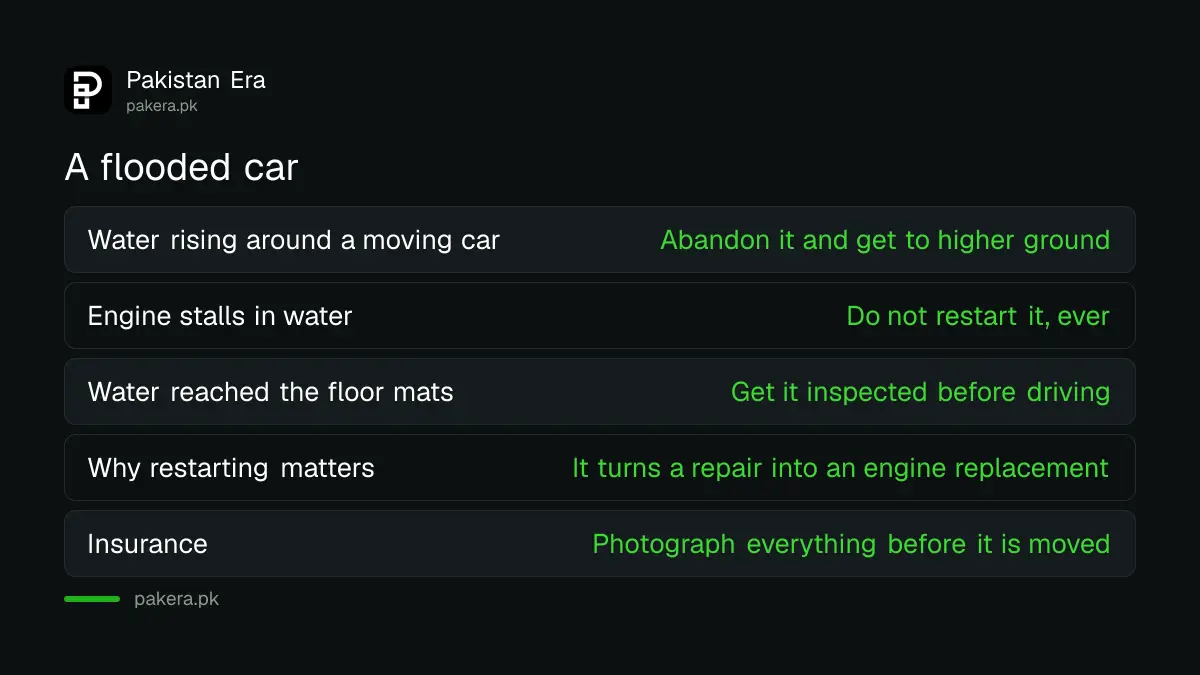
The reason not to restart is mechanical. Water drawn into the cylinders cannot compress, and turning the engine over bends the connecting rods. A stalled car that is drained and dried is often repairable. The same car started once is frequently an engine replacement.
Before the next spell
Monsoon spells arrive in sequence rather than singly, so there is usually time between them.
- Clear the drain outside your gate. Most street level flooding in Pakistani neighbourhoods is a blocked local drain rather than a failed city system.
- Move anything electrical off the floor in ground floor rooms and basements.
- Know where your main breaker is, and make sure somebody else in the house does too.
- Keep a torch that is not your phone, charged, somewhere you can reach in the dark.
- Charge power banks between spells, since outages follow flooding.
- Park uphill if you have the option, even if it means a walk.
Which cities this affects
The Meteorological Department's urban flooding watch covers a long list, including Islamabad, Rawalpindi, Lahore, Faisalabad, Multan, Sialkot, Gujranwala, Gujrat, Sheikhupura, Kasur, Sahiwal, Okara, Bahawalnagar, the Potohar region, Peshawar and Nowshera.
What that list really tells you is that this is not a Karachi problem or a Lahore problem. It is what happens when heavy rain meets drainage built for less, which is most of urban Pakistan.
River flooding is a separate danger with separate warnings, and we track those in the piece on the NDMA flood alert and districts at risk. Which official warning sources are actually updated, and which are more than a week behind, is set out in our test of Pakistan's flood warning websites.
Open water is a different risk again. Canals, ponds and rivers kill children in hot weather with no flood involved at all, which we covered after seven drowned in Sindh over one weekend.
After the water goes
- Do not switch the power back on until sockets and wiring that were submerged have been checked.
- Throw away food and drinking water that touched flood water.
- Wash anything that touched it, and wash your hands properly. Urban flood water is sewage.
- Watch for standing water afterwards, in pots, tyres and coolers. That is where dengue breeds, and the outbreak follows the flooding by a few weeks.
That last point matters more than it sounds. We covered the warning signs that mean go to hospital in the guide to dengue symptoms.
Questions readers are asking
What is the biggest danger in urban flooding in Pakistan?
Electricity. Electrocution has killed more people than drowning this monsoon, usually from fallen lines, submerged pole bases and wet connections.
Should I switch off the electricity if my street floods?
Switch off your main breaker before water reaches socket level, and do not touch switches or plugs with wet hands or while standing in water.
Is it safe to walk through flood water?
Not if it is moving, and not if you cannot see the bottom. Moving water at ankle depth can knock you over, and open manholes are the common hazard in still water.
My car stalled in water. Can I restart it?
No. Restarting can bend the connecting rods and turn a repair into an engine replacement. Have it drained and inspected first.
What should I do after the water goes down?
Have submerged wiring checked before restoring power, discard food and water that touched the flood, wash thoroughly, and clear standing water to prevent dengue.
Which cities are most at risk of urban flooding?
PMD's watch list runs from Islamabad and Rawalpindi through Lahore, Faisalabad, Multan, Sialkot and Gujranwala to Peshawar and Nowshera. It is most of urban Pakistan rather than one city.
About the author

Senior Writer, Public Services and Technology
Shahid joined us in 2024 as an author. He is a senior contributor to Pakistan's leading technology websites. He writes detailed articles, mostly covering his expertise in the latest tech, mobiles, apps, gadgets, and step-by-step guides. His ideology is to help people understand the latest trends and explain complex methods through very easy-to-understand guides.