Seven Children Drowned in Sindh in Two Days, Not in Floods
Four died in a Jacobabad pond and canals, three teenagers in the Indus at Kotri. None of it was flooding, and that changes what helps.
At least seven children and teenagers drowned in Sindh over the weekend of 8 and 9 August 2026. Four in Jacobabad district, three in the Indus near Hyderabad.
Here is the part that matters and that the reports mostly skipped. None of them died in a flood. There was no storm, no swollen river, no rescue that went wrong. Four died in a village pond and two irrigation canals. Three were bathing in the river on a hot day.
That changes what would have prevented it.
What happened, and where
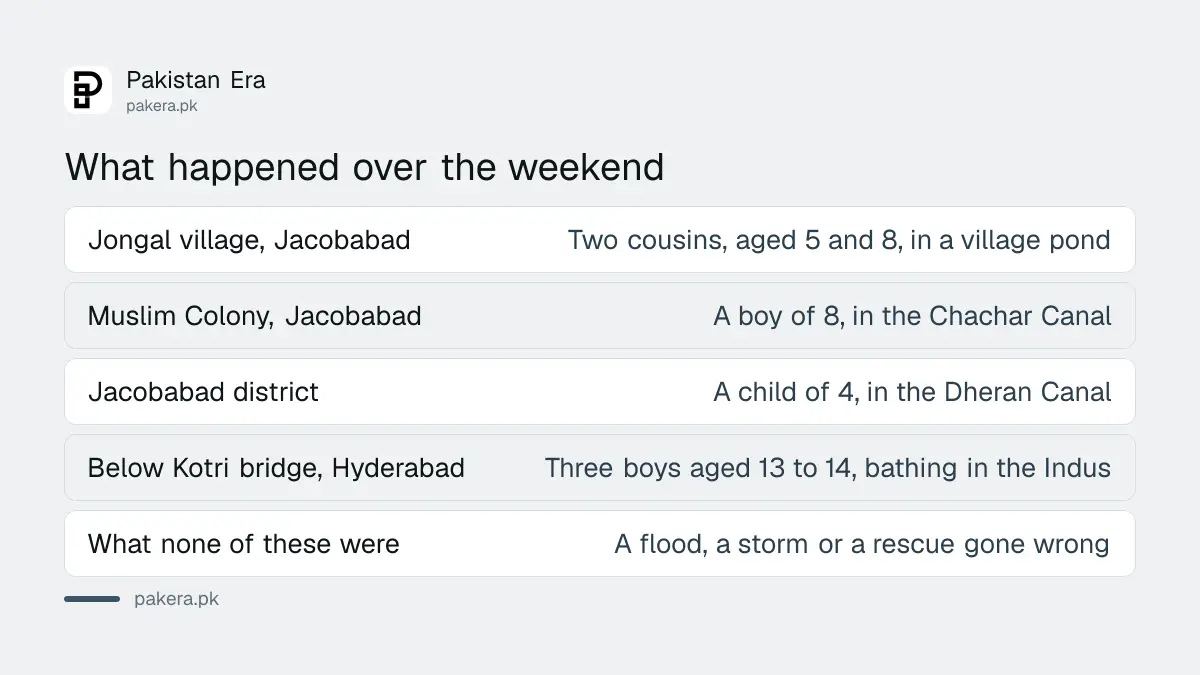
Police reported four deaths in three separate incidents in Jacobabad on Sunday 9 August.
| Place | Water | Who |
|---|---|---|
| Jongal village, Jacobabad | Village pond | Two cousins, aged 5 and 8 |
| Muslim Colony, Jacobabad | Chachar Canal | A boy aged 8 |
| Jacobabad district | Dheran Canal | A child aged 4 |
| Below Kotri bridge, Hyderabad | Indus River | Three boys aged 13 to 14 |
The three in Hyderabad went into the Indus on Saturday to bathe, between Hyderabad and Kotri. Rescue 1122 divers resumed the search on Sunday morning and recovered two of the bodies. One was still missing. Their clothes and slippers were found on the riverbank.
One note on the count. A figure of more than a dozen deaths across the two districts in three days has been widely repeated, and the Hyderabad commissioner cited that scale when issuing the order described below. We could verify seven by name and incident and could not verify the higher number ourselves, so we are reporting seven as the floor rather than the total.
Update, 9 August: the Hyderabad division administration responded by banning swimming and bathing in the Indus and all canals for 30 days under Section 144. We set out that order, and the four others in force across Punjab and Sindh, in where swimming is banned right now.
Four of the seven were under nine years old
The youngest was four. Two were five and eight, and they were cousins, in a pond in their own village.
This is the ordinary shape of child drowning and it is worth saying out loud, because it is not the shape most people picture. Small children do not drown on adventures. They drown in the water nearest to the house, in the few minutes when nobody is watching, and usually without making any noise.
The World Health Organization puts children under five at nearly a quarter of all drowning deaths worldwide. Drowning is the fourth leading cause of death for ages one to four, and the third for ages five to fourteen. About 92 per cent of drowning deaths happen in low and middle income countries.
So a village pond within walking distance of a four year old is not a background detail. It is the hazard.
A canal is not a swimming pool
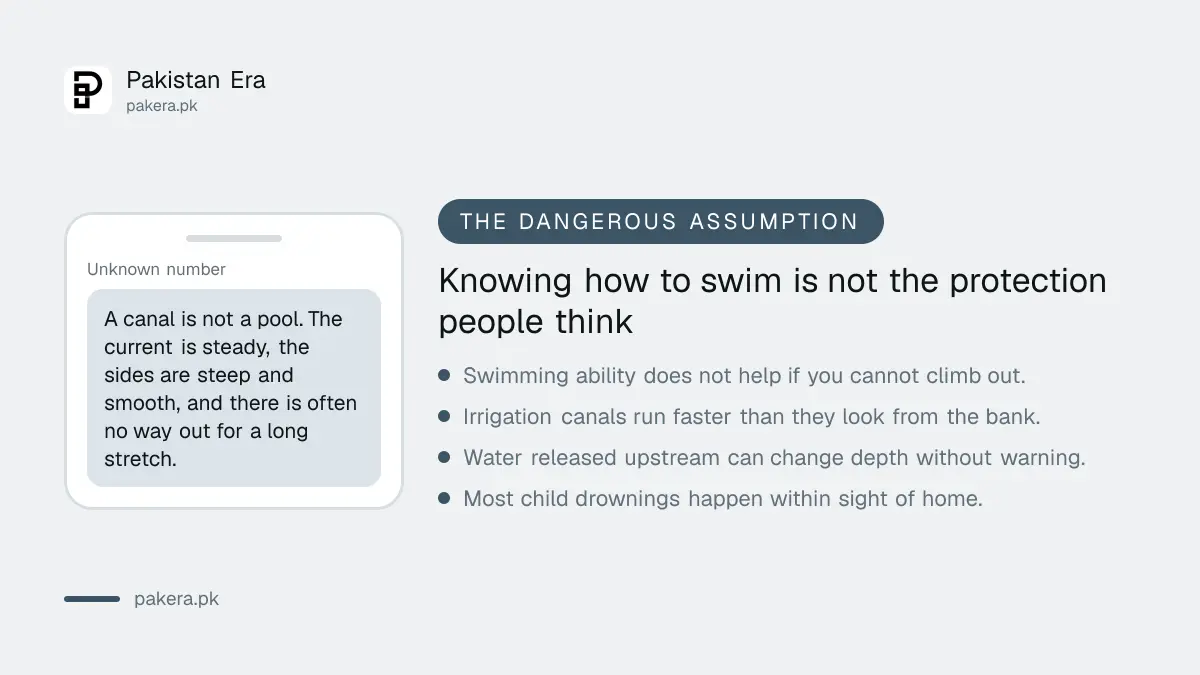
The teenagers in the Indus were old enough to swim and very possibly could. That is exactly why this needs explaining.
An irrigation canal or a river in August is a different problem from a pool:
- The current is steady and stronger than it looks. Flat water on the surface can be moving hard underneath.
- The sides are steep, smooth and often lined. You can be a competent swimmer and still have nothing to grip for a long stretch.
- The depth is not what you judged from the bank. A step can go from knee deep to over your head.
- Water gets released upstream. Levels and speed change during the day without any warning at the bank.
- Cold water takes your breath. The first involuntary gasp is what fills the lungs.
Being able to swim answers one of those five problems. It does not answer the other four.
Never send a person in after a person
This is the single piece of advice worth carrying away, and it is the one most often ignored in the moment.
When somebody is in trouble in a canal, the instinct is to go in. It is a good instinct and it kills people regularly. Both the Hyderabad and Jamshoro districts have earlier cases where more than one person died in a single incident because others followed the first in.
What to do instead:
- Shout for help first. Get other adults to the bank before anything else.
- Throw, do not go. Anything that floats. An empty jerry can, a plastic canister, a rope, a tyre tube.
- Reach from the bank with a branch or a stick if the person is close, and stay low so you cannot be pulled in.
- Call Rescue 1122. Divers and throw lines are what recover somebody from a canal, and they are not far away in most districts.
- Keep watching the water and mark where the person went under, because that point is what the divers will ask for.
Rescue 1122 operates across Sindh as the Sindh Emergency Rescue Service, and 1122 is the number reported for it. We are saying reported rather than verified because the provincial disaster authority website would not open when we tried to read it, which we documented in our test of Pakistan's flood warning websites the same day. The numbers we have been able to read off institutions' own pages are collected in our verified helplines directory.
What actually reduces these deaths
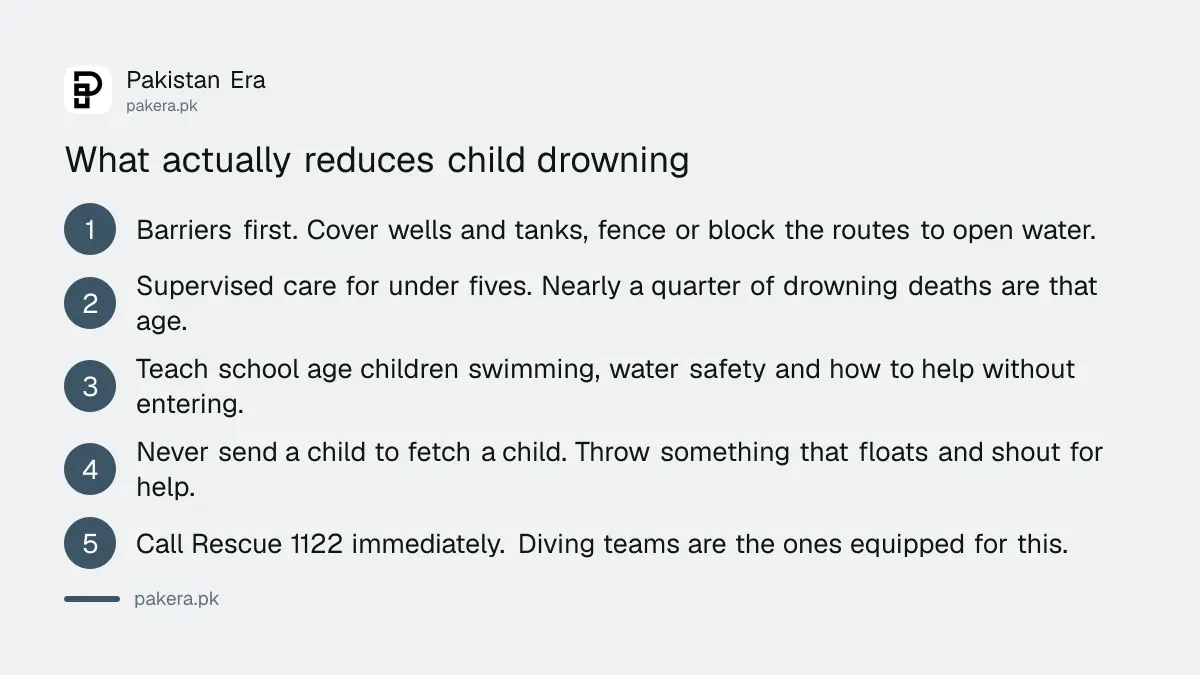
The WHO's prevention guidance is unusually plain, and it is ordered by what works rather than by what is easiest to say.
Barriers come first. Cover wells and open tanks. Block or fence the direct route from home to a pond or canal. This is the intervention with the strongest evidence behind it, and it is the one that would have mattered in Jongal village.
Supervised care for the under fives. Community childcare for preschool children has a measurable effect on drowning deaths. In practice, for most families, it means one named adult is responsible for the small children at any given time, rather than everyone assuming somebody else is looking.
Swimming and water safety for school age children. Not just the stroke. Water safety and how to help somebody without entering the water, taught with proper supervision.
And a rule about time of day. Bathing in a river or canal in the hottest part of the afternoon is when these incidents cluster, because that is when children go in. It is also when the banks are emptiest.
This is a separate problem from the monsoon toll
Pakistan has had a hard monsoon and there is a real death toll from it. That is a different set of deaths from these.
In the National Disaster Management Authority's own breakdown of monsoon fatalities this season, the leading cause is not drowning at all. It is electrocution, which we wrote about in our piece on monsoon deaths and electrocution. Flash floods come next, then drowning.
Keeping the two apart matters because the advice is not the same. Flood advice is about not crossing moving water and staying away from live electricity in a flooded street. What happened in Jacobabad needs a fence and an adult. If you are dealing with water in your street rather than a canal, our guide to urban flooding safety is the one you want.
The wider numbers, for context
Worldwide, the WHO counts about 300,000 drowning deaths a year. People aged nought to twenty nine make up 57 per cent of them.
There is one genuinely hopeful number in that data. The global drowning death rate has fallen 38 per cent since 2000, from 6.1 to 3.8 per 100,000 people. Drowning is not a fixed cost of living near water. It responds to barriers, supervision and teaching, which is precisely why it falls where those are put in place.
Pakistan's canal network is one of the largest irrigation systems in the world, running past thousands of villages, so the exposure is both enormous and permanent. That is the scale any prevention effort has to work at.
The WHO's ranking is worth reading against that. Barriers first, supervision second, swimming instruction third. Pakistan's standing response to canal drowning is a seasonal prohibition notice, which appears nowhere on that list, and which we set out in full in where swimming is banned right now.
Questions readers are asking
How many children drowned in Sindh this weekend?
At least seven. Four in Jacobabad district, in a village pond and two irrigation canals, and three teenagers in the Indus below the Kotri bridge. A higher figure of more than a dozen has been reported but we could not verify it.
Were these deaths caused by flooding?
No. None of the seven died in a flood. Four were in a pond and canals, three were bathing in the river. That is why flood safety advice would not have prevented them.
What number do I call if someone is drowning in Pakistan?
Rescue 1122. In Sindh it operates as the Sindh Emergency Rescue Service. Call before attempting anything yourself, and tell them the point where the person went under.
Should I jump in to save a drowning child?
No, not as the first action. Throw something that floats, reach from the bank with a stick or branch, and shout for other adults. People who go in after somebody frequently drown alongside them.
Why are canals so dangerous if you can swim?
Because swimming is only part of the problem. Canal sides are steep and smooth with nothing to grip, the current is stronger than the surface suggests, depth changes suddenly, and upstream releases alter the flow during the day.
What age group drowns most?
Children under five account for nearly a quarter of drowning deaths worldwide, according to the WHO. Drowning is the fourth leading cause of death for ages one to four and the third for ages five to fourteen.
What is the single most effective prevention?
Barriers between children and open water, which means covering wells and tanks and blocking the route to a pond or canal, combined with supervised care for the youngest children.
About the author

Tax, Bills and Technology Writer
Ali Akhtar is a young and curious voice here at Pakistan Era. He is currently pursuing his A-Levels and has a growing interest in Pakistan’s changing industrial landscape and educational trends. Ali likes to write in a way that helps him explain and explore the world around him. His writing reflects the perspective of the new generation navigating the evolving trends of Pakistan where technology, youth innovation, and shifting opportunities are reshaping the country’s future.