Swimming Is Banned in Punjab and Much of Sindh Right Now
Punjab has a 60 day ban, Hyderabad division 30 days from 9 August, Karachi beaches to 23 August. Breaking one is a criminal offence.
Swimming in canals and rivers is currently prohibited across Punjab and much of Sindh, under orders that carry legal force.
Five separate bans are running at once, issued by different authorities, covering different areas, for different lengths of time. They have not been listed in one place, so a lot of people are unaware of them.
Here is what is actually banned, where, and until when.
The five orders in force
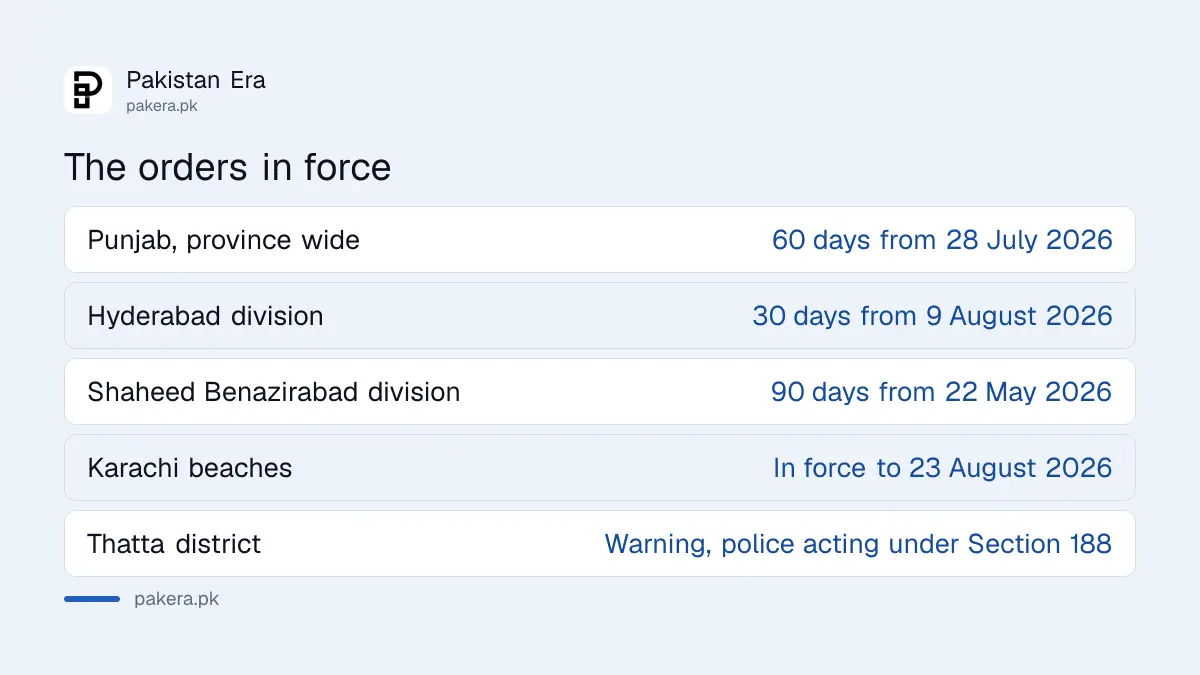
| Where | Issued | Runs for | What it covers |
|---|---|---|---|
| Punjab, province wide | 28 July 2026 | 60 days | Rivers, canals, dams, lakes, ponds, distributaries, rainwater, boating |
| Hyderabad division | 9 August 2026 | 30 days | Indus, canals, ponds, distributaries, lakes |
| Shaheed Benazirabad division | 22 May 2026 | 90 days | Canals, distributaries, waterways |
| Karachi beaches | In force | To 23 August 2026 | Swimming, bathing, diving |
| Thatta district | Warning issued | Monsoon season | Entering water bodies |
The durations matter. Punjab's 60 days from 28 July runs to roughly 26 September. Hyderabad's 30 days from 9 August runs to about 8 September. Shaheed Benazirabad's 90 days from 22 May expires around 20 August, so it is close to lapsing.
Punjab's ban covers more than you think
The Punjab Home Department issued its notification on 28 July 2026 under Section 144 of the Code of Criminal Procedure, 1898. It took effect immediately and runs for 60 days unless withdrawn earlier.
It bans three things, and the second one surprises people:
- Swimming in rivers, canals, dams, lakes, ponds and distributaries.
- Bathing in rainwater that has collected on streets, roads, open spaces and other public places.
- Unauthorised boating at any of those water bodies.
That second point is aimed squarely at what happens on the first heavy rain day in Lahore or Faisalabad, when children play in flooded streets. The reason is not drowning. It is what is in the water and what is running through it, which we set out in our piece on electrocution being the leading monsoon killer.
Hyderabad's order came two days after three teenagers died
Commissioner Fayaz Hussain Abbasi issued the Hyderabad division notification on Sunday 9 August 2026. It bans swimming and bathing in the Indus, canals, ponds, distributaries and lakes across the division for 30 days, and district administrations have been told to enforce it.
The trigger is not in dispute. On Saturday 8 August, three youths went into the Indus between Hyderabad and Kotri to bathe. Rescue teams recovered two bodies on Sunday. One was still missing when the order was signed.
Thatta's district administration has issued its own warning against entering water bodies during the monsoon, with police directed to act against violators.
We covered those deaths, and the four children who drowned in Jacobabad the same weekend, in our piece on why canal drownings are a separate problem from flooding.
Breaking the order is a criminal offence, not a fine on the spot
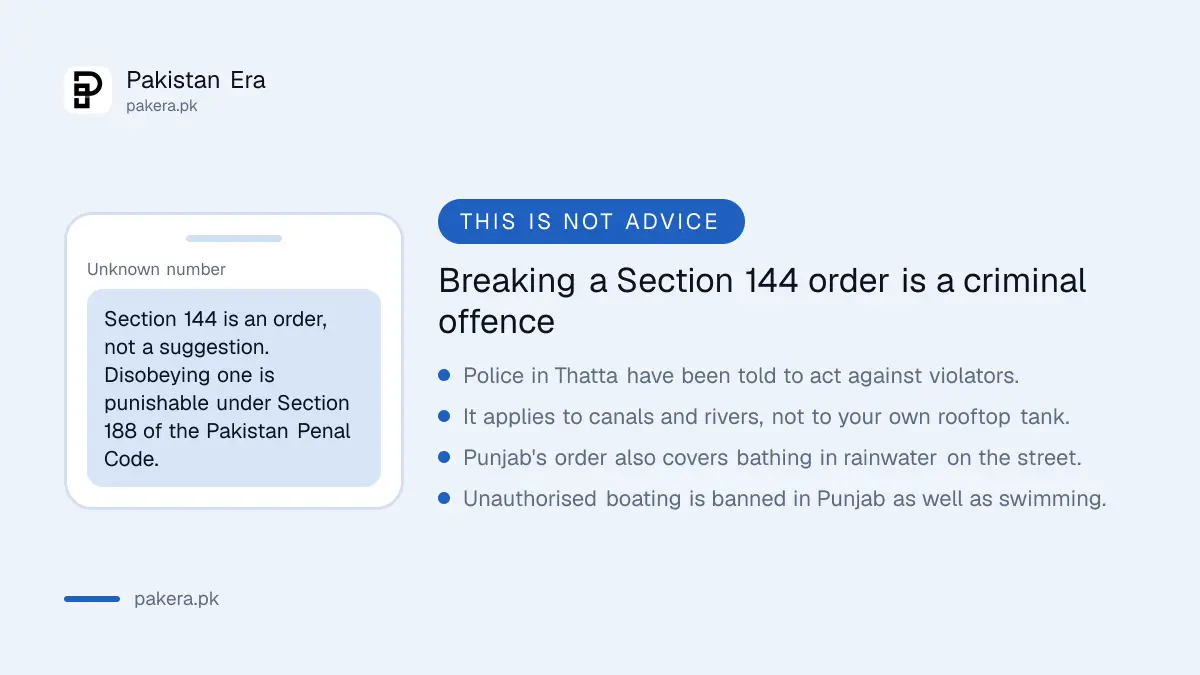
People treat Section 144 as advice. It is not.
Section 144 CrPC is the power a district magistrate or commissioner uses to prohibit an activity in a defined area for a defined time. Disobeying an order made under it is an offence under Section 188 of the Pakistan Penal Code. That is the section police in Thatta have been instructed to use.
We are not printing a fine or a sentence, because we did not read one on an official notification. The point for a reader is simply that these orders are enforceable rather than advisory.
One thing they do not cover. These orders address rivers, canals, dams, lakes, ponds and public water. A private pool or your own water tank is not the subject of the notification.
This article is general information, not legal advice. Orders are issued district by district, are amended and withdrawn, and the wording of the notification that applies to you is what counts. Check with your district administration before relying on any date here.
Sindh's other Section 144 is a different thing entirely
This is where reporting goes wrong, so it is worth being precise.
The Government of Sindh imposed Section 144 province wide for one month from 1 August 2026. That order is about the peaceful observance of Chehlum. It restricts assembly. It is not a swimming ban.
Two Section 144 orders can be running over the same ground for completely unrelated reasons. If you read that Sindh has banned swimming province wide, that is the confusion. The swimming bans in Sindh are divisional and district level, not provincial.
What a 30 day order reaches, and what it does not
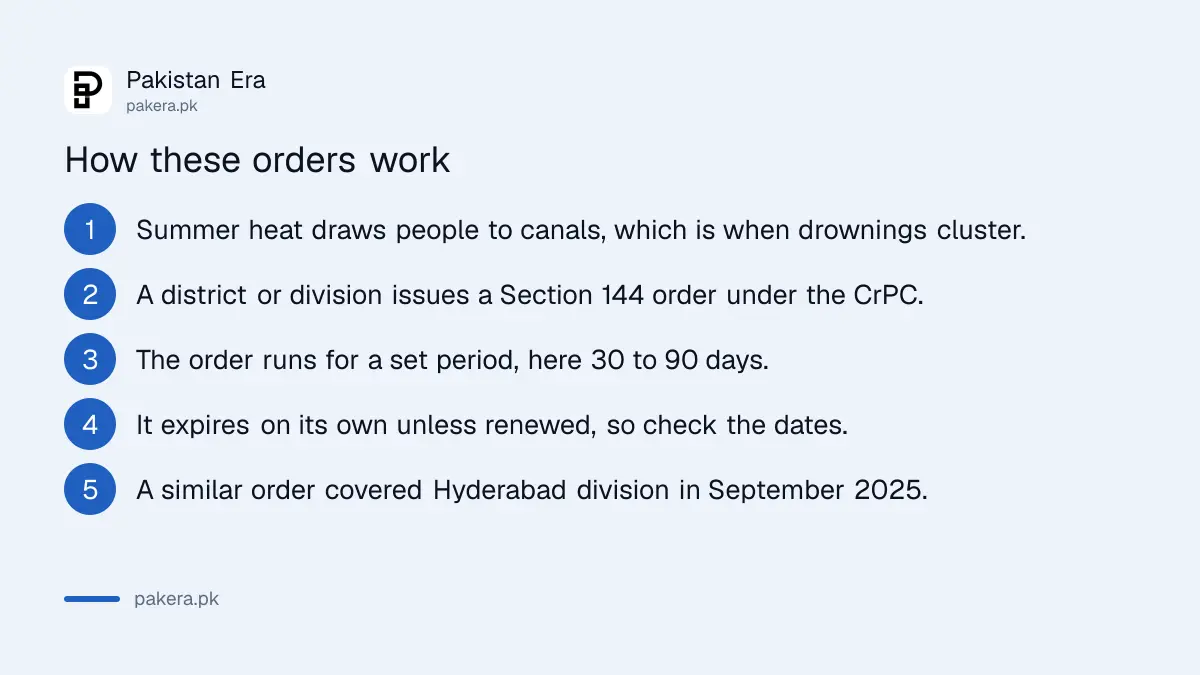
The practical thing to understand is that none of these are permanent.
Hyderabad division issued a near identical order in September 2025: same 30 day duration, same rivers and canals. It expired, as such orders do. A fresh order was issued this month after further drownings were reported.
Shaheed Benazirabad's order is explicit about why. Commissioner Shahmir Khan Bhutto issued it because of recurring incidents of drowning during the summer when people go to canals to bathe.
Section 144 is a fast instrument, which is why commissioners reach for it. It is worth being precise about what a time limited order reaches and what it does not.
The World Health Organization ranks drowning prevention measures by the evidence behind them. Physical barriers limiting access to water come first. Then supervised childcare for children under five. Then teaching school age children to swim and to help safely. Prohibition notices do not appear on that list at all.
Four of the seven who died in Sindh this weekend were under nine years old. Two of them drowned in a pond in their own village. An order covering rivers and canals, running for 30 days, does not reach either of those facts.
What this means for you this month
- In Punjab, do not swim in any canal, river, dam or lake until late September, and keep children out of flooded streets.
- In Hyderabad division, the Indus and the canals are closed to swimmers until early September.
- On Karachi beaches, swimming, bathing and diving are banned to 23 August.
- Everywhere, if somebody is in trouble in the water, throw something that floats and call Rescue 1122 rather than going in.
- Check locally before a picnic, because these orders are issued division by division and change through the season.
River conditions change daily, and the one source we found that is actually kept current is listed in our test of Pakistan's flood warning websites.
Questions readers are asking
Is swimming banned in Punjab right now?
Yes. The Punjab Home Department imposed Section 144 province wide on 28 July 2026 for 60 days, banning swimming in rivers, canals, dams, lakes, ponds and distributaries, bathing in accumulated rainwater and unauthorised boating.
How long does the Hyderabad swimming ban last?
Thirty days from 9 August 2026, so until roughly 8 September. It covers the Indus, canals, ponds, distributaries and lakes across Hyderabad division.
What happens if you break a Section 144 order?
It is an offence under Section 188 of the Pakistan Penal Code. Police in Thatta have been specifically directed to act against violators. We are not quoting a fine because we did not read one on an official notification.
Has Sindh banned swimming across the whole province?
No. Sindh's province wide Section 144 from 1 August 2026 concerns the observance of Chehlum and restricts assembly. The swimming bans in Sindh are issued by divisions and districts.
Are Karachi beaches closed?
Swimming, bathing and diving at Karachi beaches are banned until 23 August 2026.
Does the ban apply to private swimming pools?
No. These notifications address rivers, canals, dams, lakes, ponds and public water bodies, along with rainwater in public places in Punjab.
Why is the same ban issued every year?
Because each order is time limited and lapses. Hyderabad division issued a near identical 30 day ban in September 2025. The orders follow the drownings rather than preventing them.
About the author

Senior Writer, Public Services and Technology
Shahid joined us in 2024 as an author. He is a senior contributor to Pakistan's leading technology websites. He writes detailed articles, mostly covering his expertise in the latest tech, mobiles, apps, gadgets, and step-by-step guides. His ideology is to help people understand the latest trends and explain complex methods through very easy-to-understand guides.