NDMA's Anticipatory Action Strategy 2026 to 2030: Cash and Help Before a Flood, Not After
NDMA's 2026 to 2030 plan would release disaster funds within 24 to 72 hours of a forecast trigger and send cash via BISP. See what is proposed, not approved.
Short answer: NDMA has published a National Anticipatory Action Strategy for 2026 to 2030. Its idea is simple: when a forecast crosses an agreed trigger, money and action start before the disaster, not after. It recommends releasing funds within 24 to 72 hours and sending cash through BISP.
Pakistan usually moves after the water arrives. A flood warning goes out, but nobody is yet allowed to spend money on it. The new strategy tries to change that order.
We read the full strategy document listed on NDMA's publications page in October 2026. This explainer covers what it says, what it only recommends, and what it could change for a family in a flood zone. It is a plan on paper. We found no sign in the document that any of its funds are already running.
The strategy turns a forecast into a pre-agreed action
Anticipatory action means acting on a forecast before harm happens. The strategy sets "triggers", which are agreed thresholds, and attaches actions and money to each one. When the trigger is met, officials do not need to wait for new approvals.
The document says it creates no new offices. It builds on the existing system, in which NDMA leads, the National Emergency Operations Centre validates triggers, and provincial disaster authorities run operations with district administrations. A National Coordination Forum on Anticipatory Action brings federal, provincial and partner bodies together.
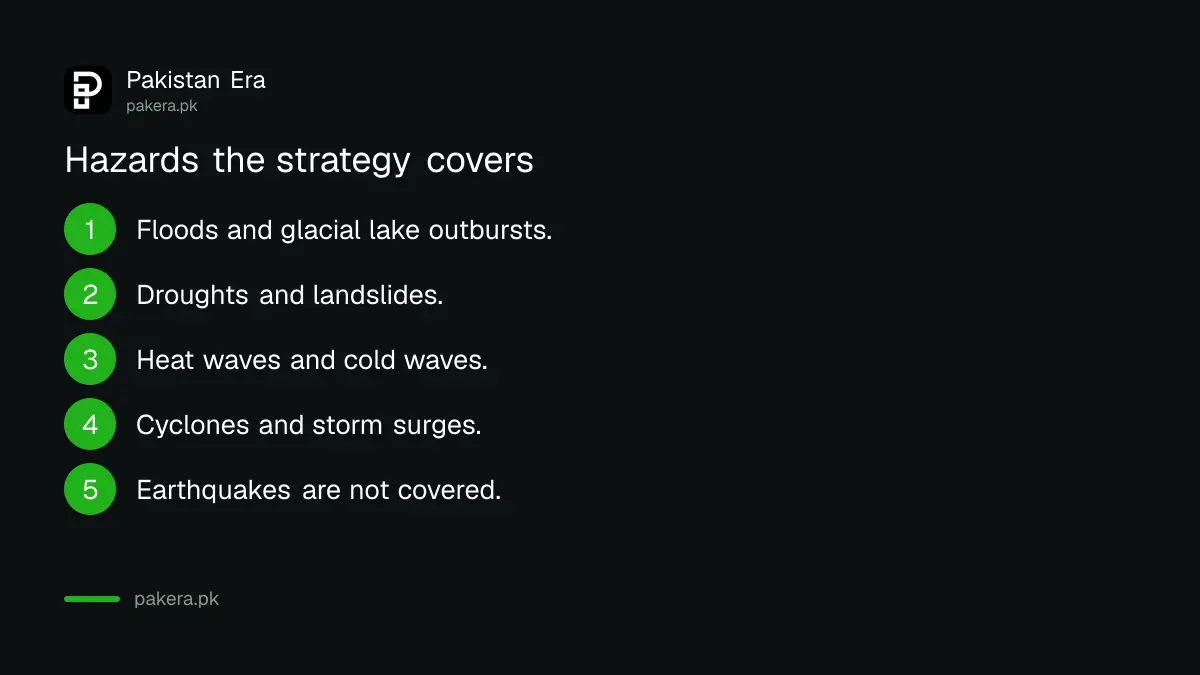
It covers hazards that can be forecast with enough warning: floods, droughts, landslides, heat and cold waves, cyclones, glacial lake outburst floods and storm surges. Earthquakes are not on that list, because they cannot be forecast.
Five pillars hold the plan together
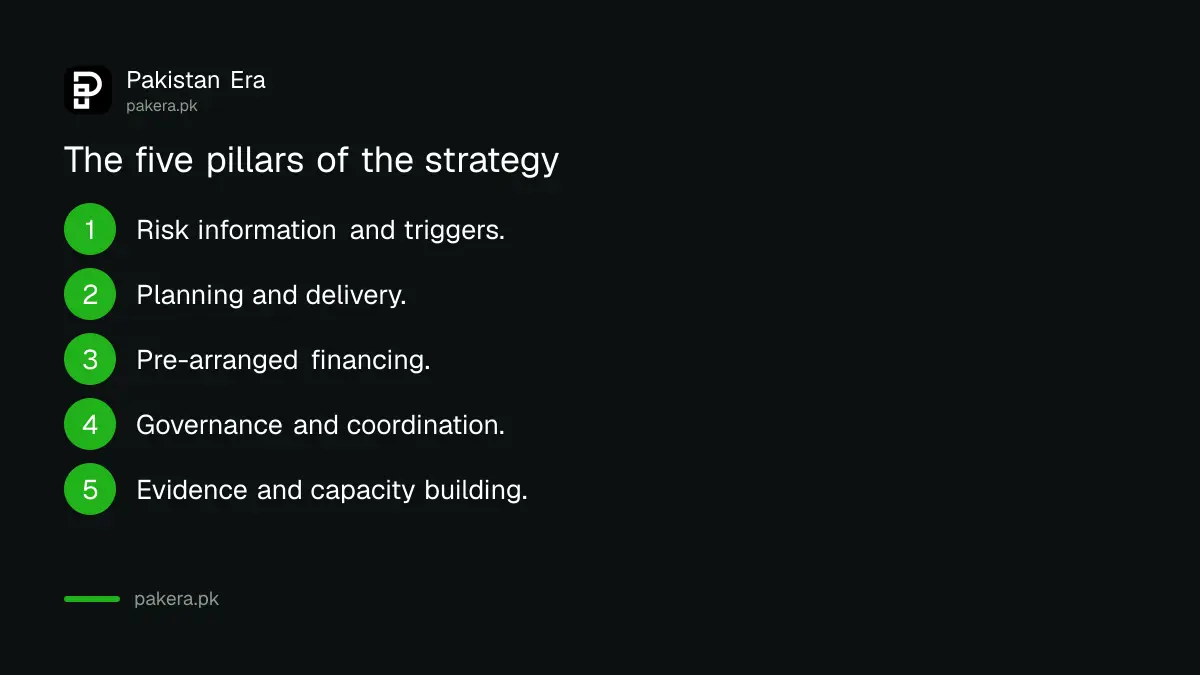
The strategy rests on five pillars: risk information and triggers, planning and delivery, pre-arranged financing, governance, and evidence and training. The document says they depend on each other. Forecasts without money, it argues, change nothing.
- Risk information, early warning and trigger systems.
- Planning and operational delivery.
- Pre-arranged financing.
- Governance, coordination and implementation.
- Evidence generation and capacity building.
The forecasts come from agencies such as the Pakistan Meteorological Department. Readers who want to follow them can use the daily flood bulletin and station alerts already open to the public.
Money would be released within 24 to 72 hours
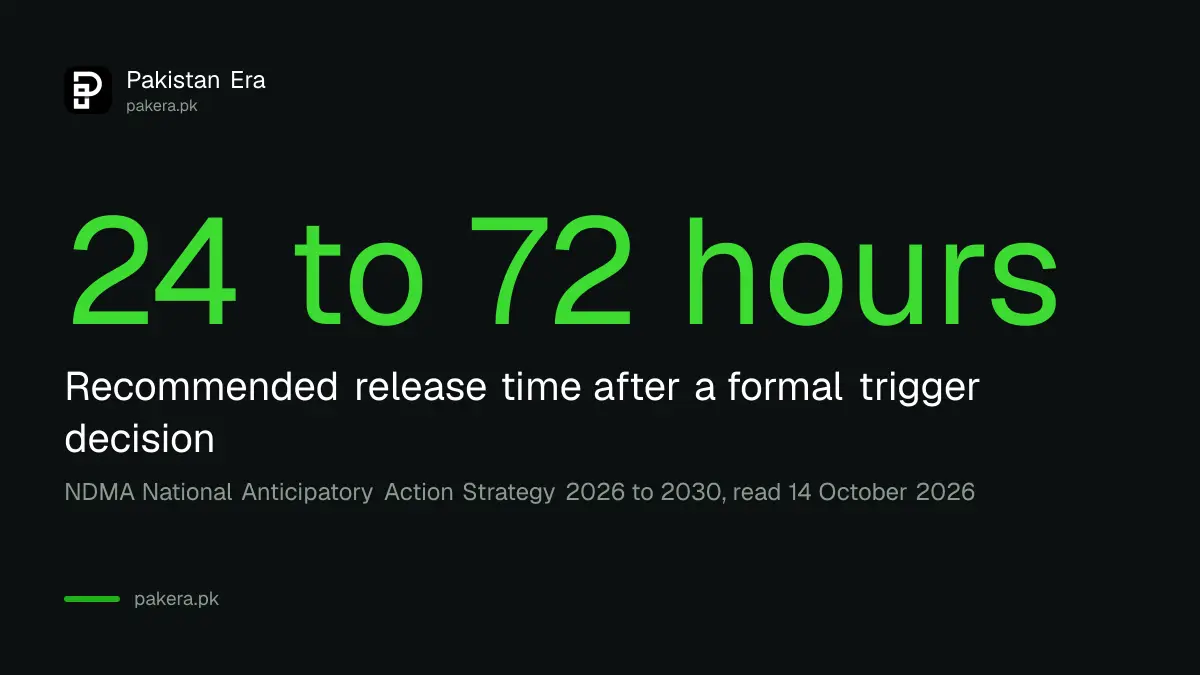
The strategy recommends a Federal Anticipatory Action Fund under the National Disaster Management Fund. A pre-agreed protocol would release money within 24 to 72 hours of a formal trigger decision. Elsewhere the document uses 48 to 72 hours.
It admits the current system is "not designed for 48 hour emergency disbursement". So it asks NDMA and the Ministry of Finance to write and gazette new financial rules. Three are named: pre-commitment of spending on probable triggers, treating a false alarm as a legitimate cost, and faster buying of pre-positioned goods.
That second rule matters. Sometimes the forecast is wrong and the flood does not come. Under the old habit, an official who spent money on a false alarm could be blamed. The strategy wants the cost to count as normal.
BISP would carry cash to families before the flood
The strategy proposes using BISP, the income support programme, as the main route for cash before a disaster. It suggests a BISP Disaster-Responsive Reserve of 5 to 10 per cent of the annual Kafaalat transfer budget. This is a proposal, not an approved payment.
The document puts BISP's budget at about Rs 716 billion for FY 2025-26 and points to its beneficiary lists. Poor households are often also the most exposed to floods. If the plan goes ahead, those already registered would be the easiest to reach. For how payments work today, see how to withdraw a BISP payment through the digital wallet.
| Item | What the strategy says | Status |
|---|---|---|
| Release time | 24 to 72 hours after a trigger | Recommended |
| Federal fund | Federal Anticipatory Action Fund under NDMF | Recommended |
| BISP reserve | 5 to 10 per cent of the Kafaalat budget | Proposed |
| New finance rules | Gazetted by NDMA and Finance | To be written |
Past events show the idea is not new
The document says Pakistan already acted early in two 2023 events. For Cyclone Biparjoy, federal action began more than ten days before landfall, and its timeline notes about 90,000 people moved to safety. The monsoon flood on the River Sutlej in August 2023 is the second case.
The strategy's point is that those actions happened without a formal trigger or dedicated money. It also quotes losses. Floods cost about USD 1.5 billion a year, and earthquakes about USD 614 million. Since 1990, it says, disasters have caused over USD 30 billion in damage.
If you live in a flood zone, nothing changes for you today. Keep your own plan. The steps for an NDMA flood emergency kit and for a flood damage claim in Punjab still apply.
Common questions about the anticipatory action strategy
What is anticipatory action?
It means acting on a forecast before a disaster hits. The strategy links forecasts to pre-agreed actions and funds so that help starts early.
Does this mean I will get cash before a flood?
Not yet. The strategy only proposes cash through BISP and a reserve of 5 to 10 per cent of the Kafaalat budget. We found no approval or start date in the document.
Who runs it?
NDMA leads. Provincial disaster authorities and district administrations carry out the work, and a national forum aligns federal, provincial and partner bodies.
Which disasters does it cover?
Floods, droughts, landslides, heat and cold waves, cyclones, glacial lake outburst floods and storm surges. Earthquakes are left out because they cannot be forecast in time.
Who helped write it?
The document says the World Food Programme gave technical and financial support, with national and provincial stakeholders involved under NDMA's leadership.
How we verified this
What we checked, where we read it, and what we could not confirm.
Last checked 14 October 2026. Everything here comes from the strategy PDF on NDMA's publications page. We did not find an official launch date, a notification or a funding approval. The loss figures, BISP budget and evacuation numbers are the document's own and we did not check them against other sources. Current NDMA warnings are on its advisories page.
About the author

Public Services and Education Journalist
Fajr Riaz is a journalist and content writer at Pakistan Era, based in Lahore. She covers the questions people meet in everyday life in Pakistan: how a public service works, what a change in the rules means, and where to find a reliable answer.