How to Read PMD's Daily Flood Bulletin and Get River Alerts in Pakistan
Read PMD's Daily Flood Bulletin in five parts and follow a river station for free alerts. Flood warnings stay on even when you mute everything else on the site.
Short answer: PMD's Flood Forecasting Division posts a Daily Flood Bulletin at ffd.weather.gov.pk/bulletin/bulletin. The 14 October 2026 issue was Bulletin No 123/26, issued at 11:00 am, and it rated all six major rivers "Below Low". You can also follow river stations for alerts, and flood warnings cannot be switched off.
Most of us only look at river news when the water is already high. By then the useful details are buried in forwarded messages. The bulletin is short, it is free, and it names every river in plain terms.
We opened the Flood Forecasting Division (FFD) bulletin page, its notification settings and its updates feed on 14 October 2026. Here is what each part tells you and how to set up alerts.
The bulletin starts with six rivers at a glance
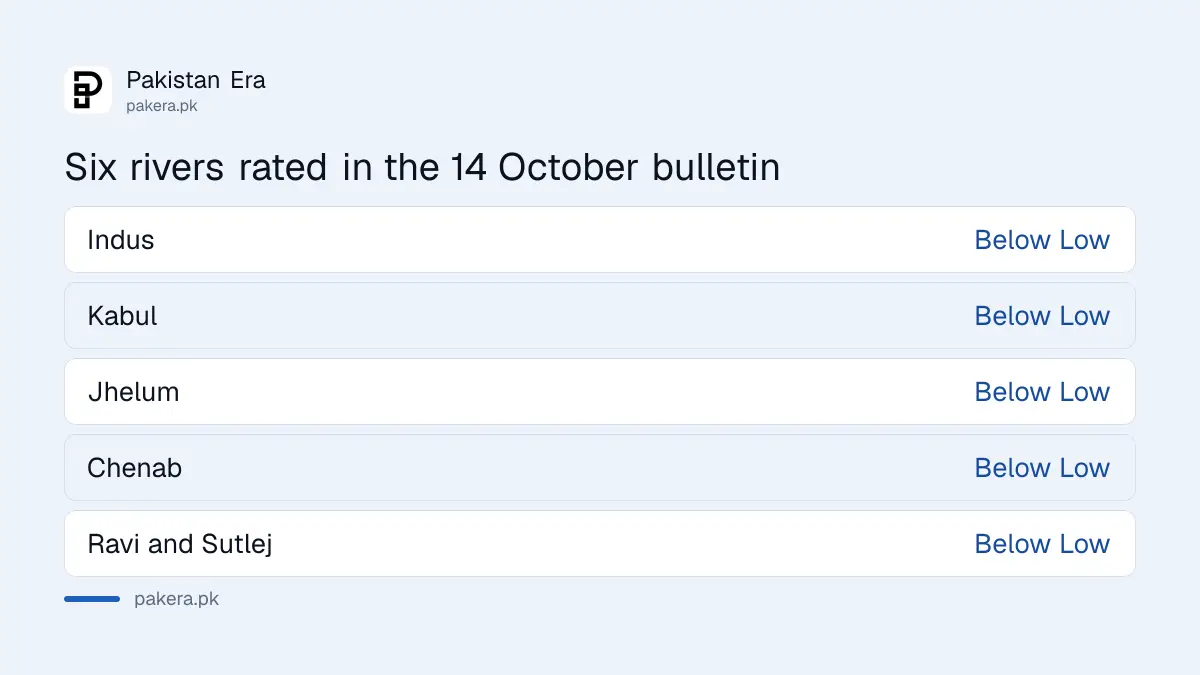
The top of the bulletin shows the Indus, Kabul, Jhelum, Chenab, Ravi and Sutlej, each with one status word. On 14 October all six read "Below Low", which means no river had reached even the first flood level.
Below that sits a flood severity scale: Below Low, Low, Medium, High, Very High and Exceptionally High. The bulletin says "Exceptionally High" where the flood limits page says "Exceptional". They refer to the top level. The numbers behind each level are in our guide to PMD's river flood limits in cusecs.
Five numbered parts explain the river situation
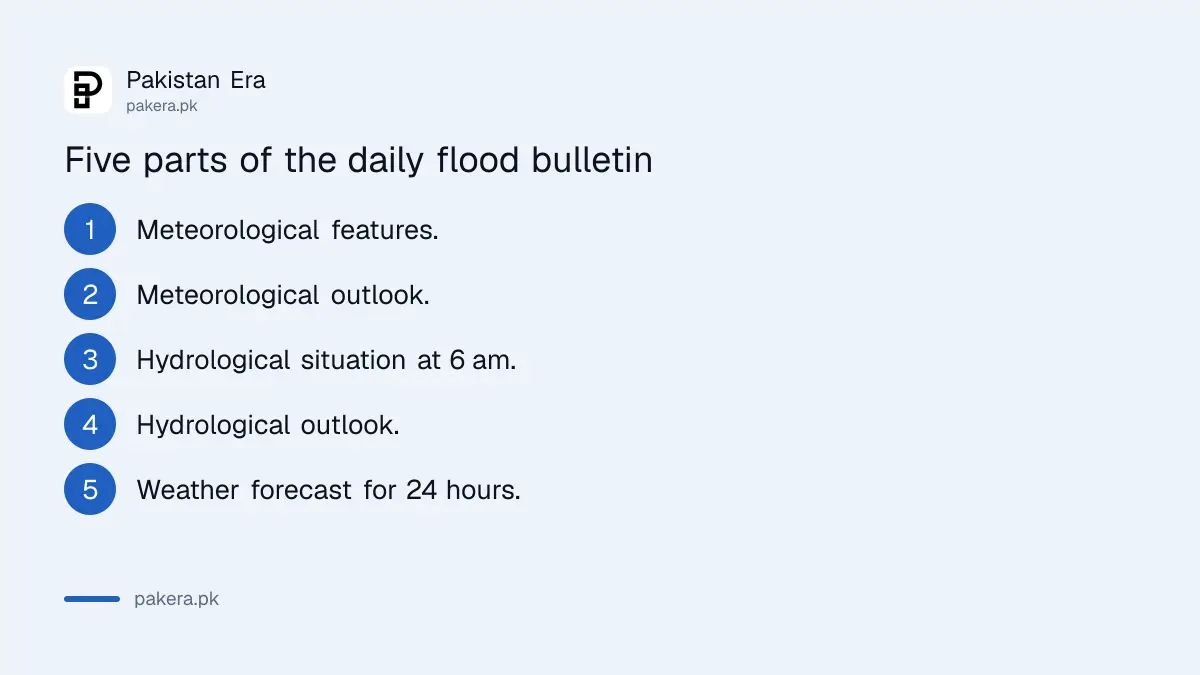
The main section is headed "Rivers situation and qualitative flood forecast". It has five parts, from weather features to a 24 hour forecast. Read them in order, because each part builds on the one before.
| Part | What it says | On 14 October 2026 |
|---|---|---|
| I. Meteorological features | The weather system now active | A westerly wave trough persisted over the north |
| II. Meteorological outlook | Where rain is expected | Isolated to scattered rain and thunderstorms over upper catchments |
| III. Hydrological situation | River flows at 6 am | All major rivers in normal flows at all gauging stations |
| IV. Hydrological outlook | Expected flows | Normal range, though Kabul tributaries may rise slightly |
| V. Weather forecast, 24 hours | Rain in the next day | Scattered storms with isolated heavy falls |
Part IV is the one to watch. It is the only part that says what the rivers themselves may do. On 14 October it flagged a possible slight rise in the Kabul river tributaries, not in the main rivers.
Flood situation reports arrive every six hours
The updates page also carries a flood situation report in Urdu. On 14 October the reports were timed 00:00, 06:00 and 12:00 PKT, and the ones for 13 October at 00:00, 06:00, 12:00 and 18:00. That is a six hour rhythm.
The 12:00 report on 14 October said flows were normal at all reporting points. Each report carries an image, so it also works well when you share it with someone who cannot read a long bulletin.
Check the date and time on every report you forward. An old image sent again during a new storm is a common source of panic. For other ways to check a warning, see how to check a weather warning before you share it.
Follow a river station to get its alerts
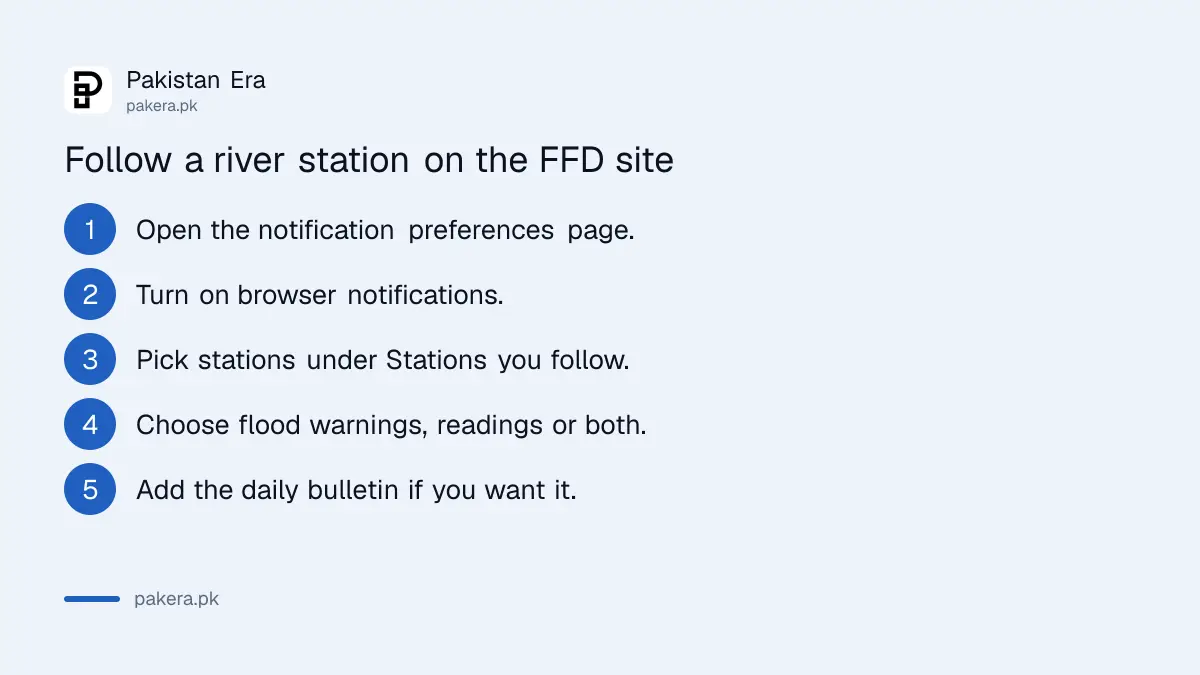
FFD's notification settings let you follow river stations and choose what you hear about. Two alerts exist for each station: a flood warning when a river crosses a flood level, and a reading with every new measurement, about four a day.
- Open ffd.weather.gov.pk/notifications/preferences.
- Turn on browser notifications for the device you use.
- Add the stations you want under "Stations you follow".
- Choose flood warnings, readings or both for each one.
- Pick optional extras such as the daily bulletin or the twice-daily river overview.
Settings apply to one browser at a time, so repeat the steps on your phone and on your laptop. For email alerts you need to sign in, because FFD confirms an address before it sends anything.
Flood warnings stay on even when you mute the rest
Two kinds of message cannot be turned off: flood alerts and the summary of rivers above their flood limits. The page says flood warnings always reach every available channel. Everything else can be switched off.
The optional messages are station readings, the daily river overview, discharge reports, advisories, daily bulletins and announcements. The page says the daily bulletin comes once a day in flood season. Choose a few, not all, or you will start ignoring them.
The FFD site also shows a WhatsApp Channel link and a newsletter box. Use only the links on the official FFD site. Alerts are one layer. For district warnings, NDMA's advisories page and helpline are the next step, and Punjab residents can call PDMA Punjab on 1129.
Common questions about the PMD flood bulletin
Where is the PMD daily flood bulletin published?
It is at ffd.weather.gov.pk/bulletin/bulletin, on the Flood Forecasting Division site in Lahore. The 14 October 2026 issue was numbered 123/26.
What does "Below Low" mean?
It means a river is under the first flood level, so there is no flood. The bulletin used it for all six major rivers on 14 October 2026.
Can I switch off flood warnings?
No. The FFD notification page says flood warnings and the list of rivers above flood limits are always on. Other message types can be turned off.
Do I need an account for alerts?
Browser notifications are set on the preferences page for that browser. Email alerts need a sign in, because FFD confirms the address first.
How often is the flood situation report updated?
The reports we saw on 13 and 14 October 2026 were timed 00:00, 06:00, 12:00 and 18:00 PKT, which is every six hours.
How we verified this
What we checked, where we read it, and what we could not confirm.
Last checked 14 October 2026. The bulletin, notification settings and updates feed come from the Flood Forecasting Division bulletin page and its notification preferences page. Warnings for districts are on NDMA's advisories page. We did not set up an account or receive a live alert, so we cannot say how fast a push message arrives. The page mentions an app, but we did not find its name.
About the author

Public Services and Education Journalist
Fajr Riaz is a journalist and content writer at Pakistan Era, based in Lahore. She covers the questions people meet in everyday life in Pakistan: how a public service works, what a change in the rules means, and where to find a reliable answer.