How to Read PMD's River Flood Limits in Pakistan: Low, Medium and High in Cusecs
PMD's Flood Forecasting Division sets five flood levels for each river station. See the Indus limits in lacs of cusecs and how to check a warning against them.
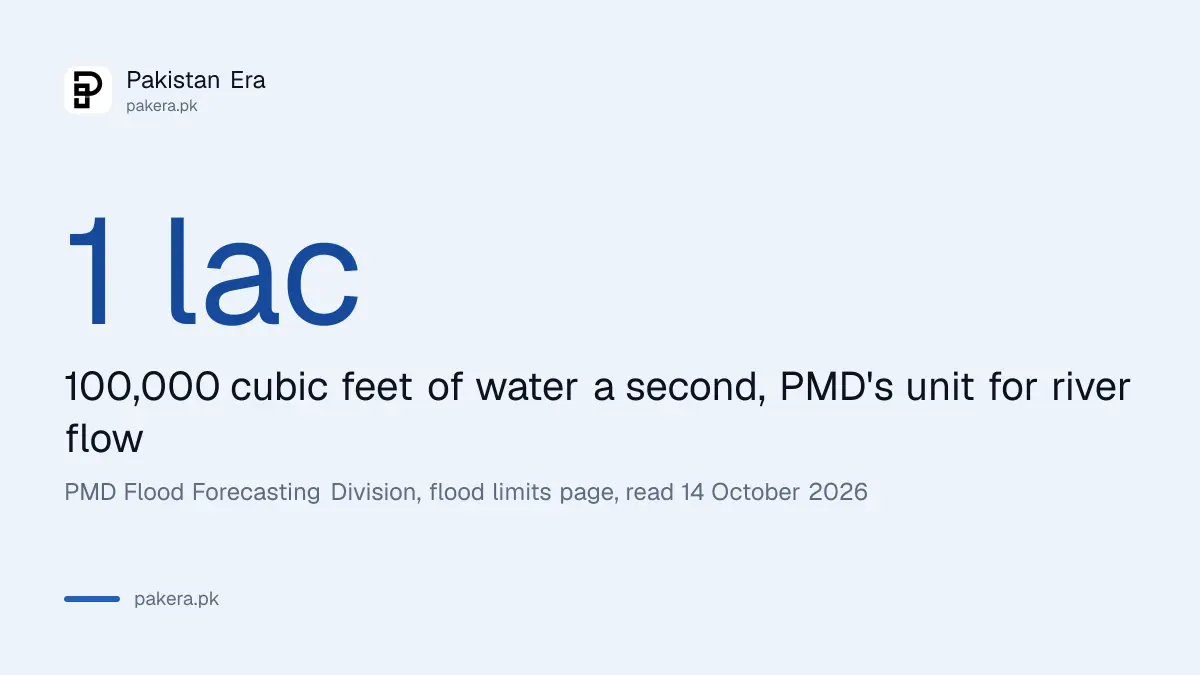
Short answer: PMD's Flood Forecasting Division sets five flood levels for each river station: Low, Medium, High, Very High and Exceptional. At Tarbela on the Indus they begin at 2.5 lacs of cusecs, which is 250,000 cusecs. A lac is 100,000, and a cusec is one cubic foot of water a second.
On 14 October 2026 the Flood Forecasting Division (FFD) said all major rivers were flowing normally at every gauging station. That is a calm day. But the numbers behind a flood warning are public all year, and few people read them before the water rises.
We opened the FFD flood limits page and the flood dashboard on 14 October 2026. This guide turns the table into plain steps, so a warning such as "medium flood at Guddu" tells you something real.
The flood limits page lists five levels for every station
The flood limits page gives each river station a design capacity and five flood levels, all in lacs of cusecs. Design capacity is what the barrage or bridge was built to pass. The five levels start at Low and climb to Exceptional.
The page covers the Indus, Kabul, Jhelum, Chenab, Ravi and Sutlej rivers, and six hill streams called nullahs. The nullah figures are in plain cusecs, not lacs. For example, the page puts Bein near Chak Amru at 1,300 cusecs for Low flood and 35,000 and above for Exceptional.
Read the number as flow, not height. A river can look calm and still carry a Medium flood, because flow depends on width and depth together.
Indus stations share the same limits from Tarbela to Taunsa
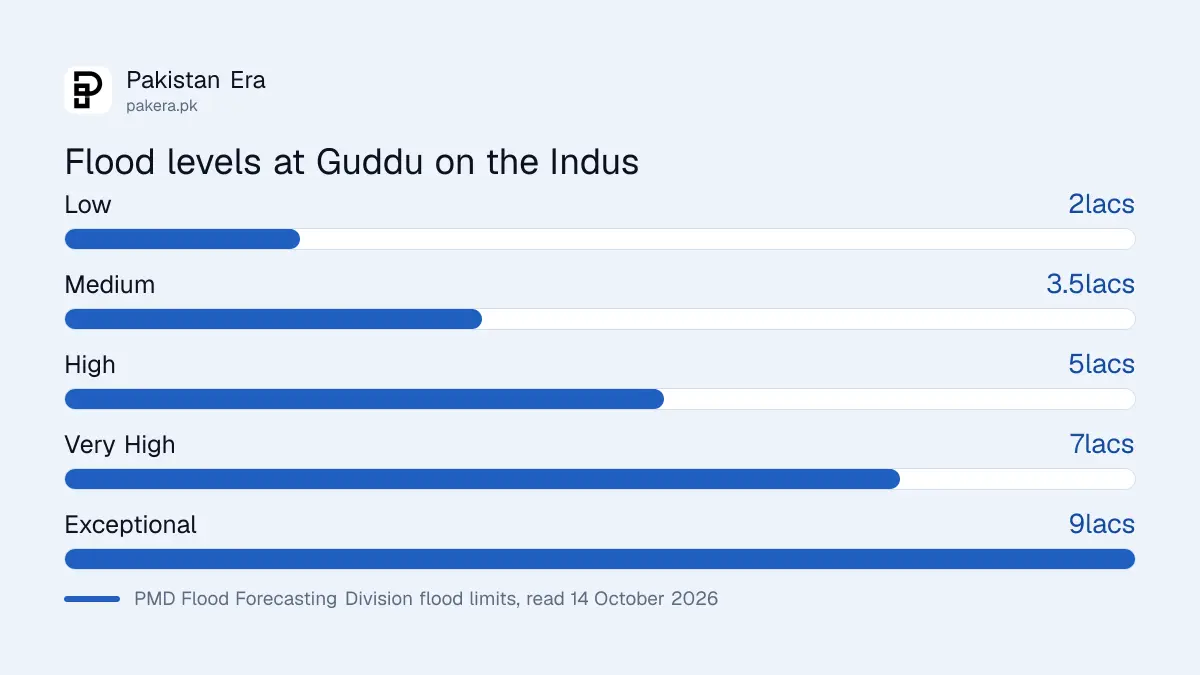
Five Indus stations from Tarbela down to Taunsa use one set of limits: Low 2.5, Medium 3.75, High 5, Very High 6.5 and Exceptional 8 lacs. Further south, Guddu and Sukkur use a higher set, and Kotri has its own lower one.
| Indus station | Design capacity | Low | Medium | High | Very High | Exceptional |
|---|---|---|---|---|---|---|
| Tarbela | 15 | 2.5 | 3.75 | 5 | 6.5 | 8 |
| Kalabagh | 9.5 | 2.5 | 3.75 | 5 | 6.5 | 8 |
| Taunsa | 10 | 2.5 | 3.75 | 5 | 6.5 | 8 |
| Guddu | 12 | 2 | 3.5 | 5 | 7 | 9 |
| Sukkur | 9 | 2 | 3.5 | 5 | 7 | 9 |
| Kotri | 8.75 | 2 | 3 | 4.5 | 6.5 | 8 |
All figures are in lacs of cusecs, as printed on the FFD page. Notice that Sukkur's design capacity is 9 lacs, and its Exceptional level is also 9 lacs. At that level the barrage is passing all it was built to carry.
Punjab's rivers use much smaller numbers than the Indus
The Chenab, Jhelum, Ravi and Sutlej carry less water than the Indus, so their limits are lower. A Low flood on the Ravi at Shahdara starts at 0.4 lacs, or 40,000 cusecs. Compare that with 2.5 lacs on the Indus at Tarbela.
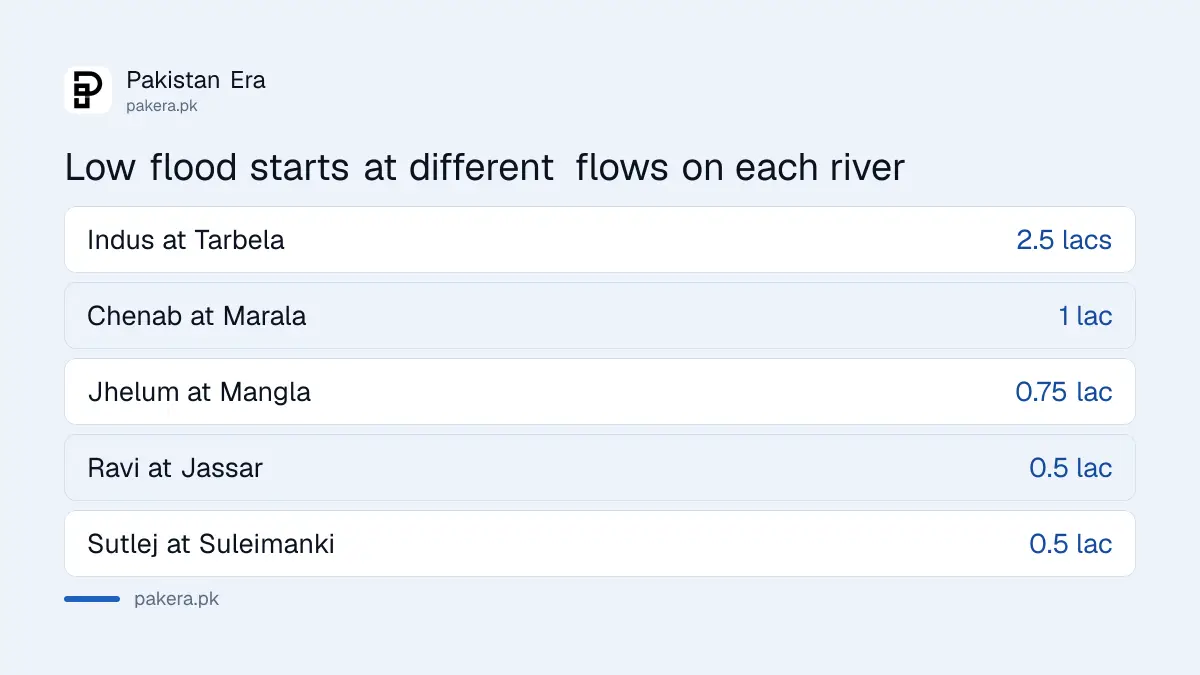
Here is how the Punjab rivers compare at one station each.
- Chenab at Marala: Low 1 lac, Exceptional 6 lacs.
- Jhelum at Mangla: Low 0.75 lac, Exceptional 3 lacs.
- Ravi at Jassar: Low 0.5 lac, Exceptional 2 lacs.
- Sutlej at Suleimanki: Low 0.5 lac, Exceptional 2.25 lacs.
So 1.5 lacs of cusecs is a Medium flood on the Chenab at Marala but a Very High flood on the Ravi at Jassar. The same number means very different things on different rivers. Always check the station and the river before you judge a figure.
Match a warning to the table in five steps
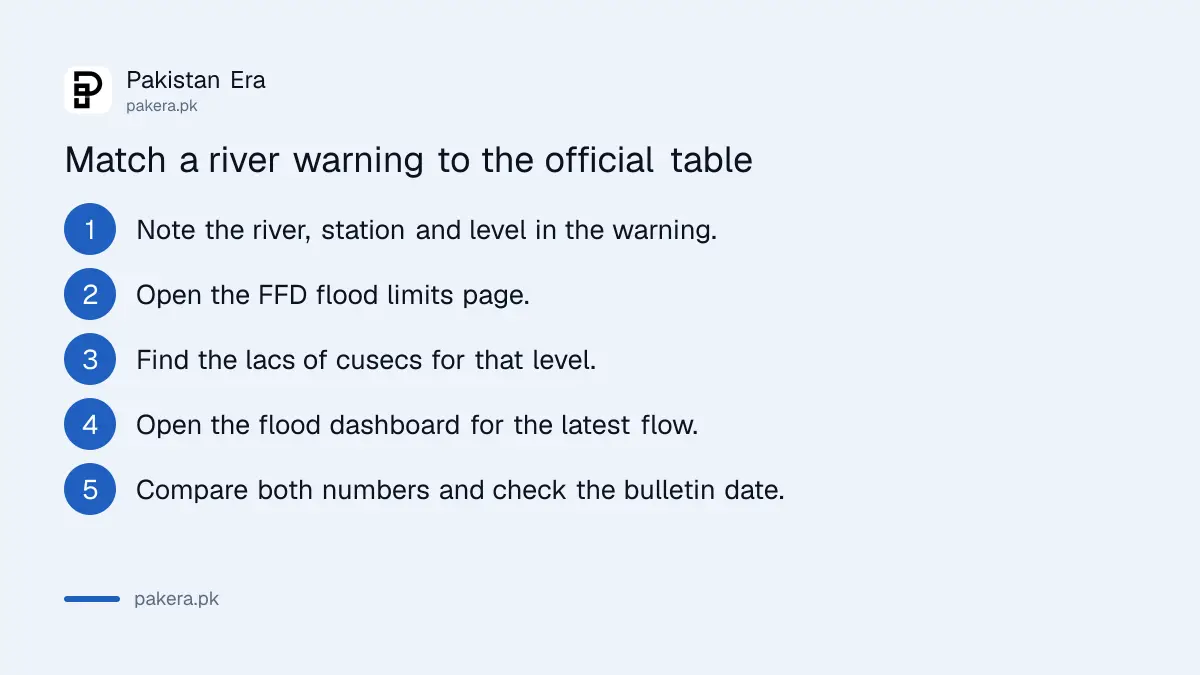
When a message says a river is at a flood level, you can check it against the official table in a few minutes. Use the steps below. They work with any warning from PMD, NDMA or a provincial authority.
- Note the river, the station and the level named in the warning.
- Open the FFD flood limits page and find that station.
- Read the lacs of cusecs for that level.
- Open the FFD flood dashboard and find the latest flow at the same station.
- Compare the two numbers and check the date and time on the bulletin.
The dashboard has seven sections, including river flows from WAPDA, Irrigation and Police sources, bulletins and warnings, and model rainfall forecasts. Its catchment forecast is updated daily between 10 am and 12 noon, as the page states.
A flood level is a river reading, not a street warning
These limits describe flow in a river channel. They do not tell you whether your street, village or field will flood. That depends on embankments, drains and local ground levels.
For your own area, follow district and provincial alerts as well. In August, NDMA's alert named eight districts at risk and Guddu at medium flood. Heavy rain inside a city is a separate problem, covered in what to do when your street floods.
Keep a bag ready before the season, not during it. The checklist for a flood emergency kit takes ten minutes to follow. And to compare official flood sources, see our test of flood warning websites.
Common questions about PMD flood limits
What is a lac of cusecs?
A lac is 100,000. A cusec is one cubic foot of water passing a point each second. So 2.5 lacs of cusecs is 250,000 cubic feet a second.
What are the five flood levels?
They are Low, Medium, High, Very High and Exceptional. PMD's Flood Forecasting Division sets them for each station on its flood limits page.
Where do I find today's river flow?
Open the FFD flood dashboard. Its hydrological section shows the latest river flow values, and its bulletin section lists current warnings from the Flood Forecasting Division in Lahore.
Are the limits the same for every river?
No. The Indus stations use the highest numbers, and the Ravi and Sutlej use some of the lowest. The same flow can be Medium on one river and Very High on another.
Did the page show any flood on 14 October 2026?
No. The dashboard said all major rivers were flowing normally at all gauging stations, and the 12 noon flood situation report said flows were normal at every reporting point.
How we verified this
What we checked, where we read it, and what we could not confirm.
Last checked 14 October 2026. All limits come from the Flood Forecasting Division's flood limits page, and the river situation comes from its flood dashboard. Warnings for the public are also posted on NDMA's advisories page. We have not tested how fast the dashboard updates during a flood. The limits can be revised, so check the page before you rely on a figure.
About the author

Public Services and Education Journalist
Fajr Riaz is a journalist and content writer at Pakistan Era, based in Lahore. She covers the questions people meet in everyday life in Pakistan: how a public service works, what a change in the rules means, and where to find a reliable answer.