Flood Alert: 8 Districts at Risk, Guddu Now a Medium Flood
NDMA has named eight districts where streams could overflow and a medium flood at Guddu. Which rivers are rising and what to avoid.
NDMA has named the places at risk. Most warnings this season have been general. This one is not.
Mohmand, Bajaur, Buner, Mardan, Kurram, South Waziristan, Shangla and Peshawar are the districts where streams and nullahs could overflow. In northern Balochistan, flash floods are possible in the Nari, Bolan, Kangri and Lehri rivers.
On the Indus, Guddu has moved to a medium-level flood.
River levels move daily. We later opened every official warning source in the country to find which ones are actually kept current, and published the results in our test of Pakistan's flood warning websites.
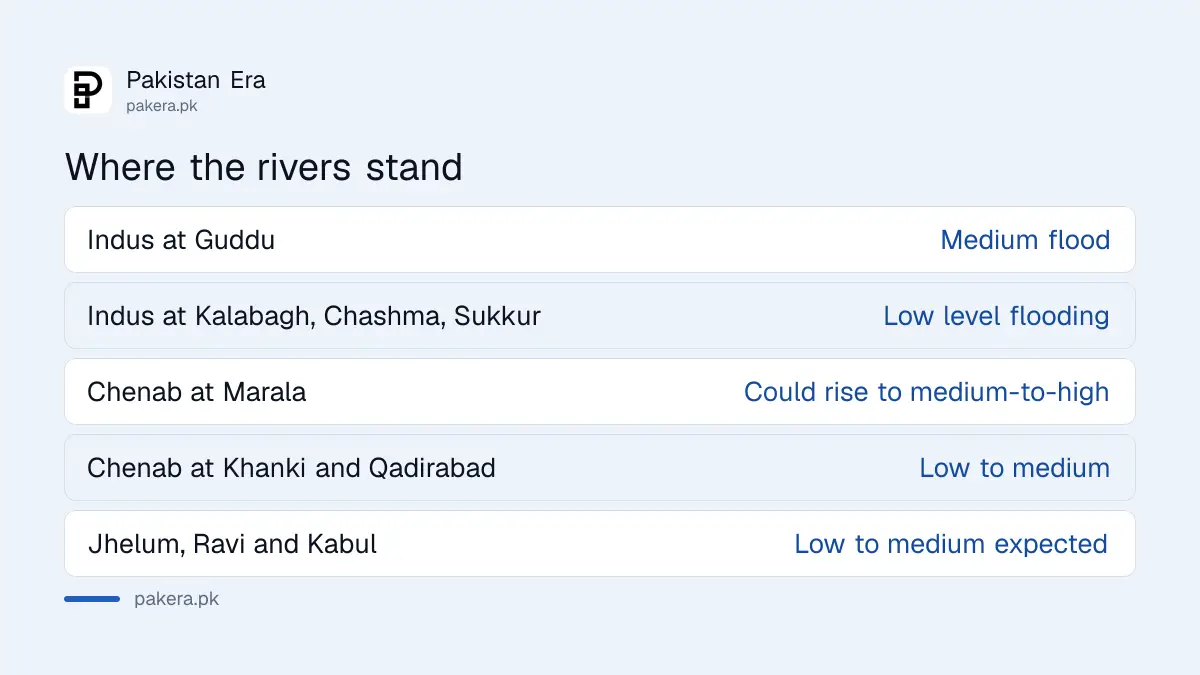
River levels right now
| River and point | Level |
|---|---|
| Indus at Guddu | Medium flood |
| Indus at Kalabagh, Chashma, Sukkur | Low level flooding |
| Chenab at Marala | Could rise to medium-to-high |
| Chenab at Khanki and Qadirabad | Low to medium |
| Jhelum, Ravi and Kabul | Low to medium expected |
Marala is the one to watch. A medium-to-high reading there feeds everything downstream on the Chenab, and Khanki and Qadirabad sit below it. If Marala climbs, the two points currently described as low to medium are the next to move.
The danger in these districts is nullahs, not big rivers
This distinction matters and it is why the eight named districts are mostly in Khyber Pakhtunkhwa rather than along the Indus.
A river flood is slow. It is forecast days early and measured at a barrage. A hill torrent or an overflowing nullah is not like that. It arrives in minutes, from rain that fell somewhere you cannot see. It is strong enough to carry a car. And it drops again before any help reaches you.
That is the danger in Mohmand, Bajaur, Buner, Kurram, South Waziristan and Shangla. Not a river you can watch rising, but a dry channel that fills without warning.
Mardan and Peshawar have a different problem: city flooding. The water has nowhere to drain, and the danger is what it touches on the way through. That is the case we set out in the piece on monsoon deaths, where electrocution rather than drowning is the leading killer this season.
Five things NDMA is telling people to do
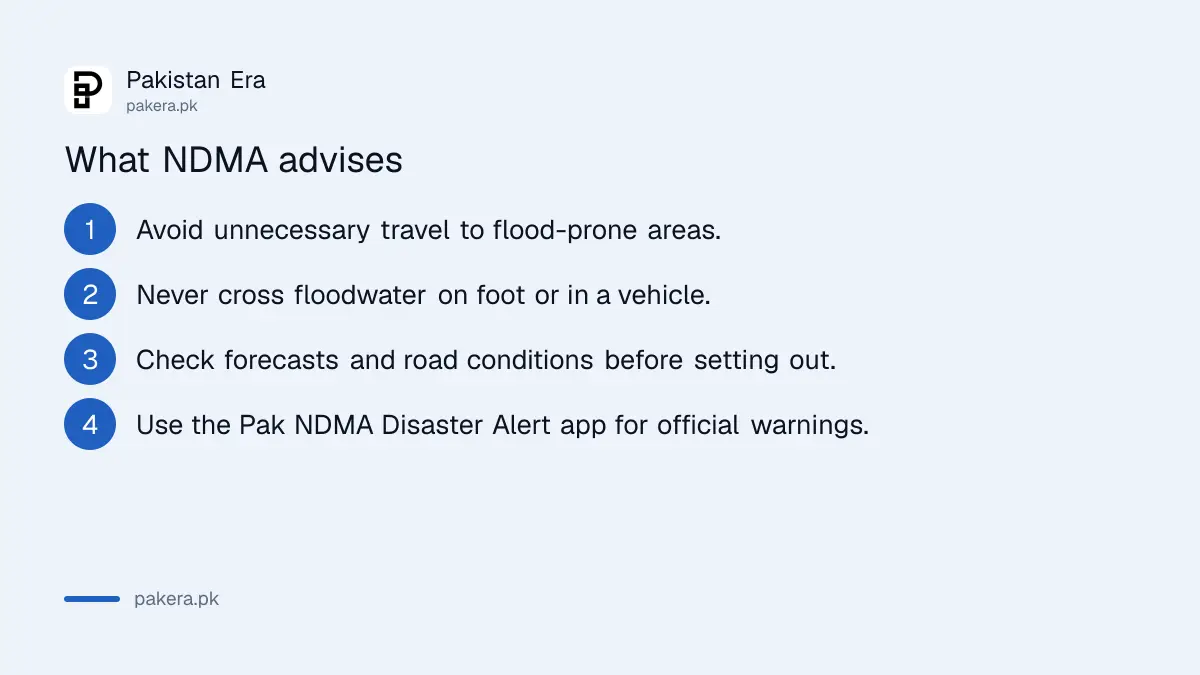
- Avoid unnecessary travel to flood-prone areas. This is the whole of the official advice and it is the part people ignore.
- Do not cross floodwater on foot or in a vehicle. Depth is unreadable and moving water carries more force than it looks like it does.
- Check forecasts and road conditions before setting out, not after.
- Follow local authority instructions rather than local opinion.
- Use the Pak NDMA Disaster Alert app, which is the channel NDMA directs the public to.
If you are travelling north this week, and 14 August falls on a Friday so a great many people will be, the road is the constraint rather than the calendar. Our northern areas travel checklist covers what to confirm before leaving, and this is the season to actually do it.
A medium flood at Guddu is not a report on your street
Flood levels are readings taken at one barrage. They tell you how much water is passing that point. They do not tell you what is happening on your street.
So a medium flood at Guddu tells you the Indus is carrying a large volume past northern Sindh, and it tells you the direction of risk for everything downstream. It does not tell you whether a particular village floods, which depends on embankments, drainage and where the water is allowed to spread.
So watch the barrage upstream of you, not the one in the headline. Water at Kalabagh today is water at Guddu later.
What to do if you live in a named district
Practical, in the order that matters.
Know your exit before you need it. Hill torrent areas lose road access first, and the decision to leave is easier made dry.
Move vehicles and livestock off low ground now, rather than at the point when the channel is filling.
Keep documents and a charged phone together in something you can carry in one hand.
Do not park or camp in a dry nullah bed. It is flat, it is convenient, and it is a channel.
Assume any standing water is electrically live until you know otherwise, especially near poles, meter boards and pumps.
Questions readers are asking
Which districts are at risk in the current NDMA alert?
Mohmand, Bajaur, Buner, Mardan, Kurram, South Waziristan, Shangla and Peshawar for overflowing streams and nullahs, plus flash flood risk in the Nari, Bolan, Kangri and Lehri rivers in northern Balochistan.
What is the flood level at Guddu?
A medium-level flood on the Indus, with low level flooding at Kalabagh, Chashma and Sukkur.
Is the Chenab flooding?
Flows at Marala could rise to medium-to-high, with low to medium at Khanki and Qadirabad. Low to medium levels are also expected on the Jhelum, Ravi and Kabul rivers.
What does a medium flood actually mean?
It is a discharge category at a specific barrage, describing the volume passing that point. It is not a description of local street flooding, which depends on embankments and drainage.
What does NDMA advise?
Avoid unnecessary travel to flood-prone areas, do not cross floodwater on foot or by vehicle, check forecasts and road conditions before travelling, and follow local authority instructions.
Where do I get official warnings?
The Pak NDMA Disaster Alert mobile application and the advisories section of ndma.gov.pk.
Why are hill torrents more dangerous than a rising river?
Because they arrive in minutes from rain that fell out of sight, move fast enough to carry a vehicle, and recede before help can reach anyone. A river flood is forecast days ahead and measured at a barrage.
About the author

Public Services and Education Journalist
Fajr Riaz is a journalist and content writer at Pakistan Era, based in Lahore. She covers the questions people meet in everyday life in Pakistan: how a public service works, what a change in the rules means, and where to find a reliable answer.