PTA Reviews the 5 Voice SIM Limit per CNIC: What Changes and How to Check Your SIMs on 668
PTA is reviewing the SIM limit per CNIC: 5 voice and 3 data today, with fewer voice and more data SIMs planned. Nothing changes yet. Check your count on 668.
یہ صفحہ اردو میں پڑھیں
Short answer: The Pakistan Telecommunication Authority (PTA) has decided in principle to review how many SIMs one CNIC can hold. Today the limit is 5 voice SIMs and 3 data SIMs, 8 in all. PTA officials want fewer voice SIMs per person and more data SIMs. Nothing changes yet: mobile operators will be consulted first, and no date has been set.
If you have SIMs you no longer use, this is a good week to count them. Send your CNIC number, without dashes, by SMS to 668. The reply tells you how many SIMs each network has registered in your name.
PTA is reviewing the 5 voice SIM limit per CNIC
PTA officials said on 14 November 2026 that the authority has agreed in principle to review the SIM limits per CNIC. The plan is to lower the voice SIM limit and raise the data SIM limit. No new figure has been notified, and operators will be consulted first.
The reason given is misuse. Illegal SIMs registered on someone else's CNIC are a common tool in cybercrime, fraud calls and blackmail.
Reports differ on the new voice number. One puts it at three voice SIMs per CNIC. The other report gives no figure. Until PTA issues a notice, treat any number as a proposal, not a rule.
One CNIC can hold 8 SIMs today, 5 voice and 3 data
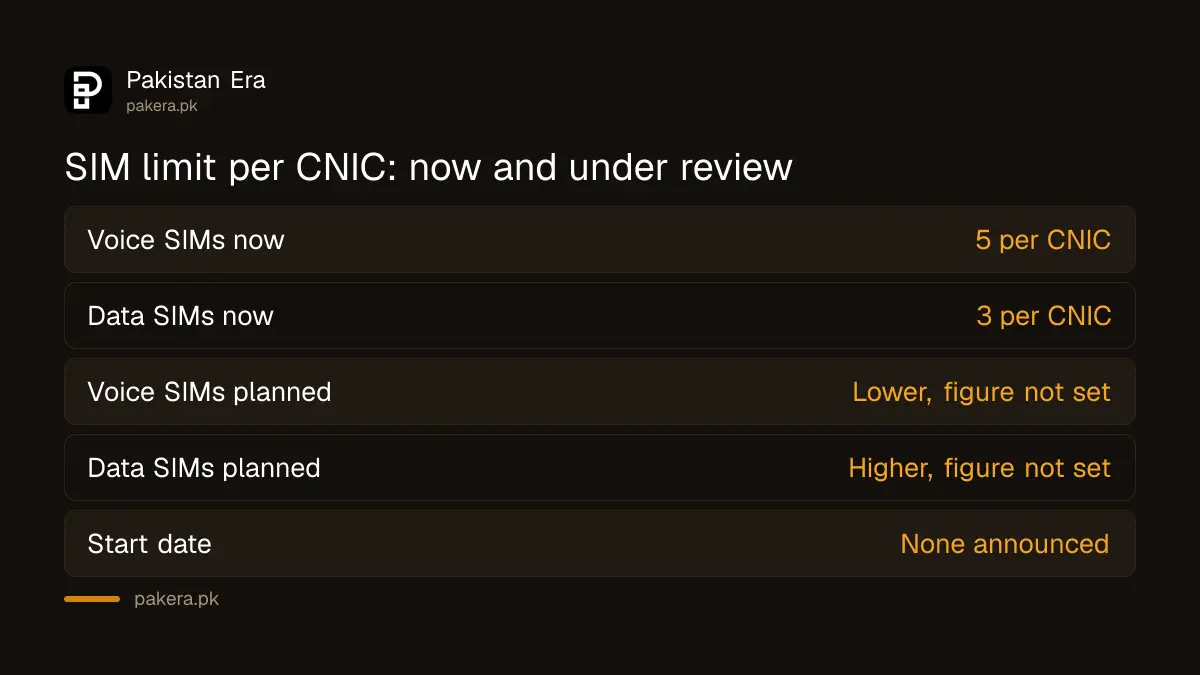
Under the current rule one CNIC can register up to 8 SIMs across all networks: 5 voice SIMs, which can make calls and send SMS, and 3 data SIMs, which carry internet only. The review would change that split, not the way SIMs are verified.
| Item | Rule now | Under review |
|---|---|---|
| Voice SIMs per CNIC | 5 | Lower (figure not set) |
| Data SIMs per CNIC | 3 | Higher (figure not set) |
| Total SIMs per CNIC | 8 | Not announced |
| Who decides | PTA | PTA, after consulting operators |
| Start date | In force | None announced |
| Biometric check for each SIM | Required | No change proposed |
The higher data limit is linked to 5G. Officials expect more demand for data SIMs in devices such as trackers, routers, smart meters and other Internet of Things (IoT) devices, which are machines that connect to the internet on their own.
Nothing changes for your SIMs until PTA issues a notice
Your SIMs keep working as they are. PTA has not ordered any SIM to be blocked, and no deadline has been announced. Any change will come in a PTA notice after operators have given their views.
If the voice limit does come down, people with more voice SIMs than the new cap may be asked to keep some and give up the rest. How that would work has not been set out. The simple step now is to know your own count, and to close any SIM you do not use or do not recognise.
Business users who keep several numbers for staff, and families who registered children's or parents' SIMs on one CNIC, are the most likely to be affected. Moving a SIM into the name of the person who actually uses it is a normal change of ownership, done with biometric verification at an operator's centre.
Check how many SIMs are on your CNIC with 668
PTA's own SIM information page gives an SMS route that works on any network. Send your 13 digit CNIC number, without dashes, to 668. The reply lists how many SIMs each operator has registered against that CNIC.
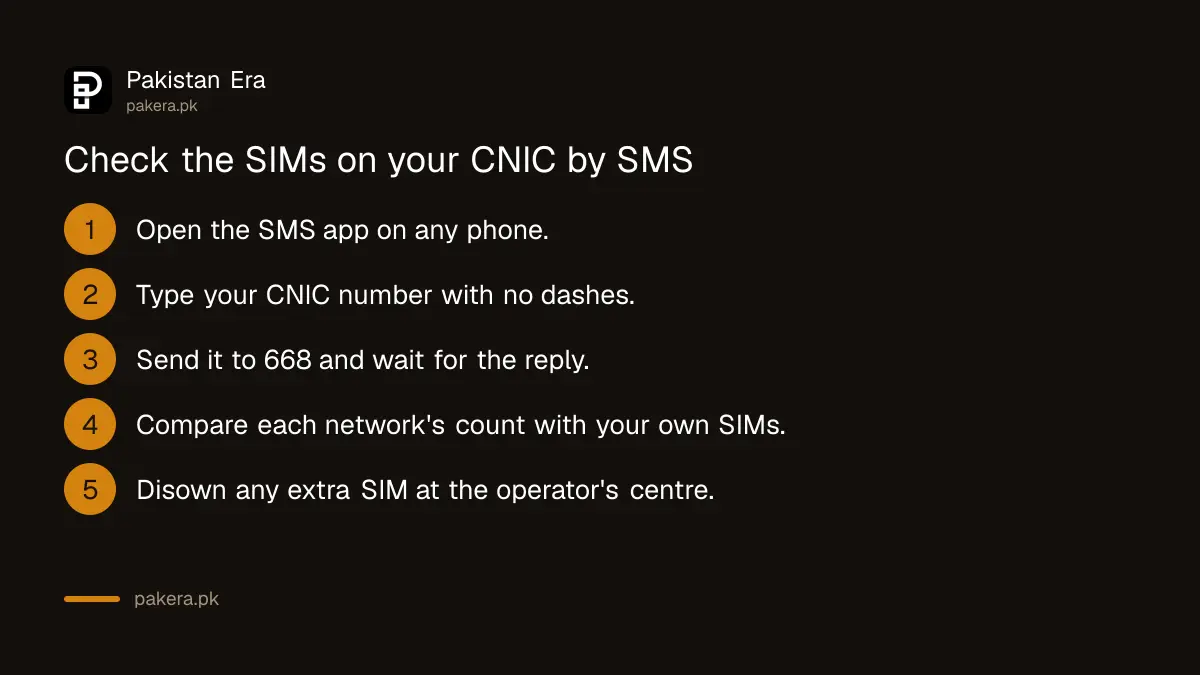
- Open the SMS app on any phone.
- Type your CNIC number with no dashes or spaces, for example 3520212345671.
- Send it to 668 and wait for the reply.
- Compare the count for each network with the SIMs you actually own.
- If the count is higher, visit that operator's customer service centre to disown the extra SIM, or complain to PTA.
For a full walk through, including what each part of the reply means, see how to check the SIMs registered on your CNIC.
Report a SIM you did not buy to PTA
If the 668 reply shows a SIM you never bought, disown it at that operator's centre with your fingerprints, then report it to PTA. PTA takes complaints on its online form, the PTA CMS mobile app and its toll free number 0800-55055.
Disowning a SIM needs the same biometric check as buying one, so go yourself with your original CNIC. Keep the complaint number PTA gives you. If the operator's staff will not help, tell PTA the date of your visit, the company and the name and address of the outlet.
A SIM in your name that someone else uses can be traced back to you if it is used in a crime or for harassment. That is why PTA asks users to check the count at regular intervals, and to help elderly relatives check theirs. If you have lost a phone as well, you can block the lost phone through the PTA CMS app at the same time.
Give your fingerprints only at an authorised SIM outlet
PTA's guidance is clear: give fingerprints only at an operator's customer service centre, franchise or registered retailer that has a biometric device and an authorisation card or letter. Never put your thumb on paper, and no prize or gift scheme needs your fingerprints.
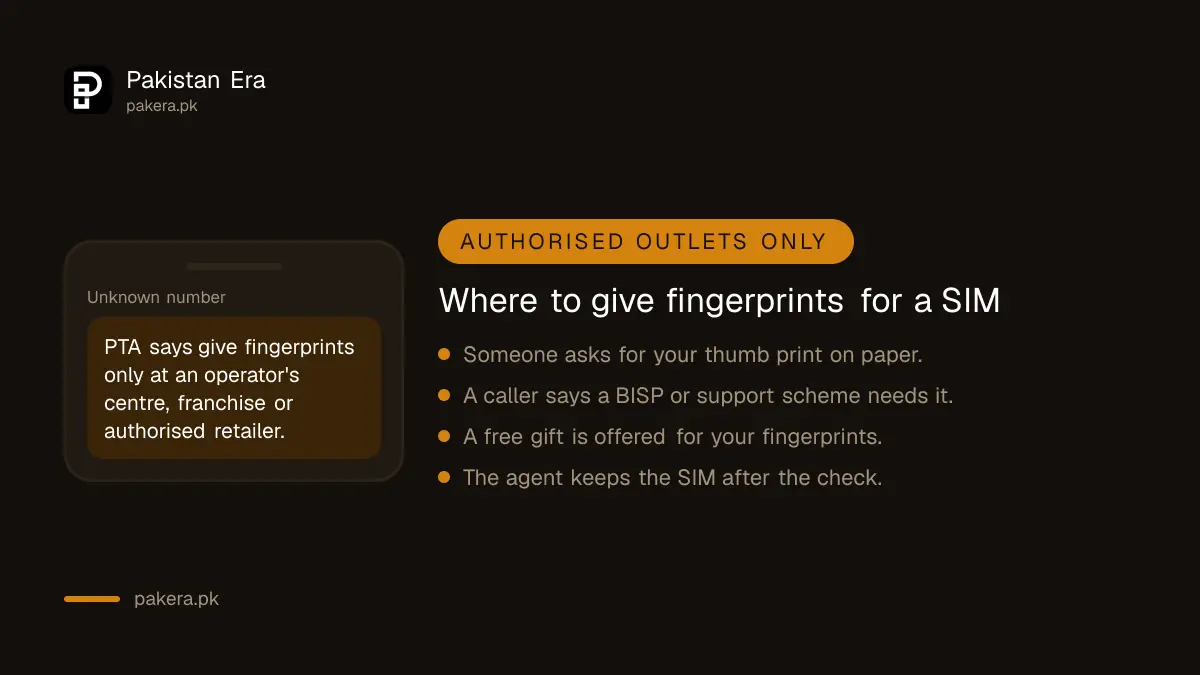
PTA's SIM page warns that gangs have collected thumb impressions from people by posing as officials of support schemes such as BISP, or by offering free items and gifts. Those prints are then used to activate SIMs in the victim's name. The same page says a sale needs at most two successful thumb or finger impressions.
- Ask what the fingerprint is for before you give it.
- Look for the operator's authorisation card or letter at a retailer.
- Collect your SIM after the check. If the agent keeps it, complain to PTA.
- Elderly people and people whose fingerprints do not read can get a SIM at a customer service centre through an administrative check instead. Here is how the alternate process for a fingerprint that does not match works.
Never share a one time password (OTP) with a caller either, even one who says they are from a courier company. That trick is covered in our piece on the fake courier call OTP scam.
Common questions
How many SIMs can one CNIC have in Pakistan?
Up to 8 across all networks: 5 voice SIMs and 3 data SIMs. PTA is reviewing that split, but the current limit stays in force until a new notice is issued.
Will PTA block my extra SIMs?
Not now. PTA has not ordered any SIM to be blocked. The review is at the consultation stage with mobile operators, and no date or new limit has been announced.
Is the new voice SIM limit three?
Three is one figure that has been reported, but PTA has not fixed or notified any number. Treat it as a proposal until PTA publishes a decision.
Is checking SIMs on 668 free?
PTA's page lists 668 as the SMS route to check your SIM count and does not mention a charge. The same check works from a phone on any network.
Why does PTA want more data SIMs per CNIC?
Officials link it to 5G and Internet of Things devices, such as trackers and routers, which each need their own data SIM. Raising the data cap would let one person register more of them.
What happens next
PTA will talk to the mobile operators about the new limits before it decides. Once it does, it will issue a notice with the new voice and data caps and the date they start. We will update this page when that notice appears.
Until then, the useful steps are the same as always: count your SIMs on 668, disown any you do not use, and keep your fingerprints away from anyone who is not an authorised outlet. If you are buying a new SIM this week, the rules have not changed, and prices are on our page for the Zong new SIM price.
How we verified this
What we checked and where we read it.
We checked PTA's SIM information and biometric verification page on 15 November 2026 for the 668 check, the complaint routes, the toll free number, the authorised outlet rules and the warnings about thumb impressions. We also checked PTA's list of press releases the same day. The latest release there was dated 12 November 2026, and none of them sets a new SIM limit, so the review described above comes from statements by PTA officials on 14 November 2026.
About the author

Technology Journalist & Multimedia Producer
Ahmad Ali is a technology journalist and multimedia producer at Pakistan Era, joining the team in October 2026. He covers consumer technology and digital life for Pakistani readers, combining research with hands-on product testing.