How to Check a Weather Warning on PMD's Press Release Page Before You Share It in Pakistan
PMD files its formal weather warnings on one page, with filters for rain, heat, cold and smog. See the latest from 9 October 2026 and how to match a message.
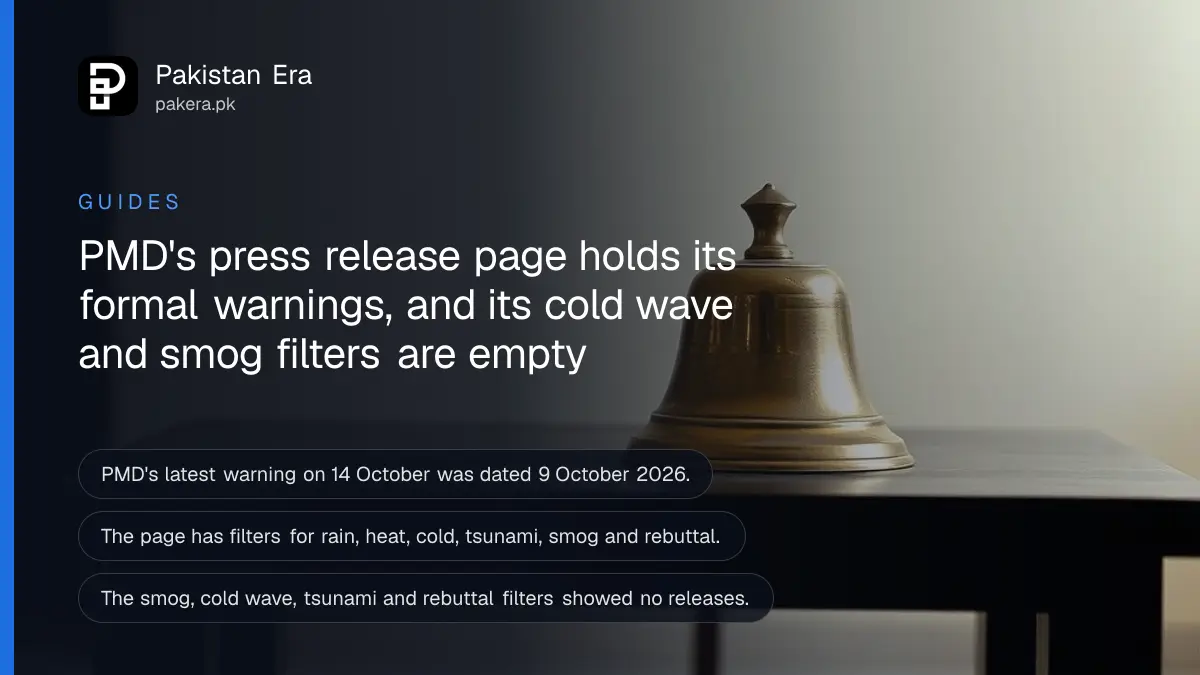
Short answer: Before you forward a weather warning, open weather.gov.pk/nwfc/all-press-releases and look for it. PMD lists its formal warnings there, newest first. On 14 October 2026 the latest was a rain, wind and thunderstorm warning dated 9 October. The page showed no smog, cold wave, tsunami or rebuttal releases.
Every week a message goes around saying a storm, a cold wave or a flood is coming on a certain date. Some are real. Many are old, or copied from another country. The Pakistan Meteorological Department, or PMD, keeps its official warnings in one list. We read that list on 14 October 2026, opened the filters and read the latest release in full.
The press release page is where PMD files its formal warnings
The page is titled Press Releases and shows entries by date with a headline. Filters across the top read ALL, RAIN-WIND, HEAT WAVE, COLD WAVE, TSUNAMI, SMOG and REBUTTAL. The daily forecast is a different page; this is where a multi-day warning is issued.
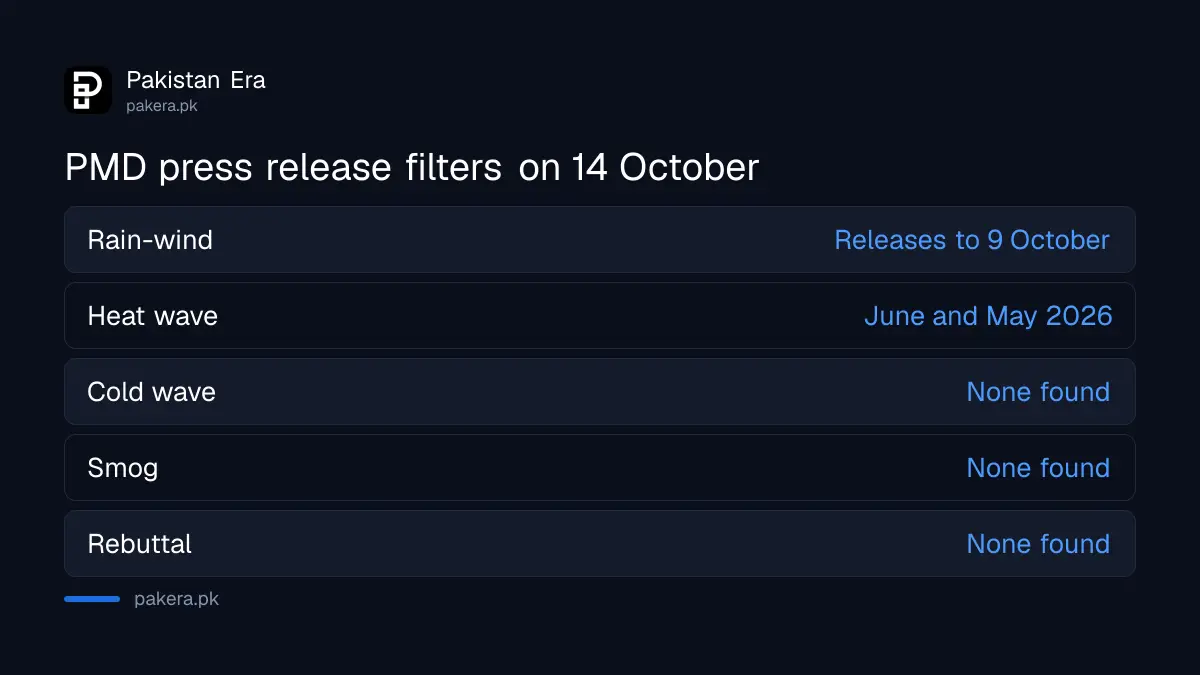
The latest five entries in the ALL list were all rain-wind warnings: 9 October, 5 October, 11 September, 2 September and 28 August 2026. The list runs to nine pages of older releases.
The main forecast and the warning can differ in detail, so read both. For where else to look, see the page on where to get the official weather forecast.
The 9 October release names districts and impacts
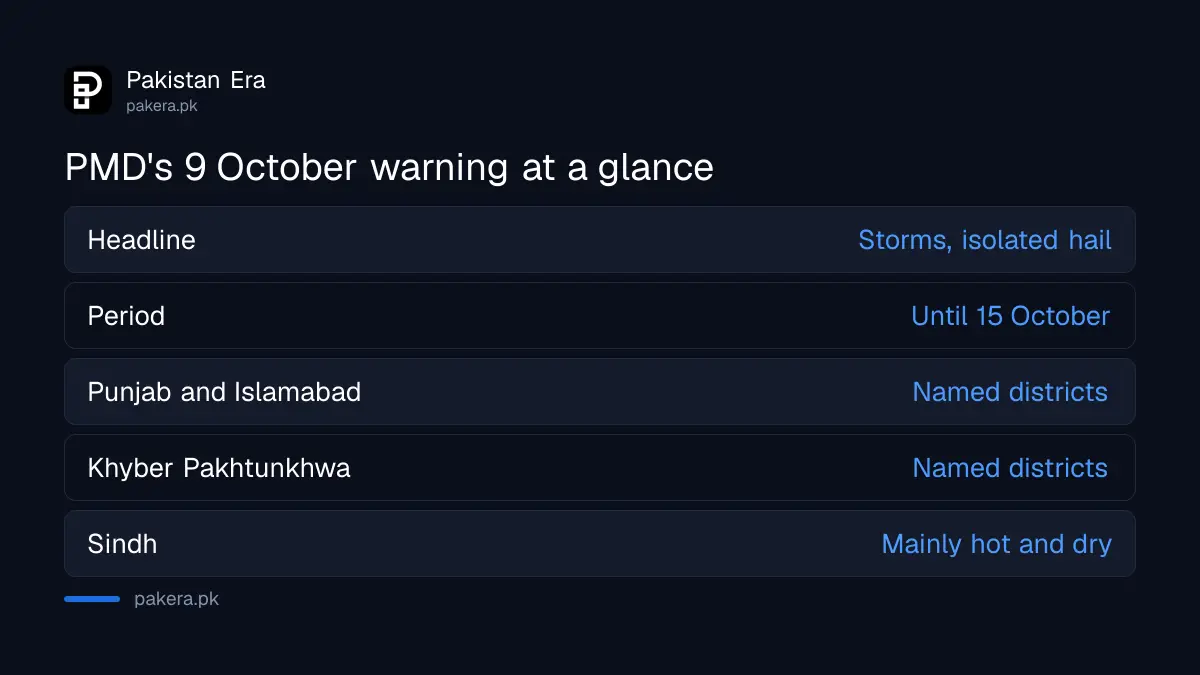
The 9 October release said a westerly wave would enter the upper parts of the country from Saturday and last until 15 October. It listed districts for Punjab, Islamabad, Khyber Pakhtunkhwa, Kashmir, Gilgit-Baltistan and Balochistan, and said Sindh would stay mainly hot and dry.
| Part of the release | What it said on 9 October 2026 |
|---|---|
| Headline | Rain-wind/thunderstorm (isolated hailstorm) in upper and central parts from the weekend |
| Period | Until 15 October, with occasional gaps |
| Punjab and Islamabad | Storms on 10 and 11 and on 13 and 14 October in named districts |
| Khyber Pakhtunkhwa | Storms from 10 to 15 October in named districts |
| Sindh | Mainly hot and dry |
It then gives "Possible impacts and advises": wind, hail and lightning may damage weak structures such as kacha roofs and walls, electric poles, billboards, vehicles and solar panels. Hail may hurt standing crops in the plains of Punjab and Khyber Pakhtunkhwa. Light snow is possible on high mountains. Day temperatures may fall by 2 to 4 degrees Celsius.
A closing note asks "all concerned authorities" to remain vigilant. For what to do before a windstorm, see how to secure solar panels and roofs.
Empty filters tell you something too
The SMOG, COLD WAVE, TSUNAMI and REBUTTAL filters each showed "No press releases found" when we opened them. HEAT WAVE showed releases from June and May 2026. So a forwarded "PMD cold wave warning" in mid-October has no match on this page.
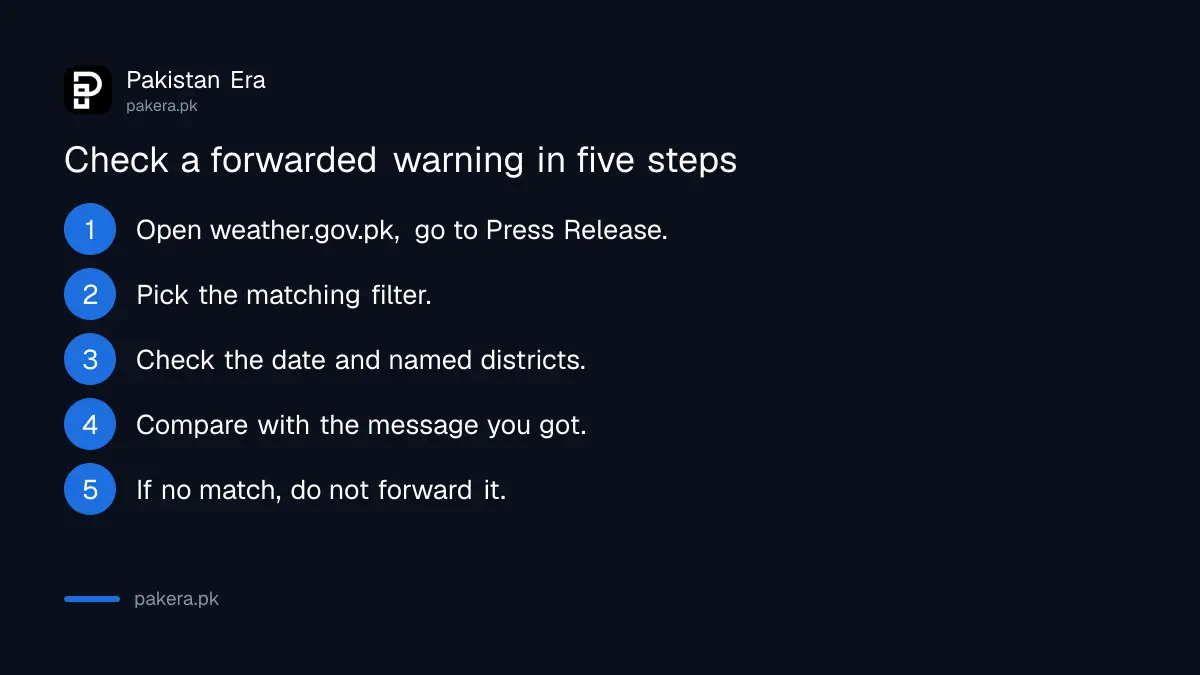
- Open weather.gov.pk and go to Press Release.
- Pick the filter that matches the warning, such as RAIN-WIND or COLD WAVE.
- Check the date and the district names in the newest entry.
- Compare with the message you received: dates, places and numbers must match.
- If there is no match, do not forward it. Check NDMA's advisories as well.
"No release found" does not prove a message is false. NDMA and the provincial authorities issue their own advisories, and PMD may add a release later. The honest line is: "I cannot find this on PMD's page." See how to get NDMA alerts for the national list.
The REBUTTAL filter is the page's own place for PMD to reply to false weather claims. It was empty when we looked, so we cannot say how it is used.
How to match a forwarded message to the release
Check four things: the date of issue, the period, the named places and the type of event. A real warning names districts, not just "Pakistan". A message with a date weeks away, or a number with no district, rarely matches anything here.
Compare it with the recent examples, and with the longer view. Real warnings name places and dates. The NDMA rain and hail alert for 10 to 15 October followed the same PMD release. For the longer view, the PMD outlook for October to December shows what the season is expected to bring.
Share the link to the release, not a screenshot. A screenshot can lose its date, and a link always shows the date of issue. Ask the sender where the message came from before you pass it on, and tell them if you cannot find it.
Common questions
Where does PMD publish weather warnings?
On the Press Release page of weather.gov.pk, at weather.gov.pk/nwfc/all-press-releases, newest first.
How do I find a heat wave or cold wave warning?
Use the HEAT WAVE or COLD WAVE filter at the top of the page. On 14 October the cold wave filter was empty.
What was PMD's latest warning on 14 October 2026?
A rain, wind and thunderstorm warning with isolated hail, issued on 9 October, valid until 15 October.
What is the REBUTTAL filter?
A category on the page that appears meant for PMD's replies to false claims. It had no entries when we looked.
Does a missing release mean a warning is fake?
Not always. It means PMD has not posted it there. Check NDMA and your provincial authority too.
How we verified this
What we checked, where we read it, and what we could not confirm.
Last checked on 14 October 2026, Pakistan time. We read PMD's press release page, each filter, and the 9 October release in full. We did not read releases older than 28 August. Filters may fill in as seasons change, so look again on the day you need it.
About the author

Tax, Bills and Technology Writer
Ali Akhtar is a young and curious voice here at Pakistan Era. He is currently pursuing his A-Levels and has a growing interest in Pakistan’s changing industrial landscape and educational trends. Ali likes to write in a way that helps him explain and explore the world around him. His writing reflects the perspective of the new generation navigating the evolving trends of Pakistan where technology, youth innovation, and shifting opportunities are reshaping the country’s future.