Secure Solar Panels and Roofs Before a Windstorm in Pakistan: What NDMA's Advisory Says
NDMA's 9 October advisory warns that windstorm and hail may damage roofs, poles, billboards and solar panels until 15 October. Read what to check and avoid.
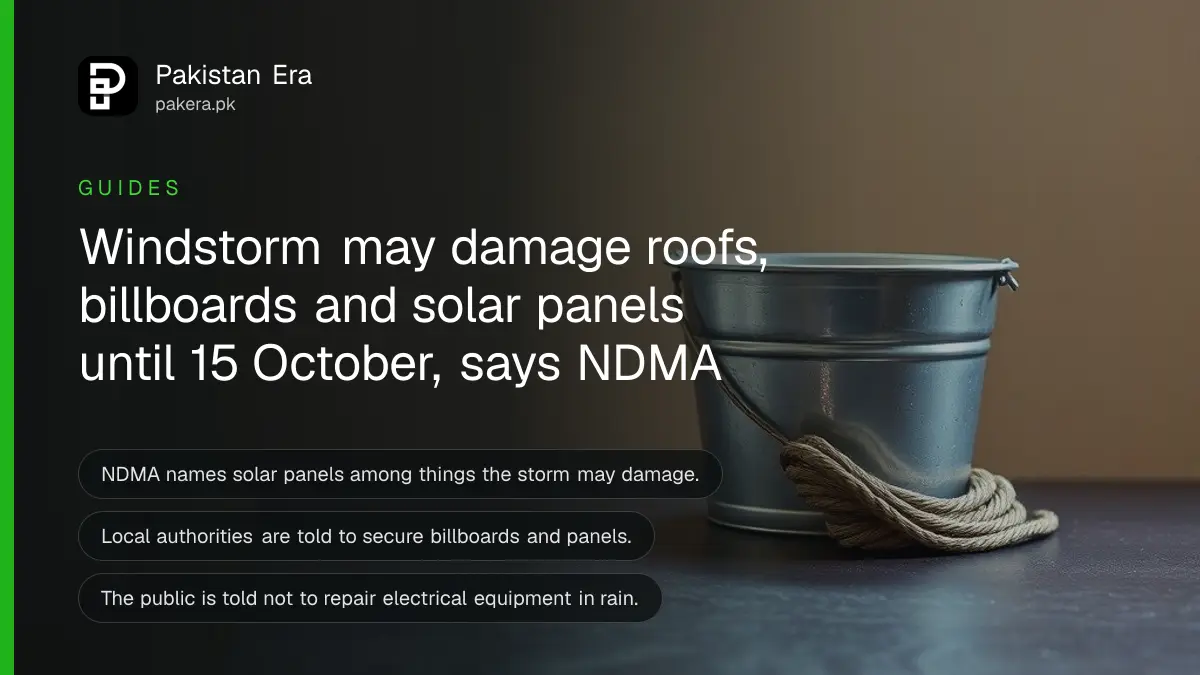
Short answer: NDMA's 9 October 2026 advisory says windstorm, hail and lightning may damage weak roofs and walls, electric poles, billboards, vehicles and solar panels until 15 October. It tells local authorities to secure loose structures, solar panels included, and tells the public not to repair electrical equipment in the rain.
A rooftop solar array is the most visible new object on Pakistani roofs. Row upon row of panels now sit above kacha and pakka houses alike, bolted down by whoever offered the lowest quote. A westerly wave with gusts and hail is the first real test of that work for many owners.
We read NDMA's eight-page weather advisory dated 9 October 2026 on 12 October 2026. This page separates what NDMA actually says from sensible steps we suggest. The two are marked, so you can tell them apart.
NDMA lists solar panels among things the storm may damage
The advisory says windstorm, hailstorm and lightning may damage weak structures such as the roof or wall of kacha houses, electric poles, billboards, vehicles and solar panels during the forecast period. It also says hail may damage standing crops in the plains of Punjab and Khyber Pakhtunkhwa.
The weather system is a westerly wave, which the Pakistan Meteorological Department says enters upper Pakistan from 10 October and stays until 15 October. Day temperatures are expected to fall by 2 to 4 degrees, and light snow is expected on high mountains and glaciers.
The advisory gives no wind speed, so we cannot tell you whether a given mounting will hold. It names the risk. The rest is for owners and installers to judge.
| At risk, per NDMA | Who acts (our summary) |
|---|---|
| Roof or wall of kacha houses | Residents, local administration |
| Electric poles | Power companies, residents keep clear |
| Billboards and hoardings | Local administration to secure |
| Solar panels | Local administration to secure; owners should check |
| Vehicles | Owners, covered or in shelter |
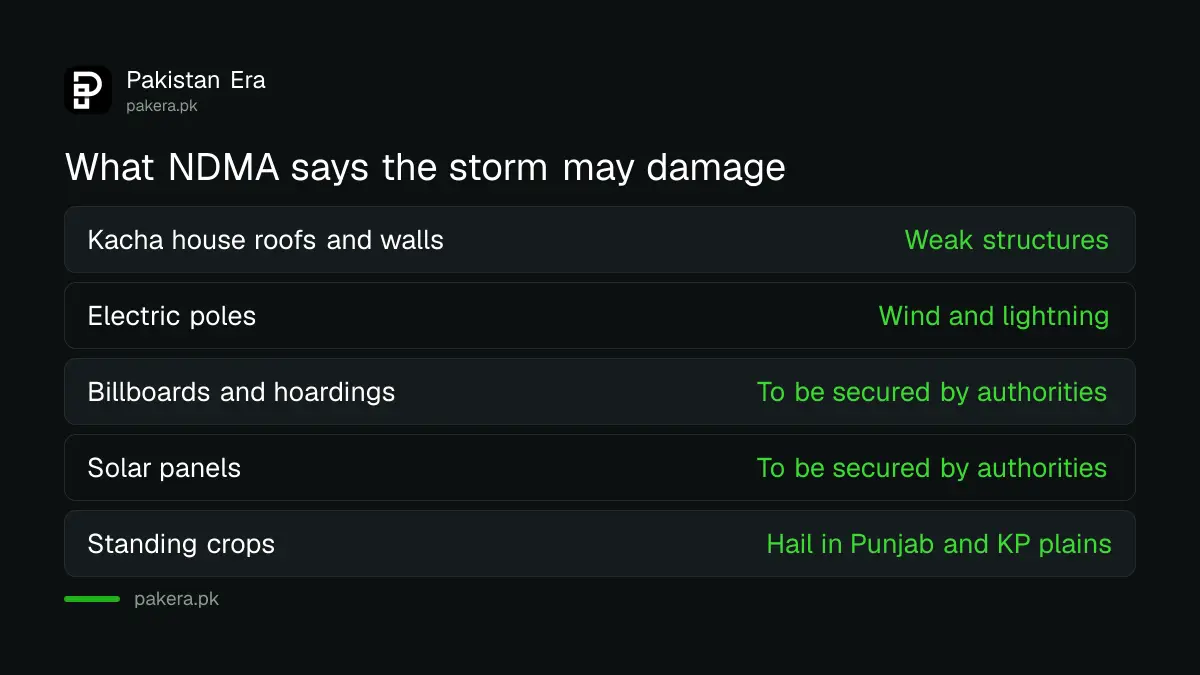
NDMA tells authorities to secure loose structures, panels included
Among the tasks given to district disaster authorities and local administrations, the advisory lists securing loose structures including billboards, hoardings and solar panels from the effects of windstorms and thunder showers. That instruction is aimed at public property and public places.
For a home, nobody will do it for you. NDMA's text says nothing on how a private owner should fix panels. We therefore keep our suggestions short and plain.
These are our suggestions, not NDMA's. Ask the installer or any competent electrician to check that the frames, bolts and clamps are tight, and that no cable is hanging loose. Do not climb a wet roof to do it yourself. Our note on solar systems of up to 25 kW explains the rule that put so many panels on roofs.
Do not touch electrical equipment or exposed lines in the rain
The public rule that matters most for solar owners is a line about electricity. NDMA says not to handle or repair any electrical equipment, especially exposed lines, to avoid electrocution during rain and water pondage. A damaged panel or wire in a storm is a reason to stay away.
If a panel has shifted, a cable is dangling, or the inverter is wet, switch it off only if you can do so safely from a dry spot, and call a qualified electrician after the storm. A leaning panel is a hazard in its own right, since it can also come loose in the next gust.
The advisory also advises people to avoid staying in weak structures and to seek shelter in concrete buildings in intense rain. For the electrical side, see why electrocution kills more people in the monsoon.
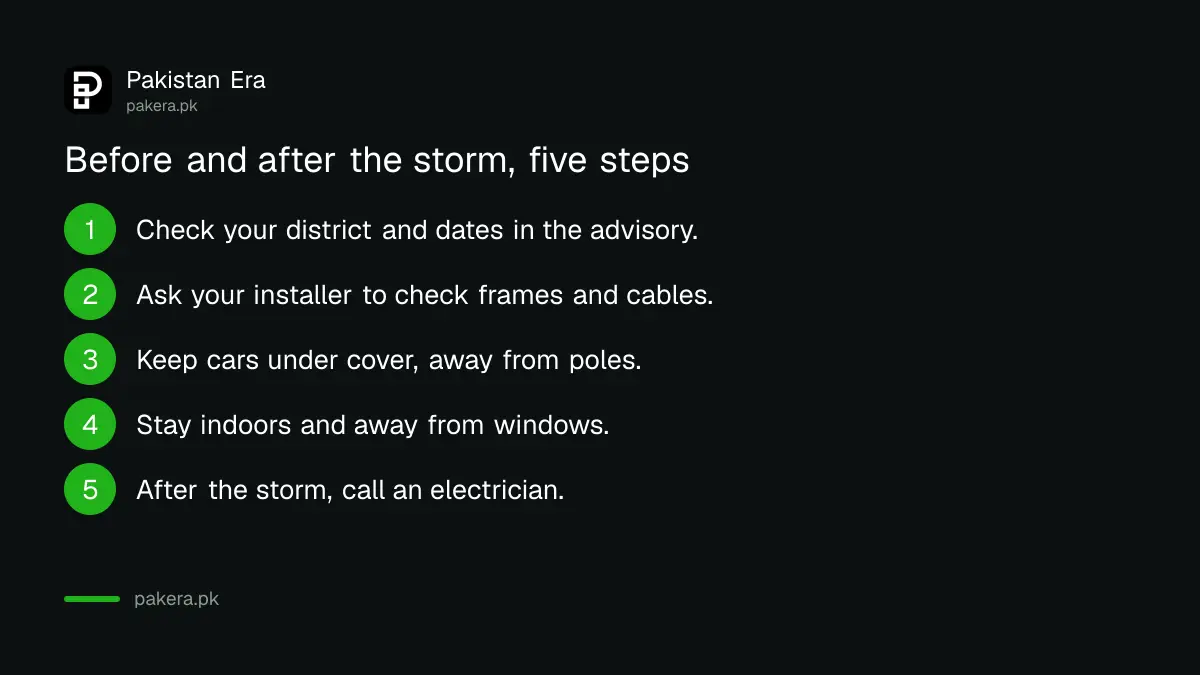
- Read the advisory and check if your district is on the list for your dates.
- Ask your installer to check frames, bolts and cable clips before the next spell.
- Keep cars under cover and away from poles, trees and billboards.
- During the storm, stay indoors and away from windows.
- After the storm, do not touch fallen wires or a damaged array. Call an electrician.
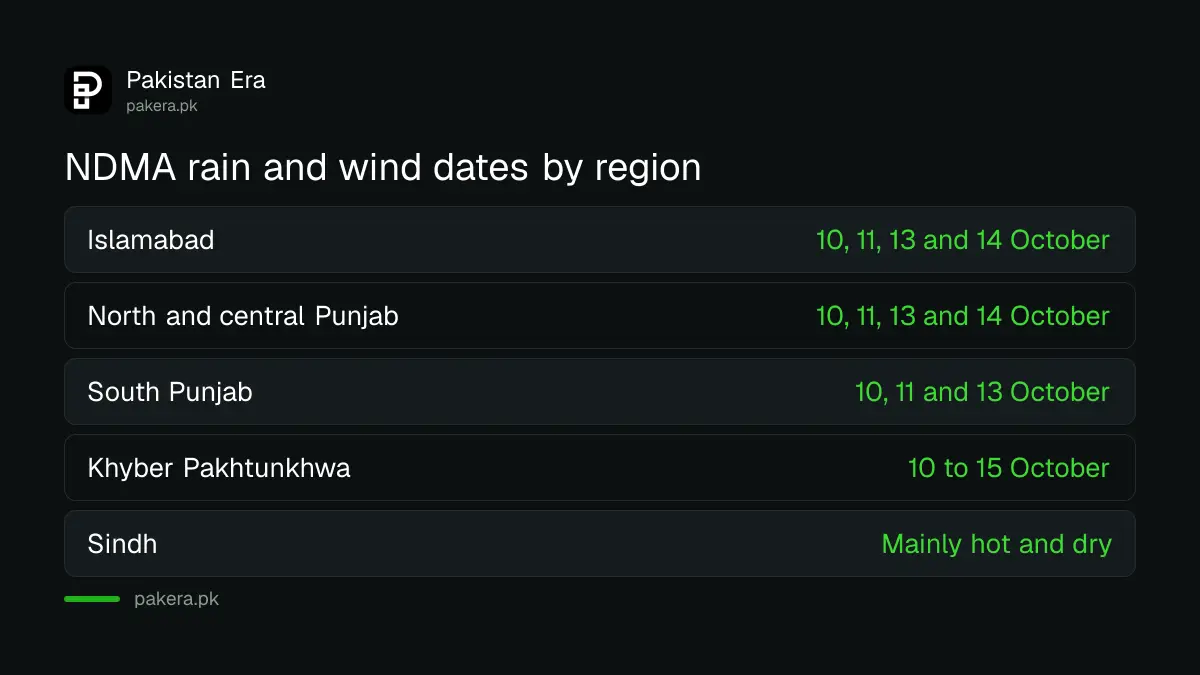
Check which dates and districts apply to you
NDMA names rain, wind and thunderstorm for Islamabad on 10, 11, 13 and 14 October, and many Punjab districts including Lahore, Rawalpindi, Faisalabad and Sargodha. Multan, Bahawalpur and D.G. Khan are on the list for 10, 11 and 13 October. Sindh is mainly hot and dry.
The district lists are in our report on the NDMA rain and hail alert. The advisory page and alerts are covered in our note on getting NDMA alerts.
Damage claims and wiring checks after a storm
NDMA's advisory does not say anything about insurance or compensation for panels. If a policy covers your system, read it for weather damage and photograph the damage before repairs. If a short circuit or fire follows, see the test report needed after a house fire or short circuit.
We did not find an official scheme for storm damage to private solar panels. Ask the installer what their warranty covers for wind and hail.
Common questions
Does NDMA say solar panels can be damaged by the storm?
Yes. Its 9 October advisory lists solar panels with roofs, poles, billboards and vehicles as things windstorm, hail and lightning may damage.
Who is responsible for securing billboards and panels?
The advisory tells district disaster authorities and local administrations to secure loose structures including billboards, hoardings and solar panels. Home owners must check their own systems.
Should I go on the roof to check my panels in the rain?
No. NDMA says not to handle or repair electrical equipment, especially exposed lines, during rain. Wait for dry weather and call a qualified installer.
Until which date does the storm warning run?
NDMA says the westerly wave is likely to persist until 15 October 2026, with rain on and off through the period.
Does Sindh have the same warning?
No. NDMA says Sindh is likely to stay mainly hot and dry in the coming days, and Balochistan is mainly hot and dry with isolated rain in a few districts.
How we verified this
What we checked, where we read it, and what we could not confirm.
We read the NDMA weather advisory dated 9 October 2026 on 12 October 2026. Our suggestions on frames and bolts are marked as ours and are not NDMA's. Check the NDMA page for any newer advisory.
About the author

Public Services and Education Journalist
Fajr Riaz is a journalist and content writer at Pakistan Era, based in Lahore. She covers the questions people meet in everyday life in Pakistan: how a public service works, what a change in the rules means, and where to find a reliable answer.