How to Check a Housing Scheme Before Buying a Plot
The authority publishes approved schemes with blocks, plot counts and mortgaged plots, plus a separate illegal list. Five checks before you pay.
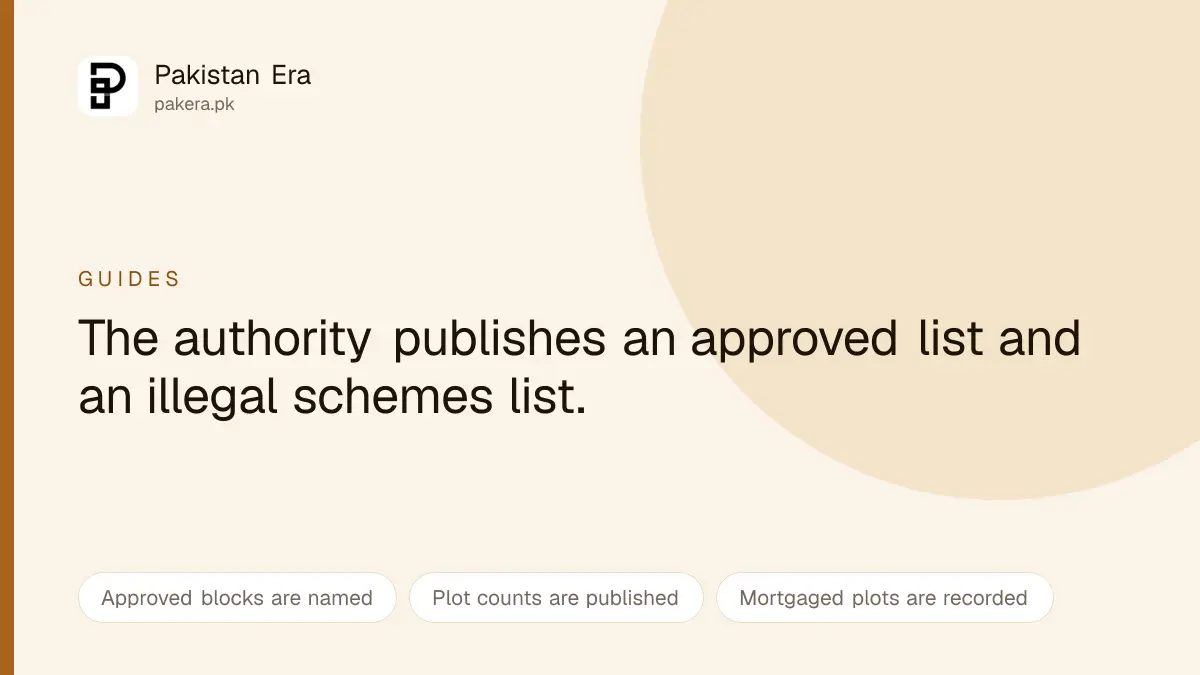
The development authority publishes a list of approved housing schemes and a separate list of illegal ones. Both are free, and almost nobody checks either before paying a booking amount.
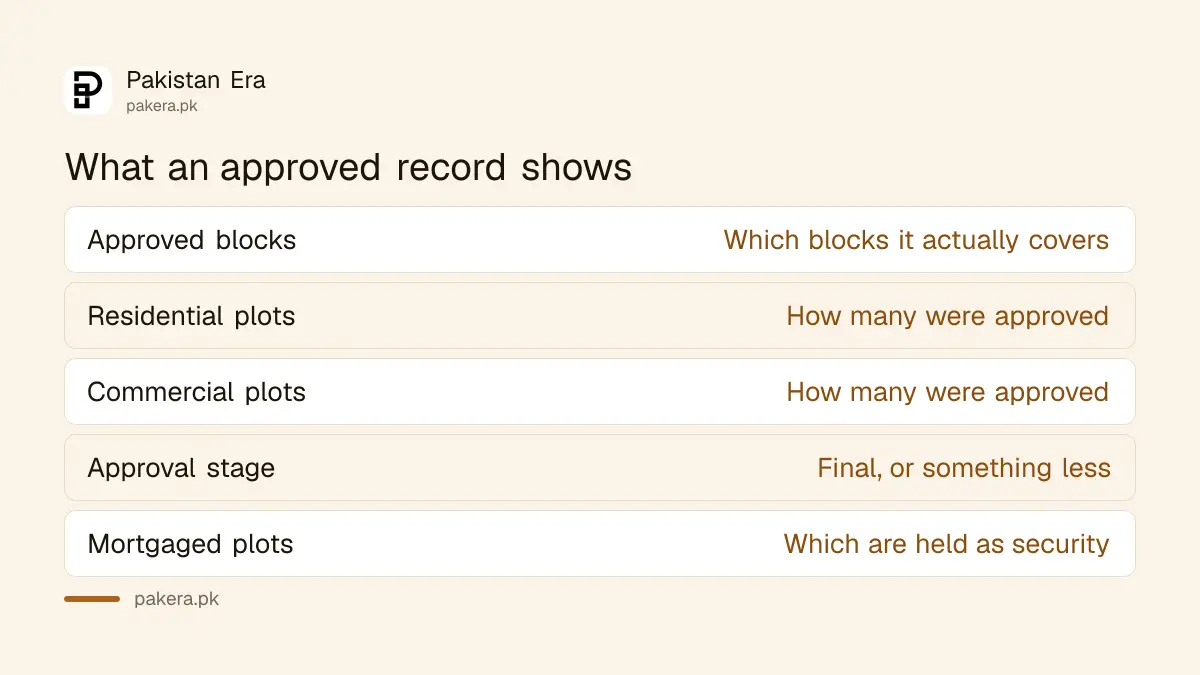
The approved list carries more than names. For each scheme it records the approved blocks, the number of residential and commercial plots approved, the approval stage, and which plots are mortgaged.
We read the Lahore Development Authority's approved schemes data at lda.gop.pk on 6 September 2026.
What an approved scheme record contains
| Field | What it tells a buyer |
|---|---|
| Approved blocks | Which blocks the approval actually covers |
| Residential plots | How many were approved |
| Commercial plots | How many were approved |
| Approval stage | Whether it is final or something less |
| Mortgaged plots | Which plots are held as security |
| Mauza and area | The revenue estate and approved area |
A typical record names the scheme, its mauza, the approved area, the plot counts, the approved blocks such as A, B and C, the date of approval, and a mortgaged plots entry with an image attached.
Approved is not one thing
This is the part that catches people, because a brochure says "approved" and stops there.
The published data carries an approval stage against each scheme. Some are recorded as Final. Others appear with wording such as approved but final approval not yet issued, approved by a union council, or approved by a TMA in a stated year.
Those are not equivalent. A scheme whose final approval has not issued is not in the same position as one that has completed the process, and an approval from a different body is not an approval from the development authority.
So the question to ask is not whether a scheme is approved. It is what stage the authority's own record shows.
Check the block, not just the scheme
The record names the approved blocks. That matters more than it sounds.
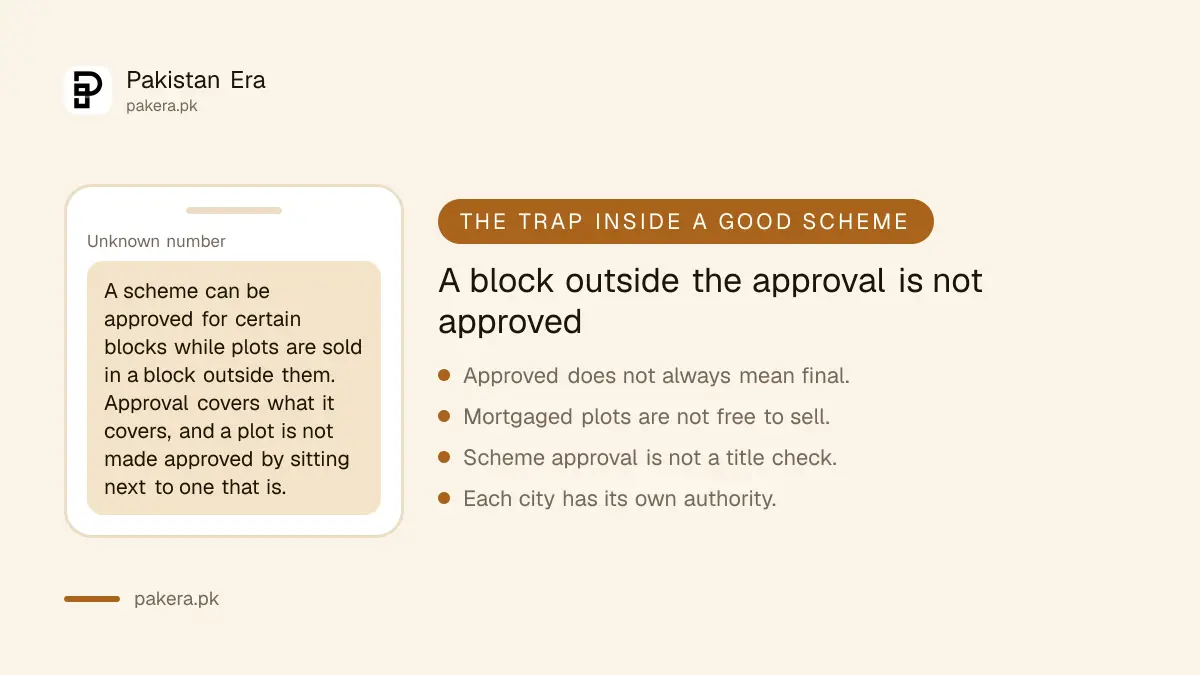
A scheme can be approved for certain blocks while the developer sells plots in a block outside them, on the strength of the scheme's overall reputation. The approval covers what it covers, and a plot in an unapproved block is not made approved by sitting next to one that is.
The same applies to the plot counts. If the record shows a number of approved residential plots, a scheme selling well beyond that is selling something the approval does not cover.
Mortgaged plots are the trap nobody explains
Each record carries a mortgaged plots entry, and many carry an image showing which plots those are.
Plots are mortgaged to the authority as security that the developer will complete the promised development. Until the mortgage is released, those plots are not the developer's to sell freely, and a buyer who pays for one is buying a dispute.
Some records show the mortgage as not executed, which is its own signal about the state of the scheme's paperwork rather than a clean bill of health.
Ask which plot number you are being sold, then check it against that image before any money moves.
What to do before you pay anything
- Find the scheme on the authority's approved list, by name.
- Check the approval stage recorded against it.
- Check your block is among the approved blocks.
- Check the plot against the mortgaged plots record.
- Check the separate illegal schemes list for the name.
Do all five before the booking amount, not after. A booking receipt is not a title, and the money is far harder to recover than it was to hand over.
Which authority applies to you
Development authorities are city and province specific, and each maintains its own lists.
The Lahore Development Authority covers Lahore. The Capital Development Authority covers Islamabad, and the Rawalpindi Development Authority covers Rawalpindi. A scheme approved by one is not thereby approved anywhere else, and a brochure naming an authority that does not govern that land is a warning in itself.
Find the authority for the district the land sits in, and look for that authority's own list.
The land record is a separate check
Scheme approval and land title are two different questions. A scheme can be approved while the specific plot has a title problem, and the mauza named in the record is where the land record check begins.
Our guide to getting a fard online in Punjab covers the land record itself. Our guide to tax on buying and selling property covers the collections at transfer, and our guide to capital gains on property covers what happens when you sell.
If you are financing the purchase, our guide to how banks decide your home loan sets out the State Bank rules, including the valuation requirement above ten million rupees, which is itself a form of independent check.
What we could not read
The illegal schemes page exists on the authority's site and we opened it, but its list loads through the browser rather than appearing in the page we could retrieve. So we are telling you the list is published and where, rather than reproducing any name from it.
That is the right way round anyway. A list of illegal schemes changes, and a name copied onto a blog goes stale while the official page does not. Open the authority's own page and search the name you have been given.
Common questions
How do I check if a housing scheme is legal?
Look for the scheme on the development authority's approved schemes list, and check the separate illegal schemes list.
Does approved mean fully approved?
Not always. The record carries an approval stage, and some schemes show approvals that are not final or that came from another body.
Why do the approved blocks matter?
Because a plot in a block outside the approval is not covered by it, even within a scheme that is otherwise approved.
What are mortgaged plots?
Plots held by the authority as security that the developer will complete the development. They are recorded, often with an image.
Which authority should I check?
The one for the district the land is in. LDA for Lahore, CDA for Islamabad, RDA for Rawalpindi.
Is this the same as checking the title?
No. Scheme approval and land title are separate checks, and you need both.
How we verified this
What we checked, where we read it, and what we could not confirm.
Last checked 6 September 2026. We read the Lahore Development Authority's site at lda.gop.pk on that date, including its approved schemes page. That the authority publishes an approved schemes list and a separate illegal schemes list, and that each approved scheme record carries the scheme name, mauza, approved area, number of residential plots, number of commercial plots, approved blocks, location, approval stage, date of approval, and a mortgaged plots entry with an associated image, are taken from that published data. The observation that approval stages differ, including entries recorded as final and others recorded as approved without final approval issued, approved by a union council, or approved by a TMA, is taken from the same data. We did not reproduce any scheme name, plot number or mortgaged plots list here, because those change and only the authority's own page is current for them. The illegal schemes page exists on the site and we opened it, but its list is loaded in the browser rather than served in the page we retrieved, so we have not read or reproduced it. The Capital Development Authority and Rawalpindi Development Authority are named as the authorities for Islamabad and Rawalpindi; we did not read their lists for this guide. Check the authority for the district your land sits in, and confirm every detail on its own page before paying anything. Nothing here is legal advice.
About the author

Tax, Bills and Technology Writer
Ali Akhtar is a young and curious voice here at Pakistan Era. He is currently pursuing his A-Levels and has a growing interest in Pakistan’s changing industrial landscape and educational trends. Ali likes to write in a way that helps him explain and explore the world around him. His writing reflects the perspective of the new generation navigating the evolving trends of Pakistan where technology, youth innovation, and shifting opportunities are reshaping the country’s future.