Baby Formula Rules in Pakistan: What the 2002 Breastfeeding Law Bans
Pakistan's 2002 Breastfeeding Ordinance bans formula promotion, free samples and gifts to doctors, with fines up to Rs 500,000. See the rules and how to report.
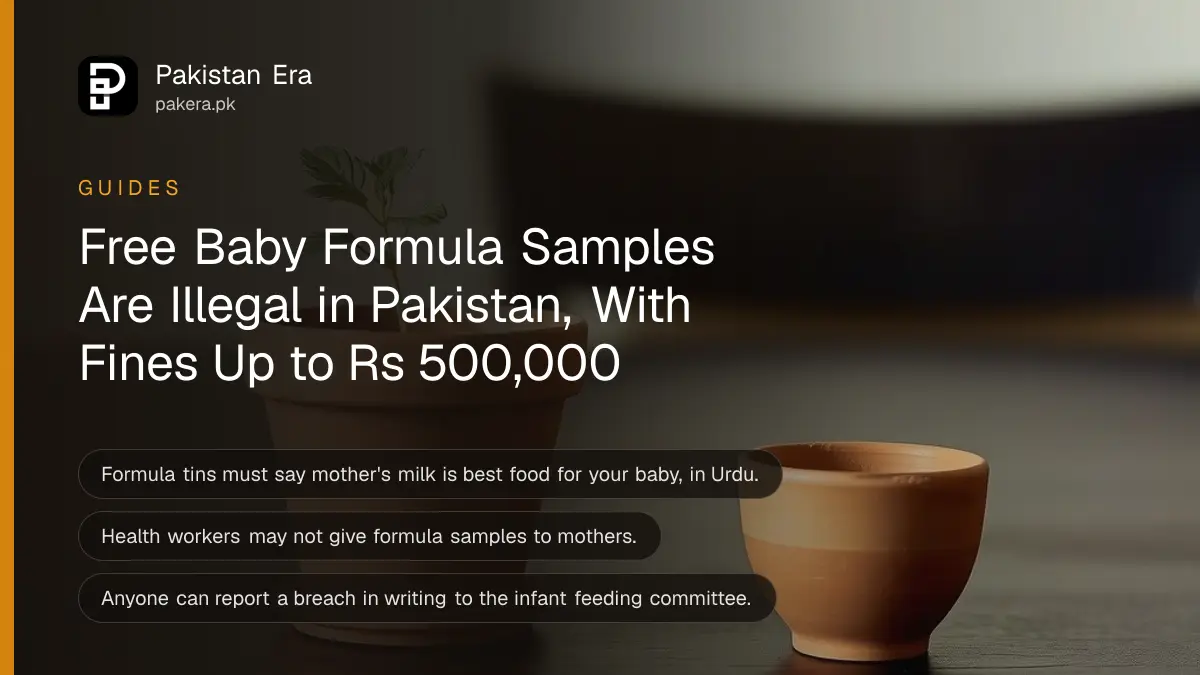
In Pakistan, no one may promote infant formula, feeding bottles, teats or pacifiers, give free samples to mothers, or claim formula equals breast milk, under the Protection of Breast-feeding and Child Nutrition Ordinance, 2002. A maker or seller who breaks these rules faces up to two years in jail or a fine of Rs 50,000 to Rs 500,000. Anyone can report a breach in writing.
The Ordinance covers what the law calls "designated products": milk sold for babies up to 12 months, products marketed as a complement to breast milk, and feeding bottles, teats, valves, pacifiers and nipple shields. We read the full text on the Pakistan Code, the federal law website run by the Ministry of Law and Justice, on 20 October 2026.
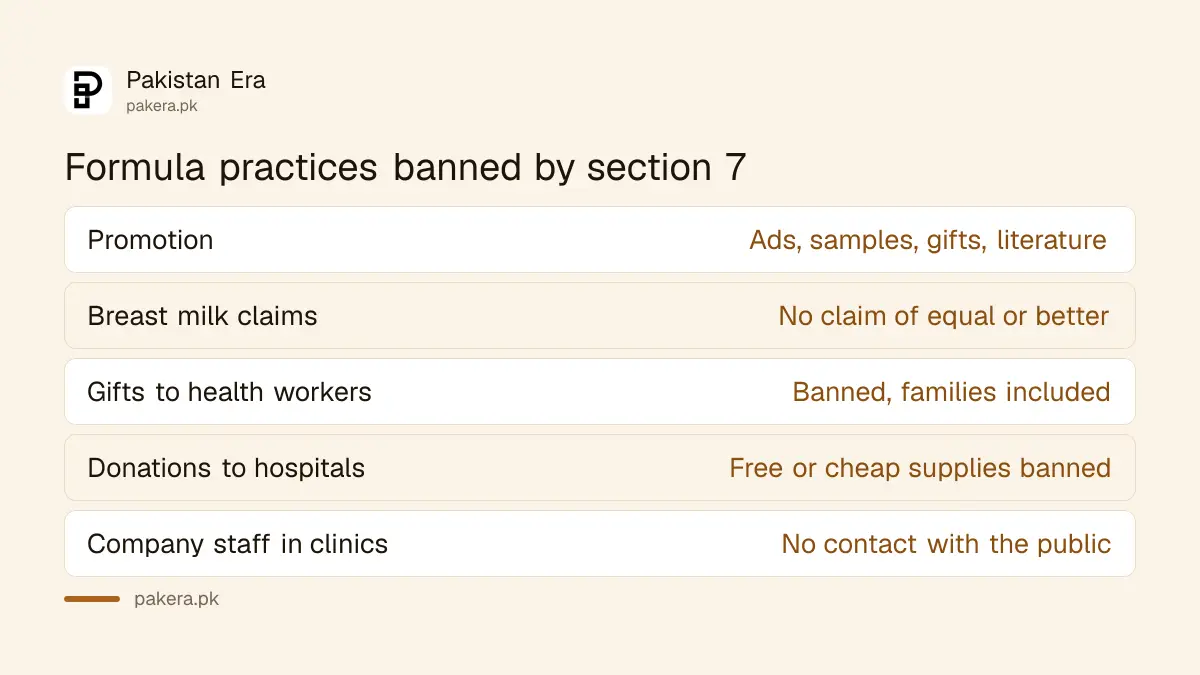
The 2002 Ordinance bans seven kinds of formula promotion
Section 7 of the Ordinance bans promoting any designated product, claiming it equals or beats breast milk, giving gifts to health workers, donating products to hospitals, instructing mothers, contacting the public inside a health facility, and producing infant feeding leaflets.
| Section 7 | What is banned |
|---|---|
| 7(1) | Promoting any designated product, except as the Ordinance allows |
| 7(2) | Saying a product is a substitute for, equal to or better than mother's milk |
| 7(3) | Gifts, payments or benefits to health workers or their families |
| 7(4) | Free or cheap products or equipment for a health care facility |
| 7(5) | Anyone but an independent health worker instructing mothers on use, except through the label |
| 7(6) | Company contact with the public inside a health care facility |
| 7(7) | Company leaflets on infant feeding, except factual material for health professionals |
"Promotion" is defined widely. It includes advertising, free samples, gifts, literature and public relations. A doctor's prescription written on health grounds is not promotion. So the law does not stop a doctor from advising formula when a baby truly needs it.
Formula labels must carry an Urdu warning and no baby pictures
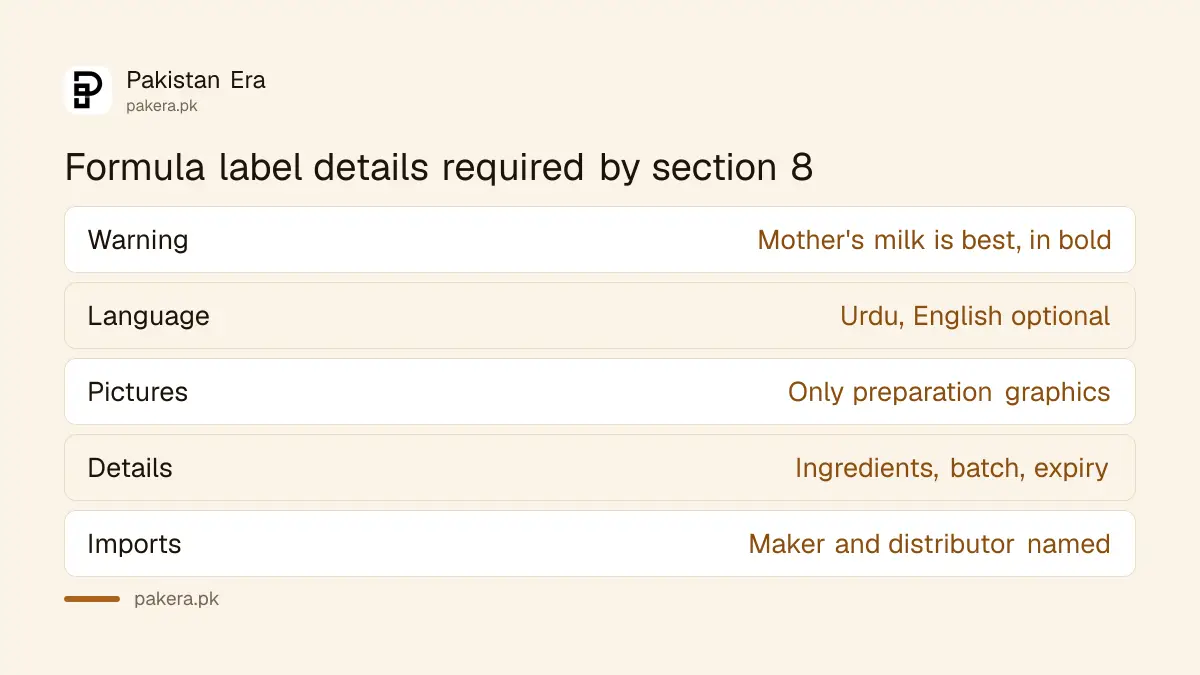
Section 8 says every formula tin must carry, in bold, "Mother's milk is best food for your baby and helps in preventing diarrhoea and other illnesses". The label must be in Urdu, must not show pictures except preparation graphics, and must not use words like "humanized".
The label must also give Urdu instructions for correct preparation, the ingredients, storage conditions, batch number and expiry date. For an imported product, it must name the maker and the wholesale distributor. Bottles, teats, pacifiers and nipple shields are spared the preparation and ingredient rules.
Section 11 adds quality rules. Formula must meet Codex Alimentarius standards, the international food standards set by the UN's food and health agencies. It cannot be sold after expiry, and it must be sold only in its original container. Loose formula from an open sack breaks the law.
Doctors and nurses may not hand out formula samples
Section 10 tells health workers to encourage and protect breastfeeding. They may not accept or give formula samples to anyone, especially pregnant women and mothers. A health worker's association may not promote any designated product, and every health facility must post an abstract of the Ordinance.
The definition of a health worker is broad. It covers doctors, nurses, midwives, traditional birth attendants, hakims, homeopaths, pharmacists, dispensers, nutritionists and hospital staff, paid or unpaid. A health worker offered a gift by a company must report it in writing.
A formula sample in your discharge bag after delivery is exactly what section 10(2) bars. If the hospital gives one, it is fair to ask why. Families on a tight budget can look at support schemes such as the Aaghosh programme for pregnant mothers in Punjab and the Sindh Mamta programme.
Breaking the rules costs up to Rs 500,000 or two years in jail
Section 17 punishes a maker or distributor who breaks sections 7, 8(1) or the key quality rules with up to two years in jail, a fine of Rs 50,000 to Rs 500,000, or both. Any other breach carries a fine of up to Rs 500,000.
A licence holder can also lose a licence under section 16, after a hearing. A doctor who breaks the rules is referred to the medical council instead. When a company is at fault, the company and the people responsible can both be found guilty.
Offences are non-cognizable, which means police cannot arrest or start a case on their own. A court acts only on a written report from an officer the federal government has authorised. An appeal goes to the High Court within 30 days of the judgment.
Report a formula promotion breach in writing
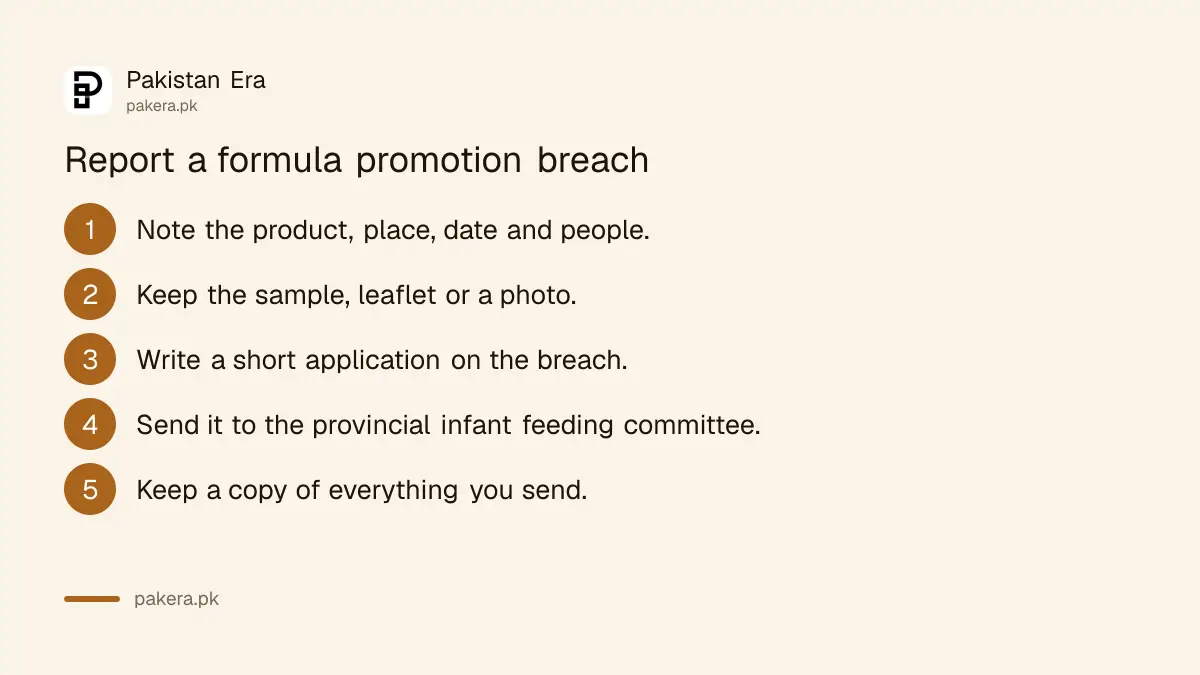
Section 15 lets any person apply in writing to the National Infant Feeding Board or the Provincial Infant Feeding Committee about a breach. The Board or Committee investigates, gives the other side a hearing, and recommends whether to prosecute.
- Note what you saw: the product, the place, the date and who was involved.
- Keep evidence, such as the free sample, the leaflet or a photo of the promotion.
- Write a short application describing the breach and the section it breaks.
- Send it to the provincial health department, addressed to the Provincial Infant Feeding Committee, and keep a copy.
- If the breach involves a medicine-like product, you can also report it to DRAP.
Specialised baby milk for medical conditions is now also a DRAP matter, after DRAP notified health and OTC products as therapeutic goods. Misleading health claims for such products can be raised when you report an illegal medicine advertisement to DRAP.
Common questions
Is it legal to sell baby formula in Pakistan?
Yes. Selling formula is legal. The Ordinance controls how it is promoted, labelled and supplied, not whether it can be sold.
Can a hospital give a free formula tin after delivery?
No. Section 10(2) bars health workers from giving samples, and section 7(4) bars companies from donating products to health facilities.
Can a doctor prescribe formula?
Yes. A prescription written on health grounds is excluded from the meaning of promotion, so a doctor can advise formula when a baby needs it.
What warning must a formula tin carry?
"Mother's milk is best food for your baby and helps in preventing diarrhoea and other illnesses", in bold, with Urdu instructions on the label.
What is the fine for breaking the formula rules?
For a maker or distributor, up to two years in jail or a fine of Rs 50,000 to Rs 500,000, or both. Other breaches carry up to Rs 500,000.
Does this law apply in every province?
The federal text says it extends to the whole of Pakistan. Health became a provincial subject in 2010, and provinces may have their own versions. We could not open the provincial law websites to check.
How we verified this
What we checked, where we read it, and what we could not confirm.
Last checked 20 October 2026. We read the full Protection of Breast-feeding and Child Nutrition Ordinance, 2002 (Ordinance XCIII of 2002, 26 October 2002) on the Pakistan Code, sections 1 to 21. The Punjab and Sindh law websites did not load for us on 20 October 2026, so we could not check provincial versions or any rules made under the Ordinance. We could not find a published contact address for the National Infant Feeding Board. This page is not medical advice about feeding your baby.
About the author
Public Services and Education Journalist
Fajr Riaz is a journalist and content writer at Pakistan Era, based in Lahore. She covers the questions people meet in everyday life in Pakistan: how a public service works, what a change in the rules means, and where to find a reliable answer.