How to Report an Illegal Medicine or Health Advertisement to DRAP in Pakistan
DRAP bans miracle cure claims, celebrity endorsements and refund offers in medicine adverts. See the rules and how to send DRAP a complaint with your evidence.
Short answer: To report an illegal medicine or health advertisement in Pakistan, fill DRAP's complaint form for advertisements of therapeutic goods, remedies and treatments. Attach a copy of the advertisement and your evidence. DRAP sends the case to its Committee on Advertisement. Call DRAP on 0800-03727 if you need to know where to send it.
The post promises a "miracle" cure for sugar. The video shows a celebrity praising a herbal capsule. The poster outside a clinic offers a money-back guarantee. Pakistan's drug regulator has written rules about all three, and most people never read them. We opened DRAP's advertisement pages and its advertisement guidelines on 15 October 2026. Here is what the rules say and how to complain.
Medicine and health product advertisements need DRAP approval first
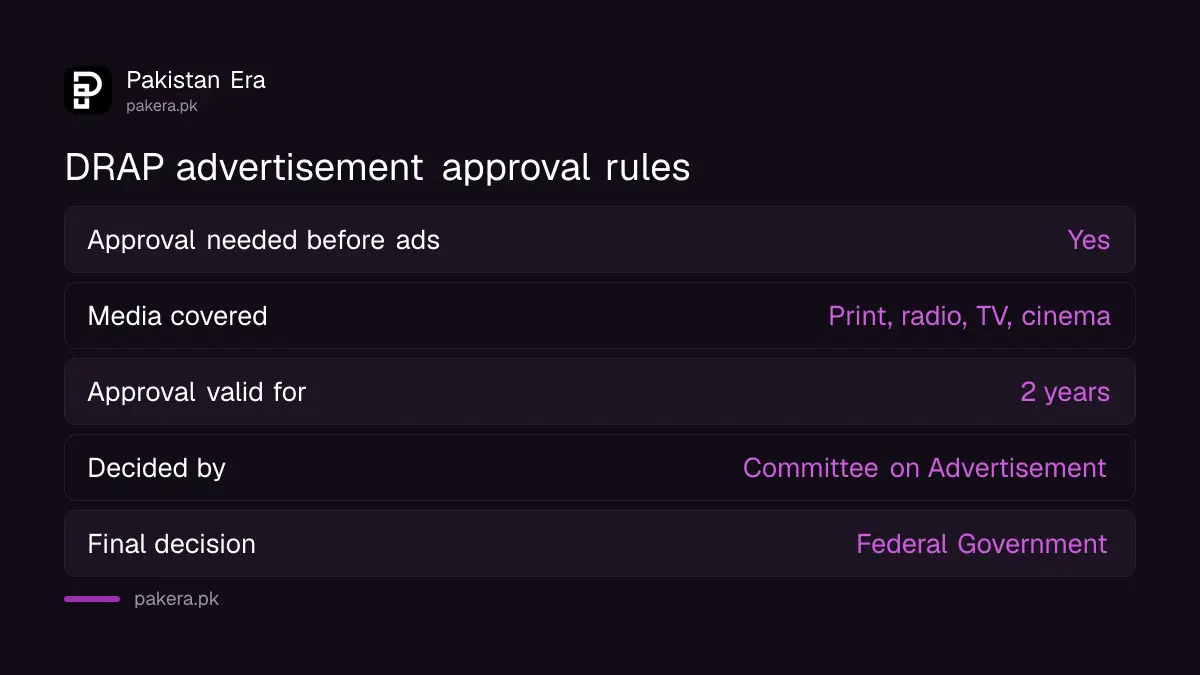
DRAP says all registered pharmaceutical and biological drugs, and enlisted health and over-the-counter products, need prior approval before any direct advertisement to consumers. The approval covers print, radio and TV or cinema. An approval letter and approved specimen are valid for two years.
The rules sit in the DRAP Act 2012, the Drugs Act 1976 and the Drugs (Licensing, Registering and Advertising) Rules 1976. DRAP's Committee on Advertisement evaluates each application, and the Federal Government takes the final decision. So an advertisement with no approval is a rule breach before you even read the claims.
That is the point to remember. You do not have to prove the product is harmful. You only have to show an advertisement for a therapeutic good that does not follow the rules.
DRAP's guidelines ban nine common claims
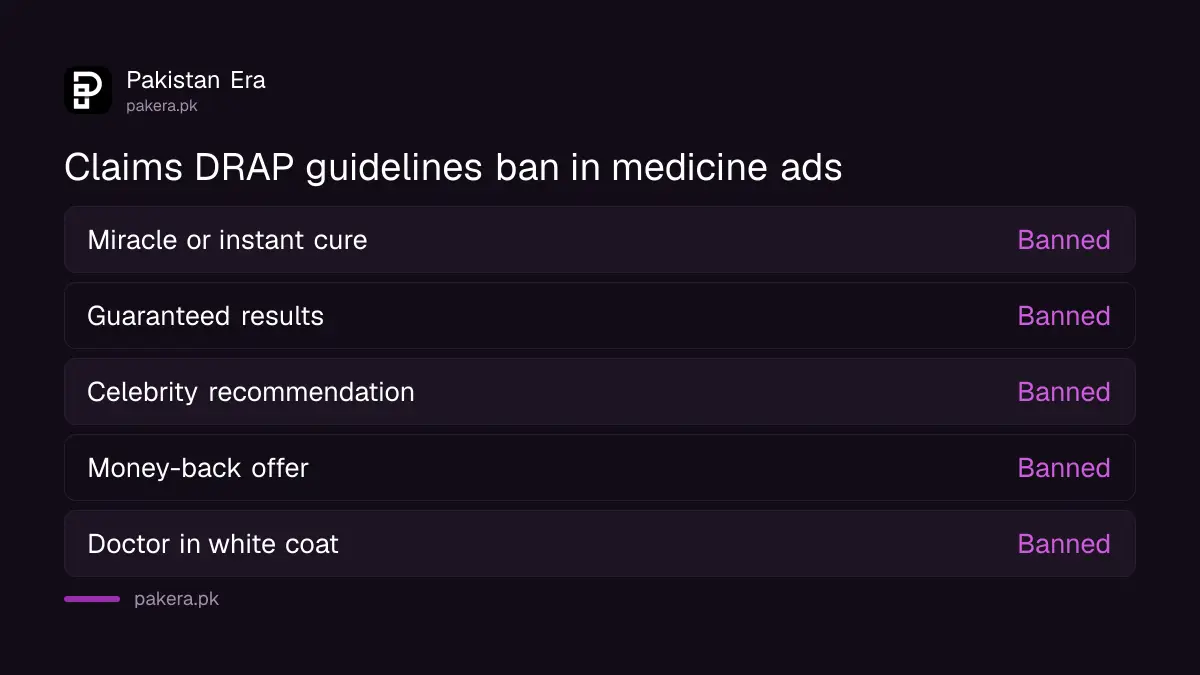
The Advertisement of Therapeutic Goods Guidelines, effective 30 June 2021, list what an advertisement must not do. Miracle words, guaranteed results, celebrity endorsements and money-back offers are all out. These are the claims you will meet most often on social media and shop boards.
| Claim in the advertisement | What the guidelines say |
|---|---|
| "Miracle", "instant cure", "100% safe" | Must be avoided, with "clinically proven" and "effective in all cases" |
| A guaranteed result | Must not claim a product is magical, infallible or guarantees results |
| "No side effects" | Must not suggest the product is free from side effects |
| A celebrity recommending it | Not allowed in advertisements aimed at consumers |
| A doctor in a white coat or with a stethoscope | Not allowed, to avoid a feeling of professional endorsement |
| Refund, discount or promotional offer | Any offer to refund money must not be made |
| Free samples for the public | Prohibited under the 1976 Rules |
| DRAP's name or logo | Must not be used to sell a product |
| Trial use of a product | The advertiser must not suggest or offer it |
The word "safe" is also restricted. The guidelines say it must not be used in promotion unless properly qualified and approved.
Some illnesses cannot be advertised to the public at all
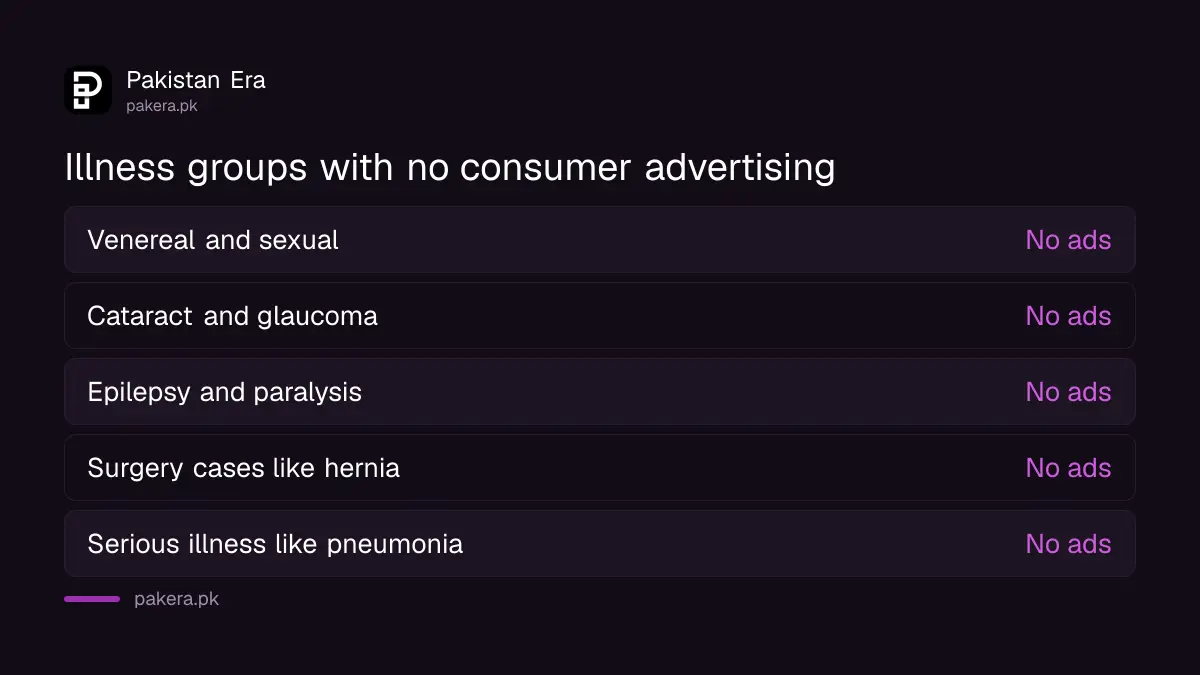
DRAP's guidelines list diseases for which direct-to-consumer advertising of treatment is prohibited in any media. The list names venereal diseases, sexual impotence, cataract, glaucoma, epilepsy, paralysis and blindness. It also names complaints that need surgery, such as appendicitis and hernias, and serious illness such as pneumonia.
Gripe waters and cough preparations are on the same list. An advert that promises to cure one of these at home is not a grey area. It is on a banned list, and it is worth a complaint.
The guidelines add that advertisements should not generally be permitted for prescription goods, or to promote self-medication or quackery. They also say advertising should not take undue advantage of people's worry about their own health.
File the complaint in five steps
DRAP's page for advertisement approvals has a section on complaints against illegal advertisement. It links a form and a flow chart. The form is addressed to the Committee on Advertisement. Prepare the evidence first, because DRAP asks for a copy of the advertisement.
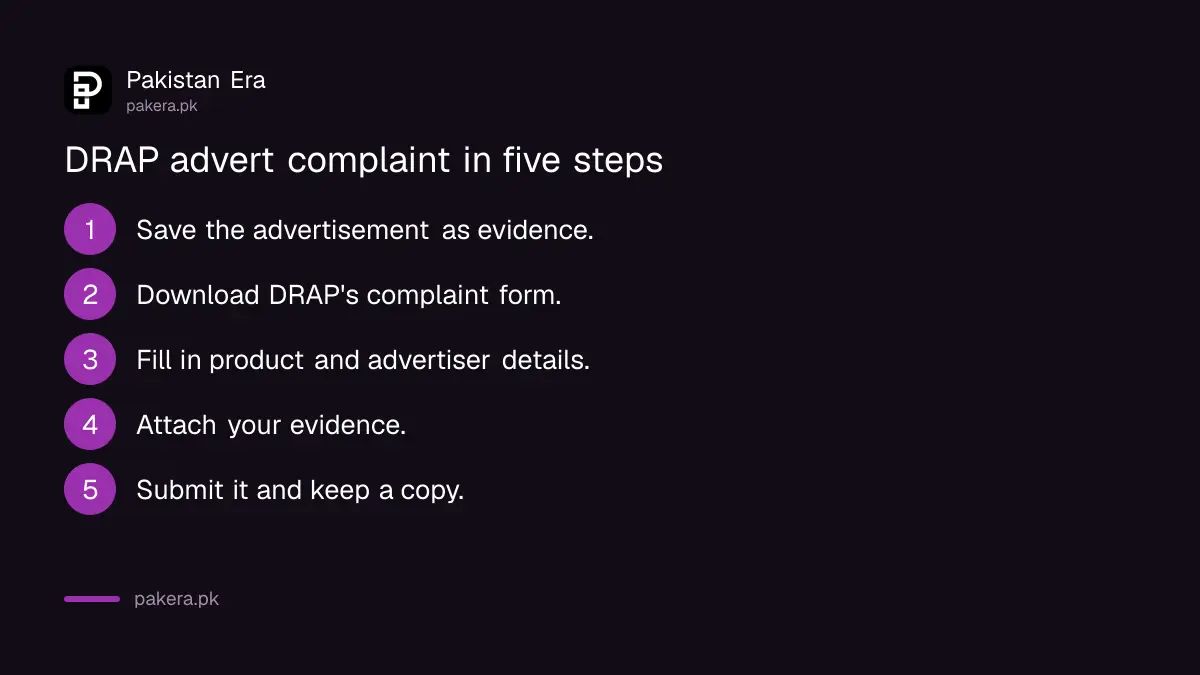
- Save the advertisement: a screenshot with the date and link, a photo of the poster, or a recording of the broadcast.
- Download DRAP's complaint form from its Application Forms page.
- Fill in your details and the product's brand name and manufacturer.
- Describe the place and the media, and name the person or business behind it.
- Submit the form with your evidence and keep a copy of what you sent.
The form has five parts: the complainant, the product, the advertisement, the person or entity involved, and supporting information. The supporting part asks for a copy of the advertisement and the reason you are worried. The entity part asks for a name, a CNIC or licence number, and an address if you have them. Do not guess. Leave a field blank if you do not know.
What happens after you send it
DRAP's flow chart shows the steps. DRAP receives the form and reviews it. If the complaint is incomplete it goes back. If needed, DRAP sends queries to its divisions or its field inspectors. A complete case goes to the Committee on Advertisement. The committee's decision is passed on for action.
The page shows a process timeline of 7 days beside the complaint flow. We could not tell which step the 7 days cover, so do not read it as a promise of a decision in a week. DRAP also does not say how to send the form. We cannot confirm whether it takes email, post or the portal, so ask first on 0800-03727.
Other routes if DRAP is not the right door
DRAP covers therapeutic goods. If the advertisement is for a food, a cosmetic or a service, another body may be right. For a product you already bought, taking a shop to consumer court is a separate remedy. For a general complaint to a federal body, the Pakistan Citizen's Portal is open to anyone.
If the product itself may be fake, report that too. The steps are in how to report counterfeit medicine to DRAP. And before you buy anything, you can check that it is registered with DRAP. DRAP has also widened what counts as a therapeutic good; see probiotics, disinfectants and food supplements.
Common questions about illegal medicine advertisements
Who regulates medicine advertisements in Pakistan?
DRAP does. Its Committee on Advertisement evaluates applications, and the DRAP Act 2012 and the Drugs (Licensing, Registering and Advertising) Rules 1976 set the rules.
Can a celebrity advertise a medicine?
Not in advertisements aimed at consumers. DRAP's guidelines say these must not carry a recommendation or endorsement from a celebrity, and the word covers media, sports and cooking personalities.
Is "100% safe" allowed in a medicine advert?
No. The guidelines list "100% safe", "miracle" and "instant cures" among terms to avoid. They also bar any claim that a product is free from side effects.
Can a shop offer a refund or a discount on medicine?
DRAP's guidelines say any offer to refund money, in full or in part, must not be made. They say this also covers discounts and promotional offers on therapeutic goods.
Do I have to give my name when I complain?
The DRAP form asks for the name and contact details of the complainant for follow up and feedback. We did not find a rule on anonymous complaints on the page.
What is DRAP's helpline?
DRAP lists 0800-03727, open Monday to Friday from 8 am to 4 pm. It has offices in Islamabad, Karachi, Lahore, Peshawar and Quetta.
How we verified this
What we checked, where we read it, and what we could not confirm.
Last checked 15 October 2026. The approval rules, platforms, two year validity and the complaint process come from DRAP's advertisement approvals page, which we opened on 15 October 2026, along with its complaint flow chart and complaint form. The banned claims and disease list come from DRAP's Advertisement of Therapeutic Goods Guidelines, Edition 01, which we read. We did not file a complaint, so we cannot say how long DRAP takes. DRAP can change its forms and rules at any time.
About the author

Tax, Bills and Technology Writer
Ali Akhtar is a young and curious voice here at Pakistan Era. He is currently pursuing his A-Levels and has a growing interest in Pakistan’s changing industrial landscape and educational trends. Ali likes to write in a way that helps him explain and explore the world around him. His writing reflects the perspective of the new generation navigating the evolving trends of Pakistan where technology, youth innovation, and shifting opportunities are reshaping the country’s future.