PECA Sections List in Pakistan: Every Cybercrime, Its Punishment and Bail Status (2026)
All 29 PECA offences in one table: section number, maximum jail and fine, and which ten are non-bailable after the 2025 amendment. Read before you file a case.
The Prevention of Electronic Crimes Act 2016 (PECA) lists 29 offences in sections 3 to 26A, with punishments from three months in jail to twenty years, and only ten of them are non-bailable. The table below gives every section, its maximum punishment and its bail status, as the law reads after the 2023 and 2025 amendments.
Most people meet PECA through a notice, a complaint or a news story about an arrest. The section number decides almost everything that follows: whether police can arrest without a warrant, whether bail is a right, and whether the case can be settled. We read the consolidated text on the Ministry of Law's Pakistan Code page for PECA on 28 October 2026.
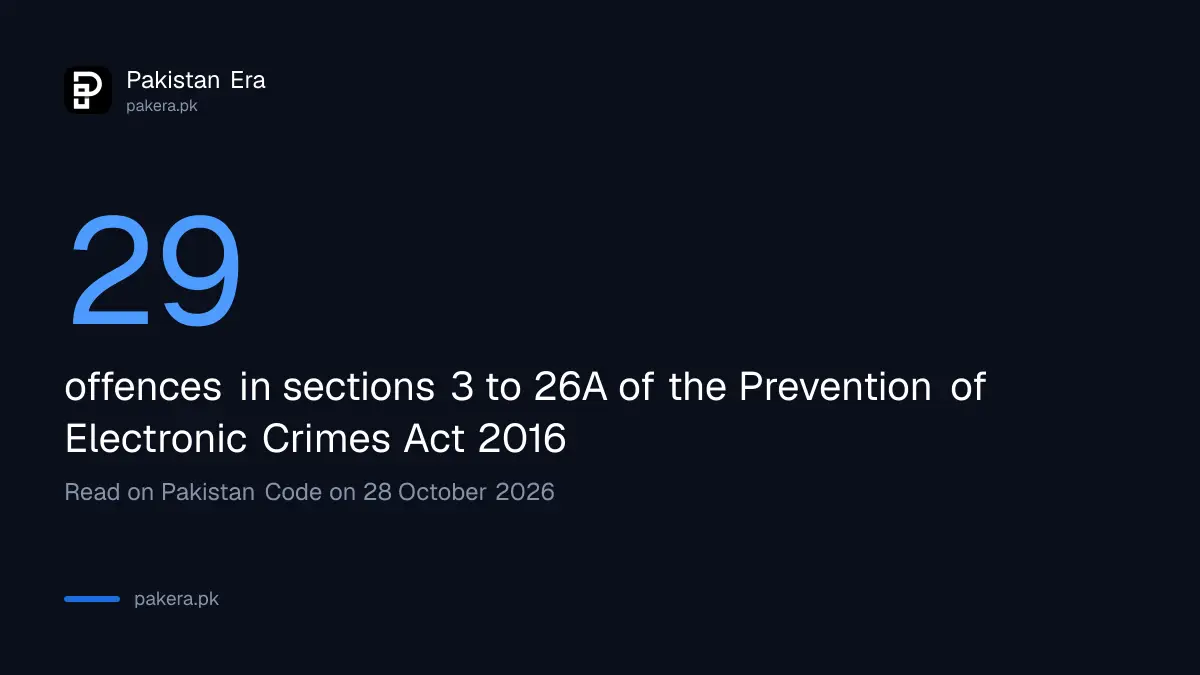
PECA has 29 offences, from section 3 to section 26A
Chapter II of PECA creates 29 offences. They run from simple unauthorised access to a phone or computer, through fraud, forgery and stalking, to crimes against children. Each has a maximum jail term, a maximum fine, or both, set out in its own section.
Read the table as the ceiling, not the usual sentence. Only a few sections, mostly those about children, set a minimum term.
| Section | Offence | Maximum punishment | Bail |
|---|---|---|---|
| 3 | Unauthorised access to a system or data | 3 months or Rs 50,000 | Bailable |
| 4 | Unauthorised copying or sending of data | 6 months or Rs 100,000 | Bailable |
| 5 | Interfering with or damaging a system or data | 2 years or Rs 500,000 | Bailable |
| 6 | Unauthorised access to critical infrastructure | 3 years or Rs 1 million | Bailable |
| 7 | Copying critical infrastructure data | 5 years or Rs 5 million | Bailable |
| 8 | Damaging critical infrastructure | 7 years or Rs 10 million | Bailable |
| 9 | Glorifying terrorism online | 7 years or Rs 10 million | Bailable |
| 10 | Cyber terrorism | 14 years or Rs 50 million | Non-bailable |
| 11 | Hate speech | 7 years or fine | Bailable |
| 12 | Recruiting or funding terrorism online | 7 years or fine | Bailable |
| 13 | Electronic forgery | 3 years or Rs 250,000 (7 years for critical systems) | Non-bailable |
| 14 | Electronic fraud | 2 years or Rs 10 million | Non-bailable |
| 15 | Making or supplying a device for an offence | 6 months or Rs 50,000 | Bailable |
| 16 | Using someone's identity information | 3 years or Rs 5 million | Bailable |
| 17 | Selling a SIM without verification | 3 years or Rs 500,000 | Bailable |
| 18 | Changing a phone's IMEI or device identifier | 3 years or Rs 1 million | Bailable |
| 19 | Unauthorised interception | 2 years or Rs 500,000 | Bailable |
| 20 | False information harming a person's dignity | 3 years or Rs 1 million | Non-bailable |
| 21 | Sexual images, fake edits or blackmail | 5 years or Rs 5 million (7 years for a minor) | Non-bailable |
| 22 | Child sexual abuse material | 14 to 20 years and at least Rs 1 million | Non-bailable |
| 22A | Online grooming of a child | 5 to 10 years and Rs 500,000 to Rs 10 million | Non-bailable |
| 22B | Commercial sexual exploitation of children | 14 to 20 years and at least Rs 1 million | Non-bailable |
| 22C | Contacting a child online to kidnap or traffic | 14 to 20 years and at least Rs 1 million | Non-bailable |
| 23 | Malicious code (malware) | 2 years or Rs 1 million | Bailable |
| 24 | Cyber stalking | 3 years or Rs 1 million (5 years for a minor) | Bailable |
| 24A | Cyberbullying of a child | 1 to 5 years and Rs 100,000 to Rs 500,000 | Bailable |
| 25 | Spamming harmful or fraudulent content | 3 months or Rs 50,000 to Rs 5 million | Bailable |
| 26 | Spoofing a website or sender | 3 years or Rs 500,000 | Bailable |
| 26A | False or fake information causing fear or unrest | 3 years or Rs 2 million | Non-bailable |
Ten PECA offences are non-bailable, and the rest are bailable
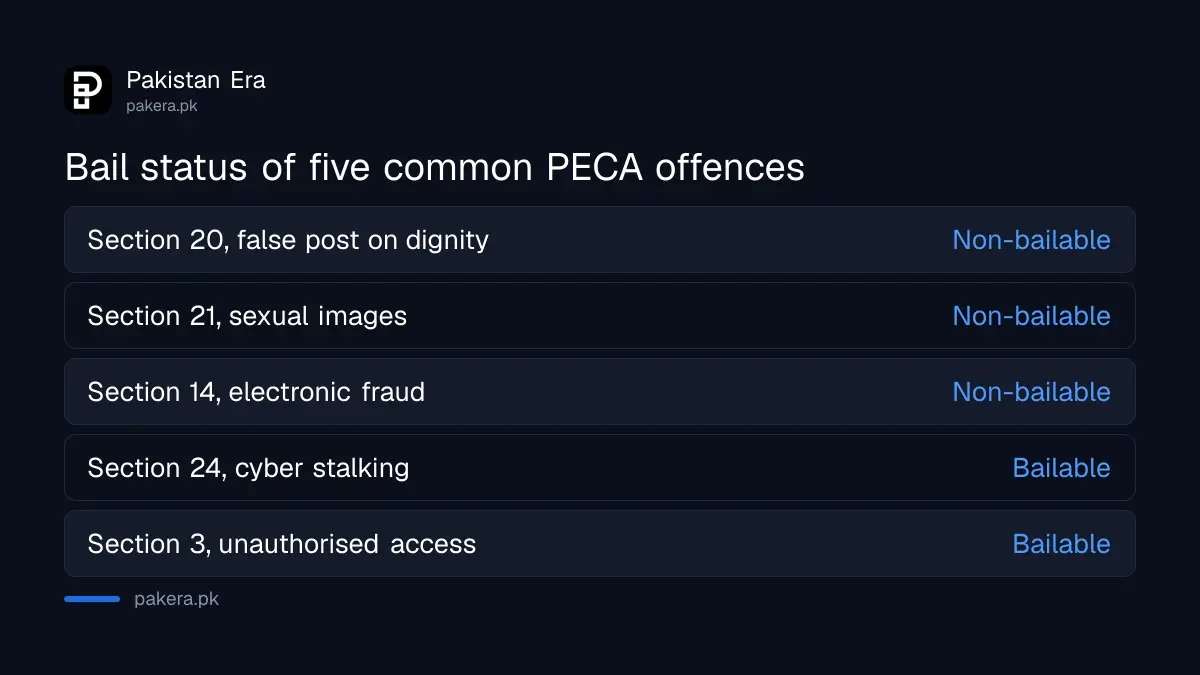
Section 43 of PECA makes ten offences non-bailable, non-compoundable and cognizable: sections 10, 13, 14, 20, 21, 22, 22A, 22B, 22C and 26A. Every other offence in the Act is bailable, compoundable and non-cognizable.
Those three words matter more than the jail term. "Bailable" means bail is a right once you offer surety. "Compoundable" means the complainant and the accused can settle the case. "Cognizable" means the investigation agency can arrest without a warrant from a court.
Some results surprise people. Hate speech under section 11 carries up to seven years, yet it is bailable. Cyber stalking under section 24, the usual charge against a fake account or online stalker, is bailable too. But section 20, about false posts that harm someone's reputation, is non-bailable under the list as rewritten in 2025, and so is section 26A on fake news. For how courts handle a non-bailable charge, the steps to get bail in Pakistan apply here as well.
Crimes against children carry the longest sentences in PECA
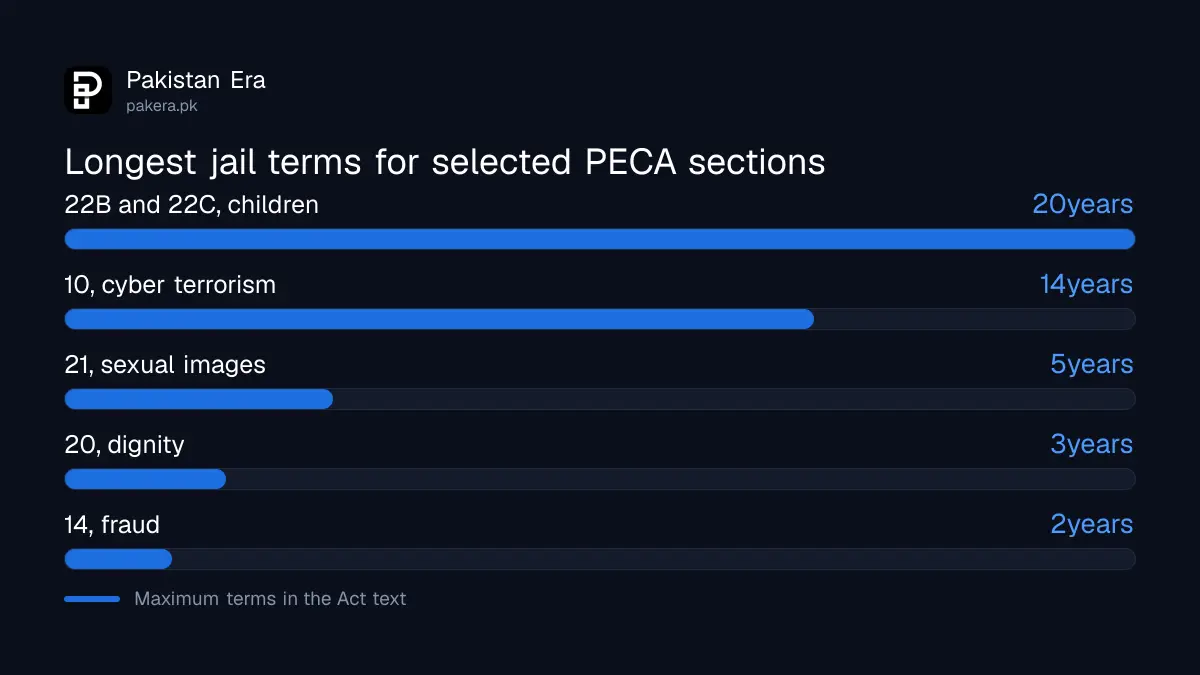
The heaviest punishments in PECA protect children. Sections 22, 22B and 22C carry at least fourteen years and up to twenty, plus a fine of at least Rs 1 million. Online grooming under section 22A carries five to ten years.
PECA defines a minor as anyone under 18, whatever any other law says, and trials of offences against minors are held in camera, with the public kept out. Cyber terrorism under section 10 is the other very serious offence, with up to fourteen years or a fine of up to Rs 50 million.
The 2025 amendment added fake news and a new regulator
The Prevention of Electronic Crimes (Amendment) Act 2025 added section 26A on false and fake information and rewrote the section 43 bail list, which now names sections 13, 14, 20 and 26A among the non-bailable offences. It also created the Social Media Protection and Regulatory Authority to take over content blocking from the PTA.
The Authority can order unlawful content removed or blocked. Under section 2C, anyone hurt by fake information can apply to it, and it must pass an order within 24 hours. The same Act renamed the investigation agency as the National Cyber Crime Investigation Agency (NCCIA). An earlier 2023 amendment had added the child offences in sections 22A to 22C, raised the section 22 penalty to 14 to 20 years, and added cyberbullying in section 24A.
We did not find, on the pages we could open, a Gazette notice setting up the Authority or its complaint form. So treat the 24 hour route as what the law promises, not yet as a working service we have tested. The NCCIA route below works today.
How to file a PECA complaint against someone
A PECA complaint goes to the NCCIA, the federal agency that investigates cybercrime. You can file it online, at a cybercrime reporting centre, or through its helpline. Keep evidence first, because posts and chats can be deleted within minutes.
- Take screenshots that show the post, the account name, the profile link, and the date and time.
- Copy the full profile URL and the post URL into a note. A screenshot alone does not prove which account it was.
- Match what happened to a section in the table, so you can name it in the complaint.
- File the complaint with the NCCIA, following the steps to report a cybercrime in Pakistan, and attach your CNIC and the evidence.
- Write down the complaint number and follow up until an inquiry officer is assigned.
The NCCIA complaint form and proforma asks for the same details. For a child victim, section 43A lets the complaint be lodged on the child's behalf.
Be careful with false complaints. A complaint made only to harass someone can expose you to action under the Pakistan Penal Code, which PECA applies under section 28.
Common questions
How many offences are in PECA?
There are 29 offences, in sections 3 to 26A of the Prevention of Electronic Crimes Act 2016, as amended in 2023 and 2025.
Is PECA section 20 bailable?
No. Section 43(2), as amended in 2025, lists section 20 as non-bailable, non-compoundable and cognizable by the investigation agency.
What is the punishment under PECA section 21?
Up to five years in jail or a fine of up to Rs 5 million, or both. If the victim is a minor, it rises to seven years and a fine of up to Rs 5 million.
Is cyber stalking a bailable offence in Pakistan?
Yes. Section 24 is not in the non-bailable list in section 43, so it is bailable and compoundable. The maximum is three years, or five years if the victim is a minor.
Can a PECA case be settled by compromise?
Yes, for the 19 compoundable offences, much as you would settle a criminal case by compromise under the CrPC. The ten non-bailable offences, such as sections 20, 21 and 26A, cannot be compounded under section 43.
Which agency investigates PECA cases?
The National Cyber Crime Investigation Agency (NCCIA), set up under section 29 as amended in 2025. It took over this work from the FIA's cybercrime wing.
How we verified this
What we checked, where we read it, and what we could not confirm.
We read the consolidated text of the Prevention of Electronic Crimes Act 2016 on the Ministry of Law and Justice's Pakistan Code site on 28 October 2026, including the footnotes for Act XXXVII of 2023 and Act II of 2025. The punishments and bail status above come from sections 3 to 26A and section 43 of that text. We could not confirm whether the Social Media Protection and Regulatory Authority has been formally notified, or whether its 24 hour complaint route is working. The law changes often, so check the section text on Pakistan Code before relying on any one figure in court.
About the author

Tax, Bills and Technology Writer
Ali Akhtar is a young and curious voice here at Pakistan Era. He is currently pursuing his A-Levels and has a growing interest in Pakistan’s changing industrial landscape and educational trends. Ali likes to write in a way that helps him explain and explore the world around him. His writing reflects the perspective of the new generation navigating the evolving trends of Pakistan where technology, youth innovation, and shifting opportunities are reshaping the country’s future.