How to Complain to the Competition Commission of Pakistan About a Misleading Advertisement
The Competition Commission can fine a company up to Rs 75 million for a false advertisement. See what counts as misleading and how to file a complaint.
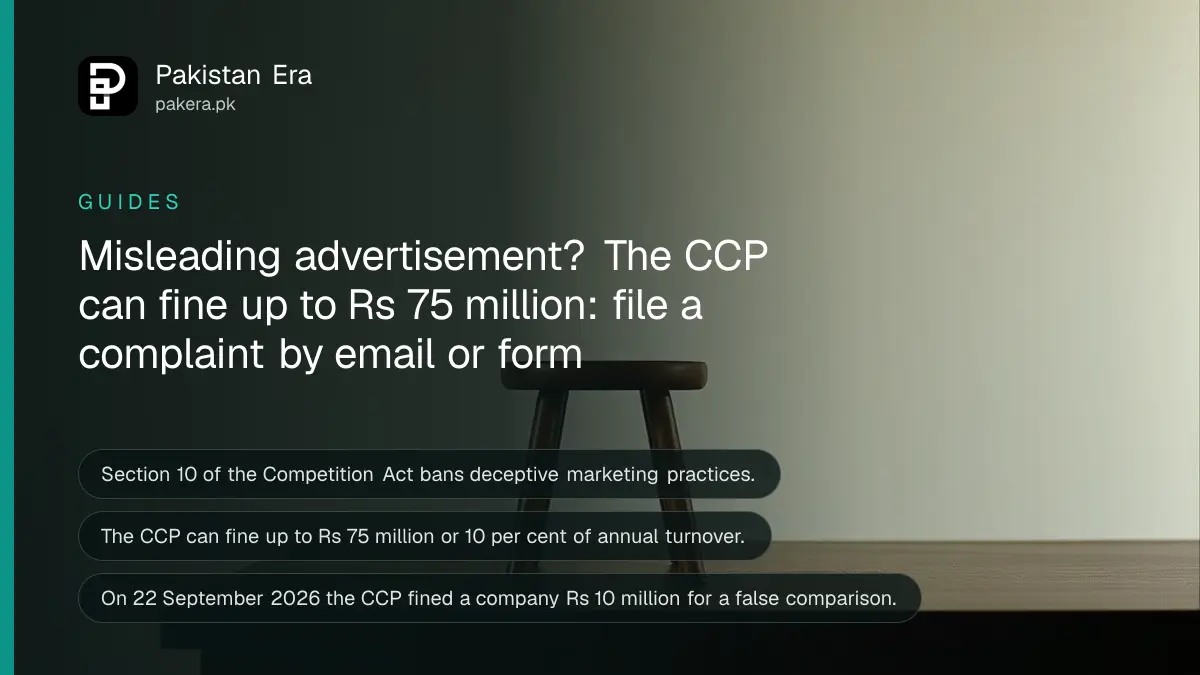
Short answer: You can complain about a false or misleading advertisement to the Competition Commission of Pakistan (CCP) by email at complaints@cc.gov.pk or through its online complaint form. Section 10 of the Competition Act, 2010 bans deceptive marketing. The CCP can fine a company up to Rs 75 million or 10 per cent of annual turnover.
Many people think only a consumer court can act on an advertisement that lied. That court can order a refund for something you bought. The CCP does a different job. It looks at the advertisement itself and can punish the company that ran it.
We opened the CCP home page, its press release of 22 September 2026, its deceptive marketing guidelines and the text of the Competition Act on 12 October 2026. We did not file a complaint ourselves, because the form needs a real name and a real case.
The CCP can fine a company for a false advertisement
Section 10 of the Competition Act says no company may enter into deceptive marketing practices. The CCP can order a penalty of up to Rs 75 million, or up to 10 per cent of the company's annual turnover, under section 38 of the Act.
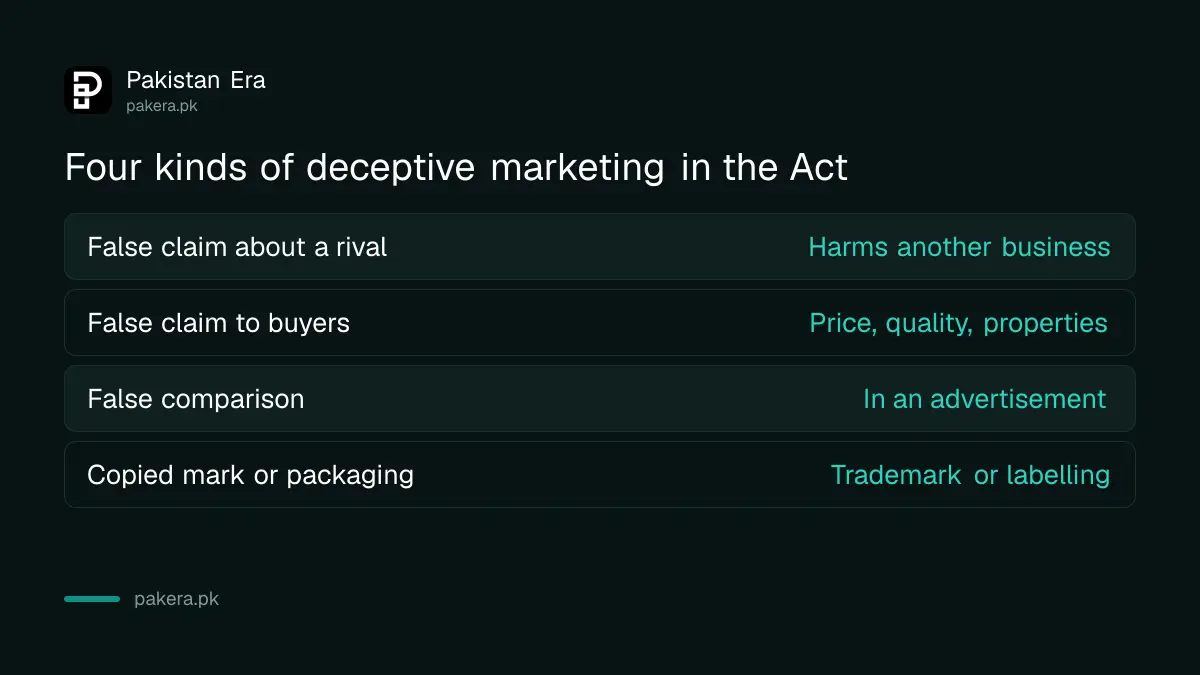
The Act lists four kinds of deceptive marketing in section 10(2). Each one is a plain idea once you read it slowly.
| Kind of deceptive marketing | What the Act says in simple words |
|---|---|
| False information about a rival | Spreading false or misleading information that can harm another company's business |
| False information to buyers | Giving buyers false or misleading information, including claims with no reasonable basis, about price, quality, properties or where goods are made |
| False comparison | A false or misleading comparison of goods in an advertisement |
| Copying a mark or packaging | Fraudulent use of another company's trademark, firm name, labelling or packaging |
The CCP fined a company Rs 10 million for a false comparison on 22 September 2026
On 22 September 2026 the CCP fined 3M Pakistan Rs 10 million for deceptive marketing of its Scotch-Brite product. The video compared it with a rival scouring pad without a reasonable basis. A laboratory report found both products were of similar quality.
The CCP press release says the complaint came from the rival company. An Enquiry Committee then looked into it. The release quotes the CCP view that a comparison made without a reasonable basis or recognisable proof may be false or misleading advertising.
The order also set two conditions. 3M had to send a compliance report within 60 days, and a further penalty of Rs 50,000 a day applies for non-compliance. The company was told not to repeat the conduct against that rival product or similar ones.
This case matters to ordinary buyers for a simple reason. The advertisement was judged on whether the claim was proved, not on whether buyers were harmed. Your complaint does not need to show that you lost money.
The guidelines say what counts as misleading
The CCP deceptive marketing guidelines of 3 April 2023 say every claim needs proof, comparisons must be true and checkable, and important conditions must be shown clearly. Examples in the guidelines show where advertisements often go wrong.
- A "Buy One, Get One Free" offer where the price of the first item is raised to cover the free one.
- A sale of "up to 70% off" where few or no items carry that discount in the store.
- An advertised price that is lower than the price charged at the till.
- An offer with no stated end date, or a discount without the dates and stock limit shown.
- A claim about health or safety made without strong proof.
Our guides on checking if an online store is a scam and on Daraz return and refund rules help when the problem is a purchase rather than the advertisement.
The guidelines add that disclosures must be clear and easy to see. Small print hidden away does not cure a misleading headline claim.
How to file a complaint with the CCP
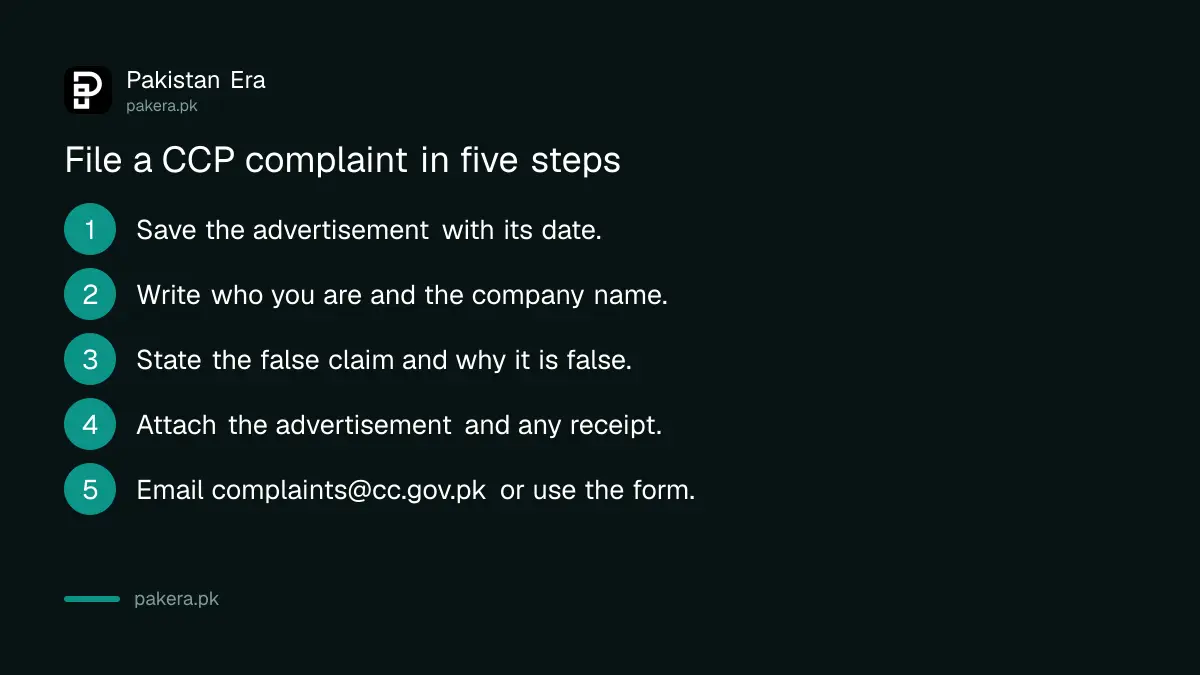
Send your complaint by email to complaints@cc.gov.pk, use the online complaint form on the CCP site, or deliver it in person or by courier. The online form asks for your name, contact number, email, a description and an optional file.
- Save the advertisement. Take a screenshot with the date, or keep the page, the packaging or the printed leaflet.
- Write who you are and where you live, and the company name and address, if you have them.
- Write a short statement of facts, then say which claim is false and why you think so.
- Attach what supports you: the advertisement, a receipt, a photo of the product or the shop price.
- State what you want. Usually it is that the CCP examine the advertisement.
- Send it, and keep a copy and the date.
The guidelines point to a form set out in the CCP's enforcement regulations. It asks for a short statement of facts, a summary of the breach, support for each point, a list of documents and the relief sought. The guidelines say a complaint should carry the fee set in the CCP fee schedule. We did not find that fee on the pages we read, so we do not state one. Ask the CCP before you pay anything.
Know what the CCP does and does not do for you
The CCP can investigate and fine a company. The pages we read do not say it will refund your money or settle a personal dispute. For a refund on something you bought, the consumer court or the provincial complaint route is the usual path.
Use both when it fits. Take the refund claim to the consumer court or the shop. Tell the CCP when the advertisement itself is false and may mislead other buyers. Our guides on taking a shop to consumer court and on the Punjab online consumer complaint route cover the refund side.
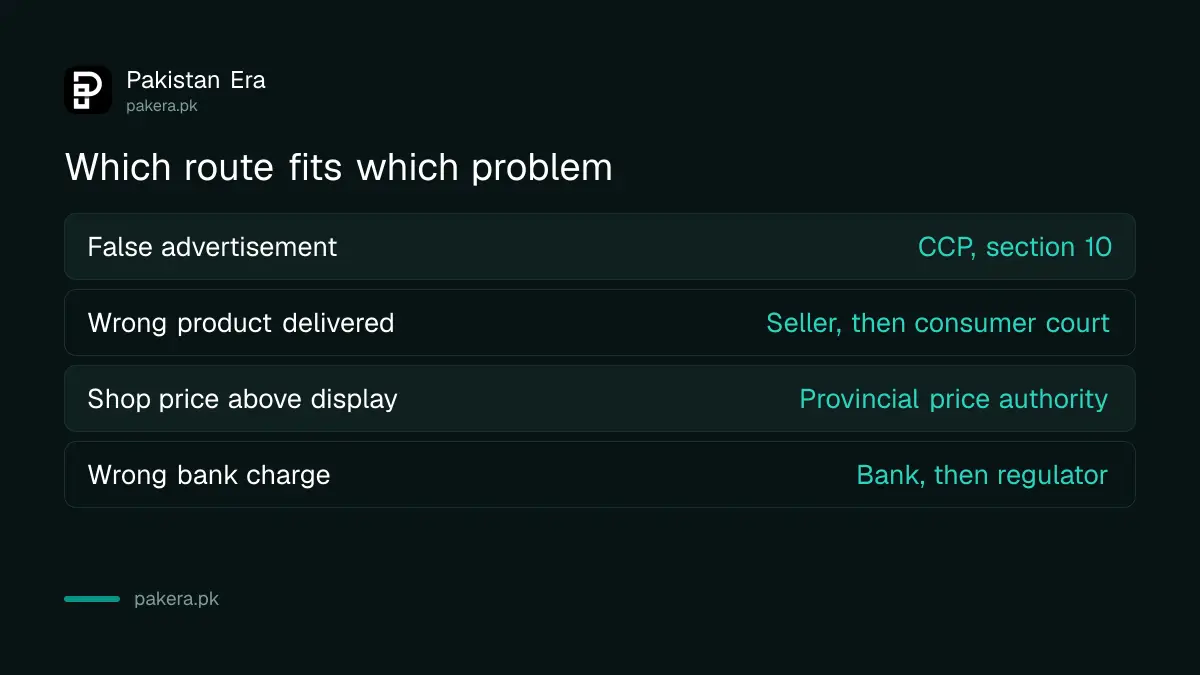
| Your problem | Where it usually goes |
|---|---|
| You paid and got a different product | The seller first, then the consumer court |
| An advertisement makes a false claim to everyone | The CCP, under section 10 |
| A shop charges above a displayed price | The provincial price authority or the consumer court |
| A bank or wallet charged you wrongly | The bank, then the banking regulator |
Common questions
Can an ordinary buyer complain to the CCP about an advertisement?
Yes, the CCP lists a public email and online form for complaints. The guidelines say complaints can be made in person, by courier, by email or through the portal. Our reading is that you do not have to be a business.
Does the CCP give me my money back?
The pages we read describe fines and orders against the company, not refunds to individuals. For your own money, use the seller and the consumer court.
How much can the CCP fine a company for deceptive marketing?
Up to Rs 75 million or up to 10 per cent of annual turnover, as the Competition Act text we read states. In the 22 September 2026 case the penalty was Rs 10 million.
How long does a CCP complaint take?
We could not find a time limit on the pages we read. The guidelines describe stages: scrutiny, an enquiry committee, a show cause notice and a hearing. Each stage takes time.
What if my complaint has no proof?
It is weak. The guidelines say a complaint should carry the advertisement and supporting documents. A frivolous or vexatious complaint can be disposed of by the CCP.
How we verified this
What we checked, where we read it, and what we could not confirm.
We read the CCP press release of 22 September 2026 and the CCP home page on 12 October 2026. We also read the CCP deceptive marketing guidelines of 3 April 2023 and the text of the Competition Act, 2010, available through the CCP site. The Act copy we read was a consolidated text, so check the CCP site for any later change. We did not read a fee schedule, and the complaint form address has changed over time, so use the link on the CCP home page at cc.gov.pk.
About the author

Senior Writer, Public Services and Technology
Shahid joined us in 2024 as an author. He is a senior contributor to Pakistan's leading technology websites. He writes detailed articles, mostly covering his expertise in the latest tech, mobiles, apps, gadgets, and step-by-step guides. His ideology is to help people understand the latest trends and explain complex methods through very easy-to-understand guides.