How to Report a False Advertisement in Islamabad: Up to 2 Years or Rs 30,000 Fine
In Islamabad, false advertising can bring up to two years in prison or a Rs 30,000 fine under the 1995 Act. Save proof and file at the Court of Session.
In Islamabad, a false advertisement is a punishable offence under the Islamabad Consumers Protection Act, 1995. Section 9(2) allows up to two years in prison, a fine of up to Rs 30,000, or both. You report it by complaining to the Court of Session, Islamabad. Save the advertisement itself before you do anything else.
We read sections 2, 5, 8 and 9 of the Act. This guide covers Islamabad only. We found the fine amounts in the 1995 text, and we did not check whether a later amendment changed them.
Section 9(2) punishes false advertising
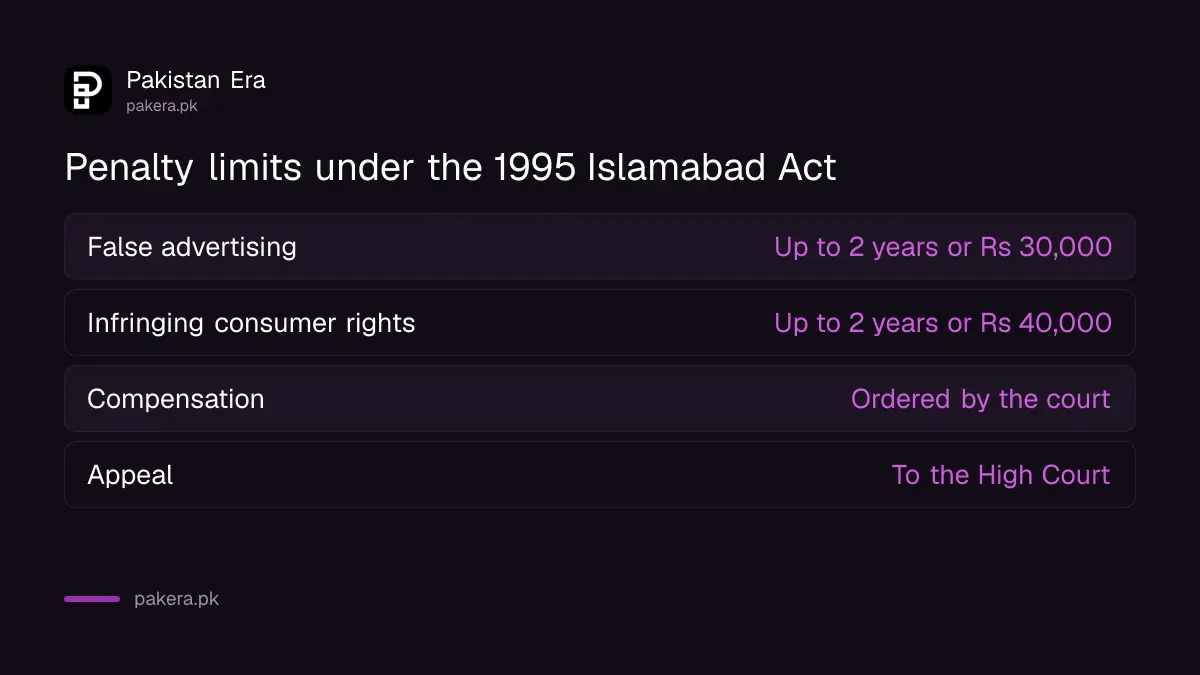
Under section 9(2), false advertising carries imprisonment of up to two years, or a fine of up to thirty thousand rupees, or both. That is a lower fine than the Rs 40,000 for infringing consumer rights in section 9(1), but the same two year prison limit.
The Act's definition of "unfair trade practice" in section 2(6) covers deceptive methods, including false representations about quality, sponsorship or performance. It lists fourteen categories of misleading conduct across different media.
Section 5 gives every consumer the right to information, to protection against hazardous goods and to redress against unfair practices. A false advertisement breaks the right to accurate information.
Save the advertisement before it changes
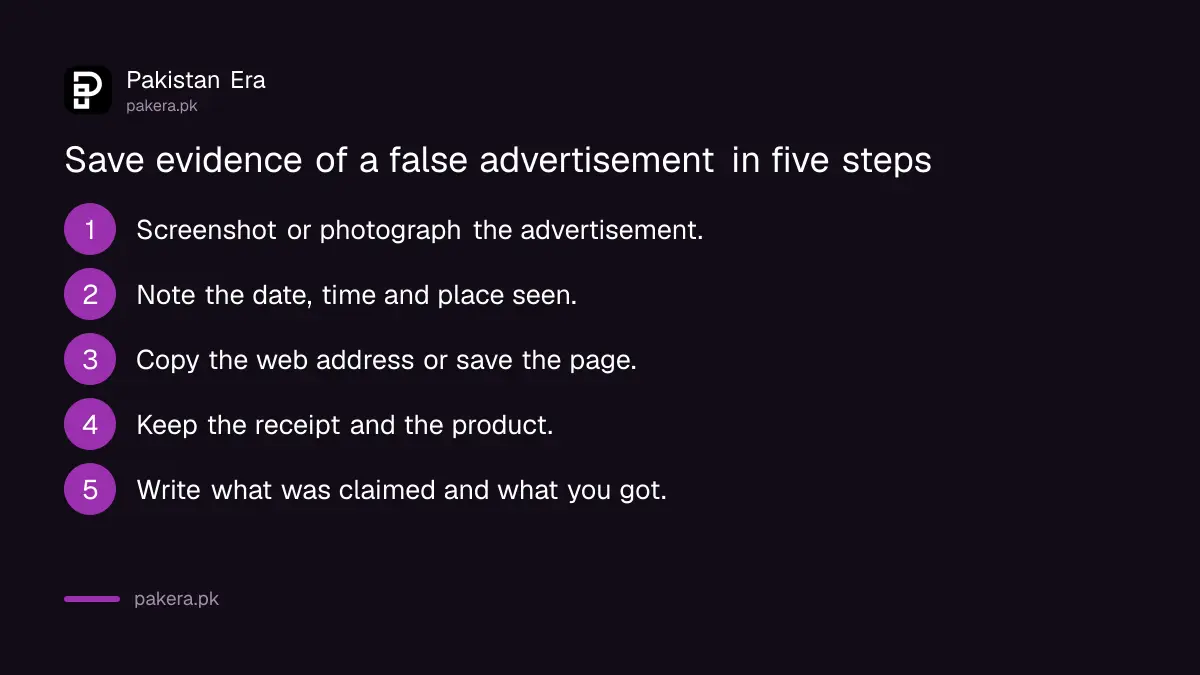
Advertisements get edited or removed. Your proof is the advertisement as you saw it, with the date. Capture it first, then think about the complaint.
- Take a full screenshot or photo of the advertisement, showing the claim and the seller's name.
- Note the date, the time and where you saw it: a website, social page, shop sign or flyer.
- Copy the web address or save the page as a file.
- Keep your receipt, order message and the product or service you received.
- Write down in one line what the advertisement claimed and what you actually got.
If you bought online, also keep the order page. Our guide to claiming an electronics warranty shows how to build a paper trail with the seller.
Check that the claim is a statement of fact
A loud advertisement is not always a false one. The Act targets false representations, for example a claim about quality, performance or sponsorship that is untrue. A vague boast such as "the best" is hard to prove false. A figure, a feature or a certification can be checked.
| Claim in the advertisement | Can it be tested? | What to keep |
|---|---|---|
| "Best in Pakistan" | Hard | The advertisement only |
| "Lasts 10 hours" | Yes | The claim and a dated test result |
| "Approved by an authority" | Yes | The claim and the authority's reply |
| "Discount 50 per cent" | Yes | Earlier and later prices |

If the claim is about a price, the guide on shop prices, receipts and refunds in Sindh shows the kind of records that help, though that law is for Sindh.
Take it to the Court of Session in Islamabad
The Authority under the Act is the Court of Session, Islamabad. Under section 8, a complainant may file a complaint about goods, a service or an unfair trade practice. The Consumer Council can also complain directly to the Authority about an unfair trade practice that comes to its notice.
The Authority serves notice and the respondent must reply within seven days. Then the Authority hears both sides and may pass orders. For the full route, read our guide to consumer court complaints in Pakistan.
The Act we read mentions no filing fee. Court practice may differ, so confirm at the court office. For a serious case, see a lawyer. This is general information, not legal advice.
Know what to expect before you file
A complaint about an advertisement is a legal step, and it can take time. The Act sets no deadline for the Authority's decision, so plan for more than one hearing. Keep every paper in one folder and note each date.
It often helps to give the seller a chance to correct the problem first. Write to the seller, say what the advertisement claimed and what you received, and ask for a refund or a correction by a set date. Keep the reply. If the seller agrees, you may not need the court. If the seller ignores you, your letter shows that you tried.
The Authority may also order compensation under section 9(3) where the consumer has suffered damage or loss. That is a different remedy from the penalty in section 9(2), which punishes the advertiser. You can ask for your loss to be made good as well as for the advertiser to be dealt with.
Do not post the seller's name with accusations online while the matter is open. Stick to the facts in your written complaint. A calm, dated, documented statement is the strongest thing you can bring.
Common questions
What is the penalty for false advertising in Islamabad?
Section 9(2) of the Islamabad Consumers Protection Act, 1995 allows up to two years in prison, a fine of up to Rs 30,000, or both.
Where do I report a false advertisement in Islamabad?
You complain to the Court of Session, Islamabad, which the Act names as the Authority.
Do I need to have bought the product?
The Act's definition of a consumer is a person who buys or hires goods or services. Keep proof of purchase. It is the safest base for a complaint.
Can I report an advertisement in Lahore with this law?
No. This Act covers Islamabad. Punjab has its own consumer law and portal.
Is a fine of Rs 30,000 still the current figure?
It is the figure in the 1995 text we read. We did not check for later amendments, so confirm before you rely on it.
How we verified this
What we checked, where we read it, and what we could not confirm.
Last checked on 13 October 2026, Pakistan time. We read the text of the Islamabad Consumers Protection Act, 1995, sections 2, 5, 8 and 9. We did not read any court notice, so fees and forms are not confirmed. We could not check later amendments to the fine amounts. The evidence steps and the table are our own plain-language suggestions, not part of the Act.
About the author

Public Services and Education Journalist
Fajr Riaz is a journalist and content writer at Pakistan Era, based in Lahore. She covers the questions people meet in everyday life in Pakistan: how a public service works, what a change in the rules means, and where to find a reliable answer.