Electric Geyser Bill Per Month in Pakistan 2026: 2 Units an Hour, and the 200 Unit Trap
A 2,000 watt electric geyser uses 2 units an hour, or 120 units a month at 2 hours a day: Rs 1,264.80 to Rs 5,664 at 2026 slab rates. See the 200 unit trap.
A 2,000 watt electric geyser uses 2 units of electricity for every hour it heats. Two hours a day adds 120 units a month. At Pakistan's 2026 home rates that is Rs 1,264.80 for a protected home under 100 units and Rs 5,664 above 700 units, in energy charges alone. For a protected home near 200 units, those extra units can cost far more, because they can end the cheaper rates.
K-Electric's energy calculator lists an electric geyser at 2,000 watts. The rates come from the federal tariff notification S.R.O. 279(I)/2026. Every unit count and rupee figure below is our own arithmetic, so you can redo it with your own geyser's label and your own bill.
A 2,000 watt geyser uses 2 units an hour
One unit is one kilowatt-hour: 1,000 watts for one hour. A 2,000 watt geyser element therefore uses 2 units in each hour it is switched on and heating. A tank geyser stops drawing power once the water is hot, so the real number depends on how long the element runs.
Use this formula with the watts printed on your geyser: watts x heating hours a day x 30 / 1,000 = units a month.
| Heating time a day | Units a day | Units a month |
|---|---|---|
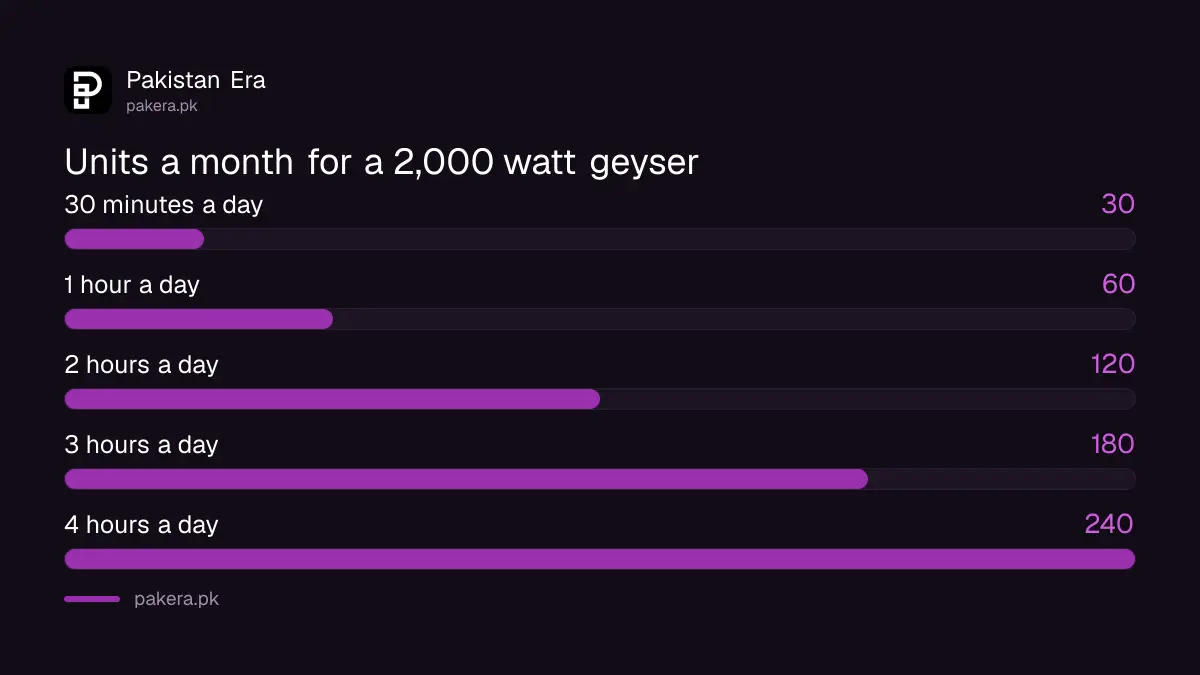
| 30 minutes | 1 | 30 |
| 1 hour | 2 | 60 |
| 2 hours | 4 | 120 |
| 3 hours | 6 | 180 |
| 4 hours | 8 | 240 |
A family that heats the tank once in the morning and again at night may run it two to three hours a day in deep winter. A geyser left on all day keeps reheating as the tank cools, which adds more. The K-Electric appliance watt list has the ratings for other appliances in the house.
Two hours a day costs Rs 1,264.80 to Rs 5,664 a month
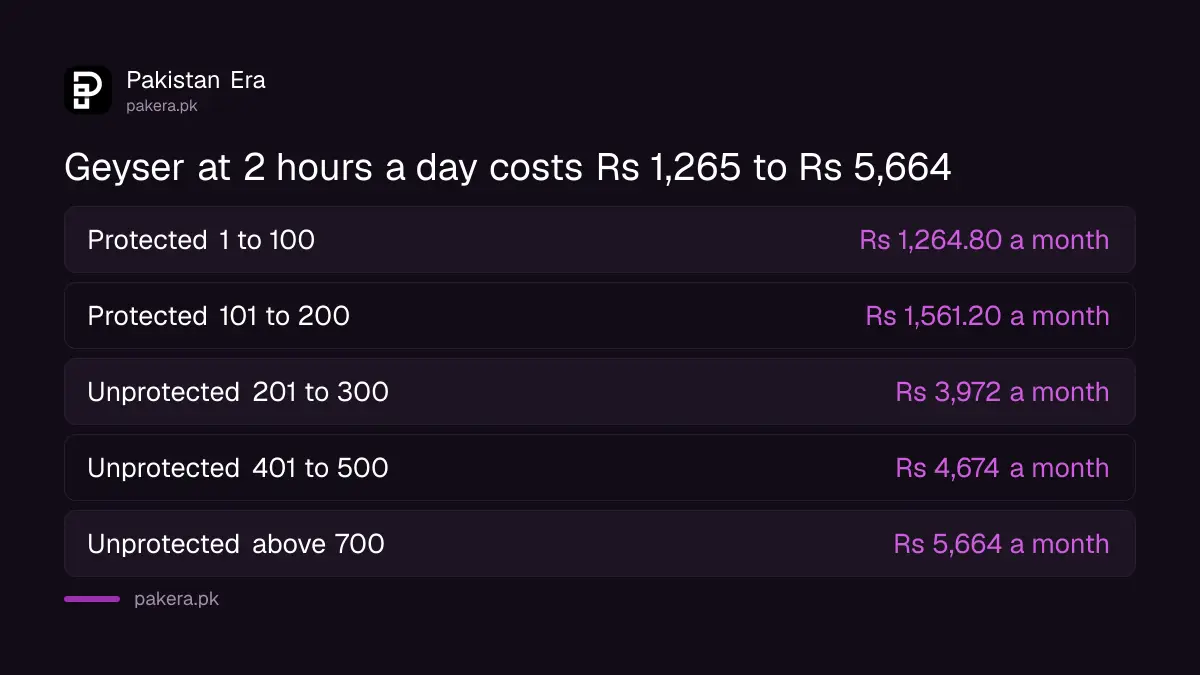
The monthly cost of 120 geyser units depends on the rate your home pays. It ranges from Rs 1,264.80 at the protected rate of Rs 10.54 to Rs 5,664 at the top unprotected rate of Rs 47.20. These are energy charges only, with no tax or adjustment added.
| Your slab | Rate per unit (Rs) | 1 heating hour (Rs) | 2 hours a day for 30 days (Rs) |
|---|---|---|---|
| Protected, 1 to 100 | 10.54 | 21.08 | 1,264.80 |
| Protected, 101 to 200 | 13.01 | 26.02 | 1,561.20 |
| Unprotected, 1 to 100 | 22.44 | 44.88 | 2,692.80 |
| Unprotected, 101 to 200 | 28.91 | 57.82 | 3,469.20 |
| Unprotected, 201 to 300 | 33.10 | 66.20 | 3,972.00 |
| Unprotected, 301 to 400 | 36.46 | 72.92 | 4,375.20 |
| Unprotected, 401 to 500 | 38.95 | 77.90 | 4,674.00 |
| Unprotected, 501 to 600 | 40.22 | 80.44 | 4,826.40 |
| Unprotected, 601 to 700 | 41.85 | 83.70 | 5,022.00 |
| Unprotected, above 700 | 47.20 | 94.40 | 5,664.00 |
Because the geyser's units add to everything else in the house, your slab may also change. The full rate schedule, with fixed charges, is in the electricity unit price slab rates for 2026.
A geyser can push a protected home past 200 units
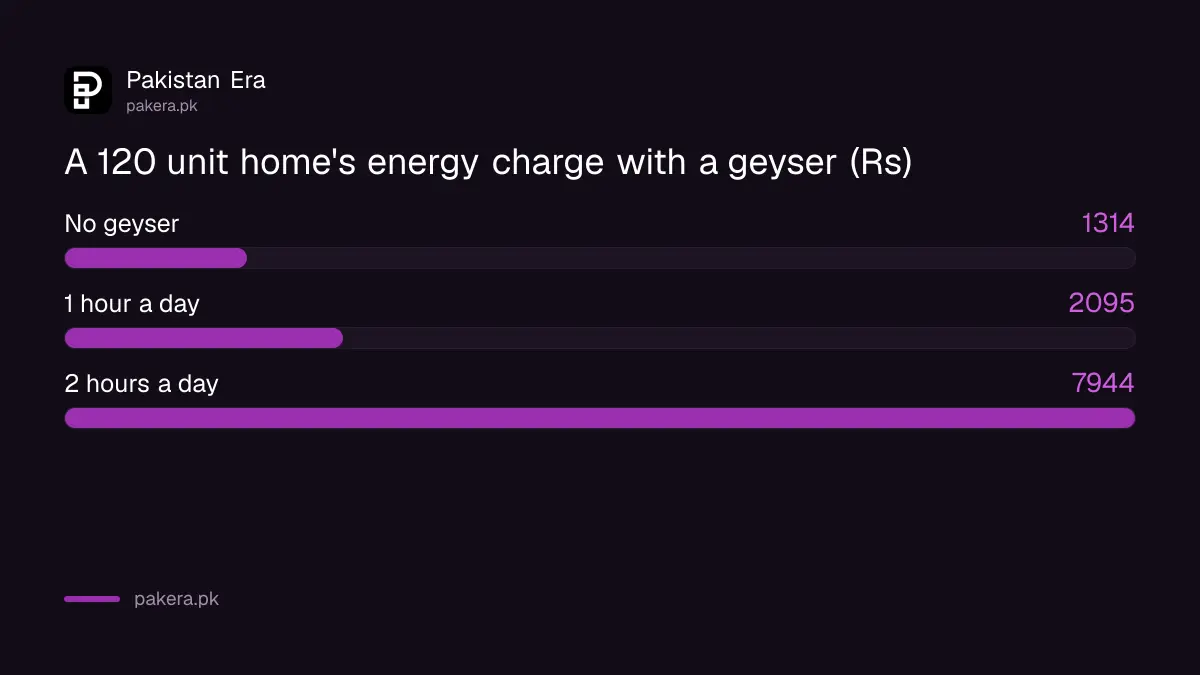
A protected home keeps its cheap rates only up to 200 units. A home that uses 120 units can add one geyser hour a day and stay protected. Add two hours a day and it reaches 240 units, and the whole bill is then charged at the unprotected rate of Rs 33.10.
| Home that normally uses 120 units | Units a month | Energy charge (Rs) | Extra over no geyser (Rs) |
|---|---|---|---|
| No geyser, protected | 120 | 1,314.20 | 0 |
| Geyser 1 hour a day, still protected | 180 | 2,094.80 | 780.60 |
| Geyser 2 hours a day, now unprotected | 240 | 7,944.00 | 6,629.80 |
The tariff notification gives the "benefit of one previous slab" only to protected homes, so an unprotected home pays every unit at its slab's rate. The rule as widely reported also keeps a home on unprotected rates for six months after it crosses 200 units. Our team could not find that six month wording in a NEPRA document, so treat it as reported. The government is reported to be considering ending it, which the six month penalty for crossing 200 units follows.
Above 200 units, each geyser hour still lifts the slab
An unprotected home on 250 units pays Rs 8,275 in energy charges. One geyser hour a day takes it to 310 units, or Rs 11,302.60. Two hours a day takes it to 370 units, or Rs 13,490.20, an extra Rs 5,215.20 a month.
- 250 units, no geyser: 250 x Rs 33.10 = Rs 8,275.
- Geyser 1 hour a day: 310 x Rs 36.46 = Rs 11,302.60, an extra Rs 3,027.60.
- Geyser 2 hours a day: 370 x Rs 36.46 = Rs 13,490.20, an extra Rs 5,215.20.
The real bill adds fuel charge adjustment, quarterly adjustment, fixed charges, electricity duty and sales tax. The fuel charge adjustment for each month of 2026 shows what has been added per unit so far.
Cut the geyser's hours, not your hot water
Most of a geyser's cost comes from heating water nobody uses and reheating a tank that cools down. Switching it on only before baths, and keeping hot water from cooling, does most of the work. If you are protected, plan around the 200 unit line first.
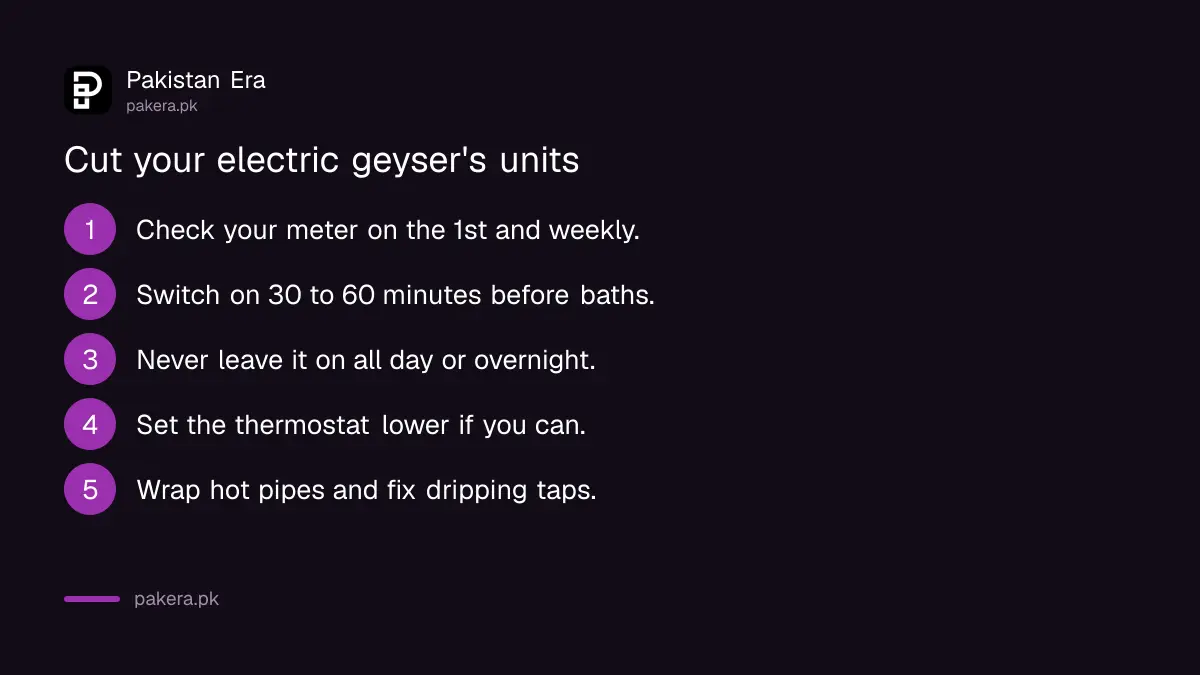
- Note your meter reading on the first of the month, then check it weekly.
- Switch the geyser on only 30 to 60 minutes before baths, then off again.
- Do not leave it on all day or overnight.
- Set the thermostat lower if your model has one. Hotter water costs more to keep hot.
- Wrap exposed hot water pipes so water stays warm on its way to the tap.
- Fix dripping hot taps, which drain heated water around the clock.
Buy a geyser and its cable with a valid quality mark, as the PSQCA licence check explains. If you switch to a gas geyser, follow the gas geyser safety rules, because a gas geyser in a closed bathroom can fill it with deadly fumes.
Common questions
How many units does a 2,000 watt geyser use?
2 units for every hour it heats. Two hours a day is 120 units a month.
What is an electric geyser's monthly bill in Pakistan?
At 2 hours a day, Rs 1,264.80 to Rs 5,664 in energy charges, depending on your slab. Taxes and adjustments are extra.
Can an electric geyser make me lose protected status?
Yes, if it takes your home above 200 units in a month. A 120 unit home reaches 240 units with two geyser hours a day.
Does a geyser use power all the time it is switched on?
A tank geyser draws full power while heating and stops when the water is hot, then reheats as it cools. Leaving it on all day adds reheating.
Are the rates the same for K-Electric customers?
The federal notification sets the same government applicable home rates for K-Electric. Your fixed charges and taxes are on your bill.
How we verified this
What we checked, where we read it, and what we could not confirm.
The 2,000 watt geyser rating is from K-Electric's Energy Consumption Calculator, which we read on 5 November 2026. The home rates are the government applicable residential rates in S.R.O. 279(I)/2026 of 12 February 2026, as read and recorded by our team on 9 October and 1 November 2026. All unit counts and rupee figures are our own arithmetic and leave out fuel adjustment, quarterly adjustment, fixed charges, duty and tax.
About the author

Public Services and Education Journalist
Fajr Riaz is a journalist and content writer at Pakistan Era, based in Lahore. She covers the questions people meet in everyday life in Pakistan: how a public service works, what a change in the rules means, and where to find a reliable answer.