Landlord Refuses Rent in Punjab: How to Deposit It With the Rent Tribunal
Landlord refusing rent in Punjab? Pay by money order or bank, keep receipts, then deposit it with the Rent Tribunal under section 20 of the 2009 Act. The steps.
If a landlord in Punjab refuses to take your rent, keep paying it another way and keep proof. Send it by money order or into the landlord's bank account, as section 7 of the Punjab Rented Premises Act 2009 allows. If the landlord still refuses, apply to the Rent Tribunal under section 20 to deposit the rent there. The Tribunal tells the landlord and can let them collect it.
A refused rent is often the first move in an eviction plan. Under section 15, a landlord can seek eviction when a tenant fails to pay or tender rent within 30 days after it falls due. A tenant who simply stops paying because the landlord said no hands the landlord that ground.
| Situation | What the Punjab Act lets you do |
|---|---|
| Deed names a payment mode | Pay in that mode, by the date in the deed (section 7(1)) |
| Deed names no date | Rent is due by the 10th of the next month (section 7(2)) |
| Deed names no mode | Money order, or deposit in the landlord's bank account (section 7(3)) |
| Landlord refuses the rent | Apply to the Rent Tribunal to deposit it (section 20) |
| Eviction case already filed | The Tribunal orders rent paid into the landlord's account or the Tribunal (section 24) |
Keep tendering the rent and keep proof of every attempt
The law looks at whether you paid or tendered the rent on time. Tender means offering it in the proper way. Offer it on or before the due date, in the mode the deed names, and keep a record each month: a money order receipt, a bank slip or a message refusing the money.
If the deed says rent goes to a named bank account, deposit it there and keep the slip. The landlord's refusal to "accept" cash at the door does not stop a bank deposit. If the deed names no mode, section 7(3) lets you use a money order or the landlord's bank account. Keep every money order receipt with its date.
Ask for any refusal in writing, or send your offer by text or WhatsApp so the refusal is on record. Write the month the payment is for on every receipt. A tribunal reads these papers later, so a clear trail helps.
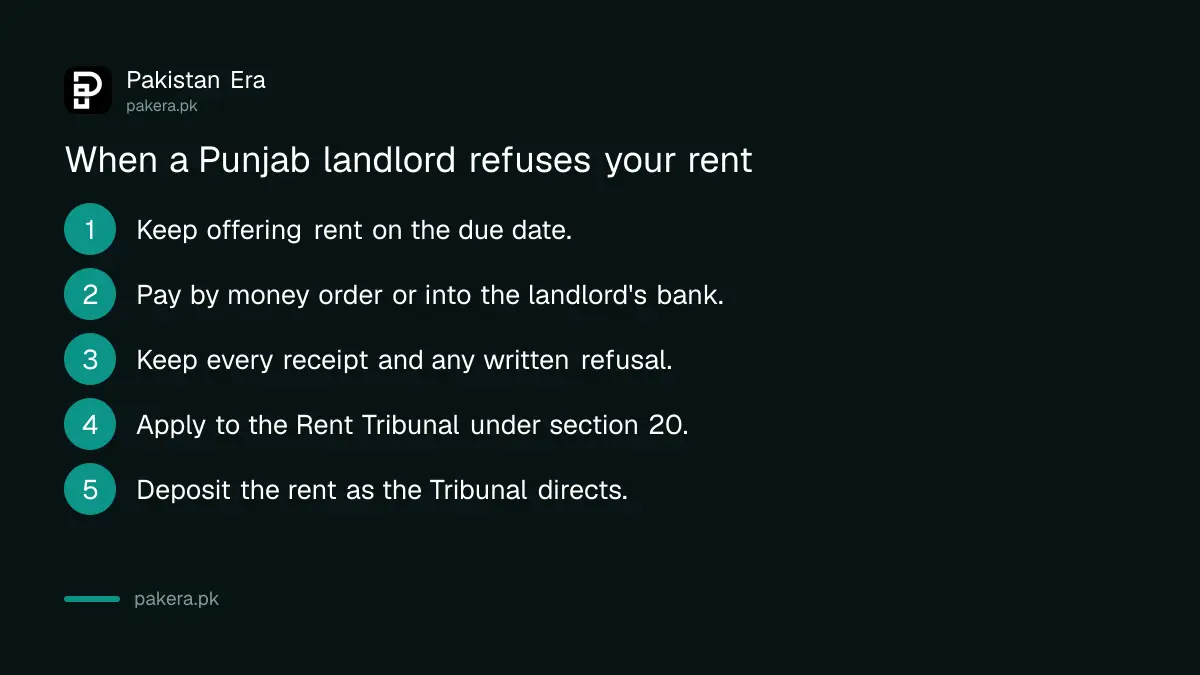
Apply to the Rent Tribunal to deposit the rent under section 20
Section 20 lets a tenant file an application in the Rent Tribunal to deposit the rent when the landlord refuses it. The Tribunal allows the deposit for the refused period, informs the landlord, and may let the landlord collect it. The deposit does not take away the landlord's other rights.
- Write an application to the Rent Tribunal of the district where the house or shop is. The Rent Tribunal is the Special Judge (Rent), or a civil judge empowered by the Lahore High Court.
- Give a short statement of facts: the premises, the monthly rent, the months refused, and how you tried to pay.
- State the relief: permission to deposit the rent for the refused months, and to keep depositing until the dispute ends.
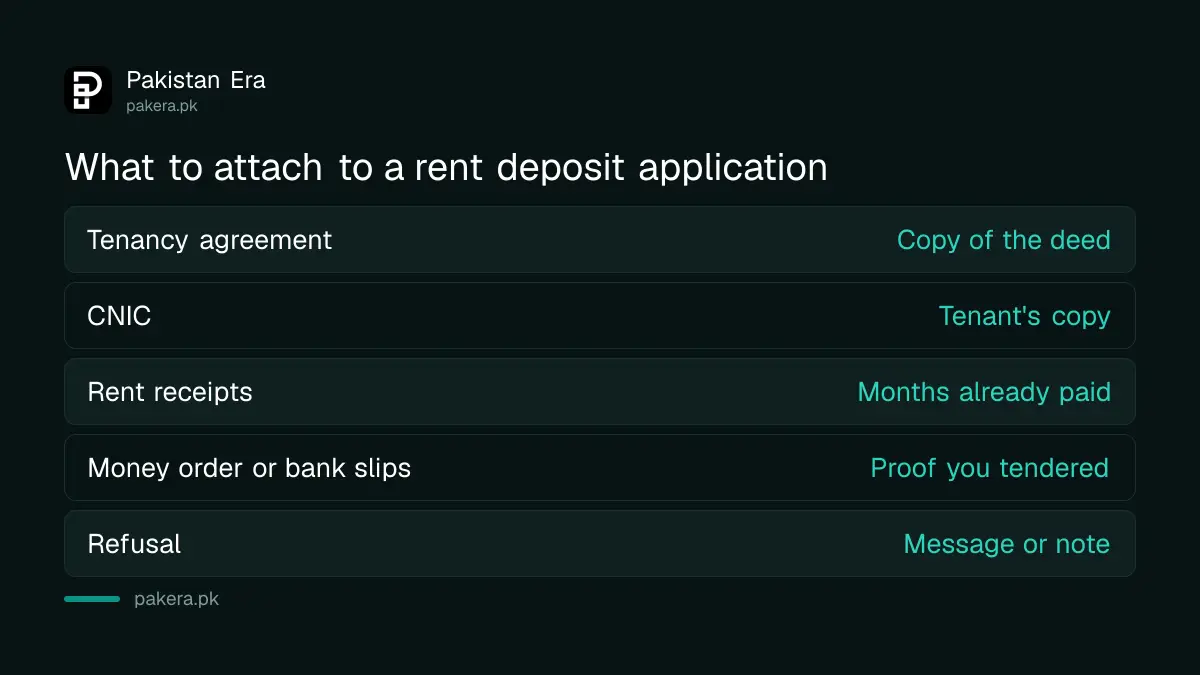
- Attach copies of the tenancy agreement, your CNIC, rent receipts, money order receipts or bank slips, and any written refusal. Section 19 asks for copies of all relevant documents in your possession.
- Deposit the rent as the Tribunal directs, and keep the receipt for each month.
Section 20 opens with the words "notwithstanding anything contained in this Act". Section 21, which sets the ten-day notice and leave-to-contest process for other applications, says it applies to applications "other than application for deposit of rent". A deposit application is meant to be quick.
The tribunal process protects a tenant who keeps paying
Eviction for non-payment needs a failure to pay or tender within 30 days after the due date. A tenant who tendered the rent, then deposited it with the Tribunal after a refusal, has a record of paying. That record answers the eviction ground in section 15(b).
| Eviction ground in section 15 | How a tenant answers it |
|---|---|
| (a) Tenancy period expired | Not answered by paying rent; check the deed's term |
| (b) Rent not paid or tendered within 30 days | Money order receipts, bank slips, Tribunal deposit |
| (c) Breach of a term of the deed | Show the term was kept |
| (e) Use for a different purpose | Show the use matches the deed |
| (f) Subletting without written consent | Show the consent or that no subletting happened |
If the landlord files for eviction anyway, the Tribunal, while granting leave to contest, directs the tenant to deposit the rent due within a set time. Payments go into the landlord's bank account or the Tribunal until the final order. If the amount is disputed, the Tribunal fixes it for the time being. Missing a deposit order leads straight to a final order against the tenant, under section 24(4).
The landlord's side of the process, including the affidavits an eviction application needs, is in how a landlord evicts a tenant through the Punjab Rent Tribunal.
Fix the problems that weaken a tenant's case
Most tenants lose ground in three ways: they stop paying the moment rent is refused, they pay in cash with no receipt, or they have no written tenancy. Each has a fix you can make now, before a notice arrives.
- You stopped paying after a refusal. Start tendering again by money order or bank at once, and apply under section 20 for the back months.
- You only ever paid cash. Switch to a bank transfer or money order now. Cash with no receipt is hard to prove.
- There is no written tenancy agreement. Section 5 requires one and section 9 attaches a fine of 5 percent of annual rent to a tenant's application when the tenancy does not conform. The fix is to put the tenancy on paper and register it, as explained in why a rent agreement on stamp paper is not enough.
- The house was sold. The new owner must tell you in writing and apply to the Rent Registrar. Rent paid to the new owner within 30 days of that notice is not a default (section 30).
- The landlord cut water or electricity to push you out. Section 12 bars cutting a utility without just cause; apply to the Rent Tribunal for an order.
Never pay a "middle man" who offers to settle the case outside the Tribunal for a fee. Deal with the landlord directly, in writing, or through the Tribunal. For a dispute over the security deposit at the end of a tenancy, the wider rules are in tenant rights in Pakistan.
A registered tenancy makes all of this easier: see how to register a rent agreement with the Rent Registrar.
Common questions
What should I do if my landlord refuses to take rent in Punjab?
Keep tendering it by money order or into the landlord's bank account and keep receipts. If the refusal continues, apply to the Rent Tribunal under section 20 of the Punjab Rented Premises Act 2009 to deposit it there.
Can the landlord evict me for rent he refused?
The eviction ground in section 15(b) is a failure to pay or tender rent within 30 days after it falls due. Proof that you tendered or deposited it answers that ground.
When is rent due if the agreement does not say?
By the 10th of the following month, under section 7(2) of the Act.
Where is the Rent Tribunal?
Each district has a Rent Tribunal made up of one or more Special Judges (Rent). The Lahore High Court can also empower a civil judge or judicial magistrate to act as the Rent Tribunal.
Can the landlord take the deposited rent?
Yes. Section 20(3) says the Tribunal informs the landlord of the deposit and may pass an order letting the landlord collect it.
Does this apply to shops as well as houses?
Yes. The Act covers buildings let for residential or non-residential use anywhere in Punjab, so a shop or office tenant can use section 20 too.
How we verified this
What we checked and where we read it.
Last checked 24 November 2026. We read the text of the Punjab Rented Premises Act 2009 on the Punjab Code, sections 1, 2, 5, 7, 9, 12, 15, 16, 19, 20, 21, 24 and 30, and the notice form in its Schedule. The Act does not set a court fee for a deposit application; ask the Tribunal's reader or a lawyer what is charged at your district. Section numbers are given so you can show them at the counter.
About the author

Senior Writer, Public Services and Technology
Shahid joined us in 2024 as an author. He is a senior contributor to Pakistan's leading technology websites. He writes detailed articles, mostly covering his expertise in the latest tech, mobiles, apps, gadgets, and step-by-step guides. His ideology is to help people understand the latest trends and explain complex methods through very easy-to-understand guides.