How to Register a Rent Agreement With the Rent Registrar in Punjab
Register a rent agreement in Punjab with the Rent Registrar under the 2009 Act. Stamp duty is 3.25% of average annual rent; skipping it costs a 5 to 10% fine.
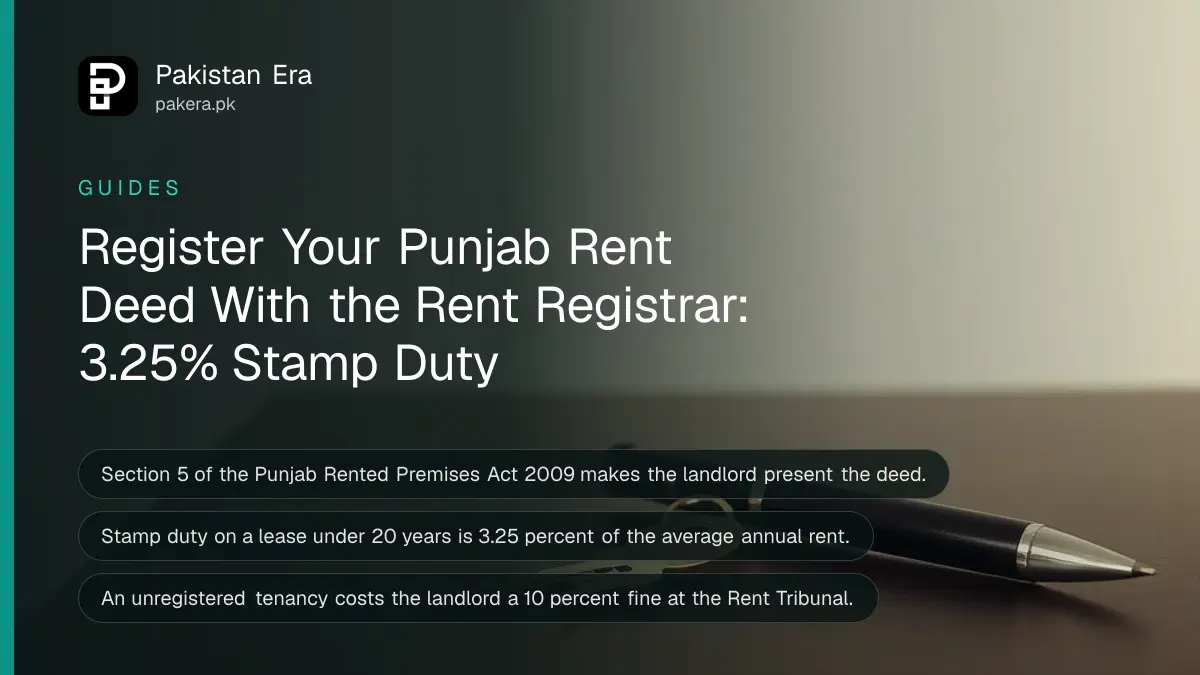
In Punjab, a landlord must rent out a house or shop only through a written tenancy agreement and must present it to the Rent Registrar, under section 5 of the Punjab Rented Premises Act 2009. The Rent Registrar enters it in a register, stamps it with an official seal, keeps a copy and returns the original. Stamp duty on a lease of less than 20 years is 3.25 percent of the average annual rent.
Most Punjab rent deeds stop at the stamp paper. That leaves both sides exposed. If a dispute reaches the Rent Tribunal, an unregistered tenancy costs the landlord a fine of 10 percent of a year's rent before the case is even heard, and the tenant 5 percent.
| Step | What it costs or needs |
|---|---|
| Write the tenancy agreement | The seven points listed in section 6 of the Act |
| Pay stamp duty (e-stamp) | 3.25% of the average annual rent, lease under 20 years |
| Present it to the Rent Registrar | Landlord's duty under section 5(2) |
| Give the tenant a certified copy | Landlord's duty under section 12(1)(a) |
| Lease over one year | Also registrable at the Sub-Registrar under the Registration Act 1908 |
The Rent Registrar records the tenancy and seals the agreement
The Rent Registrar is an officer the Punjab government appoints for a district under section 17 of the Act. The office keeps a register of tenancy agreements, agreements to sell and other agreements about rented premises. An entry there is legal proof that the landlord and tenant relationship exists.
Section 5(5) says a tenancy agreement entered in the Rent Registrar's office, or a certified copy of it, is proof of the relationship of landlord and tenant. That matters in the two fights that reach the Rent Tribunal most: unpaid rent and eviction. With the entry, nobody can deny the tenancy or the agreed rent.
The Act applies to the whole of Punjab, in cities and towns alike. It covers houses, flats, shops, offices, godowns and open space let with a building. It does not cover a room in a hotel, hostel, boarding house or guest house.
A Punjab tenancy agreement must carry seven points
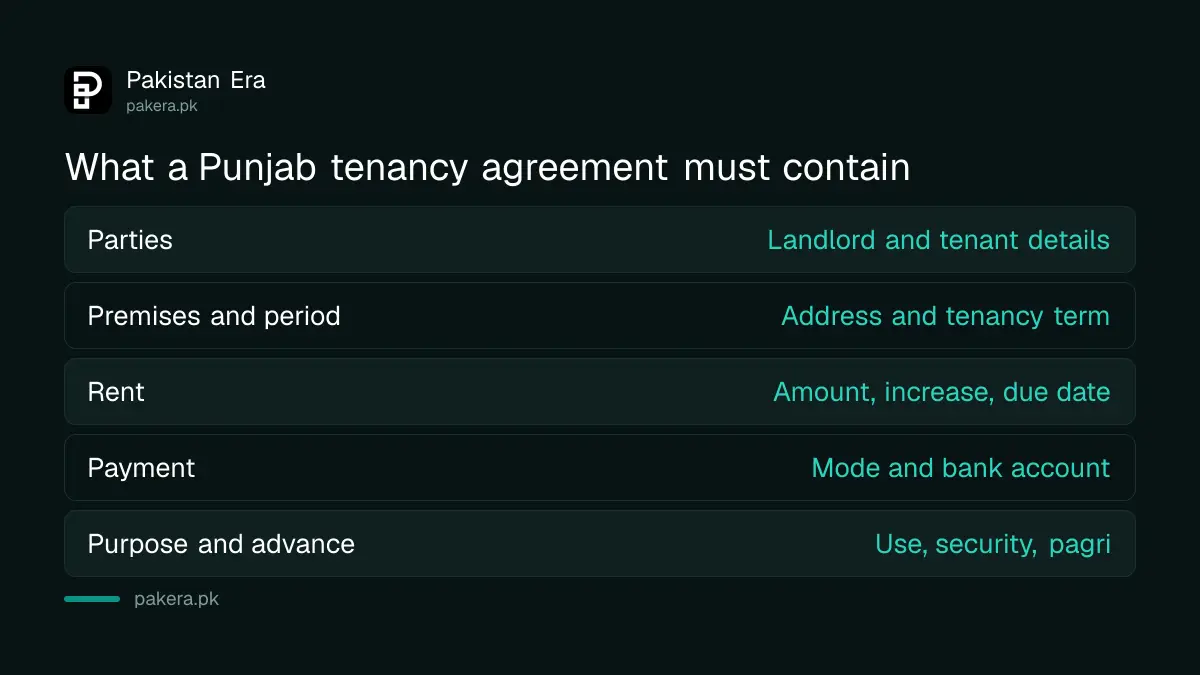
Section 6 of the Punjab Rented Premises Act 2009 lists what a tenancy agreement should contain. Put in the names of both parties, the premises, the period, the rent and yearly increase, the payment mode, the purpose and any advance, security or pagri. Missing terms cause disputes later.
- Particulars of the landlord and the tenant, with CNIC numbers.
- A description of the premises, such as house number, floor and street.
- The period of the tenancy.
- The rent, the rate of increase, the due date and how it is paid.
- The landlord's bank account, if rent goes through a bank.
- The purpose, for example residence, shop or office.
- Any advance rent, security deposit or pagri.
Two rules apply when the deed is silent. If no due date is written, rent is due by the 10th of the following month (section 7). If no payment mode is written, the tenant may pay by money order or into the landlord's bank account. And if rent is fixed for only part of a fixed term, it stays the same for the whole term unless the deed says otherwise.
Write the yearly increase as a clear figure, such as 10 percent each year. The guide to rent increases and tenant rights explains why a vague clause causes trouble.
Stamp duty on a Punjab rent deed is 3.25 percent of average annual rent
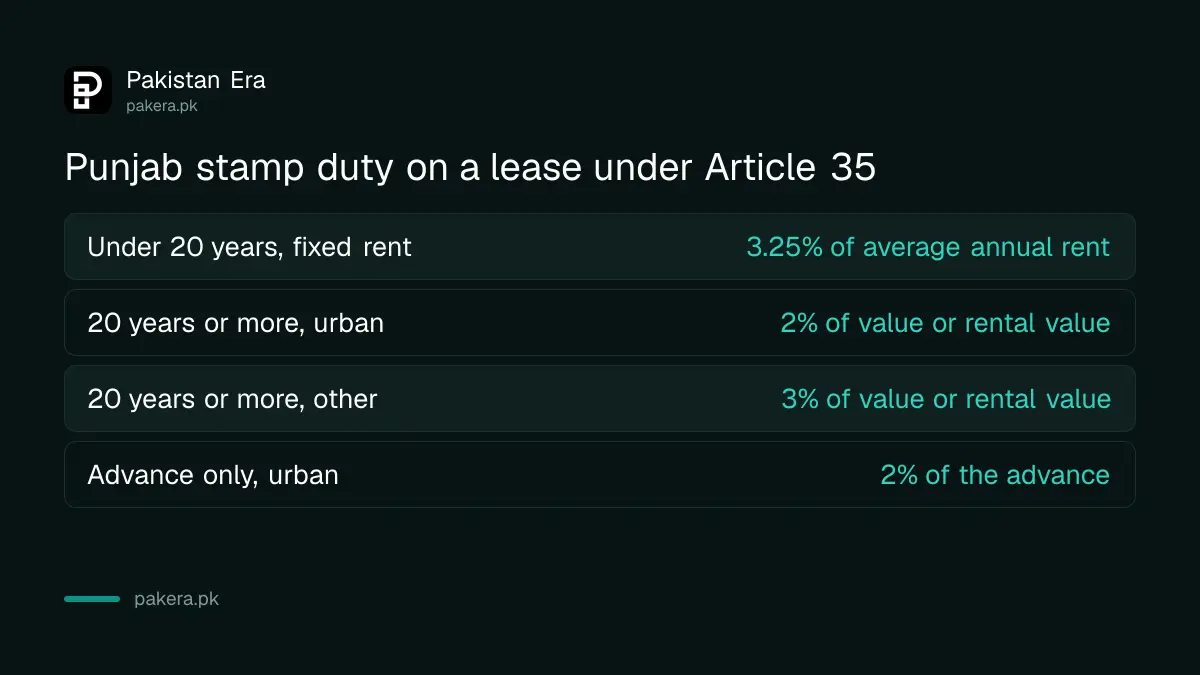
Article 35 of Schedule I to the Stamp Act 1899, as it applies in Punjab, sets stamp duty on a lease. A lease of less than 20 years with fixed rent and no premium pays 3.25 percent of the average annual rent. Longer leases pay on the property's value.
| Type of lease in Punjab | Stamp duty under Article 35 |
|---|---|
| Fixed rent, no premium, term under 20 years | 3.25% of the average annual rent |
| Term of 20 years or more, urban property | 2% of the property value or rental value, whichever is higher |
| Term of 20 years or more, other areas | 3% of the property value or rental value, whichever is higher |
| Advance money only, no rent, urban property | 2% of the advance set out in the lease |
Here is a worked example for an ordinary house rent. Rent is Rs 50,000 a month for two years, with 10 percent more in the second year. Year one is Rs 600,000 and year two is Rs 660,000, so the average annual rent is Rs 630,000. Stamp duty is 3.25 percent of that, Rs 20,475.
Pay it through a Punjab e-stamp paper, not an old paper stamp. Before signing, check that the e-stamp is genuine using the steps to verify a Punjab e-stamp paper. A deed that is not duly stamped cannot be used as evidence until the duty and any penalty are paid, under section 35 of the Stamp Act.
Register the agreement with the Rent Registrar in five steps
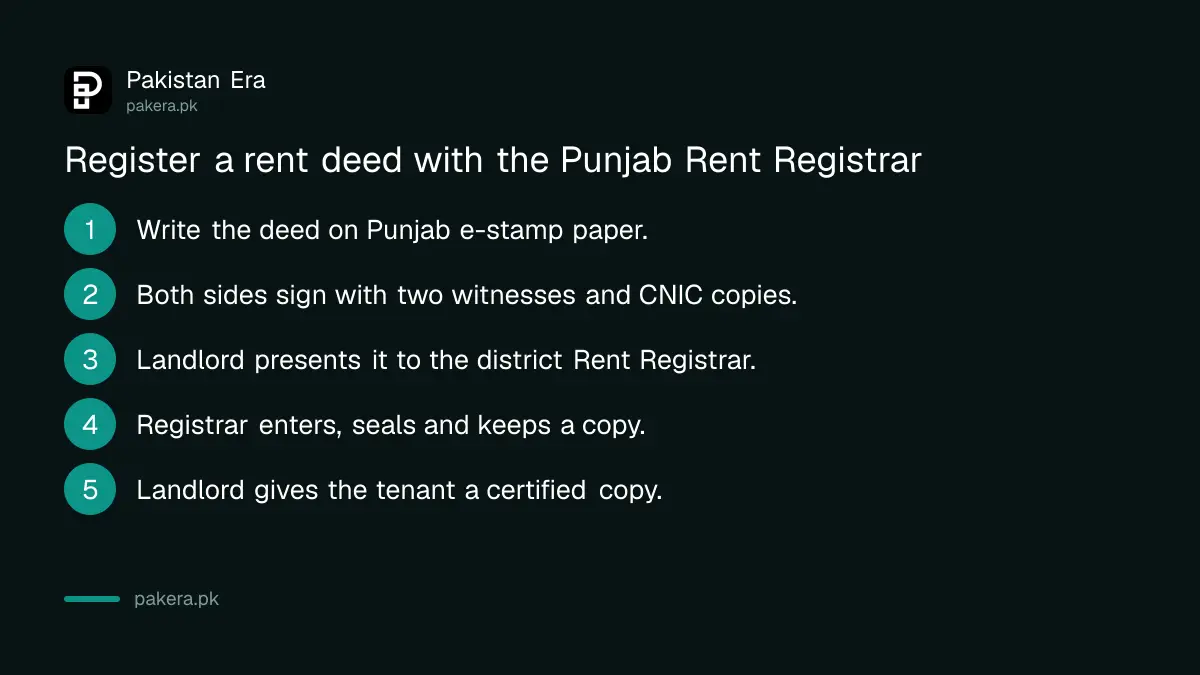
The landlord takes the signed, stamped agreement to the Rent Registrar of the district where the premises are. The Registrar enters the particulars, seals the deed, keeps a copy and returns the original. The landlord then gives the tenant a certified copy. Both should keep CNIC copies attached.
- Agree the terms and write them on the e-stamp paper, with all seven points.
- Both parties sign, with two witnesses, and attach CNIC copies of everyone.
- The landlord presents the agreement at the Rent Registrar's office for the district. Ask at the Rent Tribunal (Special Judge Rent) of your district for the counter.
- The Rent Registrar enters the tenancy in the register, seals the deed, keeps a copy and returns the original.
- The landlord gives the tenant a certified copy, as section 12 requires.
Any later agreement about the same premises, such as a renewal, a new rent or an agreement to sell to the tenant, must be presented to the Rent Registrar in the same way (section 5(6)). Ending a tenancy early by agreement should also be written and entered there, under section 10.
This entry is separate from police tenant registration. Punjab Police still want the tenant's details at the Khidmat Markaz or through their app. The steps for that are in Punjab tenant registration with the police.
A lease over one year also needs Sub-Registrar registration
Section 5(4) says the Rent Registrar's entry does not replace registration under the registration law. Section 17 of the Registration Act 1908 makes registration compulsory for a lease from year to year, for a term over one year, or reserving a yearly rent. That happens at the Sub-Registrar.
In practice, a deed of 11 months stays outside section 17(1)(d), which is why so many Punjab rent deeds are written for 11 months. It still has to go to the Rent Registrar under the Rented Premises Act. A deed of two or three years should go to both offices.
Present a document for Sub-Registrar registration within four months of signing, under section 23 of the Registration Act. A late deed can still be accepted within a further four months on payment of a fine.
Skipping registration costs money at the Rent Tribunal
Section 9 stops the Rent Tribunal from hearing a case on a non-conforming tenancy until a fine is paid into the government treasury. The tenant pays 5 percent of the annual rent. The landlord pays 10 percent. On Rs 50,000 a month, that is Rs 30,000 or Rs 60,000.
| Who files at the Rent Tribunal | Fine first, if the tenancy is not in order | Example on Rs 600,000 a year |
|---|---|---|
| Tenant | 5% of the annual rent | Rs 30,000 |
| Landlord | 10% of the annual rent | Rs 60,000 |
That fine lands at the worst time, when rent is unpaid or someone wants the premises back. The eviction grounds and the tribunal process are in how to evict a tenant in Punjab through the Rent Tribunal.
A new owner has a duty too. Under section 30, a buyer of rented premises must tell the tenant in writing by registered post or courier and apply to the Rent Registrar to be entered as landlord. The tenant is not in default if rent goes to the new owner within 30 days of the notice.
Common questions
Who has to take the rent agreement to the Rent Registrar in Punjab?
The landlord. Section 5(2) of the Punjab Rented Premises Act 2009 puts that duty on the landlord, and section 12 makes the landlord give the tenant a certified copy.
How much stamp paper is needed for a rent agreement in Punjab?
For a lease under 20 years with fixed rent and no premium, stamp duty is 3.25 percent of the average annual rent. On Rs 30,000 a month for one year, that is Rs 11,700.
Is an 11 month rent agreement valid in Punjab?
Yes. A deed of 11 months does not need Sub-Registrar registration under section 17 of the Registration Act, but it should still be entered with the Rent Registrar under the Rented Premises Act.
What happens if my rent agreement is not registered?
The deed still binds the parties, but the Rent Tribunal will not hear a case until the filing side pays a fine: 5 percent of annual rent for a tenant, 10 percent for a landlord.
Is the Rent Registrar the same as police tenant registration?
No. The Rent Registrar records the contract under the Rented Premises Act. Police registration records who lives in the house, for security. A Punjab landlord needs both.
Does the Act cover shops and offices?
Yes. A building under the Act includes premises let for residential or non-residential use, with any garage, godown or open space attached. Hotel and hostel rooms are excluded.
How we verified this
What we checked and where we read it.
Last checked 24 November 2026. We read the Punjab Code texts of the Punjab Rented Premises Act 2009 (sections 1, 2, 5 to 12, 17 and 30), the Stamp Act 1899 as it applies in Punjab (Schedule I, Article 35, last substituted by the Stamp (Amendment) Act 2021, and section 35), and the Registration Act 1908 (sections 17 and 23). We also read the Punjab Finance Acts 2022 and 2024 and found no change to Article 35. The worked stamp duty examples are our own arithmetic on the Article 35 rate. The e-stamp portal works out the final figure when you generate the challan.
About the author

Senior Writer, Public Services and Technology
Shahid joined us in 2024 as an author. He is a senior contributor to Pakistan's leading technology websites. He writes detailed articles, mostly covering his expertise in the latest tech, mobiles, apps, gadgets, and step-by-step guides. His ideology is to help people understand the latest trends and explain complex methods through very easy-to-understand guides.