How to Evict a Tenant in Punjab Through the Rent Tribunal: 6 Grounds and a 4 Month Limit
Punjab landlords can seek eviction on six grounds only, through the Rent Tribunal. See the steps, the 10 and 30 day limits and the fine if unregistered.
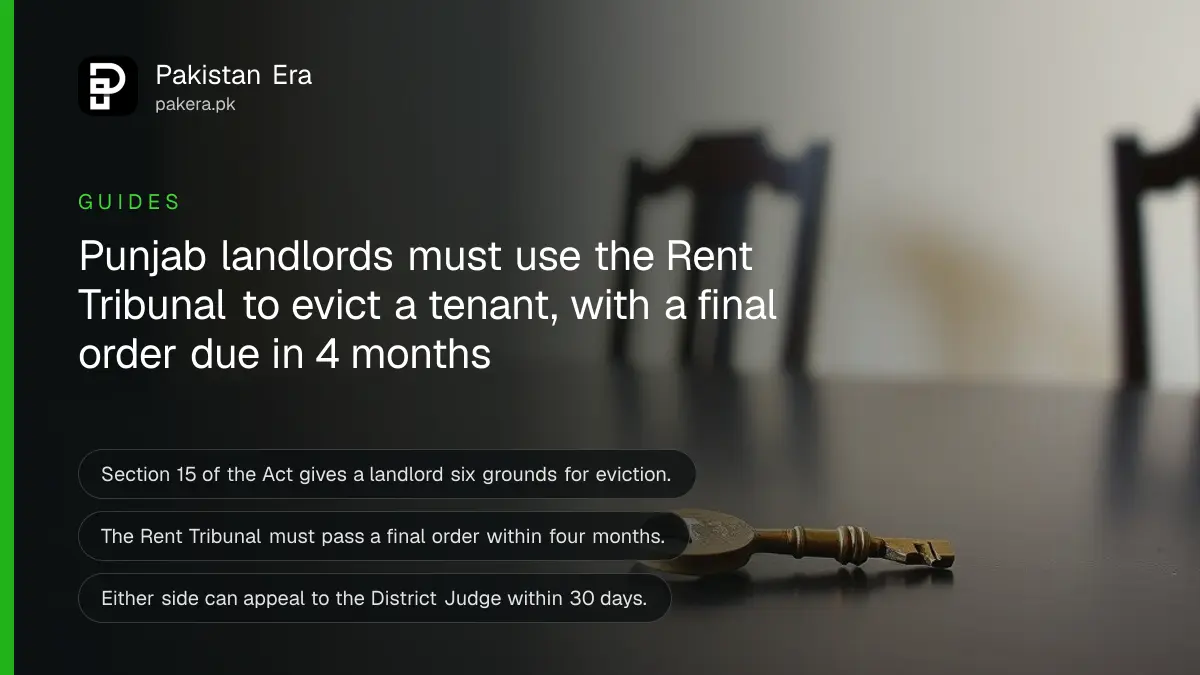
Short answer: In Punjab a landlord cannot evict a tenant through the ordinary civil court. You file an eviction application in the district Rent Tribunal under the Punjab Rented Premises Act 2009, with your own affidavit and at most two witness affidavits. The Act tells the Tribunal to pass a final order within four months, and either side can appeal to the District Judge within 30 days.
A shop owner in Faisalabad has a tenant who stopped paying in July. He wants the shop back. Throwing the tenant's goods out would be illegal. Cutting the electricity would be illegal too. There is one lawful road, and the Act sets out every step of it.
We read the Act on the Punjab Code, the provincial government's own law database, on 12 October 2026. Every section number below comes from that text. The Act covers buildings and rented land in Punjab, but not agricultural land.
Six grounds allow a landlord to seek eviction
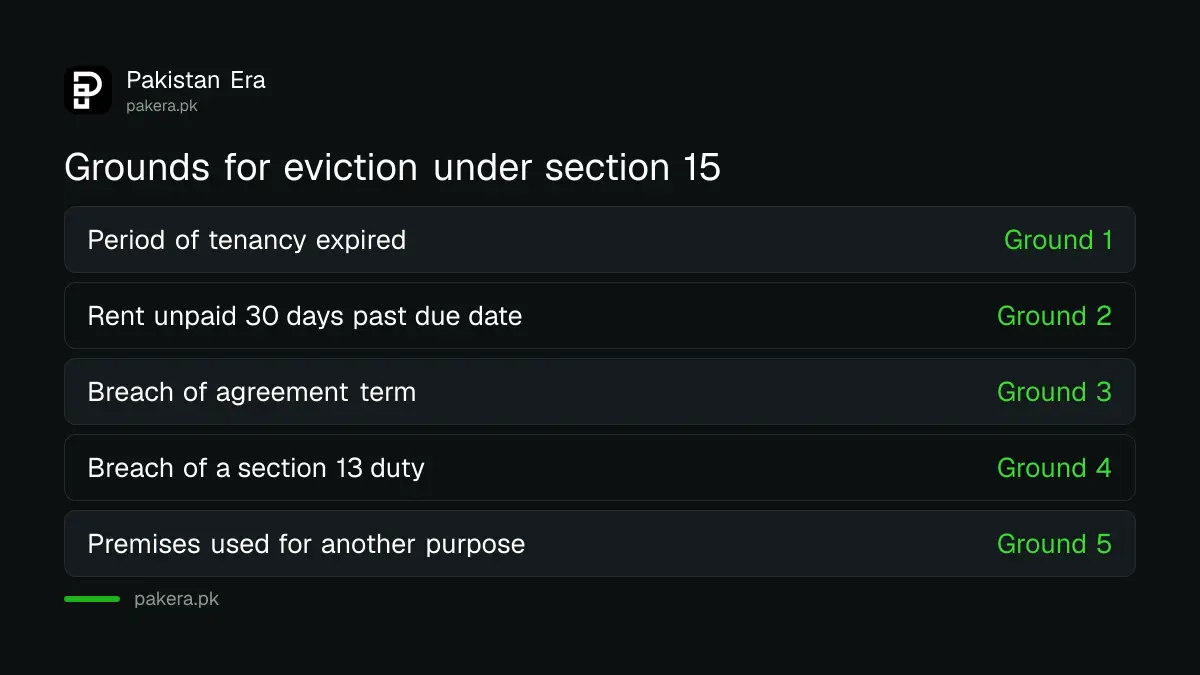
Section 15 gives six grounds. A landlord must fit the case into one of them. A bare wish to take the premises back, with no ground, does not start a case.
| Ground in section 15 | What it means in plain words |
|---|---|
| Tenancy period has expired | The agreed term ended and the tenant has not left |
| Rent not paid in time | Rent was not paid within 30 days after the due date set by section 7 |
| Breach of a term of the agreement | The tenant broke a condition written in the agreement |
| Breach of a duty under section 13 | For example a structural change without written consent |
| Different use | The premises are used for a purpose other than the agreed one |
| Subletting without consent | The tenant sublet without your written permission |
The due date matters. If the agreement names no date, rent is due by the tenth of the following month under section 7. The Act also counts a utility bill as rent, so an unpaid bill can feed a rent default ground.
The tenancy agreement must go before the Rent Registrar first
Section 5 says a landlord shall not let premises except by a written tenancy agreement, and shall present it to the Rent Registrar, who enters it in a register and seals it. This step comes before any dispute, but it decides whether the Tribunal will hear you.
If the tenancy does not follow the Act, section 9 says the Tribunal will not entertain a landlord's application unless he first deposits a fine equal to 10 per cent of the annual rent in the government treasury. For a tenant the figure is 5 per cent. A landlord with an old, unregistered agreement should plan for this cost. Stamp paper rules are a separate matter, covered in the note on rent agreements and stamp paper.
How the Rent Tribunal case runs, step by step
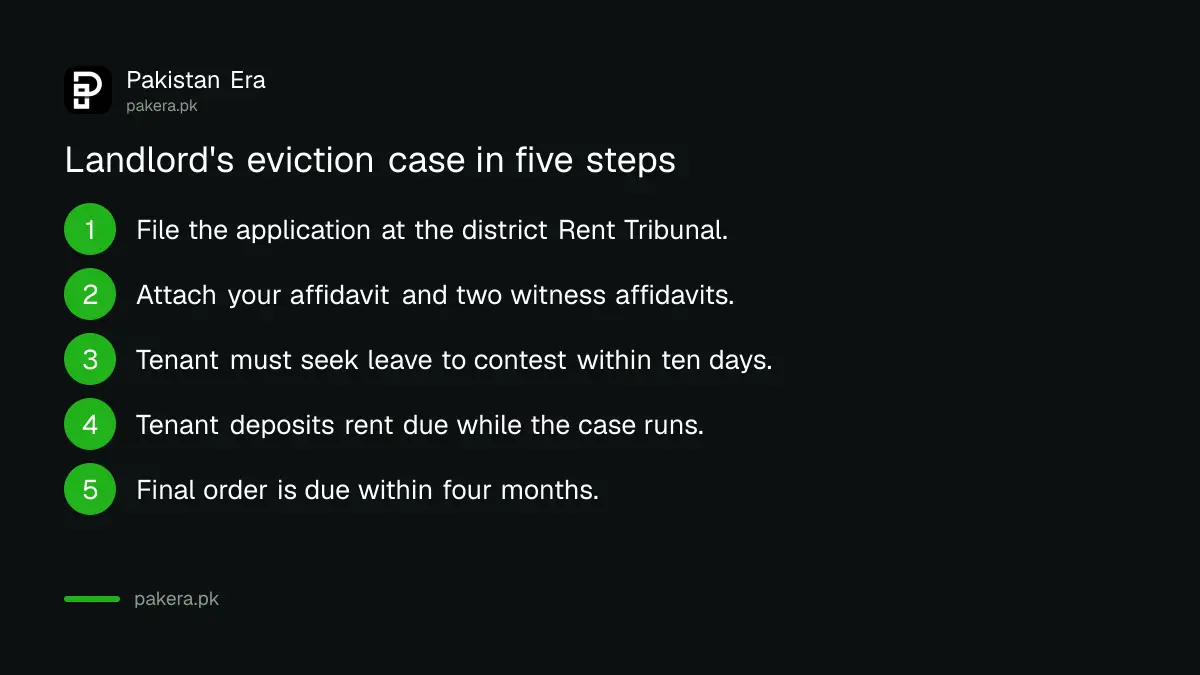
The process is short on purpose. Sections 19 to 27 set deadlines for each stage. Here is the order in which a landlord's eviction case moves.
- File the application in the Rent Tribunal of your district. Give a short statement of facts, the relief you want and copies of your documents (section 19).
- Attach your own affidavit and the affidavits of not more than two witnesses (section 19(4)).
- The Tribunal sends notice to the tenant to appear on a date not later than ten days away (section 21).
- The tenant must apply for leave to contest within ten days of first appearing. The Tribunal decides that request within 15 days (section 22).
- If leave is granted, the tenant must deposit the rent due and keep paying while the case runs. If he does not, the Tribunal passes the final order at once (section 24).
- Evidence comes mainly through affidavits. No party gets more than two chances to produce evidence (section 25).
- The Tribunal passes the final order within four months of filing (section 27).
The Act itself says the Qanun-e-Shahadat Order and the Code of Civil Procedure do not apply to these proceedings, except where the Act says so (section 34). That is why the process moves faster than a civil suit.
A tenant who skips the leave step can lose the case
This is the point many tenants miss. Under section 22 a tenant cannot defend the case at all unless the Tribunal gives him leave to contest. His application must come with an affidavit and show sufficient grounds for oral evidence.
If he files late or the Tribunal refuses leave, the final order follows. An order passed without the tenant present can be challenged. He has ten days from knowledge to ask the Tribunal to set it aside (section 21(4)).
Landlords should keep proof that the notice reached the tenant. Where the tenant dodges service, the Tribunal may direct notice by pasting it on the premises or by press publication (section 21(3)).
What a landlord must not do while the case is pending
Section 12(2) bars a landlord from cutting off, suspending or withholding a utility without just cause. It also bars him from entering the premises without reasonable notice. The Tribunal can order a cut service restored. The situation is explained from the tenant's side in the note on what to do if a landlord cuts your utilities.
Take possession only through the Tribunal's order. Section 31 says the Tribunal executes its own order as a civil court decree, which means it can use the powers of a civil court to get the premises vacated.
Appeal rights and timelines on both sides
Either side can appeal a final order to the District Judge within 30 days (section 28). There is no appeal against an interlocutory order, which is a mid-case order. The District Judge can suspend the final order while the appeal is pending, and must decide the appeal within two months. No further appeal lies against the District Judge's order.
| Stage | Time under the Act |
|---|---|
| Appearance on notice | Within 10 days |
| Application for leave to contest | Within 10 days of first appearance |
| Decision on leave | Within 15 days |
| Final order | Within 4 months of filing |
| Appeal to the District Judge | Within 30 days of the final order |
| Decision on appeal | Within 2 months |
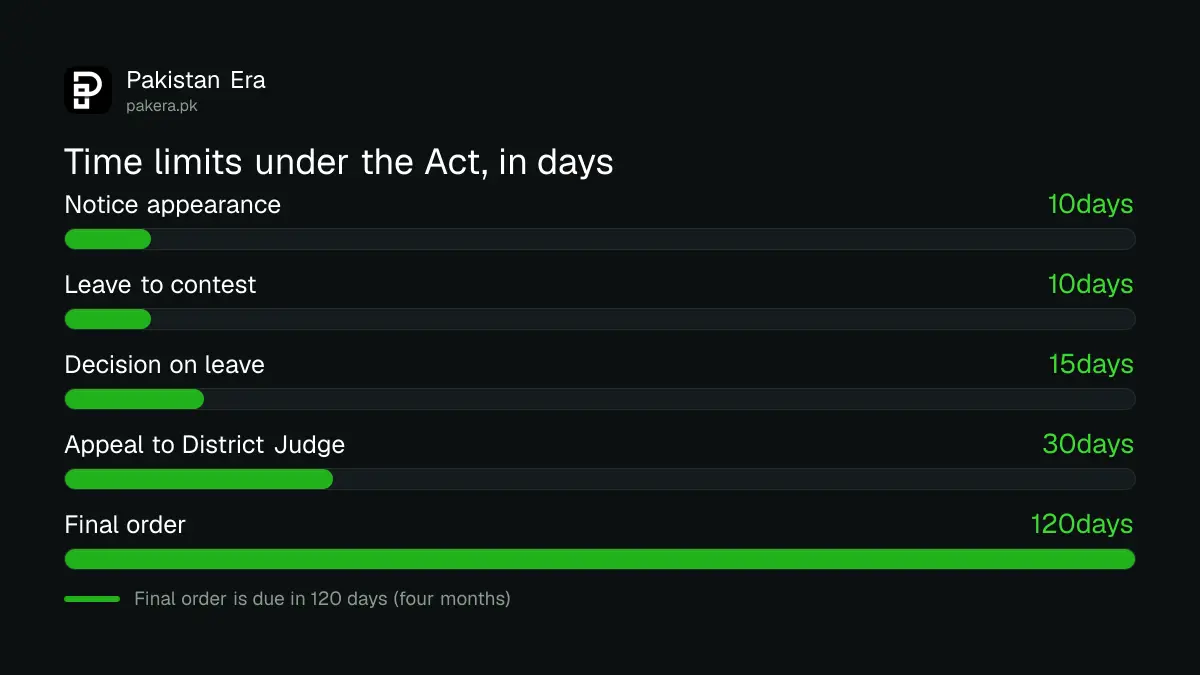
These are the Act's targets. We did not test how closely Punjab's Tribunals keep to them, so treat four months as the legal limit and not a promise.
If you bought the property with a tenant inside
A new owner must send the tenant a written notice of the transfer by registered post or courier, and apply to the Rent Registrar to be entered as the landlord (section 30). The tenant is not in default if he pays the new landlord within 30 days of the notice reaching him. A buyer should check this before buying, and a check of the title comes first, as set out in the guide to verifying a property's title before you buy.
Common questions
Can I evict my tenant without going to the Rent Tribunal in Punjab?
No. Section 16(4) gives the Rent Tribunal exclusive jurisdiction over cases under the Act, and eviction without its order is not lawful.
How long does an eviction case take in Punjab?
The Act requires a final order within four months of filing, then an appeal period of 30 days and two months for the District Judge. Real delays depend on the tribunal.
Does an unpaid electricity bill count as unpaid rent?
Yes, the Act defines rent to include a utility bill, and section 24 lets the Tribunal order the tenant to pay it while the case is pending.
What if my tenancy agreement is not registered with the Rent Registrar?
The Tribunal will not entertain your application until you deposit a fine of 10 per cent of the annual rent in the treasury. A tenant pays 5 per cent in the same position.
Can I appear without a lawyer?
Yes. Section 21(6) lets parties appear in person or through a recognised agent.
Does this law apply in Sindh, KP or Islamabad?
No. The Act extends only to Punjab. Other provinces and Islamabad have their own rent laws, and a Sindh landlord who is refused rent has a different route, set out in the note on paying rent in Sindh when a landlord refuses it.
How we verified this
What we checked, where we read it, and what we could not confirm.
We read the Punjab Rented Premises Act 2009 on the Punjab Code on 12 October 2026. We did not read the Rent Tribunal rules or any fee schedule, so we state no court fee. This is general information, not legal advice. A lawyer should review the facts of a specific tenancy.
About the author

Senior Writer, Public Services and Technology
Shahid joined us in 2024 as an author. He is a senior contributor to Pakistan's leading technology websites. He writes detailed articles, mostly covering his expertise in the latest tech, mobiles, apps, gadgets, and step-by-step guides. His ideology is to help people understand the latest trends and explain complex methods through very easy-to-understand guides.