What to Do If a Landlord Cuts Your Utilities in Punjab
A landlord cannot cut water or power without cause, and a tenant whose rent is refused can deposit it in the Rent Tribunal instead.

A landlord in Punjab cannot cut your water, electricity or gas to push you out, and cannot refuse your rent to build a case against you. The Rented Premises Act 2009 gives you an answer to both, and neither answer is moving out.
These two moves are the most common way a tenancy goes wrong in Pakistan, and most tenants do not know the law already deals with them.
We read the Punjab Rented Premises Act 2009 on 6 September 2026 in the text published by the Law and Parliamentary Affairs Department, Government of the Punjab.
Cutting a utility is not a landlord right
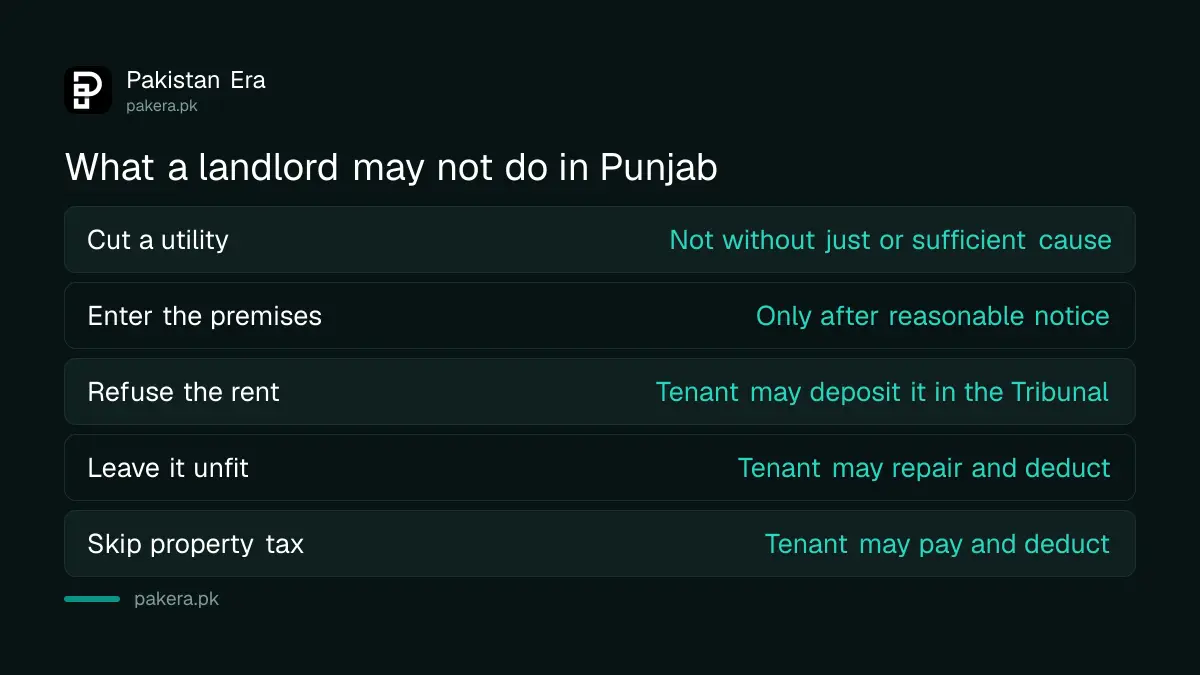
| Landlord action | What the Act says |
|---|---|
| Cutting an amenity or utility | Not allowed without just or sufficient cause |
| Entering the premises | Only after reasonable notice to the tenant |
| Refusing to accept rent | Tenant may deposit the rent in the Rent Tribunal |
| Leaving the place unfit | Tribunal may let the tenant repair and deduct from rent |
| Not paying property tax | Tenant may pay it and take it out of the rent |
Section 12 sets out what a landlord must do and what a landlord must not do, and both lists are short enough to remember.
What section 12 actually says
A landlord shall give the tenant a certified copy of the tenancy agreement, keep the premises in habitable condition, and pay the tax, fee or charge levied on the premises.
A landlord shall not cut off, suspend or withhold an amenity, utility or easement of the premises without just or sufficient cause, and shall not enter the premises without giving the tenant reasonable notice.
If the landlord fails on any of these, the tenant may file an application in the Rent Tribunal. The Tribunal can order the amenity restored, or it can authorise the tenant to restore it at their own expense and take the allowed cost out of the rent.
The same power applies to repairs. If the landlord has failed to keep the place habitable, the Tribunal may direct that the tenant makes the repairs and defrays the allowed expense from the rent.
When a landlord refuses to take the rent
Refusing the rent is a tactic, not an oversight. Thirty days later the landlord has a ground for eviction that looks like your fault.
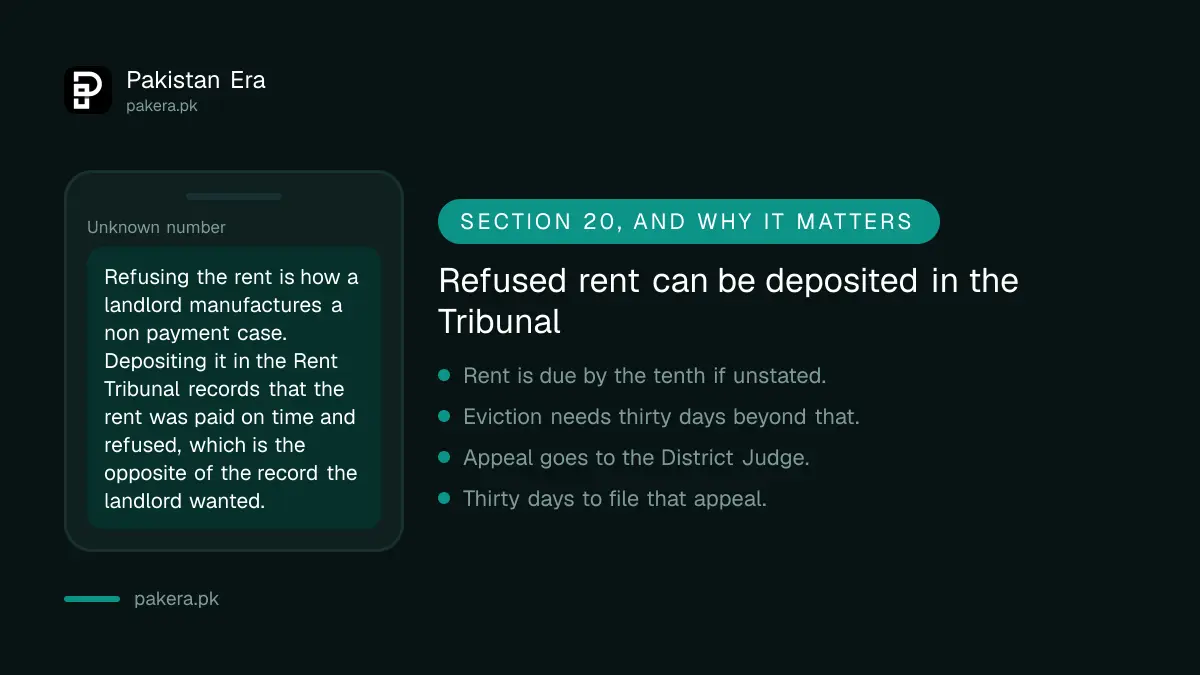
Section 20 closes that door. If a landlord refuses to accept the rent, the tenant may file an application in the Rent Tribunal for deposit of the rent. The Tribunal shall allow the tenant to deposit the rent for the period the landlord refused it, shall inform the landlord of the deposit, and may permit the landlord to collect it.
Once the rent is deposited, the record shows it was paid on time and refused, which is the opposite of the record the landlord was trying to build.
What counts as late rent
Section 7 sets the due date. You pay in the mode and by the date in the tenancy agreement. If the agreement is silent on the date, rent is due not later than the tenth day of the following month. If it is silent on the mode, you pay by money order or into the landlord's bank account.
Section 15 then sets the eviction ground. A landlord may seek eviction if the tenant has failed to pay within thirty days after the period in section 7 expires.
So a few days late is not a ground for eviction. The other grounds are the tenancy period expiring, breach of the agreement, breach of a tenant duty under section 13, using the place for a different purpose, and subletting without prior written consent.
The step both sides usually skip
Section 5 says a landlord shall not let out premises except by a tenancy agreement, and shall present that agreement before the Rent Registrar. The Registrar enters the particulars in a register, seals the agreement, keeps a copy and returns the original.
Section 9 gives that step teeth. If a tenancy does not conform to the Act, the Rent Tribunal will not entertain an application unless a fine is deposited in the Government treasury first.
- A tenant pays five per cent of the annual value of the rent.
- A landlord pays ten per cent of the annual value of the rent.
- Only then does the Tribunal take up the application.
- The sealed agreement itself is proof of the landlord and tenant relationship.
- So the cost of skipping it lands on whoever needs the Tribunal first.
Notice the landlord pays double. Our guide to making a rent agreement on stamp paper covers the document itself, and section 6 lists what it must contain, including the rate of rent, the rate of enhancement, the due date and the amount of any advance, security or pagri.
How long the Tribunal takes
Section 27 requires the Rent Tribunal to pass a final order as quickly as possible and not later than four months from the date the application was filed. If four months pass without a final order, the Tribunal shall conduct proceedings on a day to day basis.
An appeal against a final order goes to the District Judge within thirty days, and no appeal lies against an interlocutory order.
Our guide to rent increases and what a landlord may charge covers the money side, and our guide to eviction and tenant rights covers the wider position. Our guide to checking a court case online is useful once an application is filed.
Common questions
Can a landlord cut the electricity to make me leave?
No. Section 12 forbids cutting off, suspending or withholding an amenity or utility without just or sufficient cause.
What can I do if a utility is cut?
Apply to the Rent Tribunal. It may order restoration, or allow you to restore it and take the allowed cost out of the rent.
My landlord will not accept the rent. What now?
Apply to the Rent Tribunal under section 20 to deposit the rent for the period it was refused.
When is rent legally late?
By the date in the agreement, or the tenth of the following month if no date is stated. Eviction needs a further thirty days of non payment.
Does the agreement have to go to the Rent Registrar?
Section 5 requires the landlord to present it. If the tenancy does not conform, the Tribunal charges a deposit before hearing either side.
How long does a rent case take?
The Tribunal must pass a final order within four months, and then proceed day to day if it has not.
How we verified this
What we checked, where we read it, and what we could not confirm.
Last checked 6 September 2026. We downloaded the Punjab Rented Premises Act 2009 from the Punjab Code portal at punjablaws.punjab.gov.pk, in the text published by the Law and Parliamentary Affairs Department, Government of the Punjab, and read it. Section 5 requiring a tenancy agreement and its presentation before the Rent Registrar, section 6 listing the contents of the agreement including the rate of enhancement and any advance, security or pagri, section 7 setting the tenth of the following month as the default due date, section 9 requiring a deposit of five per cent of the annual rent value from a tenant and ten per cent from a landlord where a tenancy does not conform, section 12 on landlord obligations and the bar on cutting off an amenity or entering without reasonable notice together with the Tribunal powers to order restoration or allow the tenant to restore and defray the cost from rent, section 14 on paying a tax the landlord did not and recovering it, section 15 listing grounds for eviction including failure to pay within thirty days after the section 7 period, section 20 allowing a tenant to deposit rent the landlord refuses, section 27 requiring a final order within four months, and section 28 giving a thirty day appeal to the District Judge, are all taken from that text. Rent is a provincial subject and this is the Punjab Act, so check the law that applies where you live. Nothing here is legal advice.
About the author

Public Services and Education Journalist
Fajr Riaz is a journalist and content writer at Pakistan Era, based in Lahore. She covers the questions people meet in everyday life in Pakistan: how a public service works, what a change in the rules means, and where to find a reliable answer.