FBISE Grace Marks: Up to 1 Per Cent for Failing Students, 1 Mark for a Higher Grade, 5 for Hardship
FBISE grace marks for SSC and HSSC: up to 1 per cent for failing students, 1 mark to reach a higher grade, 5 hardship marks and the 33 per cent pass mark.
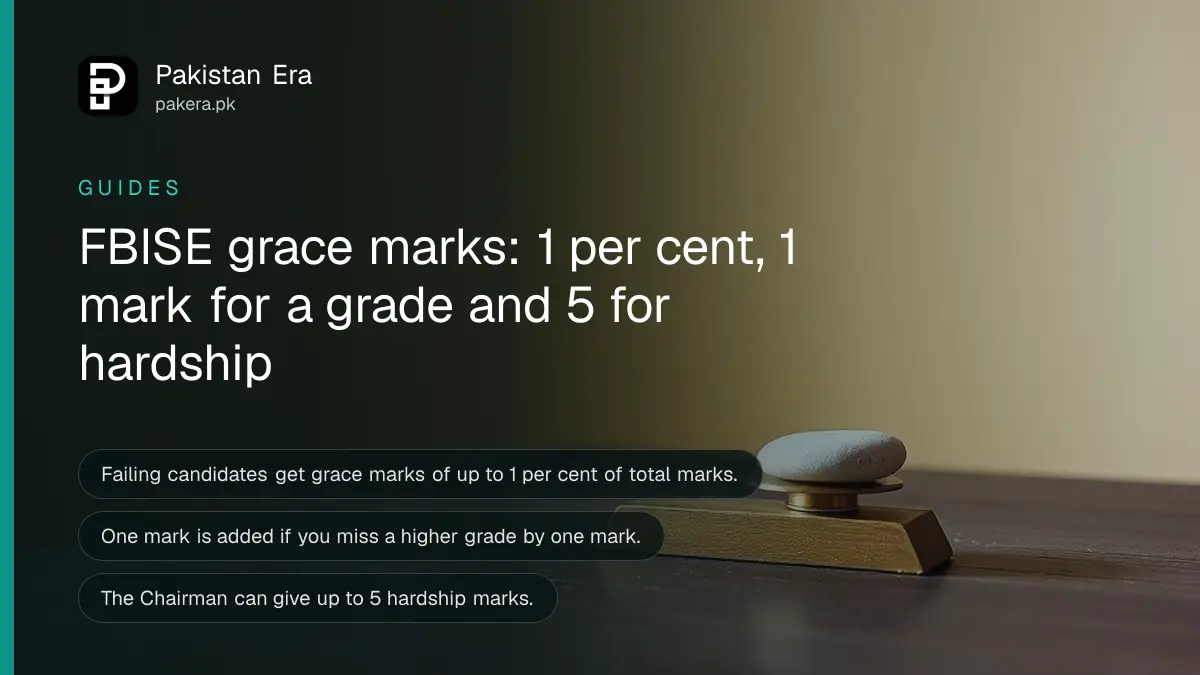
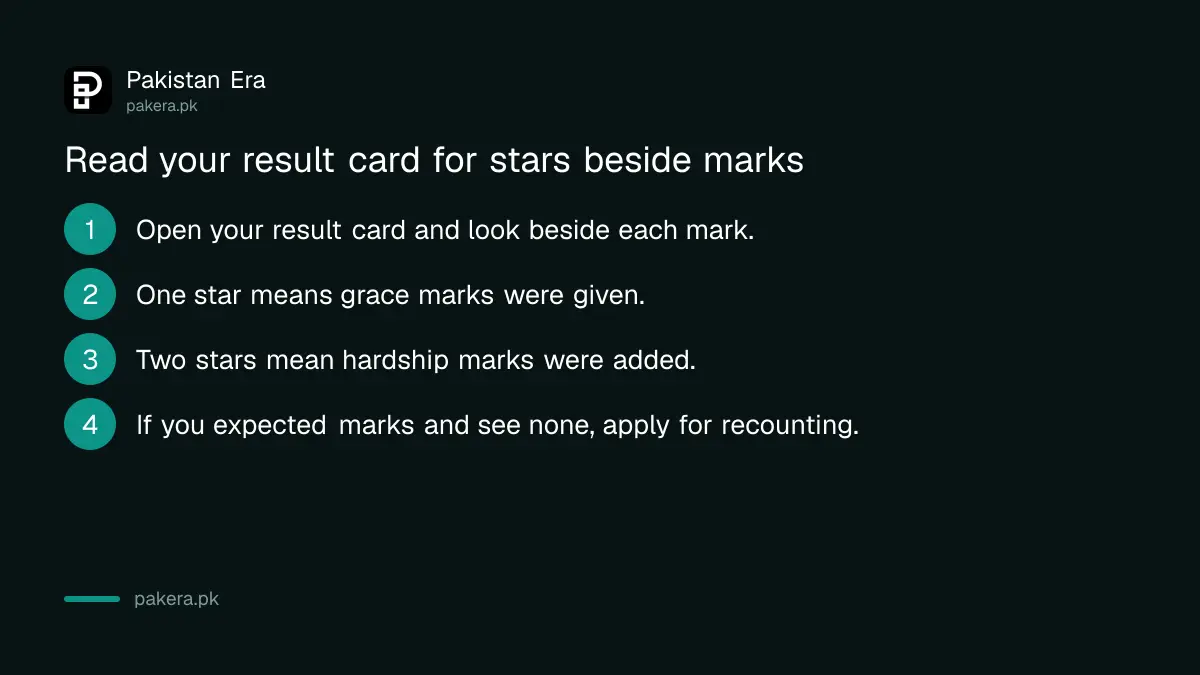
Short answer: FBISE gives grace marks of up to 1 per cent of total marks to students who fail, and 1 mark to a student who misses a higher grade by exactly 1 mark. The Chairman can also give up to 5 hardship marks. The pass mark in each paper is 33 per cent. Improvement candidates get no ordinary grace marks.
A student in Rawalpindi gets 32 in a paper. The pass mark is 33. One mark is the difference between a pass and a retry. Many families do not know that the Federal Board has written rules for exactly this case, and that the marks are often added with no application at all.
We read rule 1.10 and rule 1.18 of the FBISE General Rules for Examination on 13 October 2026. This guide explains them in plain words. It covers SSC (matric) and HSSC (intermediate) under the Federal Board. Other boards have their own grace rules.
The pass mark is 33 per cent in each paper
A student must pass every subject. In a subject with theory and practical, the student must score at least 33 per cent in theory and in practical separately. The two scores are not added together to reach a pass.
If a subject has two or three papers, the student must pass the subject on the total of those papers. A student who fails the total is marked failed in the paper or papers where the failure actually happened. FBISE uses the word "Retry" on a result card instead of "fail".
| Rule | What FBISE says |
|---|---|
| Pass mark | 33 per cent in theory and in practical, separately |
| Grace marks | Up to 1 per cent of total marks, for failing candidates |
| Missing a grade by 1 mark | 1 mark is added |
| Hardship marks | Up to 5 marks, by the Chairman |
| Improvement candidates | No ordinary grace marks |
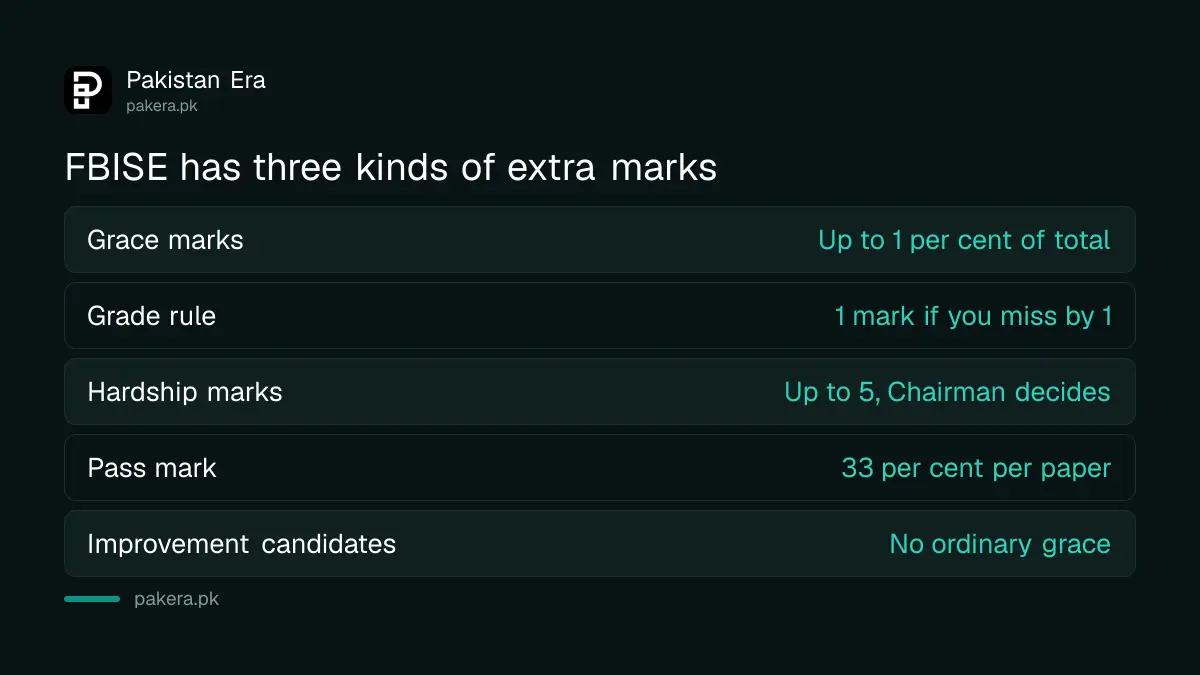
Grace marks of up to 1 per cent go to failing candidates
FBISE rule 1.10 (k) gives regular, ex and private candidates grace marks up to 1 per cent of total marks, whatever the number of subjects they fail. The same grace applies to a candidate who sits an additional subject.
The rule is written as a percentage of total marks, not of one paper. As an example, on a total of 1,000 marks, 1 per cent is 10 marks. These marks are counted across the examination and used to help you reach a pass. A star is printed beside any mark where grace was given, and a footnote on the result card explains the star.
There is nothing to apply for. The marks are added when the result is compiled. If your result shows a star, grace marks were used.
One mark is added if you miss a higher grade by one mark
Rule 1.10 (l) says one mark is allowed to every candidate who loses a higher grade by one mark. This is a small rule with a big effect, because grades decide merit and scholarships.
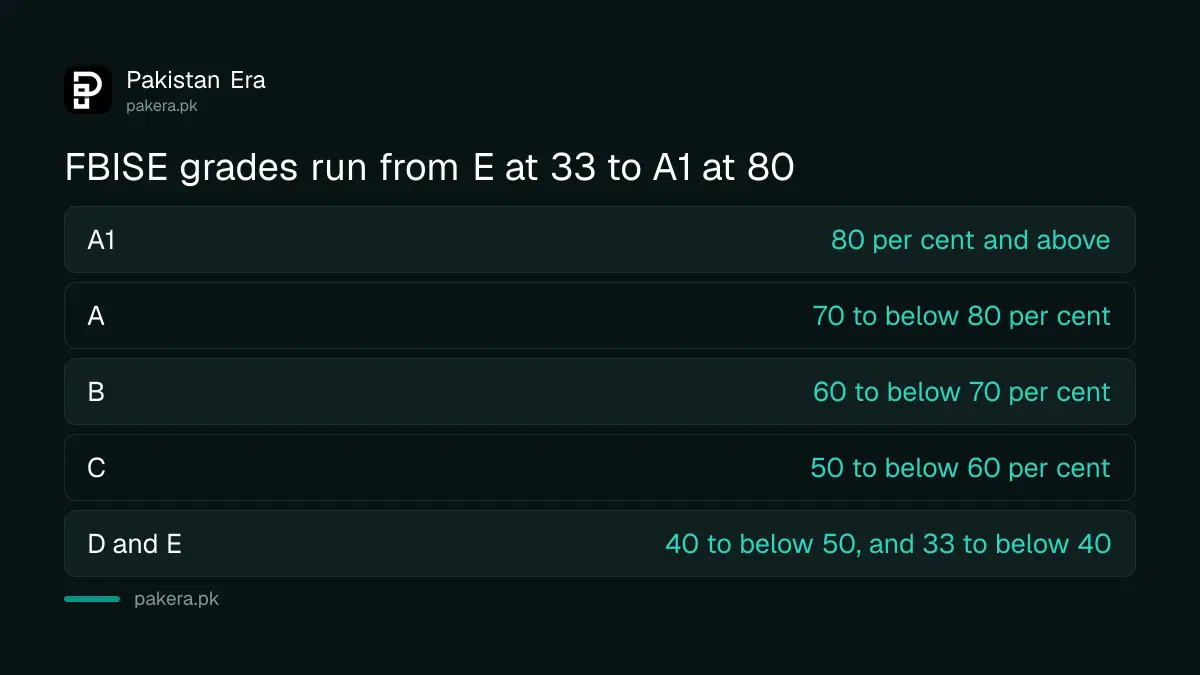
FBISE places a student who has qualified in one of six grades. The grades are fixed by percentage of total marks:
- A1: 80 per cent and above
- A: 70 per cent and above, but below 80
- B: 60 per cent and above, but below 70
- C: 50 per cent and above, but below 60
- D: 40 per cent and above, but below 50
- E: 33 per cent and above, but below 40
A student whose total is exactly one mark below the A1 line moves up to A1. The rule does not need a request.
Hardship marks of up to 5 are decided by the Chairman
Rule 1.10 (n) lets the Chairman consider a case of extreme hardship and give up to 5 marks. The same rule says candidates who lose a better division, or a subject, for want of one to five marks get those marks automatically through the computer at the time of the result.
This includes candidates who appear for improvement. Two stars are shown beside any mark where hardship marks were added. A candidate who gets hardship marks cannot claim more later, and cannot claim both grace marks and the one-mark rule for the same loss. The Chairman's decision on hardship is final.
Because the system adds these marks itself, you do not need a separate form. If you believe you were within five marks of a better division and nothing was added, apply for recounting of marks within 20 days of the result.
Improvement candidates do not get ordinary grace marks
Rule 1.10 (m) says no grace marks go to candidates who appear for improvement of marks or grade. The hardship rule is the exception, because it applies to those who lose a better division for want of one to five marks.
If you plan to retake papers to raise your marks, plan on the marks you really earn. Better marks are granted in improvement and compartment cases, and in the case of an absentee the previous marks stay. The 2026 paper pattern is covered in the page on the FBISE 50 per cent multiple choice papers.
For the dates of the next paper, see the FBISE second annual exam page. A student who failed can also check the matric second annual date sheet.
Common questions
How many grace marks does FBISE give?
It gives up to 1 per cent of total marks to a failing candidate. It also gives 1 mark to a candidate who misses a higher grade by exactly 1 mark.
Do I need to apply for grace marks?
No. The rules add grace and hardship marks when the result is compiled. A star beside a mark shows grace was used, and two stars show hardship marks.
What is the pass mark in FBISE exams?
It is 33 per cent. A student must reach it in theory and in practical separately, and must pass every subject.
Can the Chairman give more than 5 marks?
No. The hardship power is limited to a maximum of 5 marks, and the Chairman's decision is final.
Do improvement candidates get grace marks?
No ordinary grace marks. But a candidate who loses a better division or subject for want of one to five marks gets those marks automatically.
What does Retry on a result card mean?
FBISE uses Retry in place of fail. It means the student did not reach the pass mark in one or more papers.
How we verified this
What we checked, where we read it, and what we could not confirm.
Last checked on 13 October 2026, Pakistan time. We read rules 1.10 and 1.18 in the FBISE General Rules for Examination, which carry amendments up to March 2024. We could not confirm whether FBISE changed these rules for the 2026 exams, and the board's 2026 move to 50 per cent multiple choice papers may affect marking. Check the latest notices on the FBISE site before relying on a single mark.
About the author

Tax, Bills and Technology Writer
Ali Akhtar is a young and curious voice here at Pakistan Era. He is currently pursuing his A-Levels and has a growing interest in Pakistan’s changing industrial landscape and educational trends. Ali likes to write in a way that helps him explain and explore the world around him. His writing reflects the perspective of the new generation navigating the evolving trends of Pakistan where technology, youth innovation, and shifting opportunities are reshaping the country’s future.