FBISE Papers Get 50% MCQs in Maths, Physics, Chemistry, Biology and Computer Science
FBISE set a 50% MCQ and 50% descriptive paper in five core subjects. See the four phases from 2026 to 2028 and when the old 2006 scheme ends for students.
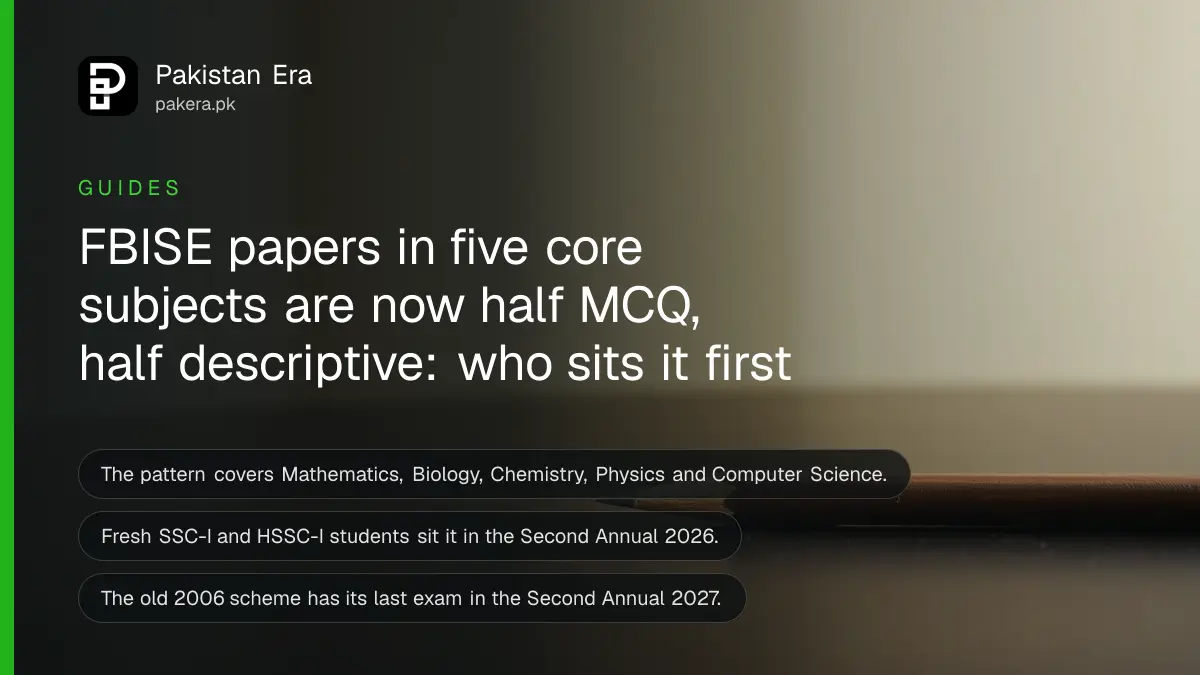
Short answer: FBISE papers in Mathematics, Biology, Chemistry, Physics and Computer Science now carry 50% multiple choice questions (MCQs) and 50% descriptive questions, at both SSC (matric) and HSSC (intermediate) level. It starts for fresh SSC-I and HSSC-I students in the Second Annual Examination 2026. All SSC-I and HSSC-I students follow it from the First Annual Examination 2027.
A student preparing for physics may have practised only long answers for years, or only MCQs from a guess paper. The paper design decides how to study. FBISE has put the new design in a notice, and the phase dates matter more than the headline.
We read FBISE notice No. 1-10/FBISE/RES/242, dated 7 August 2026, and its notice No. 0-5/FBISE/RES/CC/248 of 10 August 2026 on the board's website on 11 October 2026. Both are addressed to the heads of institutions affiliated with FBISE. They do not apply to other boards.
The 50-50 pattern covers five core subjects at SSC and HSSC
FBISE says it has introduced a restructured pattern with 50% MCQs and 50% descriptive questions in the question papers of five core subjects: Mathematics, Biology, Chemistry, Physics and Computer Science. The notice says its Board of Governors approved it at the 124th meeting on 28 July 2026.
The notice also lists new assessment frameworks, model question papers, student learning outcome (SLO) alignment charts and tables of specifications for these subjects. The board says they are on its website under curriculum and model papers.
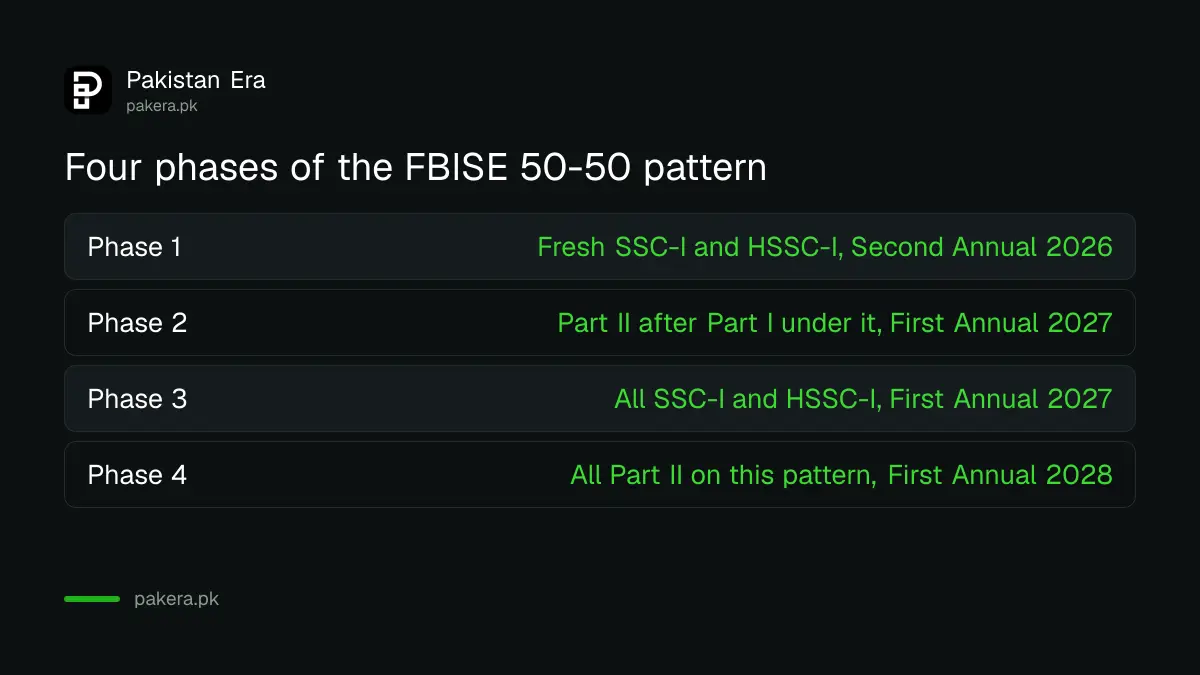
| Phase | Who | From |
|---|---|---|
| 1 | Fresh SSC-I and HSSC-I students, appearing for the first time under the 1200-mark Inclusive Scheme of Studies 2024 | Second Annual Examination 2026 |
| 2 | SSC-II and HSSC-II students, if they already appeared in the Second Annual 2026 under the same pattern | First Annual Examination 2027 onwards |
| 3 | All SSC-I and HSSC-I students under the Inclusive Scheme (1200 marks) | First Annual Examination 2027 |
| 4 | SSC-II and HSSC-II students who sat the same pattern in their Part I | First Annual Examination 2028 onwards |
Which students sit the new pattern first
Students who are fresh in SSC-I or HSSC-I and take the Second Annual Examination 2026 for the first time sit the new paper in those five subjects. Our guide to the FBISE Second Annual 2026 examination has the exam schedule and fee details we read earlier.
Students in Part II are not in phase one. Phase two applies to Part II students only if they already appeared in the Second Annual 2026 under the same pattern.
If you are unsure which row fits you, ask your school for the notice number above. Do not rely on a social media post.
What 50 percent MCQs means for preparation
Half the marks now come from selecting an answer, and half from writing one. A student needs quick recall for concepts and formulas, and full working for numerical and long answers. Practise both together, with timed sets, and not one at the expense of the other.
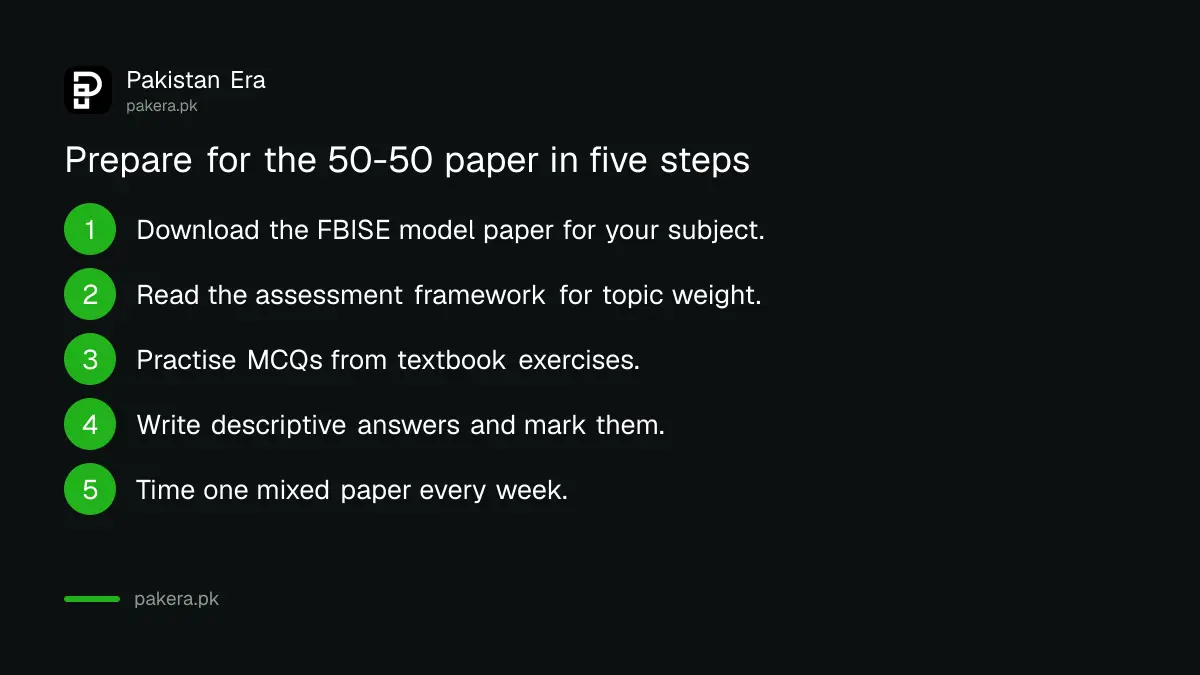
- Download the FBISE model question papers for your subject from the board's site.
- Read the assessment framework, which shows how marks are spread across topics.
- Practise MCQs from the textbook exercises first, then the model paper.
- Write descriptive answers by hand and compare them to the marking points.
- Time one full mixed paper every week before the exam.
The old 2006 curriculum ends after the Second Annual 2027
A second notice, dated 10 August 2026, says the old Curriculum 2006 and Scheme of Studies 2006 (1100 marks) will be phased out. The Second Annual Examination 2027 is the last one under it. From the First Annual Examination 2028, only the National Curriculum 2022 to 23 and the Inclusive Scheme (Revised Version-I) 2024 will apply.
Students who sat under the old scheme and choose to reappear under the revised one will not lose the academic benefit, says the notice, because their marks will be proportionately converted "where applicable". The notice does not give the conversion method, so ask FBISE before you choose.
| Scheme | Marks | Last or first exam |
|---|---|---|
| Old Curriculum and Scheme 2006 | 1100 | Last: Second Annual Examination 2027 |
| National Curriculum 2022 to 23, Inclusive Scheme 2024 | 1200 | Only scheme from First Annual Examination 2028 |
Other FBISE changes notified in August 2026
On 10 August 2026 FBISE also notified new trades: Beautician and Cosmetology at SSC-I and HSSC-I levels, and Professional Cooking and Chef at HSSC-I level, from the 2026 to 27 session. It adds that schools must have qualified teachers (BS or equivalent) before starting them.
For your registration status, see the FBISE Class 11 registration notice. The date sheet for matric is in our second annual date sheet guide.
Common questions
Which subjects are in the 50% MCQ pattern?
Mathematics, Biology, Chemistry, Physics and Computer Science, at SSC and HSSC levels, according to FBISE's notice of 7 August 2026.
Does this apply to Punjab or Sindh boards?
No. The notice is from FBISE and goes to FBISE affiliated institutions. Other boards set their own papers.
When does it start?
For fresh SSC-I and HSSC-I students, in the Second Annual Examination 2026. For all SSC-I and HSSC-I students, in the First Annual Examination 2027.
Does it apply to other subjects like English or Urdu?
The notice names only the five core subjects. It does not say anything about the other subjects.
When is the last exam under the old 2006 scheme?
The Second Annual Examination 2027, says FBISE's notice of 10 August 2026.
Where are the model papers?
The notice says they are on the FBISE website, in the curriculum and model papers section.
How we verified this
What we checked, where we read it, and what we could not confirm.
We read three FBISE notices on fbise.edu.pk on 11 October 2026: the 50% pattern notice of 7 August 2026 and the old curriculum and new trades notices, both of 10 August 2026. We did not read the model papers themselves, so we state no marks split inside a subject beyond the 50-50 rule.
About the author

Public Services and Education Journalist
Fajr Riaz is a journalist and content writer at Pakistan Era, based in Lahore. She covers the questions people meet in everyday life in Pakistan: how a public service works, what a change in the rules means, and where to find a reliable answer.