How to Recover Unpaid Maintenance in Punjab: Execution Petition, Land Revenue Recovery and the Surety's Liability
Recover unpaid maintenance in Punjab by an execution petition in the Family Court. It can order recovery as land revenue after 30 days and act against a surety.
If your ex-husband has a maintenance decree against him in Punjab and still does not pay, file an execution petition in the Family Court that passed the decree. Under section 13 of the Family Courts Act, 1964, the court can order the money to be recovered as arrears of land revenue if it is not paid within the time it fixes, which cannot exceed 30 days. The court can also act against anyone who signed as surety for him.
A Lahore High Court ruling uploaded on 6 November 2026 confirmed that point. A father who signed a surety bond to get his son out of civil prison could not later stop the court from taking the house promised to the wife in the nikahnama. The steps below cover the whole process, from decree to recovery.
How a maintenance decree is enforced in Punjab
The Family Court that passed the decree also executes it, unless the District Judge sends it to another civil court. If the money is not paid within the time the court fixes, up to 30 days, the court can direct recovery as arrears of land revenue and pay it to you.
Section 13 of the Family Courts Act, 1964 sets out these powers:
- The court records any money paid or property delivered in its presence against the decree.
- Unpaid money can be recovered as arrears of land revenue, through the revenue machinery, on the court's direction.
- The decree is executed by the court that passed it, or another civil court named by the District Judge.
- The court may allow payment in instalments it thinks fit.
Maintenance in a decree also rises on its own. Under section 17-A, if the court did not set an annual increase, the amount goes up by 10 per cent every year. Count that increase when you work out what is owed.
How to file an execution petition for unpaid maintenance
Apply in writing to the same Family Court with a copy of the decree and a statement of what has not been paid. Ask for recovery as arrears of land revenue, and list any property or surety you know of.
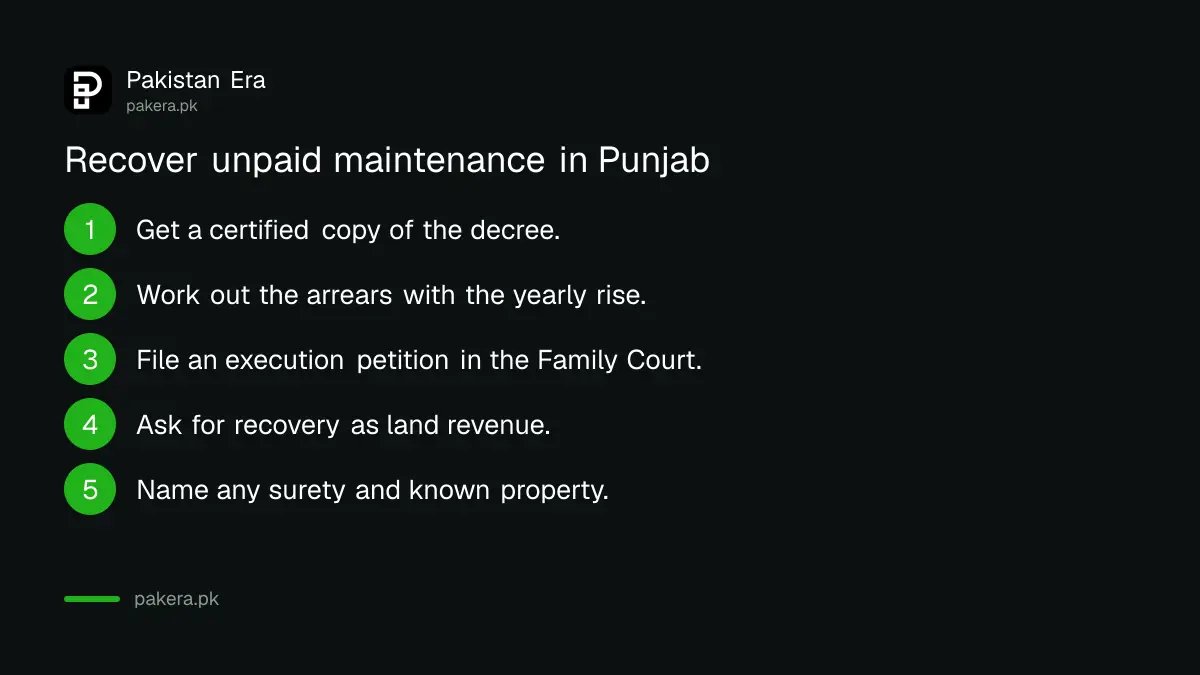
- Get a certified copy of the decree, and of the appeal decree if there was one.
- Work out the arrears month by month, adding the annual increase.
- File the execution petition in the Family Court that passed the decree.
- Give the judgment debtor's current address, employer and any property you know of.
- Ask the court to fix a date for payment and, if he fails, to direct recovery as arrears of land revenue.
- Name any person who stood surety for him, and attach a copy of the surety bond if you have it.
- Attend each date. Ask the court to record any payment made in its presence.
| Tool the court can use | Where it comes from |
|---|---|
| Deadline to pay, up to 30 days | Section 13(3), Family Courts Act |
| Recovery as arrears of land revenue | Section 13(3), Family Courts Act |
| Payment by instalments | Section 13(5), Family Courts Act |
| Order to protect property before decree | Section 21A, Family Courts Act |
| Execution against a surety | Section 145 CPC and section 128 Contract Act, as applied by the LHC |
The surety is liable too, the Lahore High Court ruled
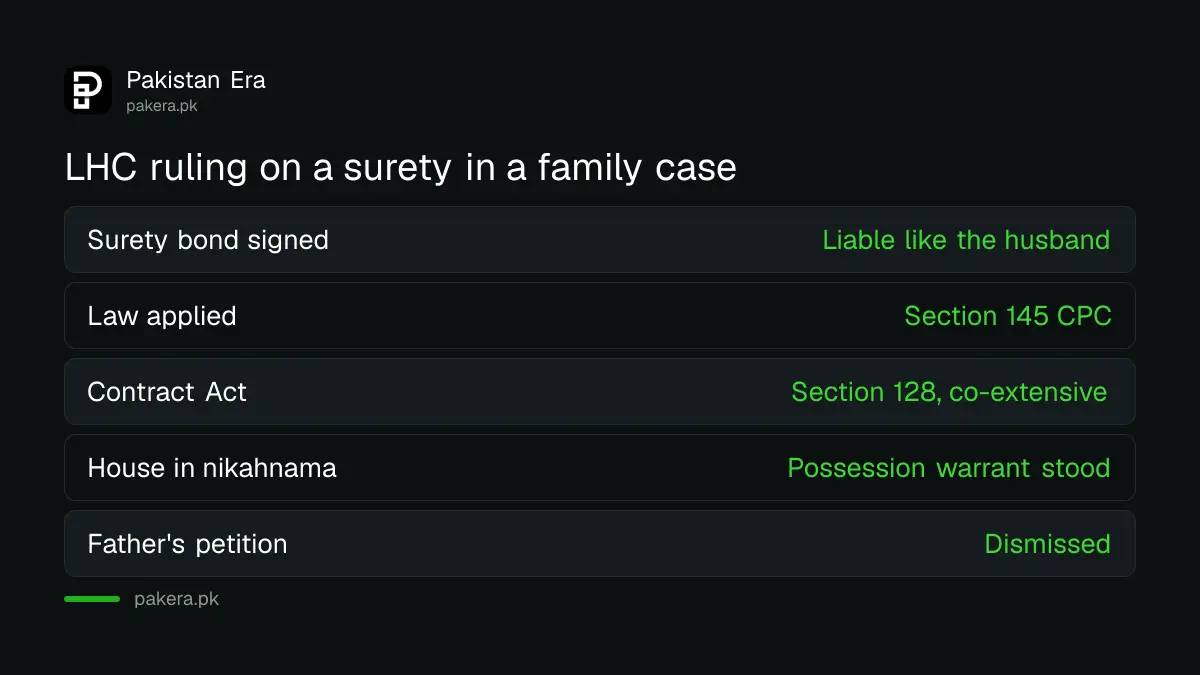
A person who signs a surety bond to satisfy a decree becomes liable to the same extent as the husband. In the Taxila case, the husband's father signed such a bond to get his son released from civil prison. The court held he could not escape that promise later.
Justice Mirza Viqas Rauf of the Rawalpindi Bench dismissed the father's petition (Writ Petition No. 3068 of 2022) after a hearing on 20 October 2026. The wife's decree was for maintenance, dower and dowry. The nikahnama recorded a house given to her, but the house was in the father's name. He argued that he never signed the nikahnama and was not a party to the suit.
The court said the general rule is true: a person who is not a party cannot be burdened with a decree. But this father had appeared as a witness in the trial, and had then signed a bond undertaking to satisfy the decree if his son failed. Under section 145 of the Code of Civil Procedure, a decree can be executed against a surety. Under section 128 of the Contract Act, a surety's liability is "co-extensive" with the principal debtor's. The warrant of possession for the house stood.
Protect property before the decree is passed
If you fear the husband will sell or transfer property before the case ends, ask the Family Court for an interim order under section 21A. The court can preserve any property in dispute, and any other property of a party, needed to satisfy the decree later.
Also ask for interim maintenance early. Under section 17-A the court must fix interim monthly maintenance for the wife or child on the defendant's first appearance. If he does not pay it by the 14th of each month, his defence is struck off and the suit can be decreed on your plaint and papers. How to start the case itself is covered in filing a maintenance case in a Punjab family court.
If the husband appeals, you can still pursue execution unless a court stays it. The appeal routes and time limits are in appealing a family court decree in Punjab. For a civil decree outside family law, the tools differ, see enforcing a civil court decree.
Common questions
Where do I file to recover unpaid maintenance in Punjab?
In the Family Court that passed the maintenance decree. Section 13(4) says that court executes it, unless the District Judge directs another civil court to do so.
What does recovery as arrears of land revenue mean?
It means the unpaid amount is collected the way the government collects unpaid land revenue, through the revenue machinery, and then paid to you. The Family Court must direct it.
Can maintenance be recovered from the husband's father?
Only if he is liable in his own right, for example as a surety. The Lahore High Court held that a father who signed a surety bond to satisfy the decree could be made to do so.
Does unpaid maintenance increase every year?
Yes. If the decree sets no annual increase, section 17-A raises the maintenance by 10 per cent each year automatically.
Can the court let him pay in instalments?
Yes. Section 13(5) allows the Family Court to direct that money under its decree be paid in instalments it thinks fit.
What if he stops paying interim maintenance during the case?
Under section 17-A, if the defendant does not pay interim maintenance by the 14th of each month, his defence is struck off and the court decrees the suit on the plaint and the papers on record.
How we verified this
What we checked and where we read it.
We read sections 13, 17-A and 21A of the Family Courts Act, 1964 on the Punjab Code on 17 November 2026. We read the full Lahore High Court Rawalpindi Bench judgment in Writ Petition No. 3068 of 2022 the same day; it is on the LHC reported judgments page, uploaded 6 November 2026, file 2026LHC8604. Sections 145 CPC and 128 of the Contract Act are as quoted in that judgment. Party names are left out on purpose.
About the author

Global Affairs & Political Economy Writer
Muhammad Hatim is a book lover who started writing because he enjoys it. At Pakistan Era he writes about international relations, geopolitics and the global economy, with a particular interest in South Asia and the forces behind current events.